
Garden croton (Codiaeum variegatum, )
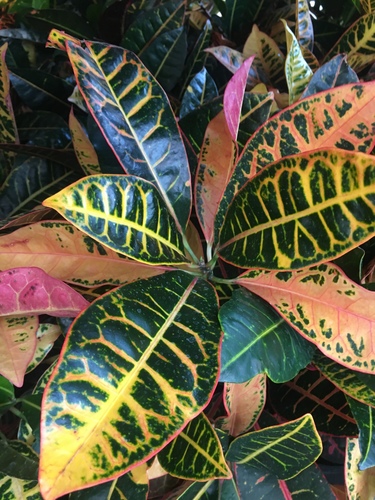

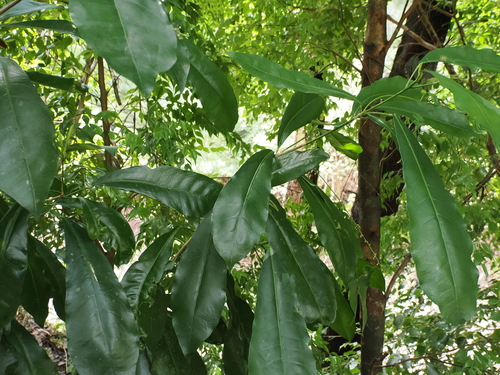
The garden croton (Codiaeum variegatum) is an evergreen tropical shrub in the genus Codiaeum, part of the spurge family, Euphorbiaceae. Native to Malesia and the southwestern Pacific, it is recognized by thick, leathery leaves mottled with green, yellow, orange, red and sometimes purple, depending on the cultivar. Grown as a hedge in the tropics, it is mainly a houseplant wherever winters turn cool.
Read moreCroton, Joseph's coat and Variegated croton
Allow a few hours of direct sun per day, preferably morning or evening.
Global distribution
The native range of Codiaeum variegatum runs from Malesia (Borneo, Java, the Philippines) to New Guinea, the Solomon Islands, Vanuatu and Fiji, reaching as far as Queensland in Australia. The plant is now grown in most tropical regions and as a houseplant far beyond that range.
- Native8
- Indonesia
- Malaysia
- Philippines
- Papua New Guinea
- Solomon Islands
- Vanuatu
- Fiji
- Australia
Hexagons: sourced regions. Green dots: native range. Statuses according to POWO (Kew).
Identity
The garden croton (Codiaeum variegatum (L.) Rumph. ex A.Juss., 1824), also known as Joseph's coat or variegated croton, is an evergreen shrub in the genus Codiaeum, part of the spurge family, Euphorbiaceae. Its everyday name carries an old horticultural mix-up: the plant does not belong to the genus Croton, home among others to the purging croton of older pharmacopoeias, but the trade adopted the name for lack of a simpler one. 1 2
Carl Linnaeus first described the species in 1753 as Croton variegatus. Not until 1824 did the botanist Adrien-Henri de Jussieu validate Georg Eberhard Rumphius's manuscript name and move the plant into Codiaeum, which explains the composite authority "(L.) Rumph. ex A.Juss." that follows the accepted scientific name today. 2
Recognition
In the wild, Codiaeum variegatum grows into a shrub up to 3 m (10 ft) tall, yet in cultivation or in a pot it rarely tops 1.8 m (6 ft). The thick, leathery leaves measure 5–30 cm (2–12 in) long depending on the cultivar, and their shape varies widely: oval, diamond, teardrop, linear or deeply lobed. 1 3
Color is a more reliable clue than leaf shape, which shifts from one cultivar to the next. Tie-dye-like patterns blend green, yellow, orange, red and sometimes purple, concentrated along the veins rather than spread evenly. Light drives this variegation: move a plant into shade and it turns noticeably greener, losing much of its contrast within a few weeks. 4 3
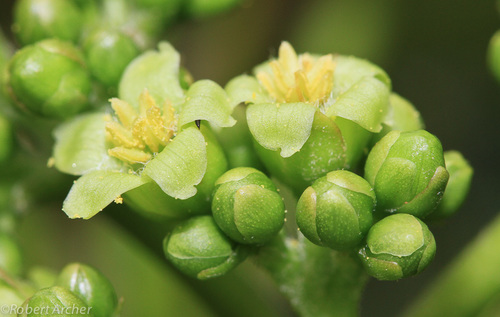
Flowering is inconspicuous and comes in late summer or fall, depending on climate. The white male flowers have 5 petals and 20 to 30 stamens, while the yellowish female flowers have no petals at all. The fruit, a flammable, inedible capsule about 9 mm (3/8 in) across, holds three seeds of 6 mm (1/4 in). 1
Useful taxonomy
POWO/WCVP accepts the name Codiaeum variegatum (L.) Rumph. ex A.Juss. The species is so variable that it has been redescribed more than 250 times since Linnaeus's original publication, which explains the pile-up of trade names at garden centers. POWO now recognizes two varieties, var. variegatum (from Java to Fiji) and var. cavernicola (endemic to Borneo), along with several hundred horticultural cultivars. 2 1
The most frequently cited synonyms and historical names are:
- Croton variegatus L. (basionym, 1753)
- Codiaeum variegatum var. pictum (G.Lodd.) Müll.Arg.
- Codiaeum variegatum var. moluccanum (Decne.) Müll.Arg.
- Codiaeum pictum Lodd.
The name var. pictum is still widely used in the horticultural trade, including by the RHS for cultivars such as 'Petra', even though POWO treats it as a mere synonym of the type variety. A nursery label can therefore show a name that differs from the current scientific classification. 3
Habitat and range
Wild populations stretch from Malesia (Borneo, Java, the Philippines) to New Guinea, the Solomon Islands, Vanuatu and Fiji, reaching as far as Queensland in Australia. There the species colonizes open forests, forest edges and coastal thickets in humid tropical climates. 2 1
The IUCN lists Codiaeum variegatum as Least Concern: its native range is wide and the population is broadly stable, despite local pressure on some coastal habitats. 5
Grown widely outside its native range as an ornamental, the plant serves as a hedge or patio specimen in the tropics and as a houseplant in cooler regions, where it cannot survive outdoors below 10–13 °C (50–55 °F). 6 1
Life cycle and reproduction
Garden croton is monoecious: male and female flowers develop separately on the same plant, gathered in inconspicuous clusters in the leaf axils. Indoors, flowering is rare and unremarkable, but it is normal on a mature plant grown in a warm climate. 1
Nurseries propagate it almost always from stem cuttings with a node. The cut end is dipped in charcoal to limit bleeding of the milky sap, then set in a moist, warm rooting medium. Air layering suits older plants that have gone bare at the base, with a trunk that has lengthened without foliage. 7 3
Uses and risks
Ornament is the main use: a brightly colored evergreen for hedges or containers in the tropics, and elsewhere a houseplant that demands plenty of light and humidity. Every part of the plant, including bark, roots and seeds, contains irritating diterpene esters, chief among them 5-deoxyingenol. 1
In cats and dogs, the ASPCA reports a typical trio of symptoms after ingestion: excessive drooling, vomiting and diarrhea. The milky sap from a cut stem irritates human skin and eyes, and repeated contact can lead to dermatitis. The seeds pose the main risk if swallowed by accident, a hazard documented in children in particular. 8 1
Varieties, look-alikes and related plants
Several hundred cultivars are on the market, told apart by leaf shape and coloring. 'Petra' carries broad leaves veined in yellow, orange and red; 'Spirale' is easy to spot by its narrow leaves twisted around themselves; 'Majesticum' forms drooping branches with a yellow midrib that turns red; 'Andreanum' stands out with large oval leaves edged and veined in gold. 3
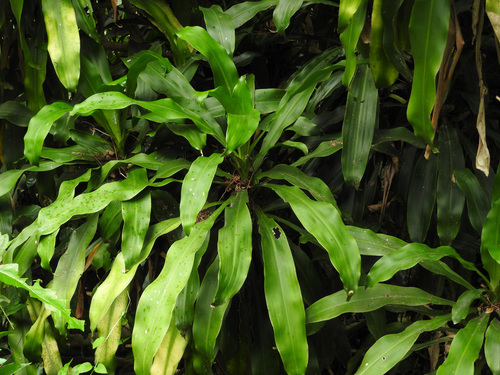
Two plants cause regular confusion in the garden center aisle. Acalypha wilkesiana, which in some regions shares the name garden croton, has coppery foliage reminiscent of croton variegation but belongs to the genus Acalypha. Cordyline fruticosa, with long red-and-green strap-shaped leaves, recalls some Codiaeum cultivars despite sitting in a different botanical family. Where color falls short, the scientific name settles it: Acalypha shares the Euphorbiaceae with garden croton, whereas Cordyline belongs to the Asparagaceae, a family with no close kinship.
Main sources
- Plants of the World Online / Kew, Codiaeum variegatum (L.) Rumph. ex A.Juss.
- Royal Horticultural Society, Codiaeum variegatum - croton
- Missouri Botanical Garden Plant Finder, Codiaeum variegatum
- NC State Extension Gardener Plant Toolbox, Codiaeum variegatum
- ASPCA, Croton toxicity entry
- IUCN Red List, Codiaeum variegatum assessment (2021)
- Encyclopaedia Britannica, croton (Codiaeum variegatum)
- Royal Horticultural Society, Codiaeum genus guide
Frequently asked questions
Does the houseplant croton really belong to the genus Croton?
No. The common name croton comes from an old horticultural mix-up with the genus Croton, another genus in the Euphorbiaceae. The houseplant sold under that name is actually Codiaeum variegatum, a separate genus.
Is garden croton toxic to cats and dogs?
Yes. Every part of the plant contains irritating diterpene esters, and ingestion most often causes drooling, vomiting and diarrhea in cats and dogs.
Why is my croton dropping its lower leaves?
The most common cause is a cold draft or a sudden change of location. Prolonged low light has the same effect, with the plant shedding leaves at the base to concentrate its resources at the top.
Why do the new leaves on my croton stay green?
On a croton, adult coloring develops gradually as each leaf ages and depends heavily on the light it receives. Light that is too weak delays or permanently mutes that coloring.
How do you take a croton cutting without too much sap bleeding?
Dip the cut end in crushed charcoal right after cutting. This limits the flow of milky sap and lowers the risk of rot before roots form.
What is the difference between 'Petra' and 'Spirale'?
'Petra' bears broad oval leaves veined in yellow, orange and red, while 'Spirale' stands out for narrow leaves twisted around themselves. Both have the same growing needs.
Can garden croton live outdoors year-round?
Only in frost-free, very mild climates, roughly USDA zones 11 to 12. Garden croton does not tolerate long spells below 13 °C (55 °F), so elsewhere it has to come indoors or be grown as a houseplant.
Similar plants
Botanical data compiled from reference sources (RHS, Kew Gardens, POWO). This profile is for guidance only and is not a substitute for advice from a botanist or veterinarian if you have concerns about toxicity.