
Cornstalk dracaena (Dracaena fragrans, )
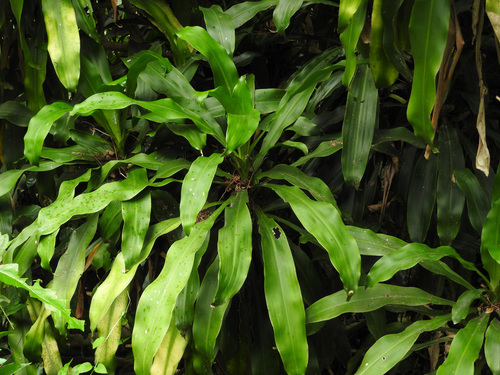
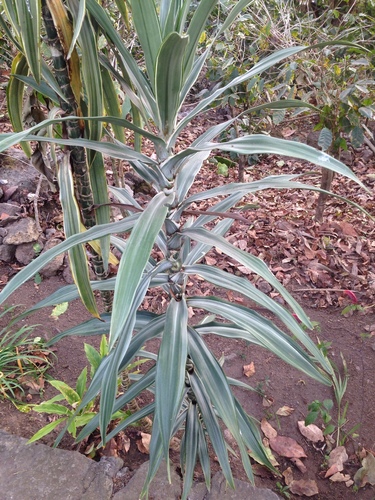
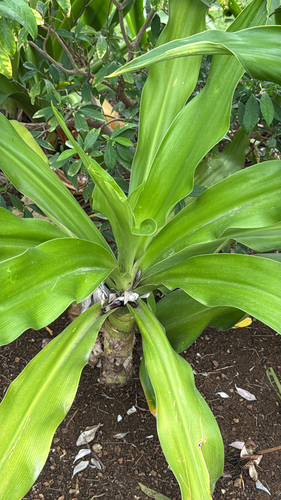
The cornstalk dracaena (Dracaena fragrans), also widely called corn plant, is a shrub in the Asparagaceae native to tropical Africa and grown worldwide as a houseplant. A young plant carries a single stem topped by a rosette of leaves; once it has flowered or lost its growing tip, it branches and can reach several meters in height.
Read moreCorn plant, Fragrant dracaena and Dracaena
Give plenty of ambient light without direct sun on the leaves.
Global distribution
The native range of Dracaena fragrans covers the mountains of tropical Africa, from Sudan to Mozambique and from Côte d'Ivoire to Angola, between 600 and 2,250 m (7,400 ft). The plant is now grown worldwide as a houseplant or hedge; records of introduction remain local, with no documented invasive status in the available sources.
- Native6
- Introduced2
- Cameroon
- Democratic Republic of the Congo
- Kenya
- Tanzania
- Mozambique
- Angola
- Guadeloupe
- Réunion
Hexagons: sourced regions. Green dots: native range. Statuses according to POWO (Kew).
Identity
The cornstalk dracaena (Dracaena fragrans (L.) Ker Gawl., 1808), also widely called corn plant, is a tree-like shrub in the Asparagaceae, native to tropical Africa. 1 2
Dracaena comes from the Greek drakaina, "female dragon," a name taken from Dracaena draco, the type species of the genus, described by Linnaeus in 1767. The epithet fragrans refers to the strongly scented flowers, which open mostly in the evening. 3
In the French Caribbean the plant is called sandragon and grows as a windbreak hedge around banana plantations. The English name corn plant rests on a specific visual likeness: the striped foliage of the cultivar Massangeana recalls a stalk of corn. 3 4
Recognition
A young Dracaena fragrans holds a single, unbranched stem crowned by a rosette of leaves. Flowering or damage to the growing tip triggers branching: two or three new shoots then emerge from old leaf scars, and every later flowering adds more stems. 4
The leaves are lance-shaped, stalkless and clasp the stem at the base. Glossy, they measure 20–150 cm (8–59 in) long and 2–12 cm (0.8–5 in) wide, arching on older plants. A mature trunk can reach 30 cm (12 in) across; in the wild the plant tops 15 m (50 ft), against only 1–4 m (3–13 ft) in a pot. 4 5
Flowers come in panicles 15–160 cm (6–63 in) long, white with a red-purple central line. They stay closed during the day and open late in the afternoon, so the scent is strongest in the evening. The fruit is an orange to red berry 1–2 cm (0.4–0.8 in) across, though flowers and fruit both remain rare indoors. 4 3
Where it is grown in the Neotropics, a few generalist hummingbirds visit these flowers for their nectar, despite the plant's African origin. 4
Useful taxonomy
Dracaena fragrans is the accepted name, but several synonyms still turn up in the trade and in the literature:
- Aletris fragrans L. (basionym)
- Dracaena deremensis Engl., 1902
- Pleomele fragrans (L.) Salisb.
- Cordyline fragrans (L.) Planch.
- Sansevieria fragrans (L.) Jacq.
Linnaeus first described the taxon in 1753 as Aletris fragrans. Ker Gawler moved it to Dracaena fragrans in 1808, in Curtis's Botanical Magazine. 3 6
At the point of sale, one name causes more trouble than the rest: Dracaena deremensis now labels a whole horticultural group, the Deremensis Group, under which nurseries sell cultivars such as Warneckei or Janet Craig, even though they belong botanically to Dracaena fragrans. 2 7
Habitat and range
Tropical Africa holds the native range, from Sudan to Mozambique, west to Côte d'Ivoire and southwest to Angola, in mountain regions between 600 and 2,250 m (2,000–7,400 ft). Above that upper limit, cold thins out wild populations. 2 4
In forest, the plant often forms clumps, with several stems rising from the base. Some specimens lean over to the horizontal before sending up upright branches. Outside Africa, Dracaena fragrans is grown worldwide: as a potted plant where winters bring frost, and in the ground in frost-free climates, USDA zones 10 to 12. 5 8
In the French Caribbean and on Réunion, generations of hedges have made it so common that it now grows wild along roadsides. 3
Life cycle and reproduction
Growth is slow, about 10 cm (4 in) a year. That pace keeps upkeep low for an indoor pot, and the plant stays at living-room scale for a long time. 3
Propagation is by stem cuttings. A section 10–20 cm (4–8 in) long, left to dry in the shade for a day and then set in moist sand, perlite or sphagnum moss, roots within 3–6 weeks as long as the medium stays moist. New shoots then appear from old leaf scars, almost anywhere along the cut stem. 8 3
Uses and risks
Ornamental use dominates, as a houseplant or, in tropical climates, as a windbreak hedge. A 1989 NASA study found that the cultivar 'Janet Craig' reduced certain indoor pollutants in a sealed chamber. A more recent review shows this lab result does not hold in real buildings: outdoor air exchange already removes volatile organic compounds at a rate that would take dozens, even hundreds, of plants per square meter to match. 9
The leaves and sap contain saponins that cause vomiting, sometimes with blood, and drooling in dogs, cats and horses; cats also show loss of appetite and dilated pupils. The sap irritates skin as well. 10 8
Among the Chagga of Tanzania, the plant, called masale, is held sacred. Among the Bamileke of Cameroon, a dracaena planted at a boundary traditionally marks a territory of peace. 4 3
Varieties, look-alikes and related plants
Variegation is what mainly separates the best-selling cultivars. Massangeana has a broad yellow central band and is also sold as corn plant; Compacta keeps shorter, denser leaves. Warneckei and Lemon Lime show white or yellow-green stripes and have received the Royal Horticultural Society's Award of Garden Merit; in both, low light tends to turn the variegation green. Janet Craig, by contrast, keeps plain green foliage, with no pattern to lose when light drops. 11 12
Common mix-ups involve:
- Dracaena deremensis, merely a trade synonym of Dracaena fragrans;
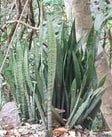
- Dracaena trifasciata, the former Sansevieria, with stiff upright leaves rather than arching ones;
- Cordyline fruticosa, often confused with it on houseplant shelves despite narrower leaves that do not clasp the stem.
The leaf base is the reliable check: sheathing in Dracaena fragrans, it is clearly stalked in most Cordyline. 3
Main sources
- Plants of the World Online / Kew, Dracaena fragrans (L.) Ker Gawl.
- USDA GRIN Taxonomy, Dracaena fragrans (L.) Ker Gawl.
- Integrated Taxonomic Information System (ITIS), Dracaena fragrans
- Royal Horticultural Society, Dracaena fragrans (Deremensis Group) Lemon Lime
- Royal Horticultural Society, Dracaena fragrans Massangeana
- Royal Horticultural Society, Dracaena fragrans (Deremensis Group) Warneckei
- NC State Extension, Dracaena fragrans (Corn Plant)
- ASPCA, Corn Plant (Dracaena fragrans) toxicity entry
- Missouri Botanical Garden Plant Finder, Dracaena fragrans
- French Wikipedia, Dracaena fragrans
- English Wikipedia, Dracaena fragrans
- Cummings & Waring, 2020, potted plants VOC removal efficiency review
Frequently asked questions
Is the cornstalk dracaena (Dracaena fragrans) toxic to cats and dogs?
Yes. The leaves contain saponins that cause vomiting, sometimes with blood, drooling and loss of appetite in dogs, cats and horses. The ASPCA lists Dracaena fragrans as toxic to all three.
Why does the name Dracaena deremensis still show up on some plant tags?
Dracaena deremensis Engl., described in 1902, is now a synonym of Dracaena fragrans. The name lives on in the trade for variegated cultivars such as Warneckei or Janet Craig, sold under the Deremensis Group label.
How much light does a cornstalk dracaena need?
The cornstalk dracaena tolerates a wide range of light, from bright indirect light to deeper shade, where the foliage turns darker. Direct sun, however, scorches the leaves.
Why are the leaf tips turning brown?
Brown tips usually come from air that is too dry, fluoridated water or salt buildup in the potting mix. Watering with non-fluoridated water and flushing the pot now and then keeps the problem in check.
Does the cornstalk dracaena really purify indoor air?
A 1989 NASA study included the cultivar Janet Craig among plants that removed certain pollutants in a sealed chamber. A more recent review shows the result does not carry over to real buildings, where outdoor air exchange already removes volatile organic compounds at a rate that would take dozens of plants per square meter to match.
Why won't my cornstalk dracaena branch?
A young plant keeps a single stem topped by a rosette of leaves as long as the tip neither flowers nor gets damaged. Branching, into two or three new shoots, appears only after flowering or an injury to the top, often after pruning.
How does Dracaena fragrans differ from real corn or a palm?
The name corn plant comes from the foliage's resemblance to a corn plant (Zea mays), but Dracaena fragrans belongs to the Asparagaceae and is unrelated to the grass family, Poaceae. Its woody stem and rosettes of leaves also set it apart from true palms (Arecaceae).
Similar plants
Botanical data compiled from reference sources (RHS, Kew Gardens, POWO). This profile is for guidance only and is not a substitute for advice from a botanist or veterinarian if you have concerns about toxicity.