
Ti (Cordyline fruticosa, )
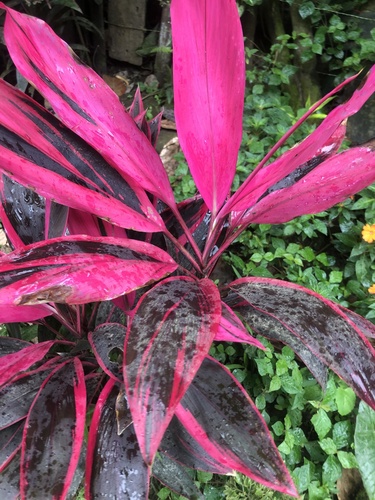
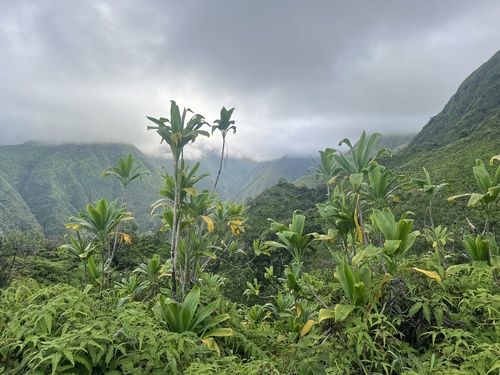
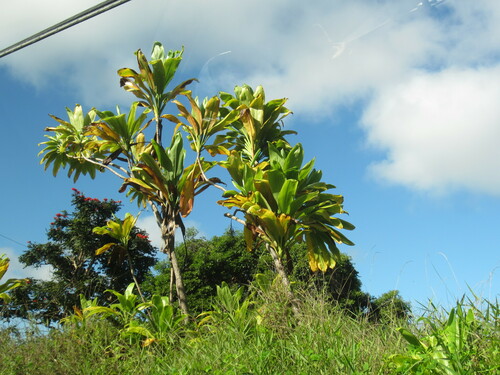
Ti (Cordyline fruticosa), also sold as ti plant, is a shrub in the Asparagaceae native to Papua and the western Pacific, now grown and spread throughout Southeast Asia and Oceania. Its bare, ridged stems carry a tuft of lance-shaped leaves at the top, green in the wild form but often red, pink or variegated in garden cultivars.
Read moreTi plant, Cordyline, Palm lily and Cabbage palm
Give plenty of ambient light without direct sun on the leaves.
Global distribution
The exact native range of Cordyline fruticosa is still debated. Plants of the World Online places it in Papua and the western Pacific, while other sources extend it to mainland Southeast Asia and northern Australia. Its much wider presence across the Pacific, as far as Hawaii and eastern Polynesia, reflects deliberate transport by Austronesian voyagers rather than natural spread.
- Native5
- Introduced2
- Papua New Guinea
- Solomon Islands
- Vanuatu
- Indonesia
- Northern Australia
- Hawaii
- French Polynesia
Hexagons: sourced regions. Green dots: native range. Statuses according to POWO (Kew).
Identity
Ti (Cordyline fruticosa (L.) A.Chev., 1919), often sold as ti plant, is a perennial shrub in the genus Cordyline, family Asparagaceae. The genus has worn other labels along the way: first placed in the Agavaceae, then in the Laxmanniaceae, it only joined the Asparagaceae in 2009, in the subfamily Lomandroideae. 1 2
The epithet fruticosa means "shrubby." It describes the upright, branching habit of the mature plant, not any feature of the flowers. The common name ti (or kī) comes from a reconstructed Proto-Malayo-Polynesian word, the source of Hawaiian kī and Māori tī, a direct linguistic trace of how people carried the plant across the Pacific. 3
Recognition
On Cordyline fruticosa, the bare, ridged stem stays unbranched until it flowers; once it blooms or is damaged, it branches. Each stem ends in a tuft of lance-shaped leaves 30–60 cm (12–24 in) long, held on a long, distinct leaf stalk. That stalk alone already separates Cordyline from Dracaena, whose petiole is short or missing. 4 5
Leaf color varies enormously with the cultivar: plain green in forms close to the wild type, but red, pink, purple or streaked with cream in garden selections. Planted in the ground in the tropics, Cordyline fruticosa can top 4 m (13 ft), against less than 1.5 m (5 ft) in a pot. 3 6
In winter or spring, a mature plant sends up a large panicle 30–60 cm (12–24 in) long, bearing many small, fragrant flowers in white to lilac. On Cordyline fruticosa, these give way to red or white berries in clusters. Indoors, flowering stays rare, usually held back by light levels and the room available to the roots. 4 3
Useful taxonomy
Much of today's confusion in the nursery trade goes back to the history of the scientific name. Linnaeus first described the plant as Convallaria fruticosa; it then circulated for a long time as Dracaena terminalis and Cordyline terminalis, until Auguste Chevalier established the combination accepted today, in 1919. 2 1
Synonyms and older names worth knowing before a purchase or an identification:
- Dracaena terminalis L.
- Cordyline terminalis Kunth
- Convallaria fruticosa L.
- Taetsia fruticosa (L.) Merr.
- Dracaena ferrea L.
Plenty of nursery catalogs still use Cordyline terminalis out of habit. The accepted scientific name remains Cordyline fruticosa, and that is the one listed in the major taxonomic databases. 2
Habitat and range
Where ti is truly native depends on which source you read. Plants of the World Online places its range in Papua and the western Pacific; other studies extend it to mainland Southeast Asia and northern Australia. 2 6
Its arrival in Hawaii, New Zealand and Easter Island was no accident. Austronesian voyagers deliberately loaded it into their canoes, for food and ritual use, long before Europeans reached the Pacific. 1 3
In the wild, Cordyline fruticosa grows in open understory and along forest edges, from sea level up to about 1,200 m (3,900 ft) depending on the site. Grown for centuries around Pacific villages, it now behaves there almost like a native plant rather than an invasive one. 3
Life cycle and reproduction
Growers multiply ti mainly by division of basal offshoots or by stem cuttings with a node. A section of bare stem, sold in the trade as a ti log, puts out new roots in 3 to 6 weeks when set in a warm, moist medium. 6
A terminal panicle often triggers branching of the flowering stem. After blooming, the stem produces one or two side shoots below the inflorescence, which is why older specimens eventually branch on their own, even without pruning. 4
The rhizomes of Cordyline fruticosa store up to 20% sugars, mostly fructose. Polynesians used that reserve to ferment the plant into a drink (Hawaiian okolehao) and ate it as a famine food when other supplies ran short. 1 3
Uses and risks
Traditional uses go well beyond ornament. The leaves of Cordyline fruticosa are woven into hula skirts and rain capes, sometimes into roofing; the fermented roots yield a traditional drink, and the young shoots are cooked as a leafy vegetable. Several Pacific cultures also regard the plant as sacred and plant it as a hedge around homes to keep evil spirits away. 3 1
Pet owners, on the other hand, need to take it seriously: the ASPCA lists Cordyline fruticosa as toxic to dogs and cats because of steroidal saponins found throughout the plant. In cats, dogs and horses, ingestion causes vomiting (sometimes with blood), drooling, lethargy and loss of appetite. The sap can irritate skin on contact. 7 6
Varieties, look-alikes and related plants
Hundreds of cultivars exist, selected for leaf color and pattern: Tricolor (pink, cream and green on the same leaf), Red Sister or Firebrand (stable bright red), Black Magic (almost black), Kiwi (cream and pink margins). Before buying, check how stable the variegation is, since it can fade when light drops. 6
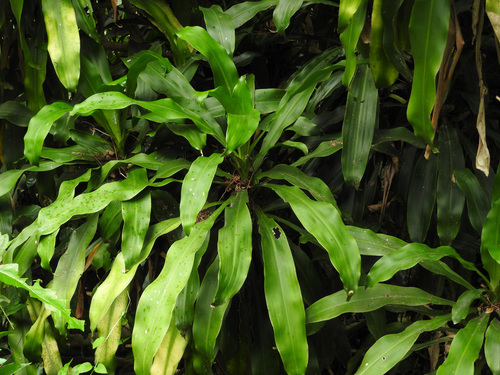
Cordyline and Dracaena are mixed up more than any other pair: both carry tufts of leaves on bare stems, but the roots settle the question, white and fibrous in Cordyline, yellow to bright orange in Dracaena. The distinct petiole of Cordyline, against a short or missing one in most Dracaena, confirms the diagnosis. 5
Cordyline australis, the New Zealand cabbage tree, causes another possible mix-up. Far hardier, with a trunk that thickens with age, it was also long classified as a Dracaena before being moved into the same genus Cordyline. 1
Main sources
- Plants of the World Online / Kew, Cordyline fruticosa (L.) A.Chev.
- ASPCA, Ti Plant (Cordyline terminalis) toxicity entry
- Missouri Botanical Garden, Plant Finder, Cordyline fruticosa
- NC State Extension, Cordyline fruticosa plant profile
- National Tropical Botanical Garden, Cordyline fruticosa (Ti)
- Ethnobotany, phytochemistry and biological activities of the genus Cordyline (PMC)
- Au Jardin, Épinard hawaïen, Ti-plant, Cordyline fruticosa (in French)
- Succulentes, Dracaena vs Cordyline, two lookalike genera that are botanically distinct
Frequently asked questions
Is Cordyline fruticosa toxic to cats and dogs?
Yes. The ASPCA lists it as toxic to dogs, cats and horses because of steroidal saponins found throughout the plant. Eating it causes vomiting, drooling and loss of appetite.
Why are my ti leaf tips turning brown?
The usual culprit is fluoride or dissolved salts in tap water, made worse by dry air. Watering with filtered water or rainwater and raising the humidity generally fixes the problem.
What is the difference between Cordyline and Dracaena?
Root color is the most reliable clue, white to cream in Cordyline and yellow to bright orange in Dracaena. The distinct leaf stalk of Cordyline, against a short or missing one in most Dracaena, confirms the identification.
Can Cordyline fruticosa live outdoors year-round?
Only in frost-free climates, roughly USDA zones 10 to 12. The species handles temperatures below 10 °C (50 °F) poorly, and some sources report brief tolerance down to -1 °C (30 °F) with no guarantee. Where winters turn colder, grow it in a pot and bring it indoors for the cold season.
Where does the name "ti" come from?
Ti (or kī) descends from a reconstructed Proto-Malayo-Polynesian word, the source of Hawaiian kī and Māori tī. The name traveled with the plant throughout its spread across Polynesia.
Why do variegated leaves lose their color?
Low light often makes colorful cultivars turn green, as they produce more chlorophyll at the expense of red or pink pigments. Moving the plant closer to a bright window usually brings back the contrast.
Similar plants
Botanical data compiled from reference sources (RHS, Kew Gardens, POWO). This profile is for guidance only and is not a substitute for advice from a botanist or veterinarian if you have concerns about toxicity.