
Spineless yucca (Yucca gigantea, )
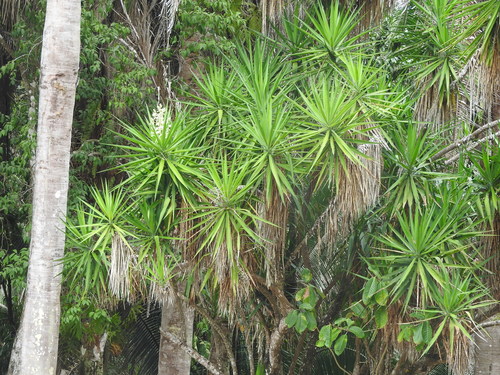
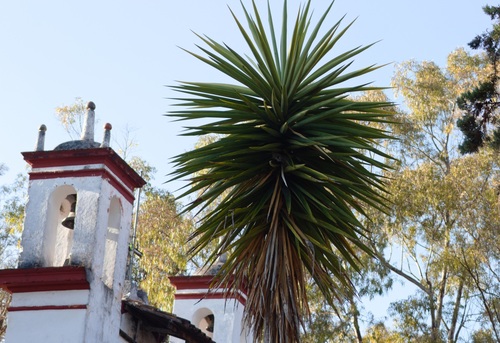
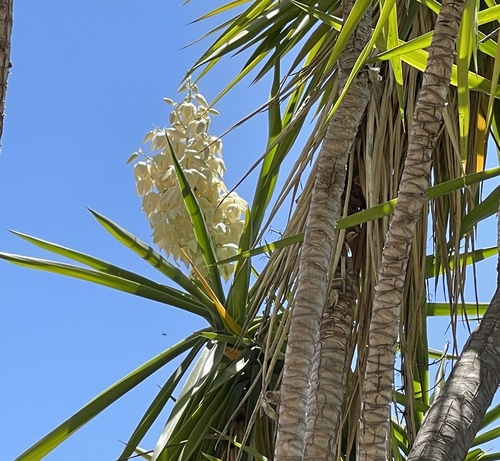
The spineless yucca (Yucca gigantea) is a tree-forming shrub in the Asparagaceae, native to eastern Mexico and Central America. Its swollen, elephant-foot base and flexible leaves without a sharp tip set it apart from most other yuccas. It should not be mixed up with Beaucarnea, a different genus often sold under the same "elephant's foot" label.
Read moreYucca cane, Soft-tip yucca, Giant yucca and Izote
Allow a few hours of direct sun per day, preferably morning or evening.
Global distribution
The native range of Yucca gigantea covers eastern Mexico (Quintana Roo, Yucatán, Campeche, Tabasco, Chiapas, Veracruz) and Central America, from Belize through Guatemala, Honduras, El Salvador and Nicaragua to Costa Rica. It has naturalized in several tropical and Mediterranean regions where it is widely planted, without being documented there as a major ecological threat.
- Native7
- Introduced3
- Mexico
- Guatemala
- Belize
- Honduras
- Nicaragua
- El Salvador
- Costa Rica
- Puerto Rico
- Hawaii
- Spain
Hexagons: sourced regions. Green dots: native range. Statuses according to POWO (Kew).
Identity
The spineless yucca (Yucca gigantea Lem., 1859) belongs to the genus Yucca in the family Asparagaceae. French botanist Charles Lemaire published the name in November 1859, a few months after Eduard von Regel had floated the name Yucca elephantipes for a plant with a swollen base, without describing it validly. That missing description makes elephantipes illegitimate under the botanical code of nomenclature, even though it still dominates horticultural literature. 1 2
Its other nickname, elephant's foot, refers to the thickened, cracked base, which holds water through dry spells. The same nickname is also applied to Beaucarnea recurvata, a different genus, so an "elephant's foot" sold at a garden center without a Latin name could be either plant. 3
Recognition
Single-stemmed or branched, Yucca gigantea can reach 8 to 12 m (26 to 40 ft) in the ground where the climate suits it, but only 2 to 3 m (6.5 to 10 ft) in a container. On the oldest specimens, the thick, woody trunk can approach 1.2 m (4 ft) in diameter. 3 4
The narrow, bluish green leaves are 50 to 90 cm (20 to 35 in) long and gather in dense rosettes at the top of the trunk. Unlike most yuccas, their tips stay flexible and lack a sharp spine: this blunt foliage is where the common names spineless yucca and soft-tip yucca come from. 5 4
In bloom, an upright stalk carries up to 1 m (3 ft) of fragrant, bell-shaped, creamy white flowers. Outside the native range, the specialized pollinating moth is missing, so no seed forms: a bright indoor plant can still flower, but fruit remains rare, unlike in the wild. 3 6
Useful taxonomy
The species has an unusually dense synonymy, largely a legacy of 19th-century naming confusion. The names you will run into most often are:
- Yucca elephantipes Regel ex Trel., nom. illeg.
- Yucca guatemalensis Baker
- Yucca lenneana Baker
- Yucca mooreana Baker
- Yucca eleana W.Watson
- Dracaena lennei Baker
Guatemalensis deserves a closer look: published by Baker in 1872, it is sometimes sold as though it named a separate species, while POWO treats it as a plain synonym of Yucca gigantea. With so many synonyms and trade names in circulation, the accepted name, Yucca gigantea, is the only label that stays the same from one nursery to the next. 1 2
Habitat and range
In the wild, the species ranges from eastern Mexico (Quintana Roo, Yucatán, Campeche, Tabasco, Chiapas, Veracruz) into Central America, from Belize through Guatemala, Honduras, El Salvador and Nicaragua to Costa Rica. There it grows in dry tropical scrub and semi-arid areas, usually in full, direct sun. 2
Planted well beyond this range for its architectural look, it has naturalized in several tropical and subtropical regions without being reported as an ecological threat. 1
Where winters bring regular frost, the plant is mostly grown in containers or as a bright houseplant. In the ground, it only lasts long term in mild, sheltered spots where frost is occasional, such as the warm coastal areas of zones 9 to 11. 5
Life cycle and reproduction
Compared with most yuccas, growth is fast: the trunk visibly thickens from one year to the next as long as the plant gets enough light. From germination, a distinct trunk usually takes 3 to 5 years to form. 5 4
Across its native range, a Prodoxus moth actively pollinates the flower while laying its eggs in it. Elsewhere that moth is absent, so fruit requires hand pollination, which explains why ornamental plants so rarely set fruit. 6
For propagation, trunk cuttings are the quickest route: a section of stem, even without roots, takes once the cut has callused and it is planted in a free-draining mix. Basal offsets, when they appear, root just as easily. Seed also works, but much more slowly than cuttings. 4
Uses and risks
Ornamental use comes first by a wide margin: dry beds, patios and seaside plantings in warm climates, or a large houseplant where winters are cold. A sculptural trunk and minimal upkeep, with no staking and little watering, explain its success in containers. 5
Known as izote, the flower is the national flower of El Salvador and a common ingredient in Salvadoran and Guatemalan cooking. With the bitter reproductive parts removed, the petals are blanched and then cooked as a side dish or in tortitas, a traditional, regional use with little following elsewhere. 6
Leaves and roots contain steroidal saponins, rated low in toxicity but not harmless. In people, ingestion causes nausea, vomiting and diarrhea. In cats and dogs, it mainly leads to vomiting. In horses, repeated ingestion has caused liver problems and dermatitis. 5 7
Varieties, look-alikes and related plants
Variegata, the main cultivar on the market, has broad cream stripes on a light green background; its growing needs match those of the species. The widespread trade name Yucca elephantipes is not a separate variety but the species itself, under its historical illegitimate synonym. 8
It is most often confused with:
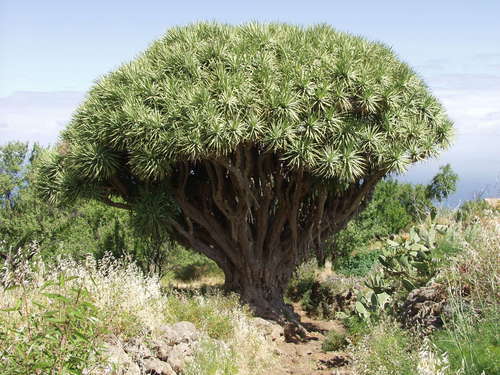
- Beaucarnea recurvata, another "elephant's foot" with a clearly bulbous caudex and thin, drooping leaves, in a different genus;
- Yucca guatemalensis, a historical synonym sometimes sold as if it were a separate species;
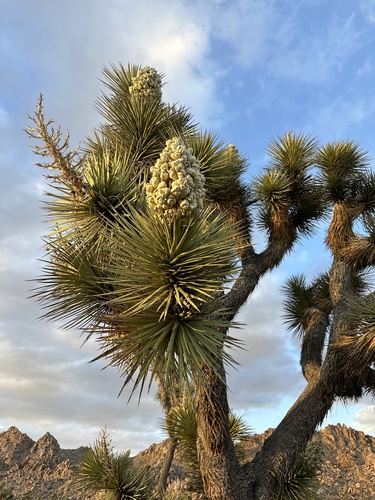
- Yucca aloifolia, with stiff, sharply spined foliage, unlike the soft leaves of Yucca gigantea.
Two traits settle it at a glance: a trunk thickened at the base and leaves without a terminal spine. No other plant sold under a similar name combines both. 3
Main sources
- Plants of the World Online / Kew, Yucca gigantea Lem.
- Royal Horticultural Society, Yucca elephantipes
- Missouri Botanical Garden Plant Finder, Yucca elephantipes
- Plants For A Future, Yucca gigantea
- NC State Extension Gardener Plant Toolbox, Yucca gigantea
- UF/IFAS Extension, ENH-831/ST675 Yucca gigantea, Spineless Yucca
- UF/IFAS Extension, ENH-832/ST676 Yucca gigantea 'Variegata'
- ASPCA, Yucca toxicity entry
- USDA GRIN Global, Yucca guatemalensis taxonomy and native range
Frequently asked questions
Are Yucca gigantea and Yucca elephantipes the same plant?
Yes. Yucca elephantipes is an illegitimate name published without a valid description in 1859, the same year as Yucca gigantea. The latter is the accepted name, even though the former is still everywhere in the nursery trade.
Is the spineless yucca toxic to cats and dogs?
Yes, with low severity. The leaves and roots contain saponins that cause vomiting in cats and dogs, and liver problems have been reported in horses after repeated ingestion.
Why is the base of my spineless yucca getting thicker?
That swelling, reminiscent of an elephant's foot, is normal and becomes more pronounced with age. It stores water and gives the plant both its nickname, elephant's foot, and its old scientific name, elephantipes.
Is Yucca gigantea the same elephant's foot plant as Beaucarnea?
No. The two plants can share the same trade nickname, but they belong to different genera. Beaucarnea recurvata has a distinctly bulbous caudex and thin, drooping leaves; Yucca gigantea has a more cylindrical trunk and stiff, upright leaves.
Can you eat spineless yucca flowers?
Yes, in some Central American cuisines. The petals, with the bitter stamens and ovary removed, are blanched and then cooked. This remains a traditional, regional use rather than a widespread one.
Why don't the leaves of my spineless yucca have spines?
That is normal and a key feature. The species is called spineless yucca because its leaves, soft at the tip, lack the sharp point typical of the genus Yucca.
Can the spineless yucca survive frost?
Once well established in the ground, it tolerates brief light frosts, matching USDA zones 9b to 11. Prolonged freezing or cold, waterlogged soil, however, is fatal to young plants.
Similar plants
Botanical data compiled from reference sources (RHS, Kew Gardens, POWO). This profile is for guidance only and is not a substitute for advice from a botanist or veterinarian if you have concerns about toxicity.