
Dragon-tree (Dracaena draco, )
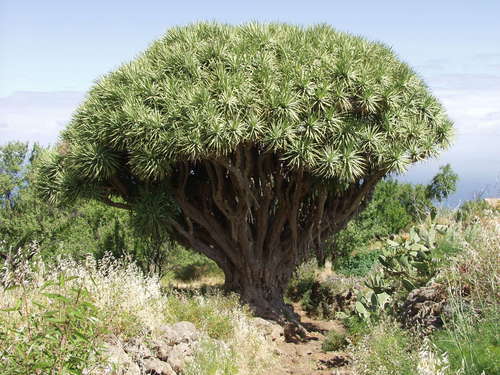


Dragon-tree (Dracaena draco) is a monocotyledonous tree in the Asparagaceae, historically recorded as native to the Canary Islands, Madeira, Cape Verde and Morocco. It spends decades on a single trunk before its first flowering, then develops an umbrella crown whose branches divide at successive flowering cycles. Its wild populations are threatened.
Read moreDragon-tree, Dragon tree, Drago and Drago de Canarias
Place in full sun, with intense direct light all day long.



© photo
no rights reserved, uploaded by Ina Siebert · cc0
Ina Siebert · cc0
Jonathan Hughes · cc0
Taken Feb 15, 2008 by Photoflora - Benoit BOCK (©)
Taken Nov 3, 2016 by Yoan MARTIN (cc-by-sa)
Taken Jan 24, 2021 by Giuseppe Visimberga (cc-by-sa)
Taken May 1, 2022 by Renaud Brochiero (cc-by-sa)
© copyright of the Board of Trustees of the Royal Botanic Gardens, Kew.




Global distribution
The historical native range of Dracaena draco includes the Canary Islands, Madeira, Cape Verde and southwestern Morocco; the origin of the Azores population remains uncertain. Some populations formerly included as subspecies are now recognized separately. The species is cultivated in mild regions beyond this range.
- Native4
- Introduced1
- Spain (Canary Islands)
- Portugal (Madeira)
- Cape Verde
- Morocco
- Portugal (Azores)
Hexagons: regions where the plant occurs. Green dots: native range.1
Identity
Dragon-tree (Dracaena draco (L.) L., 1767), also called dragon tree, is a monocotyledonous member of Dracaena. It is now placed in Asparagaceae, following earlier classifications in Liliaceae and Agavaceae. 1 6
The epithet draco refers to the red resin released when the bark is cut. Known as dragon’s blood, it was long compared in Europe with the blood of a mythical dragon. The adult tree’s umbrella crown, unusual among monocots, distinguishes it from most plants sold under the same common name. Drago and drago de Canarias are established names for it. 5
Recognition
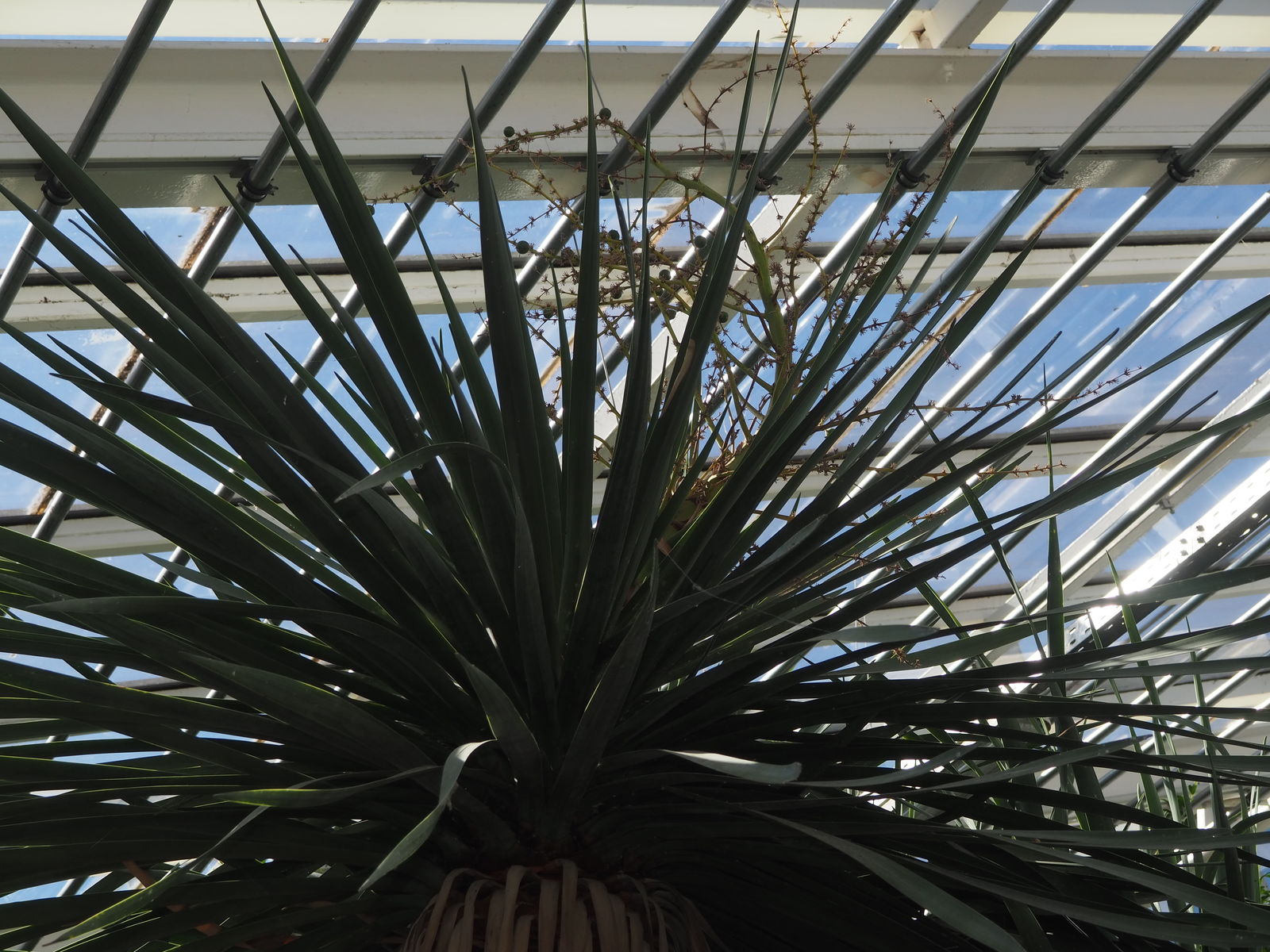
A young dragon tree looks quite unlike its eventual adult form. For its first ten to fifteen years, it retains a single, unbranched stem topped with a tuft of narrow, sword-shaped leaves. 2
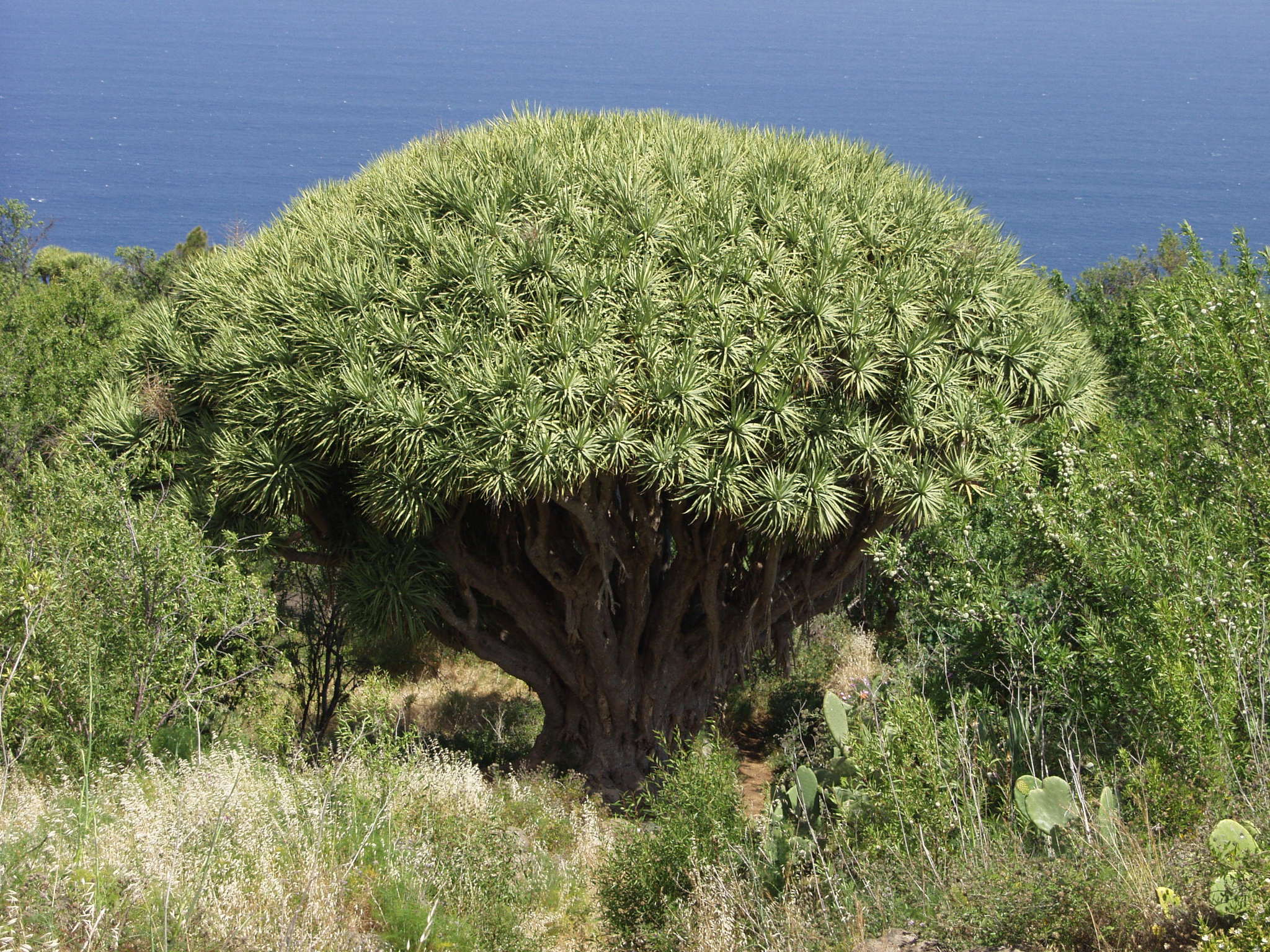
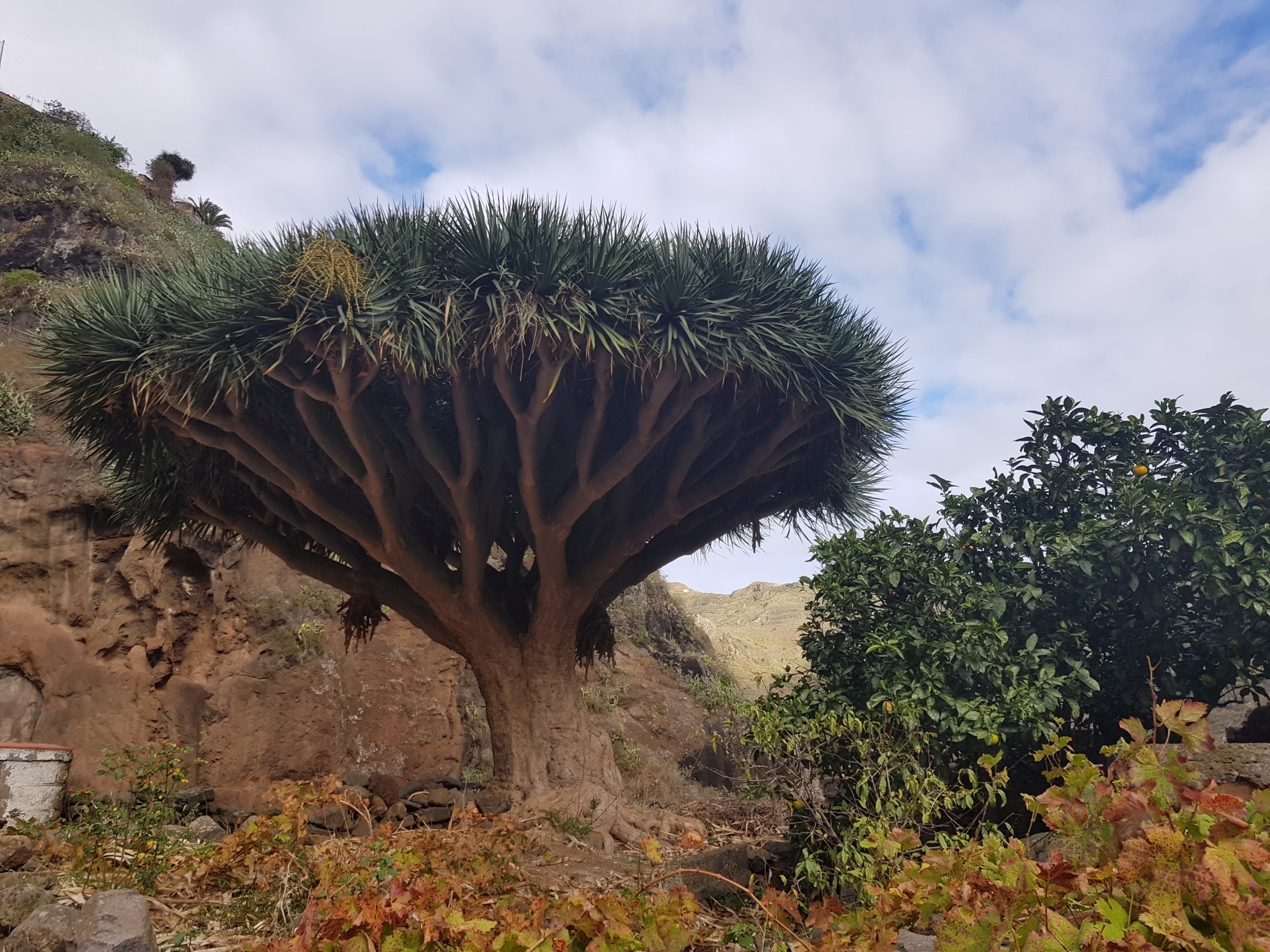
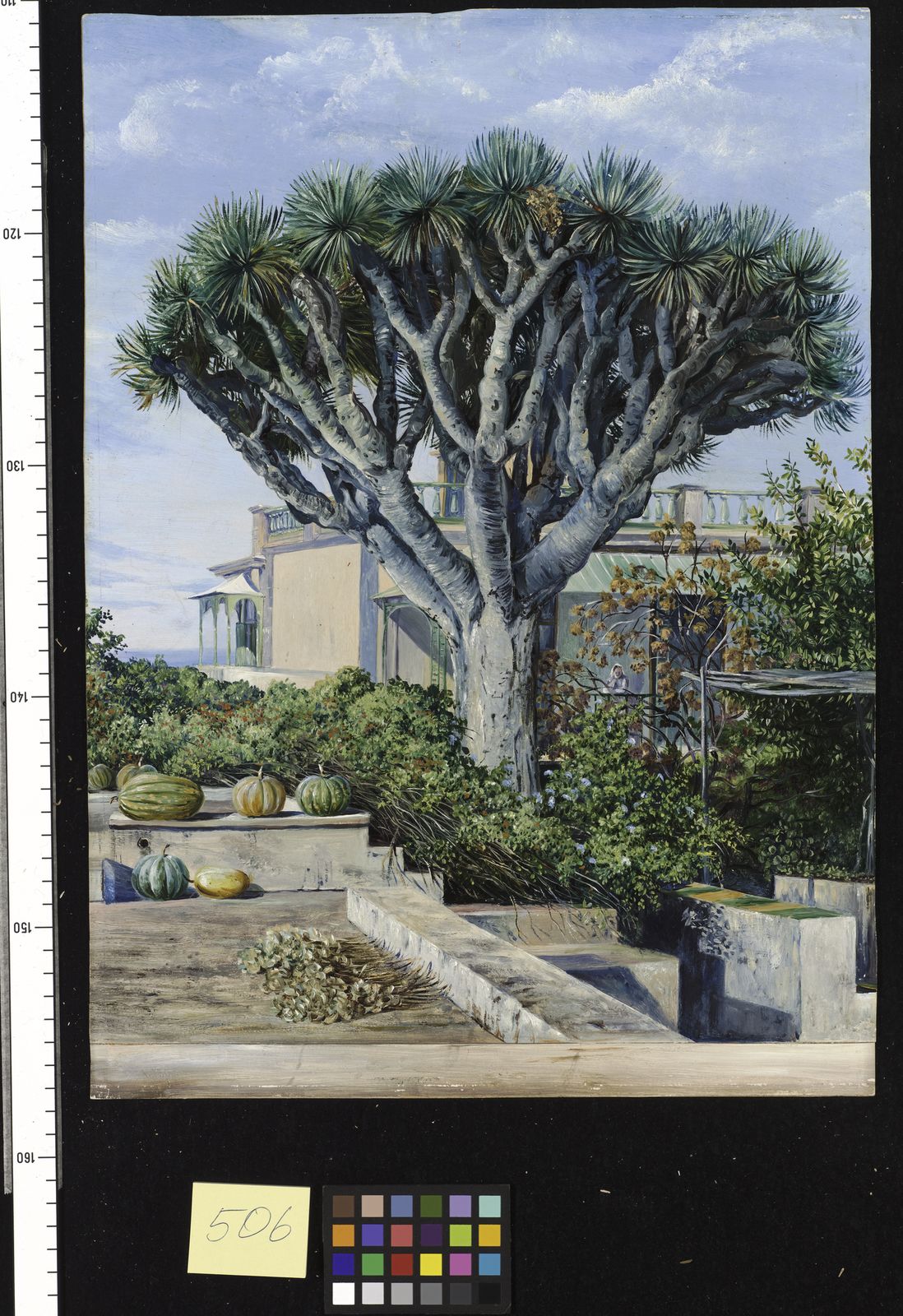
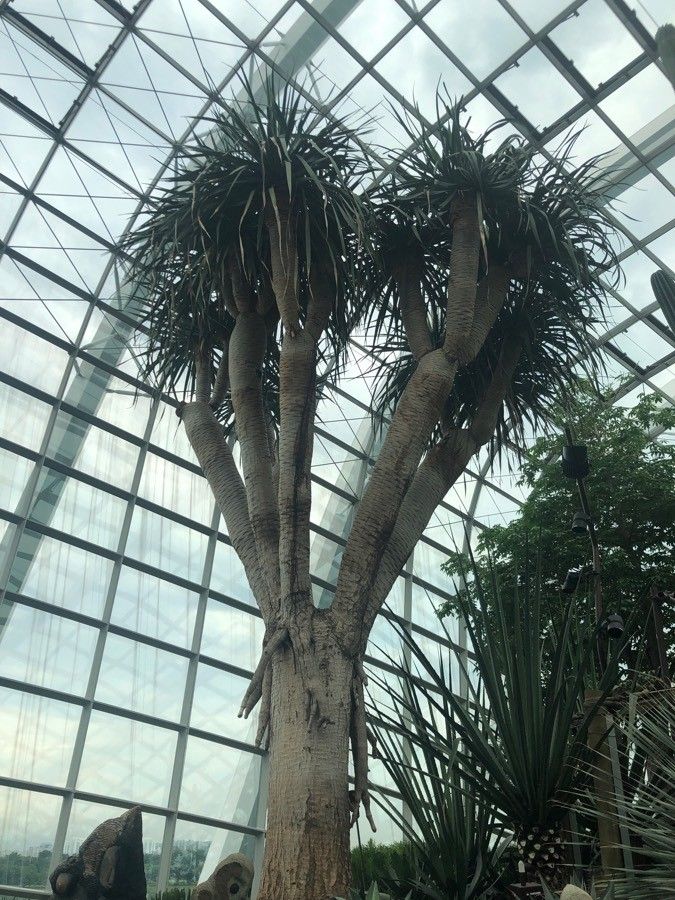
Branching begins at the first flowering. The terminal bud is exhausted and then divides into two new shoots, a dichotomous pattern repeated at subsequent flowering cycles. An old tree eventually carries an umbrella crown of dozens of layered branches. In cultivation, adult height reaches 4–8 m (13–26 ft) over several decades; wild trees exceed 15–18 m (49–59 ft), with a crown around 6 m (20 ft) across. 2 5
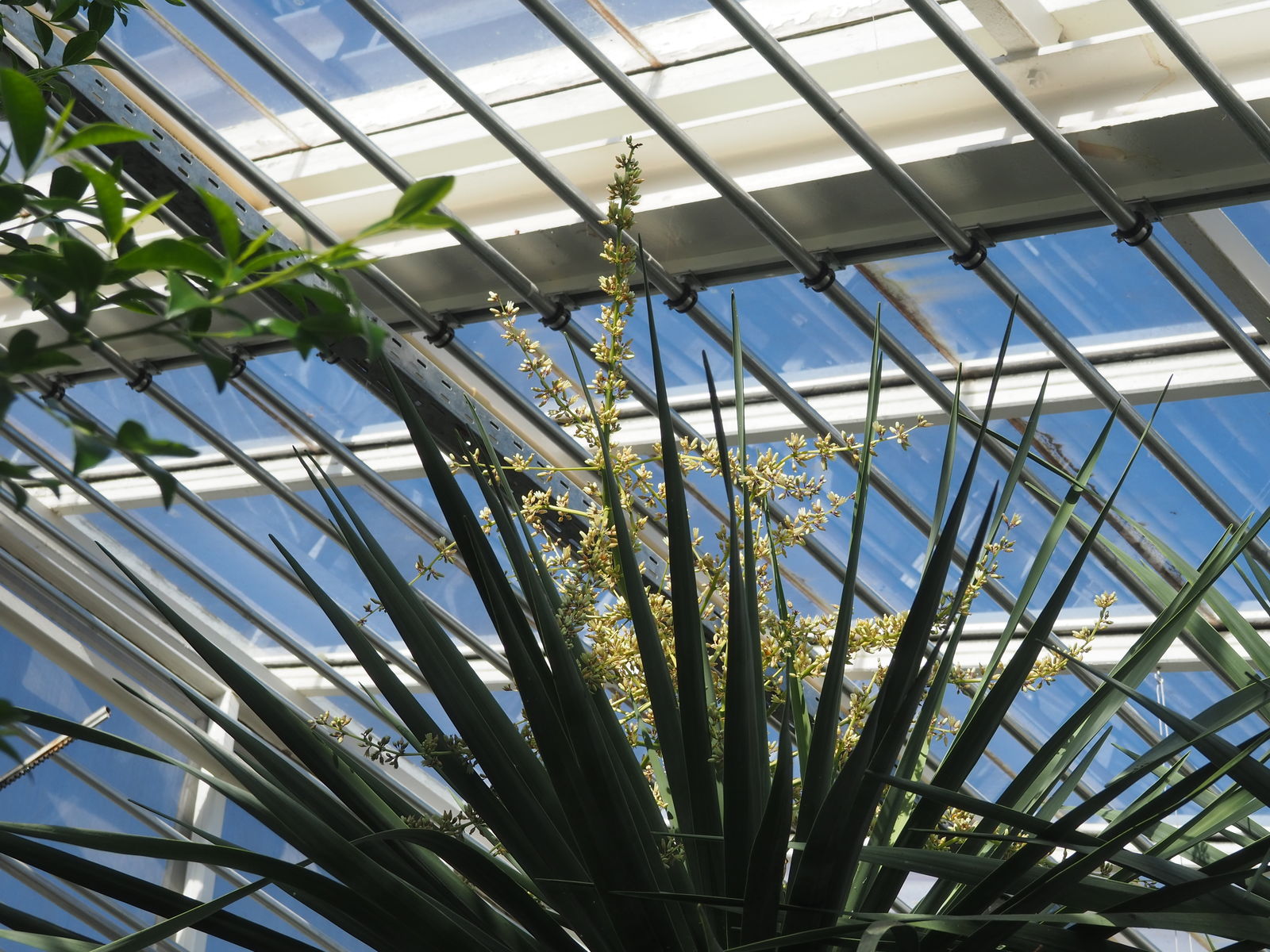
Waxy, gray-green leaves form rosettes at the branch tips. Fragrant greenish-white flowers resemble small lilies and precede orange to coral-colored berries, which are relatively uncommon outside the native range. 5
Useful taxonomy
The species does not produce true wood in the manner of dicotyledonous trees, making remarkable old specimens difficult to age. The IUCN assessment gives reproductive maturity at about 30 years. 3
Dracaena draco (L.) L. is the accepted name, with the homotypic synonym Asparagus draco L., and later synonyms Palma draco (L.) Mill. and Yucca draco (L.) Carrière. 1 8
Two populations once treated as subspecies have changed status. The southwestern Moroccan form, described as Dracaena draco subsp. ajgal Benabid & Cuzin, is now recognized as the distinct species Dracaena ajgal (Benabid & Cuzin) Rivas Mart. & al.. Likewise, the Cape Verde population, Dracaena draco subsp. caboverdeana Marrero Rodr. & R.S.Almeida, has been raised to species rank as Dracaena caboverdeana (Marrero Rodr. & R.S.Almeida) Rivas Mart. & al.. 1
Habitat and range
The historical native range includes the Canary Islands, especially Tenerife, with rare wild trees on Gran Canaria, La Palma, El Hierro and La Gomera, as well as Madeira, Cape Verde and southwestern Morocco. The origin of the Azores population remains uncertain. These historical range accounts include populations discussed above that were later separated at species level. 3
Trees grow on coastal and inland cliffs, ravine walls and in dry subtropical scrub at 30–1,000 m (100–3,280 ft) above sea level. They occur alongside wild olive (Olea cerasiformis) and Canary Island juniper (Juniperus turbinata subsp. canariensis), without forming dense stands. 3
Historical conservation data mention the death of the last known wild tree on Gran Canaria in 2009 and, on Madeira, one adult growing naturally, supplemented by about ten reintroduced plants. The overall trend is declining, despite local natural regeneration on Tenerife. 3
Life cycle and reproduction
Flowering is irregular and climate-dependent, first occurring at around ten to fifteen years. It then recurs with further branch divisions, sometimes separated by decades on the same tree. Pollinated flowers produce fleshy berries that birds disperse. 5
Seed germination and establishment account for most losses in the life cycle. Goat and rabbit browsing sharply reduces recruitment in several wild populations, particularly on Tenerife and Gran Canaria. 3
In horticulture, propagation is almost exclusively by seed. Germination takes four to eight weeks in a warm, freely draining medium, followed by very slow growth for several years. 2
Uses and risks
For centuries, red resin extracted from the trunk, dragon’s blood, served as a dye, varnish, notably for stringed instruments, and traditional remedy for digestive and skin complaints. 7
As an ornamental, Dragon-tree makes an architectural specimen in Mediterranean and subtropical gardens. In cooler climates it remains in a large tub, greenhouse or bright conservatory while still below adult size. It needs very freely draining soil, full sun and protection when temperatures approach 5 °C (41 °F). 2
ASPCA lists Dracaena spp. as toxic to dogs and cats and identifies saponins as the toxic principle. Its reported signs include vomiting, sometimes blood-stained, lethargy, loss of appetite, excessive salivation and, in cats, dilated pupils. 4
Varieties, look-alikes and related plants
Unlike many commercially popular houseplants, Dracaena draco has no established, widely distributed horticultural cultivar. Plants sold under fanciful names generally belong to other species, notably Dracaena fragrans or Dracaena marginata, with comparable needs but very different adult forms. 1
The main look-alike is Socotra dragontree, Dracaena cinnabari Balf.f., which has the same umbrella form but grows only on Yemen’s Socotra Island, more than 3,000 km (1,860 miles) from the Canaries. Dracaena ajgal and Dracaena caboverdeana, long confused with Dracaena draco, differ mainly in geographic range and fine floral details. Cabbage tree (Cordyline australis), sometimes wrongly sold as a dragon tree, has finer, drooping leaves and lacks red resin. 5
Main sources
- Plants of the World Online / Kew, Dracaena draco (L.) L.
- Royal Horticultural Society, Dracaena draco - Dragon tree
- IUCN Red List, Dracaena draco assessment 2021
- ASPCA, Dracaena (Dragon Tree) toxicity entry
- Encyclopaedia Britannica, dragon tree
- GBIF, Dracaena draco (L.) L. species record
- Gupta, Bleakley & Gupta 2008, Dragon's blood — botany, chemistry and therapeutic uses
- International Plant Names Index, Dracaena draco (L.) L.
Frequently asked questions
Is Dragon-tree threatened?
Yes. IUCN has classified it as Endangered since 2021, after a Vulnerable assessment in 1998. Wild populations are declining under pressure from overgrazing, storms and competition from invasive plants.
Why do some dragon trees have only one trunk?
Young trees retain a single, unbranched trunk for ten to fifteen years, until their first flowering. The umbrella crown starts branching only after that first flowering cycle.
Is Dragon-tree toxic to pets?
Yes. RHS identifies Dracaena draco as harmful to pets if eaten. ASPCA lists Dracaena spp. as toxic to cats and dogs and identifies saponins, with vomiting, excessive salivation and lethargy after ingestion.
Is Dragon-tree the same as Socotra dragontree?
No. Dracaena cinnabari, Socotra dragontree, has the same umbrella shape but grows only on Yemen’s Socotra Island, more than 3,000 km (1,860 miles) from the Canaries. They are distinct species in the same genus.
What is dragon-tree resin used for?
The red resin, or dragon’s blood, was long used as a dye, varnish for stringed instruments and traditional remedy for digestive and skin complaints.
Does Dragon-tree grow quickly?
No. Growth is very slow, particularly in the first decades. In cultivation it takes several decades to reach 4–8 m (13–26 ft) tall.
Can Dragon-tree tolerate frost?
Very poorly. It needs protection below 5 °C (41 °F) and can only be planted in the ground in mild climates without marked or prolonged frost.
Similar plants
If you are unsure about a plant’s toxicity, ask a botanist or veterinarian for advice.