
Cannonball tree (Couroupita guianensis, )
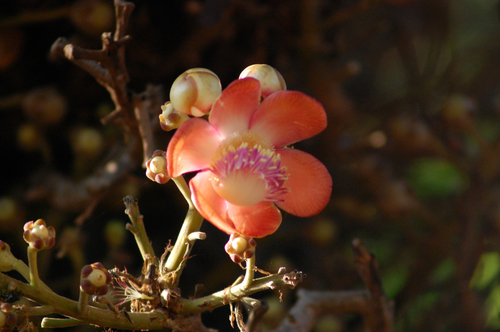

Cannonball tree (Couroupita guianensis) is a large Lecythidaceae tree native to humid tropical forests of Central and South America. Flowers and fruits grow directly from its trunk rather than at branch tips, a habit called cauliflory. Venerated at Hindu and Buddhist temples in South Asia as nagalingam, it is best known for the heavy, spherical woody fruits behind its English name.
Read moreCannonball tree
Allow a few hours of direct sun per day, preferably morning or evening.
Full sun to light partial shade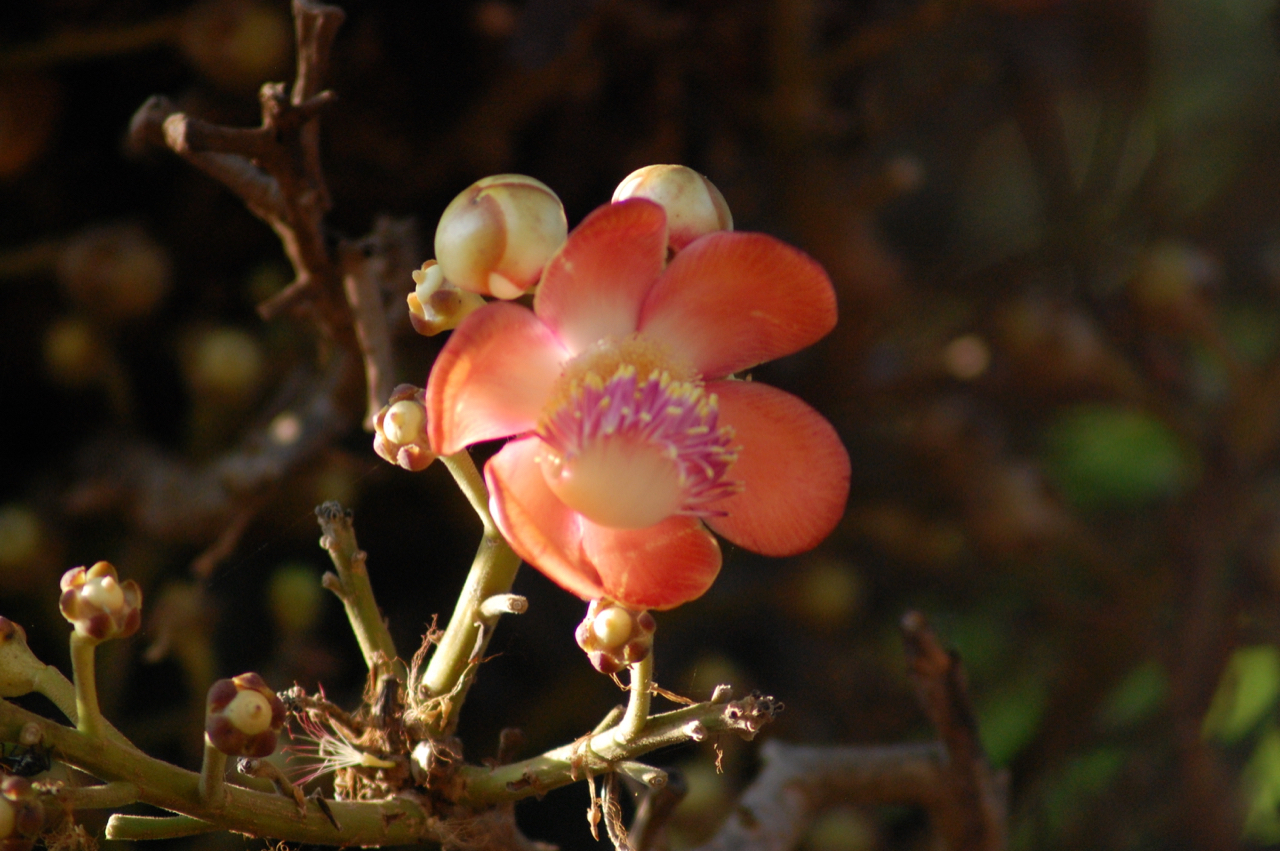



© photo
Prashanth N S · cc-by
Raja Sekhar Chimirala · cc-by
Guillaume Delaitre · cc-by
Taken Jan 4, 2020 by MAHENDRAN MAHENDRAN MAHENDRAN (cc-by-sa)
Taken Aug 30, 2019 by Blue Bottle (cc-by-sa)
Taken Nov 14, 2013 by Tela Botanica − Liliane Roubaudi (cc-by-sa)
Taken Jul 1, 2012 by Thomas Delhotal (cc-by-sa)
Taken Mar 13, 2022 by Wiezel de Carvalho Nicole (cc-by-sa)
© copyright of the Board of Trustees of the Royal Botanic Gardens, Kew.




Global distribution
The native range covers lowland tropical America, from Costa Rica and Panama to Brazil and northern Bolivia, with the Guianas at its center. It is now cultivated throughout much of the tropical world for fragrant flowers, and was introduced long ago to South Asia, where it gained strong religious significance.
- Native5
- Introduced2
- Costa Rica
- Panama
- French Guiana
- Brazil
- Bolivia
- India
- Sri Lanka
Hexagons: regions where the plant occurs. Green dots: native range.1
Identity
Cannonball tree (Couroupita guianensis Aubl., 1775) belongs to the genus Couroupita in the Lecythidaceae, the same family as Brazil nut, Bertholletia excelsa. French botanist Jean-Baptiste Christophore Fusée Aublet described it from French Guiana in 1775, the geographical connection recorded in the epithet guianensis. 1 5
The English and French common names both describe its fruit: a hard, spherical woody capsule, 20–25 cm (8–10 in) across, resembling a cannonball. South American names include ayahuma and the French abricot sauvage, meaning wild apricot; in French Guiana it is also called calabasse colin. These regional names refer to the same tree rather than to true apricots or gourds. 2
In South and Southeast Asia it is planted at Hindu and Buddhist temples under the name nagalingam. The flower is interpreted as a sacred cobra protecting an object of Shiva worship, a cultural reading of its unusual floral structure. 4
Recognition
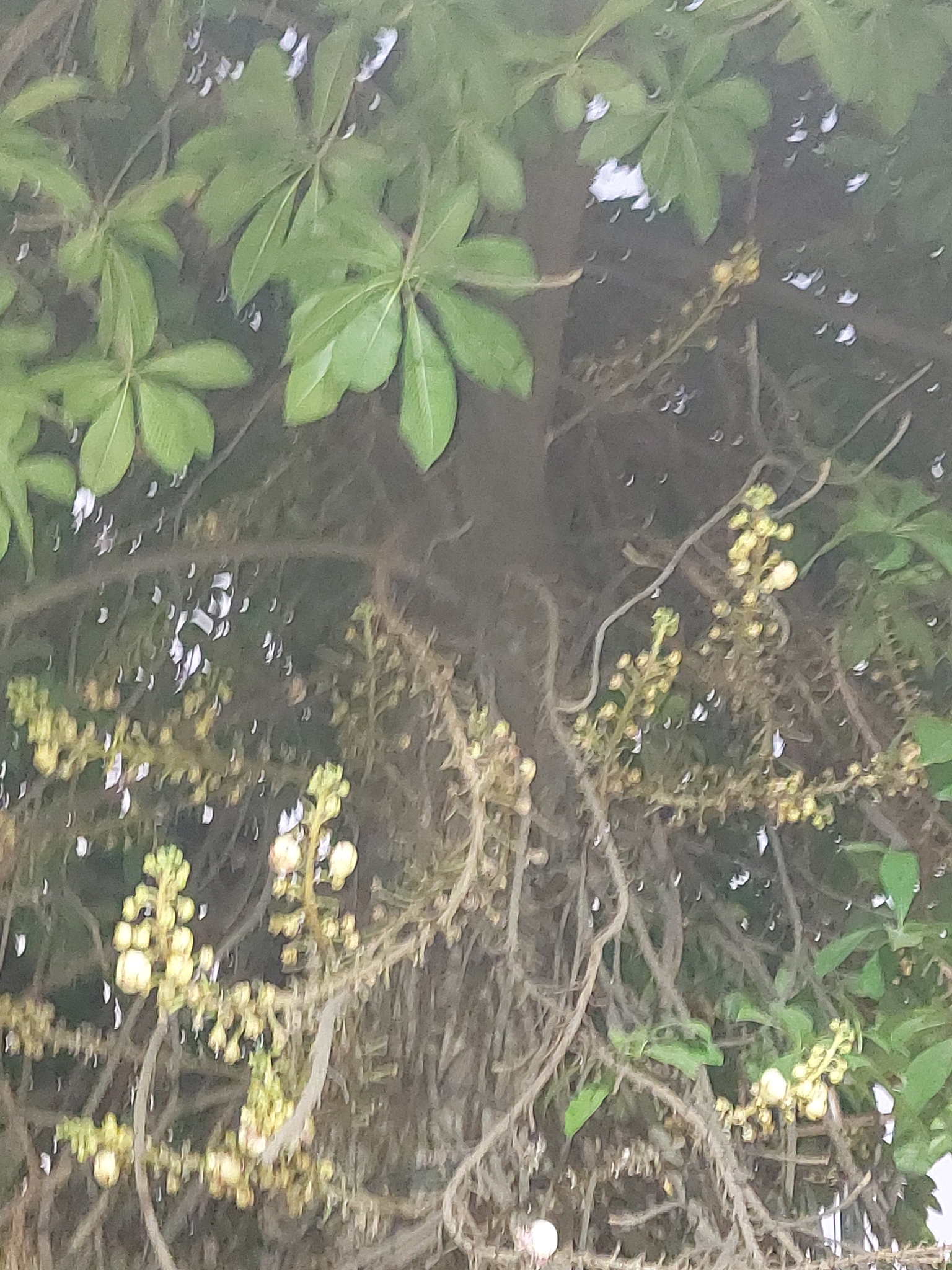
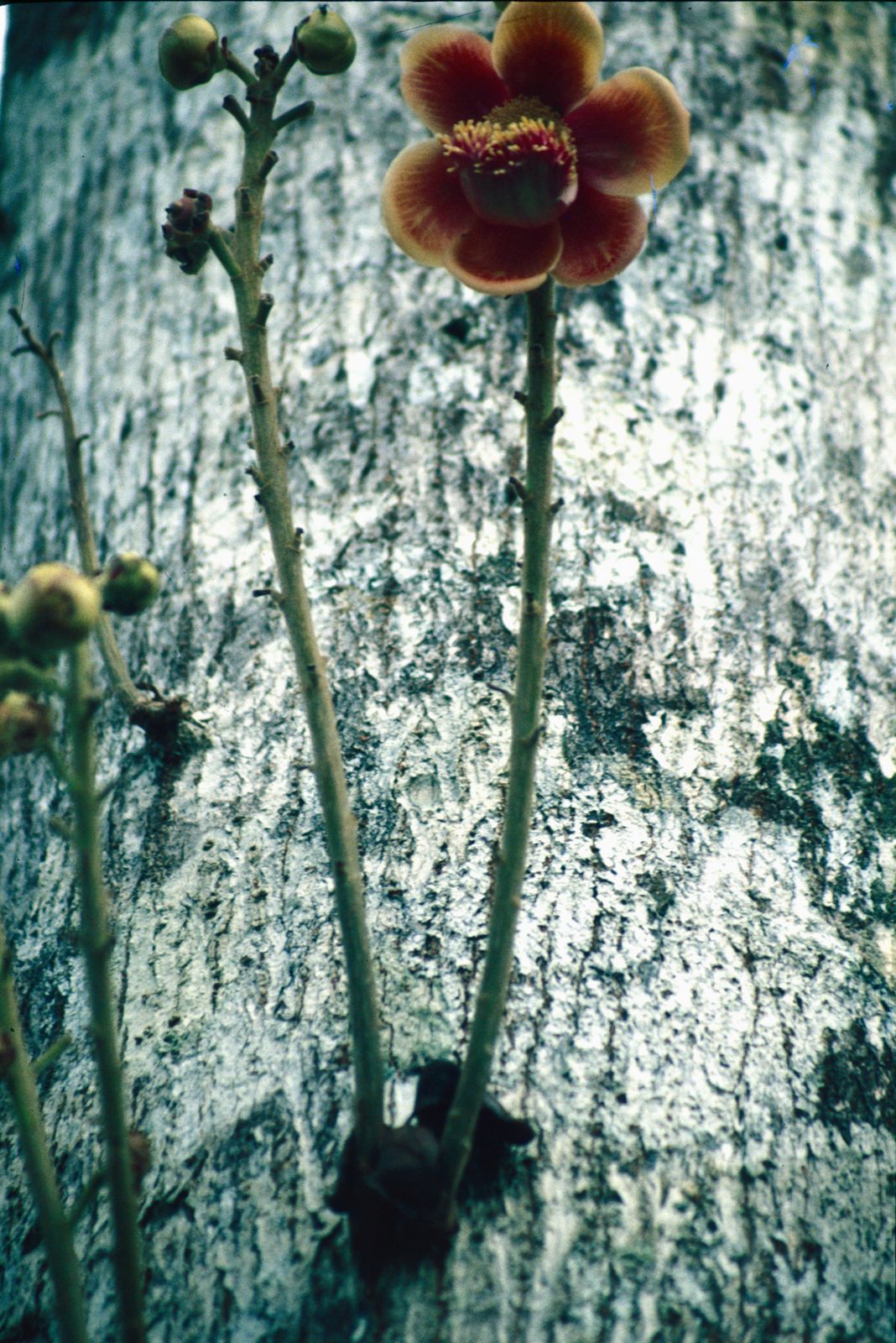
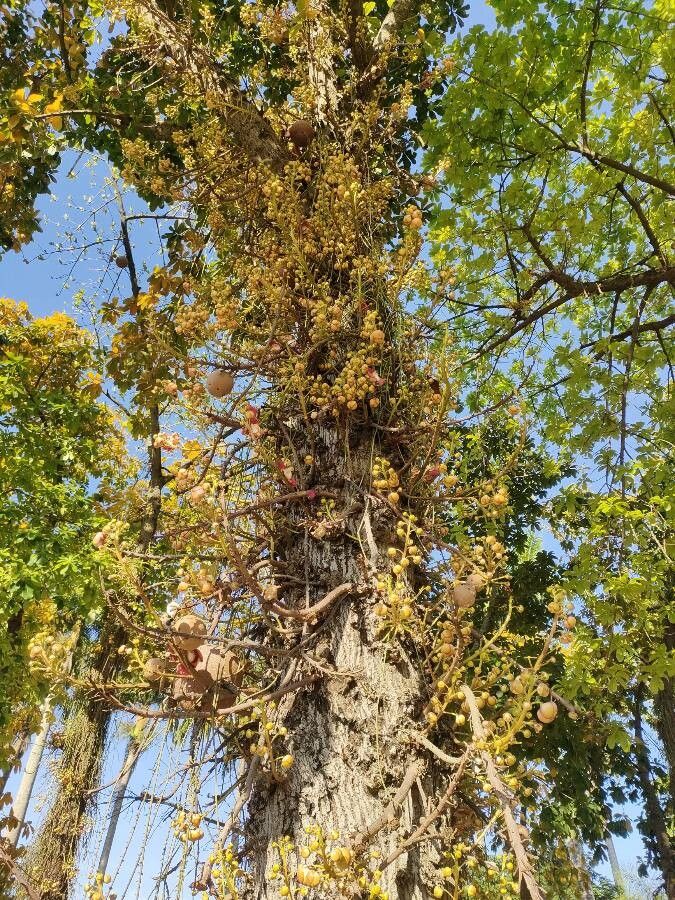
The trunk is more useful than a leaf alone for recognizing this tree. Flowers and fruits grow directly from its bark rather than only at branch tips, a habit called cauliflory. Long, vine-like flowering stems develop each year from the same points on the trunk. Extending for 60 cm to more than 1 m (2 to over 3 ft), they carry successive clusters of flowers. 2
Leaves are gathered in clusters at the ends of the branches and commonly measure 8–30 cm (3–12 in) long. In response to a marked dry season, the tree may shed them twice a year. A leafless individual is therefore not necessarily diseased; it may be undergoing a seasonal rest. 2
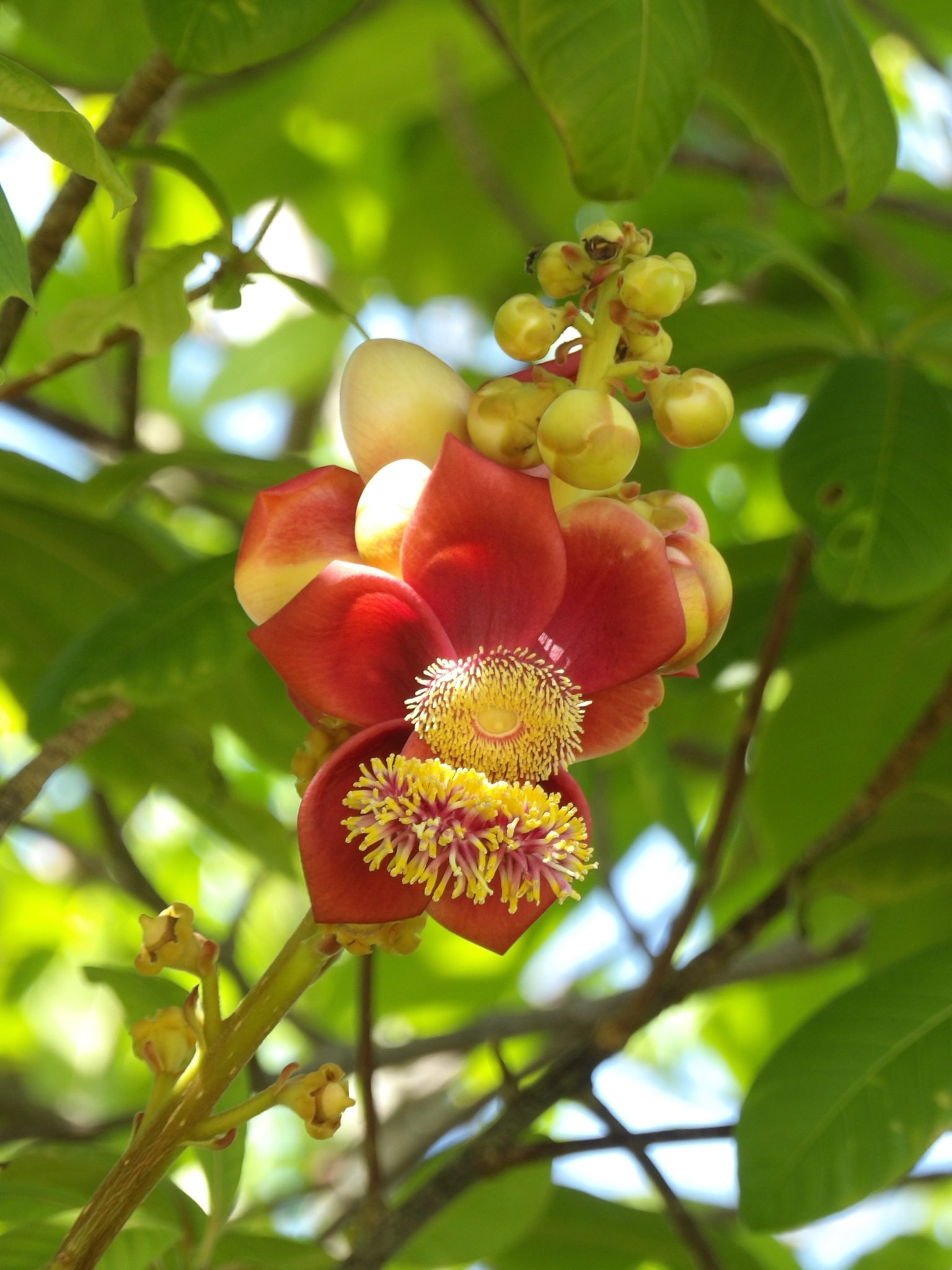
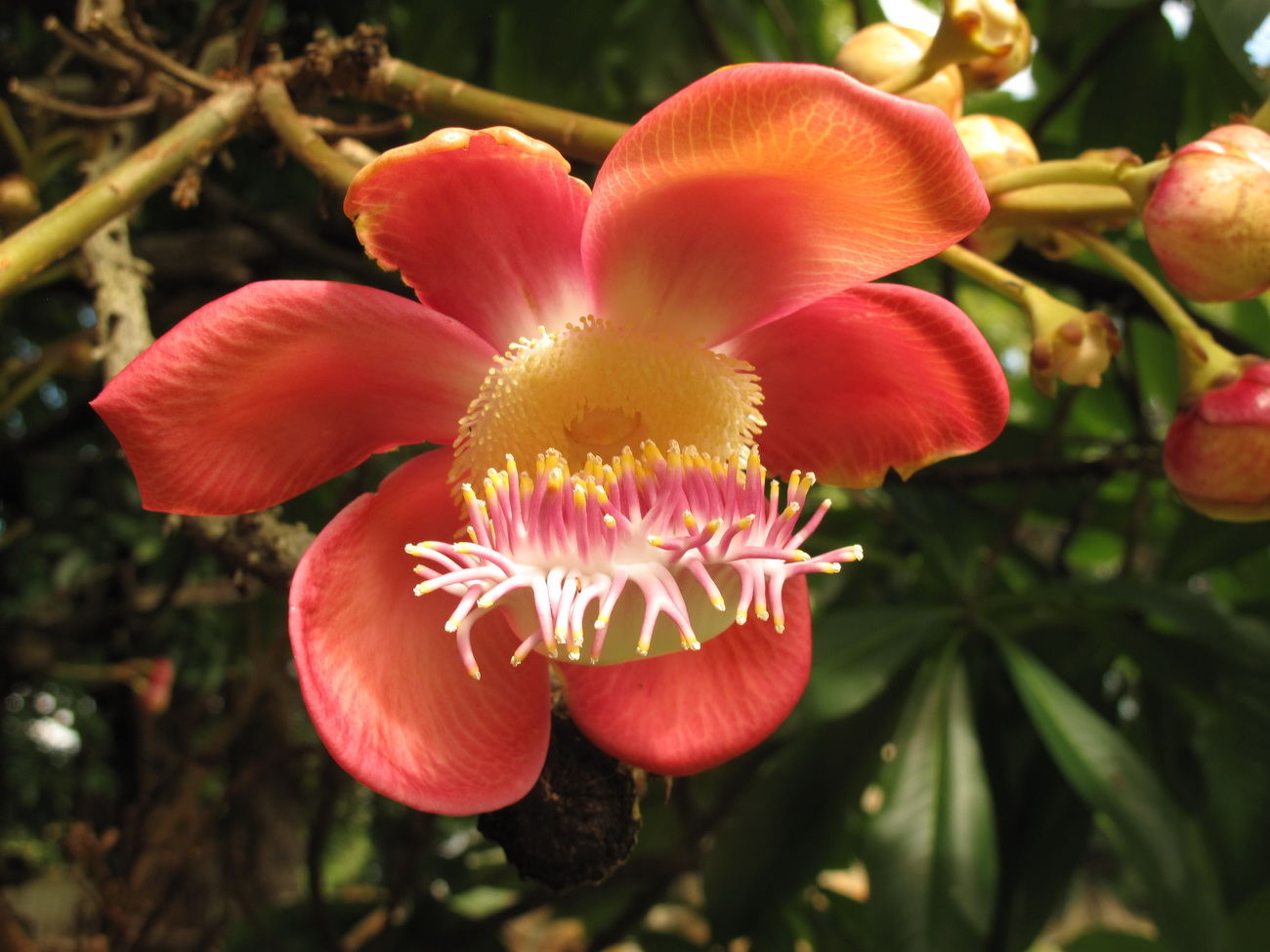
Flowers measure 10–13 cm (4–5 in) across, range from pink to red and have six petals. Their stamens form a two-level structure: a central ring is associated with a curved hood resembling a snake's head. This conspicuous arrangement explains the flower's religious interpretation in India. 2
Useful taxonomy
Published in 1775, Couroupita guianensis Aubl. remains the accepted name. Several later binomials were placed in synonymy after herbarium material was compared:
- Couroupita surinamensis Mart. ex Berg
- Couroupita peruviana O.Berg
- Couroupita venezuelensis R.Knuth
- Couroupita membranacea Miers
- Couroupita antillana Miers
- Lecythis bracteata Willd.
Among these historical names, variety Couroupita guianensis var. surinamensis (Mart. ex Berg) Eyma still circulates in horticulture for trees with somewhat smaller fruits. It has no status distinct from the accepted name. Couroupita guianensis is consequently a more reliable reference than regional names that change between countries. 1 5
Habitat and range
The native range lies in lowland tropical America, from Costa Rica and Panama south to Brazil and northern Bolivia, with the Guianas at its center. Humid tropical forest provides its natural habitat. This American origin is distinct from its long cultural association with Asian temples. 1 6
Cultivated widely in the tropics for its fragrant flowers, it was planted in Sri Lanka by the British in 1881. It was subsequently confused with sal, Shorea robusta, a sacred Buddhist tree native to Asia and belonging to a different family. Cannonball tree inherited a place at monasteries through that confusion, rather than through a close botanical relationship. 4
In metropolitan France the species is confined to heated greenhouses or botanical collections; in French Guiana, within its native range, it grows in forest. More generally, frost-prone climates require protected tropical growing conditions rather than treating its English name as a guide to outdoor suitability. 6
Life cycle and reproduction
The nectarless flowers chiefly attract carpenter bees collecting pollen. They open early in the morning, last a single day and soon fade, so effective pollination depends on morning visits. The brief life of each flower contrasts with the succession of blooms along the persistent flowering stems. 2
A heavy, spherical woody capsule follows, 20–25 cm (8–10 in) across, containing 200–300 seeds embedded in white pulp. When ripe it drops abruptly from the trunk rather than opening while suspended. The falling weight is substantial enough for botanical gardens to restrict access beneath mature specimens. 2
On the ground, the capsule releases pulp with an unpleasant smell, markedly different from the fragrance of the flowers borne earlier on the same tree. Mammals such as peccaries and agoutis eat the pulp and carry seeds away from the parent. 2
Uses and risks
Ornamental and cultural uses dominate. Fragrant flowers borne directly on the trunk make the tree a sought-after curiosity in tropical botanical gardens; it is also planted along streets in several South American cities. The unusual fruit adds interest, but also affects where a mature tree can safely stand. 2
Traditional Amazonian medicine has used the bark, leaves and fruits for hypertension, pain, inflammation and wounds. A fruit extract studied in the laboratory showed marked antibacterial activity against Staphylococcus aureus and partial inhibition of biofilm formation in Pseudomonas aeruginosa. This is a research direction concerning bacteria resistant to conventional antibiotics, rather than evidence of a clinical treatment. 3
No toxicity is documented in people, cats or dogs; the main risk is mechanical, from falling heavy ripe fruits, rather than chemical. The status for horses remains unreported because published data are lacking. 2
Varieties, look-alikes and related plants
Unlike familiar ornamental crops, Couroupita guianensis has no stabilized horticultural cultivars. Flower colors vary between individual trees, from pale pink to bright red, rather than representing reliably fixed selections. 2
Its most widespread confusion is cultural rather than botanical. In South Asia it has long been mistaken for sal, a tree of an entirely different family, because of a shared sacred status rather than a similar outline. The distinction matters when identifying the tree referred to in religious accounts. 4
Botanically its closest relatives include other Amazonian Couroupita species and Brazil nut, Bertholletia excelsa, in the same Lecythidaceae family. Brazil nut does not share the cauliflorous habit: its fruits mature high in the branches, whereas cannonball tree carries them directly against the trunk, even on a relatively young specimen.
Main sources
- Plants of the World Online / Kew, Couroupita guianensis Aubl.
- Missouri Botanical Garden, Plant Finder, Couroupita guianensis
- BMC Complementary and Alternative Medicine 2012, antibacterial and antibiofilm properties of Couroupita guianensis fruit extract
- Encyclopaedia Britannica, cannonball tree
- Integrated Taxonomic Information System, Couroupita guianensis Aubl.
- USDA GRIN / National Plant Germplasm System, Couroupita guianensis
- IUCN Red List, Couroupita guianensis assessment
Frequently asked questions
Is cannonball tree poisonous?
No toxicity is documented in people, cats or dogs. The main risk is mechanical, from sudden falls of heavy ripe fruits, rather than chemical.
Why do the flowers grow directly on the trunk?
This habit, called cauliflory, lets the tree carry flower clusters and large fruits on a framework strong enough to support them, without relying on slender branches.
Is cannonball tree fruit edible?
The pulp is rarely eaten because of its unpleasant smell once the fruit is open, quite different from the flowers' fragrance. Documented uses are chiefly traditional medicinal ones rather than food uses.
Why is cannonball tree planted at Indian temples?
The stamens form a curved hood above a central ring. This is interpreted as a sacred cobra protecting a linga, giving the tree its name nagalingam and a frequent place at Hindu temples.
Can cannonball tree grow in France?
Only in a large heated greenhouse or botanical collection in metropolitan France. It has no frost tolerance there; in French Guiana, by contrast, it is part of the native flora. Elsewhere, outdoor suitability likewise depends on tropical conditions.
Is cannonball tree related to the sal at Buddhist monasteries?
Not botanically. The confusion arose after its introduction to Sri Lanka in 1881, where it acquired the religious significance of sal, Shorea robusta, a species in a different family.
How is cannonball tree related to Brazil nut?
Both belong to the Lecythidaceae, but Brazil nut, Bertholletia excelsa, does not bear fruits directly on its trunk as Couroupita guianensis does.
Similar plants


If you are unsure about a plant’s toxicity, ask a botanist or veterinarian for advice.