
Sycamore fig (Ficus sycomorus, )


Sycamore fig (Ficus sycomorus) is a large Moraceae tree native to sub-Saharan Africa, the Arabian Peninsula and Madagascar. Cultivated in Egypt since antiquity, it bears clusters of figs directly on its trunk and large branches. It is unrelated to the sycamore maple familiar in temperate Europe.
Read moreSycamore fig, Fig-mulberry and Mulberry fig

© photo
(c) Alan Manson, some rights reserved (CC BY), uploaded by Alan Manson · cc-by
Daniel van der Post · cc0
Alan Manson · cc-by
(c) Alan Manson, some rights reserved (CC BY) · cc-by
no rights reserved · cc0
Global distribution
The native range of Ficus sycomorus covers sub-Saharan Africa, from Senegal to Ethiopia and south into southern Africa, with natural populations in the Arabian Peninsula and Madagascar. Cultivation in Egypt and the Levant dates to antiquity; these very early introductions are distinct from the strict native range.
- Native5
- Introduced2
- Senegal
- Ethiopia
- South Africa
- Saudi Arabia
- Madagascar
- Israel
- Cyprus
Hexagons: regions where the plant occurs. Green dots: native range.1
Identity
Sycamore fig (Ficus sycomorus L., 1753), also called fig-mulberry or mulberry fig, is a large Moraceae tree in the genus Ficus. Its name comes from the ancient Greek sykomoros, combining sykon, fig, and moron, mulberry, in reference to its mulberry-like leaves. 1 7
Do not confuse it with sycamore maple (Acer pseudoplatanus), which shares the common name in France. Only the name connects them: the former is a tropical Ficus with figs and latex, in Moraceae; the latter is a temperate maple with winged fruits, in Sapindaceae. 2
Recognition
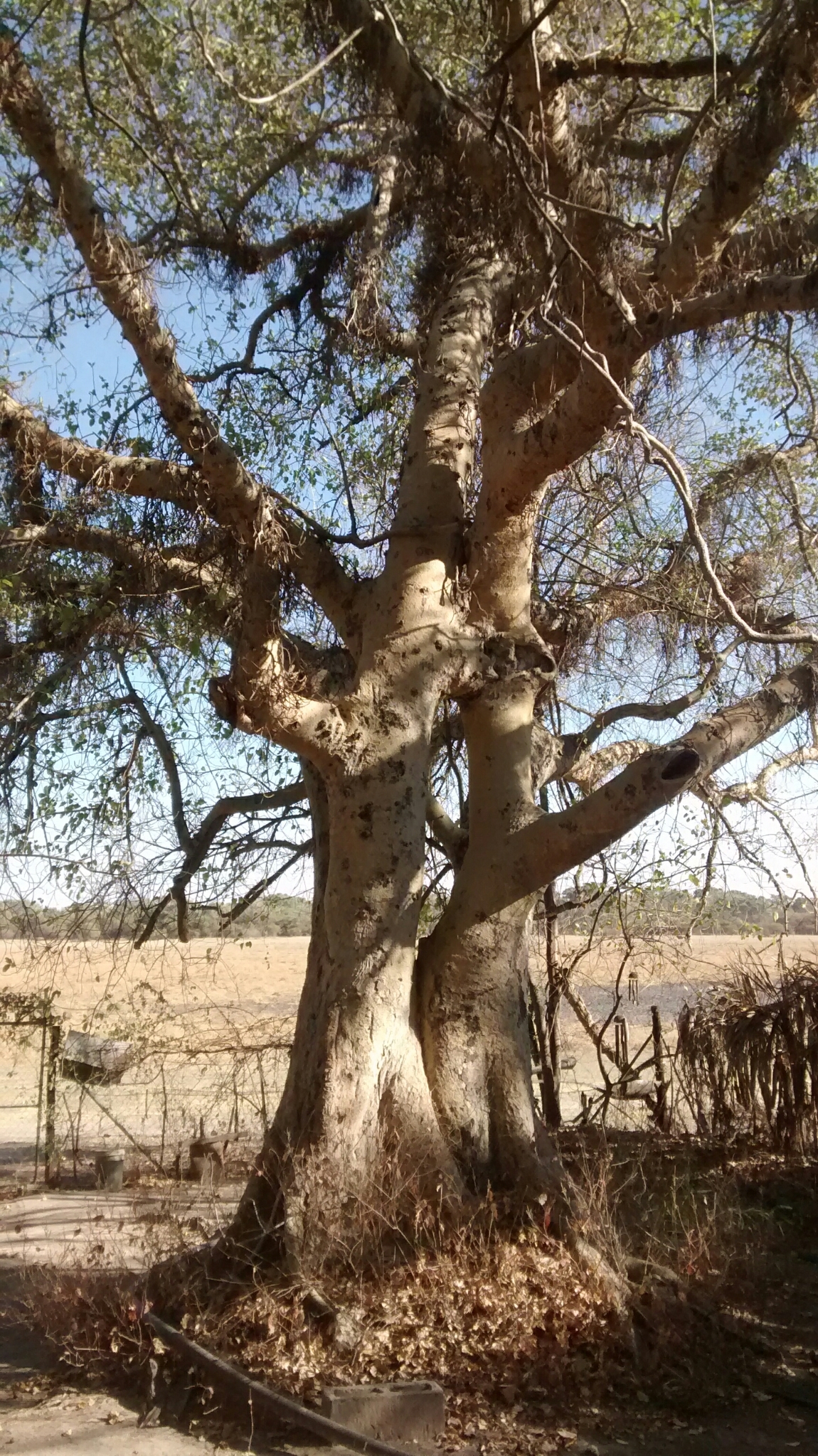
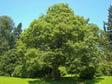
Ficus sycomorus has a dense, spreading crown and commonly reaches 10–21 m (33–69 ft) tall. Exceptional old trees with buttressed trunks have been reported at up to 46 m (151 ft). 4
Young bark is yellow-green, becoming orange with age. It peels in long, papery strips that reveal paler bark beneath. In all figs, even a small injury promptly releases milky white latex, a useful feature for recognizing the genus. 5
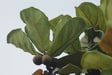
The heart-shaped leaves are about 14 cm (5.5 in) long and 10 cm (4 in) wide. Their upper surfaces are dark green; beneath, they are rough to the touch with conspicuous bright yellow veins. 5
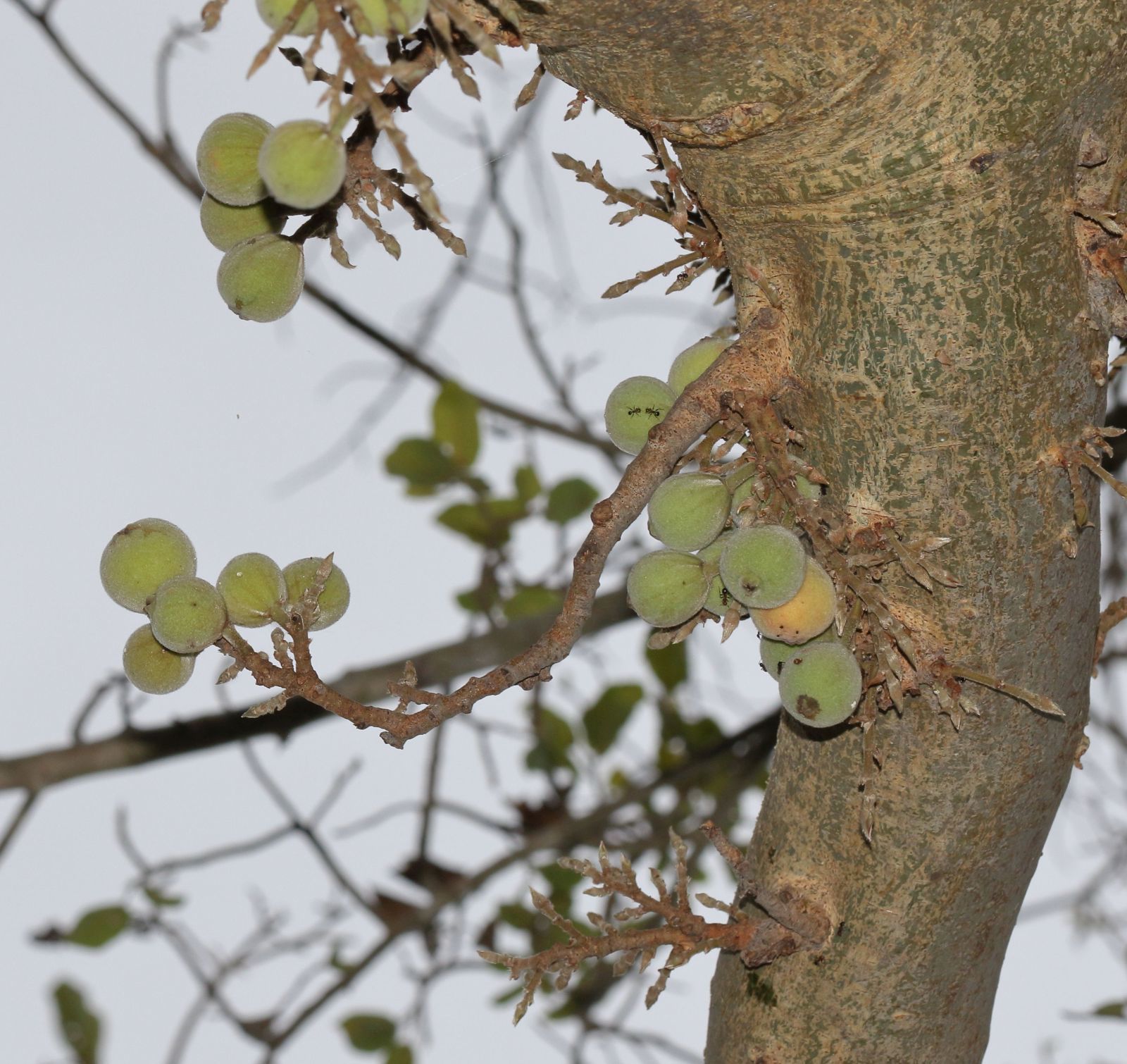
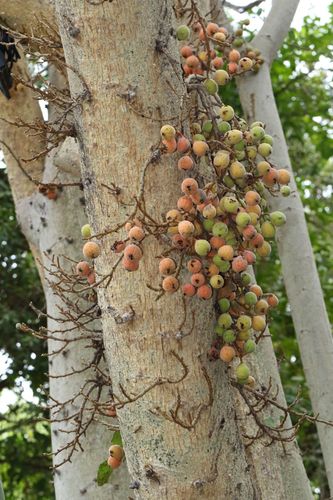
The figs grow in thick clusters directly on the trunk and large branches, rather than in leaf axils as in common fig. This is a striking feature among cultivated figs. They measure 2–3 cm (0.8–1.2 in) across, sometimes more, and turn from green to yellow or red as they ripen. 4 5
Useful taxonomy
Linnaeus described the species as Ficus sycomorus L. in 1753. Older treatments also used the genus name Sycomorus. Botanical synonyms and one former subspecies include:
- Sycomorus antiquorum Gasp.
- Ficus gnaphalocarpa (Miq.) Steud. ex Miq.
- Ficus cocculifolia Baker
- Ficus chanas Forssk.
- Ficus damarensis Engl.
The subspecies Ficus sycomorus subsp. gnaphalocarpa (Miq.) C.C.Berg, with larger, downy figs, was long treated as a separate species before being placed in synonymy. The accepted scientific name remains Ficus sycomorus, including in the French national inventory. 1 2 9
Habitat and range
Its native range covers sub-Saharan Africa, from Senegal to Ethiopia and south into southern Africa, with natural populations in the Arabian Peninsula and Madagascar. The tree grows in wooded savanna and gallery forest, often beside streams, in rich soil with a high water table. 4 1
Cultivation in Egypt and the Levant is so ancient that it is sometimes confused with native occurrence. These populations instead represent very early introduction. Notably, the pollinating wasp is absent from the Nile Valley, yet this has never prevented widespread cultivation. 8 5
The IUCN Red List classifies Ficus sycomorus as Least Concern, with no threat identified across its range as a whole. 3
Life cycle and reproduction
Fig reproduction depends on an obligate mutualism with a specialized pollinating wasp. In Ficus sycomorus, Ceratosolen arabicus enters the closed fig to pollinate the flowers inside. 8
In Egypt, where this wasp is absent, the tree nevertheless produces abundant fruit. Ancient Egyptians maintained it through cuttings of large branches, rather than seeds, a method still used to propagate the species. 4 5
Fruiting is almost continuous through the year; reported regional patterns include a July–December peak and sometimes five successive crops on one tree. Ancient Egyptians cut immature figs to hasten ripening, a practice also mentioned in the Hebrew Bible. 5
Sowing is possible, but germination is slow and erratic, succeeding reliably only at around 20 °C (68 °F). In cultivation, sections 5–15 cm (2–6 in) in diameter, dried for a few days before planting, give more reliable propagation than seed. 4
Uses and risks
In ancient Egypt, sycamore wood was used chiefly for sarcophagi and coffins. This funerary and religious role accompanied reverence for the tree as a tree of life associated with Hathor, Isis and Nut. 5
The ripe fruit is edible, eaten fresh, dried or fermented. Leaves feed livestock, and latex is traditionally used to curdle milk. African traditional medicine uses the bark, leaves and latex for digestive and inflammatory complaints. 4
The main risk comes from the latex, rich in ficin and the photosensitizing substance psoralen. Skin contact followed by sunlight can cause phytophotodermatitis, with redness, burns and blisters. Avoid latex contact in people and animals; the cited ASPCA entry concerns another Ficus species and does not establish these effects for each animal species. 6
Varieties, look-alikes and related plants
Two long-established Egyptian forms are Roumi, with horizontal branches and large pink fruit, and Kelabi, with more upright growth and small, yellowish, pear-shaped fruit. These are selections maintained through centuries of cuttings, rather than separate species. 5
The most frequent confusion involves the name itself: in France, sycamore usually means sycamore maple (Acer pseudoplatanus), an entirely different temperate tree. Other less frequent look-alikes include:
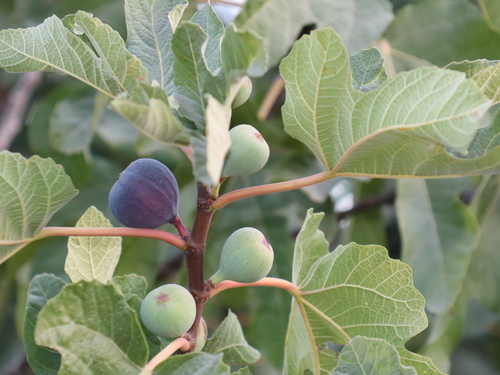
- Ficus carica, common fig, whose figs grow in leaf axils rather than on the trunk;
- Ficus vallis-choudae, another African fig with fruit clustered on old wood;
- ornamental Ficus species that share white latex but lack this large-tree habit and trunk-borne fruiting.
The massive crown, bark peeling in strips and figs clustered directly on the trunk are the most reliable features for recognizing Ficus sycomorus. 4 1
Main sources
- Plants of the World Online / Kew, Ficus sycomorus L.
- GBIF Backbone Taxonomy, Ficus sycomorus L.
- IUCN Red List, Ficus sycomorus assessment
- Useful Tropical Plants Database, Ficus sycomorus
- Encyclopaedia Britannica, sycamore fig
- ASPCA, weeping fig / Ficus toxicity entry
- Perseus Digital Library / Tufts, entry sykomorea
- Susoy et al. 2016, Science Advances, fig nematodes and their pollinator wasp Ceratosolen arabicus
- INPN / MNHN, Ficus sycomorus L., 1753 (cd_nom 807349)
Frequently asked questions
Is sycamore fig the same as the sycamore grown in France?
No. The familiar sycamore in France is sycamore maple (Acer pseudoplatanus), a temperate tree in the Sapindaceae family. Sycamore fig (Ficus sycomorus) belongs to Moraceae and grows in tropical Africa; the common name is their only connection.
Is sycamore fig toxic?
Its latex contains ficin and the photosensitizing substance psoralen. Skin contact followed by sunlight can cause phytophotodermatitis. Avoid latex contact in people and animals; the cited ASPCA entry concerns another Ficus species. The ripe fruit is edible.
Why do the figs grow directly on the trunk?
This is cauliflory. Clusters on old wood make fruit accessible to bats, monkeys and other large animals, rather than placing it at the ends of twigs too thin to support them.
How was sycamore fig used in ancient Egypt?
Its wood was used for sarcophagi and coffins. It was revered as a tree of life associated with Hathor, Isis and Nut. Ancient Egyptians also cut immature figs to hasten ripening.
Can sycamore fig grow outdoors in mainland France?
No, it cannot tolerate frost. Long-term cultivation there requires a heated greenhouse, while tropical French overseas territories offer suitable outdoor climates. Elsewhere, outdoor cultivation likewise depends on frost-free conditions.
How does sycamore fig reproduce without its pollinating wasp in Egypt?
Ceratosolen arabicus, a pollinating wasp of the species, is absent from the Nile Valley. Egyptians maintained the tree by taking cuttings of large branches rather than sowing seeds, a practice still used today.
Where is sycamore fig native?
Its native range covers sub-Saharan Africa from Senegal to Ethiopia and southern Africa, with populations in the Arabian Peninsula and Madagascar. Cultivation in Egypt and the Levant dates to antiquity but represents early introduction rather than the native range.
Similar plants
If you are unsure about a plant’s toxicity, ask a botanist or veterinarian for advice.