
Persian cyclamen (Cyclamen persicum, )
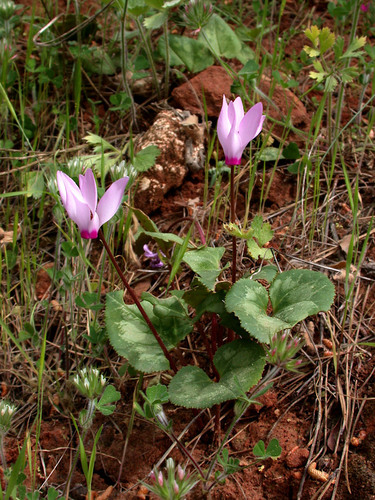
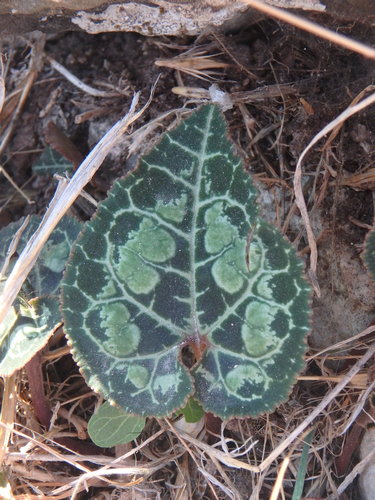
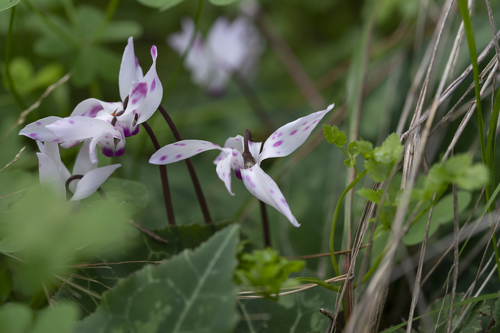
The Persian cyclamen (Cyclamen persicum) is a tuberous perennial in the primrose family, Primulaceae, native to rocky hillsides and open woodland in the eastern Mediterranean. Grown in pots, it blooms in winter, holding its flowers with swept-back petals above heart-shaped, marbled leaves; the tuber, rich in saponins, is the most toxic part of the plant.
Read moreFlorist's cyclamen and Cyclamen
Global distribution
The native range of Cyclamen persicum runs from North Africa (Algeria, Tunisia) to southern Turkey and the Levant, taking in several Greek islands where the species may have been introduced long ago. The epithet persicum, which evokes Persia, is misleading, since the plant does not grow wild there.
- Native6
- Introduced1
- Turkey
- Lebanon
- Syria
- Israel
- Algeria
- Tunisia
- Greece
Hexagons: sourced regions. Green dots: native range. Statuses according to POWO (Kew).
Identity
The Persian cyclamen (Cyclamen persicum Mill., 1768) is a tuberous perennial in the genus Cyclamen, part of the primrose family, Primulaceae. Philip Miller described it in the 18th century, and breeding from this one species produced almost every florist's cyclamen sold in pots today. 1 2
Despite the name, the species does not come from Persia: the epithet persicum is an early mistake that simply stuck. The plant actually grows around the eastern Mediterranean, and its habit of flowering through winter in a cool room is what made it such a familiar winter pot plant. 3 4
Recognition
Look first at the heart-shaped leaves, dark green and marbled with silver, held on long stalks that rise straight from a rounded tuber sitting at the surface of the potting mix. Together they form a low rosette 10–30 cm (4–12 in) wide. 4 3
The flowers are unmistakable. Carried above the foliage, each has five petals swept back and twisted upward, which gives it a butterfly-like look. They measure 2–5 cm (0.75–2 in) across and range from white through pink, red and purple, often with a darker blotch at the throat. 3 5
One detail helps confirm the species: after flowering, the flower stalk coils into a spiral and pulls the seed capsule down toward the soil. That behavior, together with winter bloom followed by summer dormancy, sets cyclamen apart from most houseplants. 2 4
Useful taxonomy
Miller published the name Cyclamen persicum Mill. in 1768, and it remains the accepted name. The genus Cyclamen now sits in Primulaceae, after long being placed in Myrsinaceae or in a family of its own. Several infraspecific names and historical synonyms are still in circulation:
- Cyclamen persicum var. persicum
- Cyclamen persicum var. autumnale Grey-Wilson
- Cyclamen persicum f. albidum (Jord.) Grey-Wilson
- Cyclamen vernale (Mill.) Martyn
- Cyclamen giganteum W.Bull
The accepted scientific name, Cyclamen persicum, is the reliable anchor, because series names such as Halios or Miracle label commercial selections, not distinct botanical taxa. 1 3
Habitat and range
Wild plants grow on rocky hillsides, in garrigue and in open woodland across the eastern Mediterranean, from southern Turkey to the Levant, up to about 1,200 m (3,900 ft). The species also occurs in North Africa and on several Greek islands, where it may have been introduced long ago. 4 2
Its home climate is Mediterranean: cool rains in fall and winter, then a hot, dry summer. That rhythm explains the plant's reversed calendar, growing and flowering in the cool season and letting the tuber go dormant through summer. 1 6
Beyond that range, Persian cyclamen is mainly a cultivated plant. It is frost-tender and only lives outdoors year-round in mild, frost-free climates (USDA zones 9 to 11); where winters bring frost, it is grown in a pot and spends the cold months indoors. 3 4
Life cycle and reproduction
Mediterranean seasons set the pace. Leaves and flowers appear in fall and winter, and in the Northern Hemisphere flowering often runs from November to March. Once pollinated, each flower forms a capsule, and its stalk coils to set it down beside the tuber. 4 2
Then comes summer dormancy: the foliage yellows and dies back, and the tuber carries on alone, dry, until the next rains. This rest is not a sign of death but a normal stage, one that buyers often mistake for a plant in decline. 6 5
Growers propagate it mostly from seed, sown fresh in darkness and kept cool; germination is slow and uneven. Division of a large tuber is possible but tricky: every piece needs at least one bud, and the cuts heal poorly, which easily lets rot in. Seedlings usually flower from their second year, once the tuber has grown large enough. 5 3
Uses and risks
Cyclamen persicum is grown mainly as an ornamental, as a winter-flowering pot plant or, in mild climates, in a cool, sheltered rock garden. Long, colorful bloom in the depths of the cold season explains its appeal for florists and garden centers. 3 4
The plant is, however, toxic. It contains terpenoid saponins (cyclamin), far more concentrated in the tuber than in the leaves and flowers. The ASPCA lists cyclamen as toxic to cats, dogs and horses: a small amount causes drooling, vomiting and diarrhea, while eating a large amount of tuber can lead to heart rhythm problems, seizures and even death. Keep the plant out of reach of pets and young children. 7 6
Varieties, look-alikes and related plants
The many series on sale are not separate species. Halios, Miracle, Laser and Sierra are horticultural lines selected for flower size, color range or earliness; Victoria is grown for ruffled, two-tone flowers, and Concerto for its fragrance. Before buying, check that the tuber is sound, the foliage firm and the base of the stems free of mold. 3
The most frequent mix-ups involve:
- Cyclamen hederifolium, ivy-leaved cyclamen, hardy and fall-flowering
- Cyclamen coum, smaller, hardy and flowering in late winter
- Cyclamen purpurascens, an alpine species with evergreen foliage
Large flowers, broad marbled leaves and frost tenderness remain the best clues for telling Persian cyclamen apart from its hardy garden cousins. 4 1
Main sources
Frequently asked questions
Is Persian cyclamen toxic?
Yes. The whole plant contains saponins, and the tuber holds the highest concentration. The ASPCA lists cyclamen as toxic to cats, dogs and horses; a small amount causes drooling and digestive upset, while eating a lot of tuber can be serious.
Why is my cyclamen wilting and turning yellow?
Usually the air is too warm or the watering is off. Persian cyclamen wants a cool room, around 12–16 °C (54–61 °F), and moist potting mix watered from below. Warm, dry air pushes it into early dormancy.
Did my cyclamen die over the summer?
Not necessarily. After winter bloom, the tuber naturally goes dormant for the summer and drops its leaves. Cut watering back sharply and keep the pot somewhere cool; new leaves emerge toward the end of summer.
How do I water a cyclamen without it rotting?
Water from below by filling the saucer for about twenty minutes, then pour off the excess. Keep the crown and the top of the tuber dry, because standing water at the base of the stems causes rot.
How does it differ from garden cyclamens?
Hardy cyclamens such as Cyclamen hederifolium and Cyclamen coum have smaller flowers and leaves and withstand frost. Persian cyclamen is larger and frost-tender, so it is mostly grown as a potted houseplant.
Why is it called Persian cyclamen if it does not come from Persia?
The epithet persicum is a historical error. The species actually grows around the eastern Mediterranean, from southern Turkey to the Levant and into North Africa, but not in Iran.
Will Persian cyclamen bloom again next year?
Yes, provided the tuber can rest through summer and restart somewhere cool in fall. Many plants are thrown away after flowering, but a well-managed tuber reblooms every winter for several years.
Similar plants




Botanical data compiled from reference sources (RHS, Kew Gardens, POWO). This profile is for guidance only and is not a substitute for advice from a botanist or veterinarian if you have concerns about toxicity.