
King begonia (Begonia rex, )


King begonia (Begonia rex) is a rhizomatous perennial in the Begoniaceae family, native to the eastern Himalayas from southern Bhutan to northern Myanmar. Grown for its richly colored foliage rather than its small pink flowers, it is best known as a parent of the extensive Begonia Rex Cultorum horticultural group.
Read moreKing begonia, Rex begonia, Painted-leaf begonia, Fancy-leaf begonia and Fan plant



© photo
Wikimedia Commons · CC BY-SA or Public Domain
Wikipedia · CC BY-SA
Taken Jan 23, 2021 by andree lorandi (cc-by-sa)
Taken Dec 12, 2020 by Cardoso Milton (cc-by-sa)
Taken Sep 27, 2020 by janampa fernando (cc-by-sa)
Taken May 4, 2017 by Pierre Bonnet (cc-by-sa)
Taken Mar 27, 2020 by Rachel Towle (cc-by-sa)
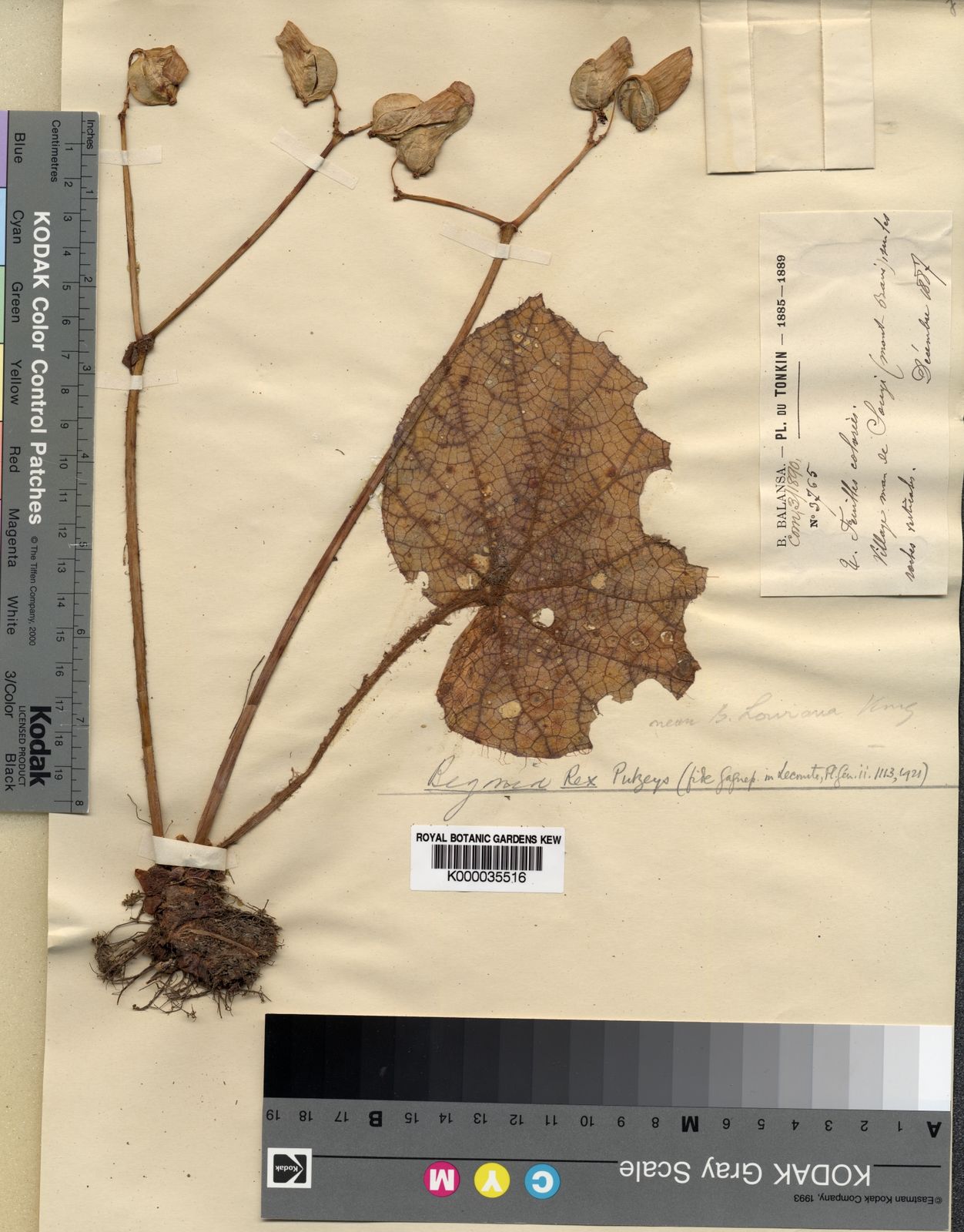
© copyright of the Board of Trustees of the Royal Botanic Gardens, Kew.




Global distribution
Begonia rex is native to the eastern Himalayas, from southern Bhutan to northern Myanmar, including Arunachal Pradesh, Assam and northeastern India. It grows in rocky forest valleys and slopes in a subtropical climate. Outside this range it is naturalized in Bangladesh, Cuba and Hispaniola (the Dominican Republic and Haiti), and locally on Réunion.
- Native4
- Introduced5
- Bhutan
- India (Assam)
- Myanmar
- Southern China
- Bangladesh
- Cuba
- Dominican Republic
- Haiti
- Réunion
Hexagons: regions where the plant occurs. Green dots: native range.1
Identity
King begonia (Begonia rex Putz. ex K.Koch) is a rhizomatous perennial in the Begoniaceae family. It is grown chiefly for richly colored leaves rather than its small pink flowers. The epithet rex means “king” in Latin, a meaning reflected directly in its English common name. 1 8
Discovery in Assam around 1850 preceded its introduction to England, where the plant was documented in 1857; the protologue appeared in the Journal général d’horticulture in 1858. An illustration of the type cultivar was prepared for the Flore des serres et des jardins de l’Europe as early as 1857. 9 8 7
Readily crossed with related begonias, Begonia rex soon became a foundation of a huge horticultural group. It appears in the parentage of more than 500 cultivars in the Begonia Rex Cultorum Group. Names such as rex begonia, painted-leaf begonia and fancy-leaf begonia are familiar in cultivation, but the wild species should be distinguished from nursery cultivars. 7 2
Recognition
A creeping rhizome produces the low clump typical of Begonia rex, without climbing stems or aerial roots. Plants commonly reach 30–45 cm (12–18 in) in height, with a similar spread. RHS gives an ultimate size of 0.1–0.5 m (4–20 in), reached in two to five years. 2 4
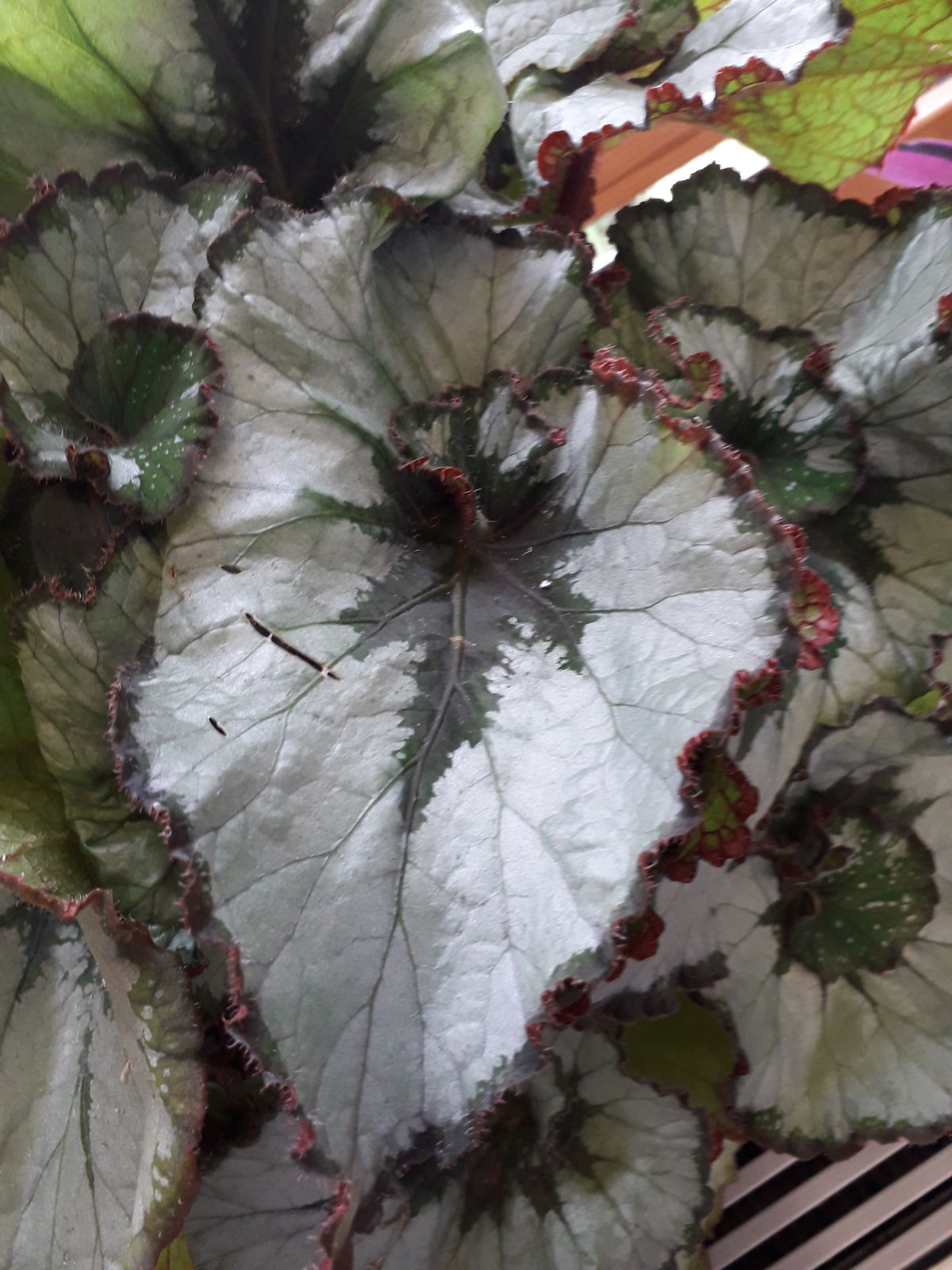
Large, asymmetrical leaves are the plant’s defining feature. They may reach 30 cm (12 in) long and 20 cm (8 in) wide. Bands of green and silver are often accented with pink, purple or red; the underside is frequently reddish, and the upper surface can have a metallic sheen. The striking pattern is more useful for recognition than the modest flowers. 4 5
Small pink flowers form loose clusters on upright stalks, mainly in winter. They remain secondary to the leaves in ornamental value. Descriptions of this begonia consistently emphasize foliage rather than flowering, which helps explain why plants are selected for leaf pattern, texture and color. 2 4
Useful taxonomy
Within Begoniaceae and the order Cucurbitales, Begonia rex Putz. ex K.Koch is the accepted name. The species belongs to section Platycentrum, reflected in the synonym Platycentrum rex. The epithet is attributed to the Belgian botanist Jules Putzeys (1809–1882). 11 8
Several synonyms appear in older references: 1
- Platycentrum rex (Putz. ex K.Koch) Seem., an older combination;
- Begonia amabilis Linden, a synonym;
- Begonia dominiana Veitch ex J.Dix, a synonym;
- Begonia marginata T.Moore, a synonym;
- Begonia picturata Hend. ex Bosse, a synonym;
- Begonia rex var. leopardina T.Moore, a name below species rank.
The main ambiguity is horticultural rather than a question of synonyms. Most plants sold as rex begonias are cultivars in the Rex Cultorum Group, bred through crosses involving Begonia rex and other Asian species. “Cultorum” refers to cultivation and signals this garden origin. The scientific name of the wild species remains the consistent botanical reference. 7 2
Habitat and range
Eastern Himalayan forests hold the native range of Begonia rex, extending from southern Bhutan to northern Myanmar through Arunachal Pradesh, Assam and northeastern India. A revision of northeastern Indian begonias confirms this region as a center of diversity for the group. The species occupies rocky forest valleys and slopes in a subtropical climate. Its rhizome is a storage organ at ground level, making it a rhizomatous geophyte. 1 10
Beyond that range, the species and especially its cultivars are grown as houseplants or greenhouse plants. King begonia is hardy only in USDA zones 10–11. RHS rates it H1B, indicating a plant that can spend summer outdoors but needs protected conditions in winter. Outdoor use therefore depends on local temperatures rather than a fixed calendar date. 4 2
Widespread cultivation should be separated from naturalization. Plants of the World Online records the species as naturalized in Bangladesh, Cuba, the Dominican Republic and Haiti, the last two sharing the island of Hispaniola. These established populations lie beyond its original range. 1 7
Local naturalization has also been reported on Réunion, a French overseas island. There, France’s Office national des forêts has classified the plant among invasive species. This is a local status and should not be read as a global designation for king begonia wherever it is cultivated. 8
Life cycle and reproduction
Leaf cuttings, rhizome division and seed are the main propagation methods in cultivation. A healthy leaf laid flat on moist growing medium can form new plantlets at cut veins, making the leaf cutting particularly characteristic of rex begonias. Dividing the rhizome during repotting also gives good results. 2 6
Slow growth means only light pruning is generally needed. Low winter light can bring a period of dormancy, during which some leaves fall. Reduce watering at this stage and keep the growing medium barely moist until spring growth resumes. The seasonal reduction in activity should guide watering rather than maintaining the summer routine. 6 4
Winter flowering is relatively inconspicuous. Because the leaves are the main attraction, many growers remove flower stalks to favor foliage growth. Flower production is therefore not always a useful measure of ornamental success in this plant. 8 2
Uses and risks
Decorative foliage is the sole main use of king begonia. It needs bright indirect light, humidity above 50%, a light, well-drained and slightly acidic growing medium, and temperatures around 21 °C (70 °F) by day and 16 °C (61 °F) at night. Growth slows below 15 °C (59 °F). Allow the top 1 cm (about 0.5 in) of growing medium to dry between measured waterings; persistently wet roots risk rot. 6 4
ASPCA lists rex begonia as toxic to cats, dogs and horses. Soluble calcium oxalates cause signs ranging from salivation and vomiting to kidney failure in grazing animals. The underground parts are the most toxic. Sap can also cause contact dermatitis, so gloves are useful during pruning. 3 5
Powdery mildew, botrytis and mealybugs are among the main growing problems. Wet foliage favors fungal disease. Good ventilation, removal of dead leaves and avoiding direct misting help reduce these problems while keeping the plant’s humid-air requirements distinct from wet leaves or waterlogged roots. 4 6
Varieties, look-alikes and related plants
Hundreds of foliage selections make up the Rex Cultorum Group. Alongside Begonia rex, its breeding history involves other rhizomatous begonias such as Begonia annulata, B. cathayana, B. decora, B. diadema, B. dregei and B. grandis. This ancestry explains the broad variety of leaf patterns within the group. 7
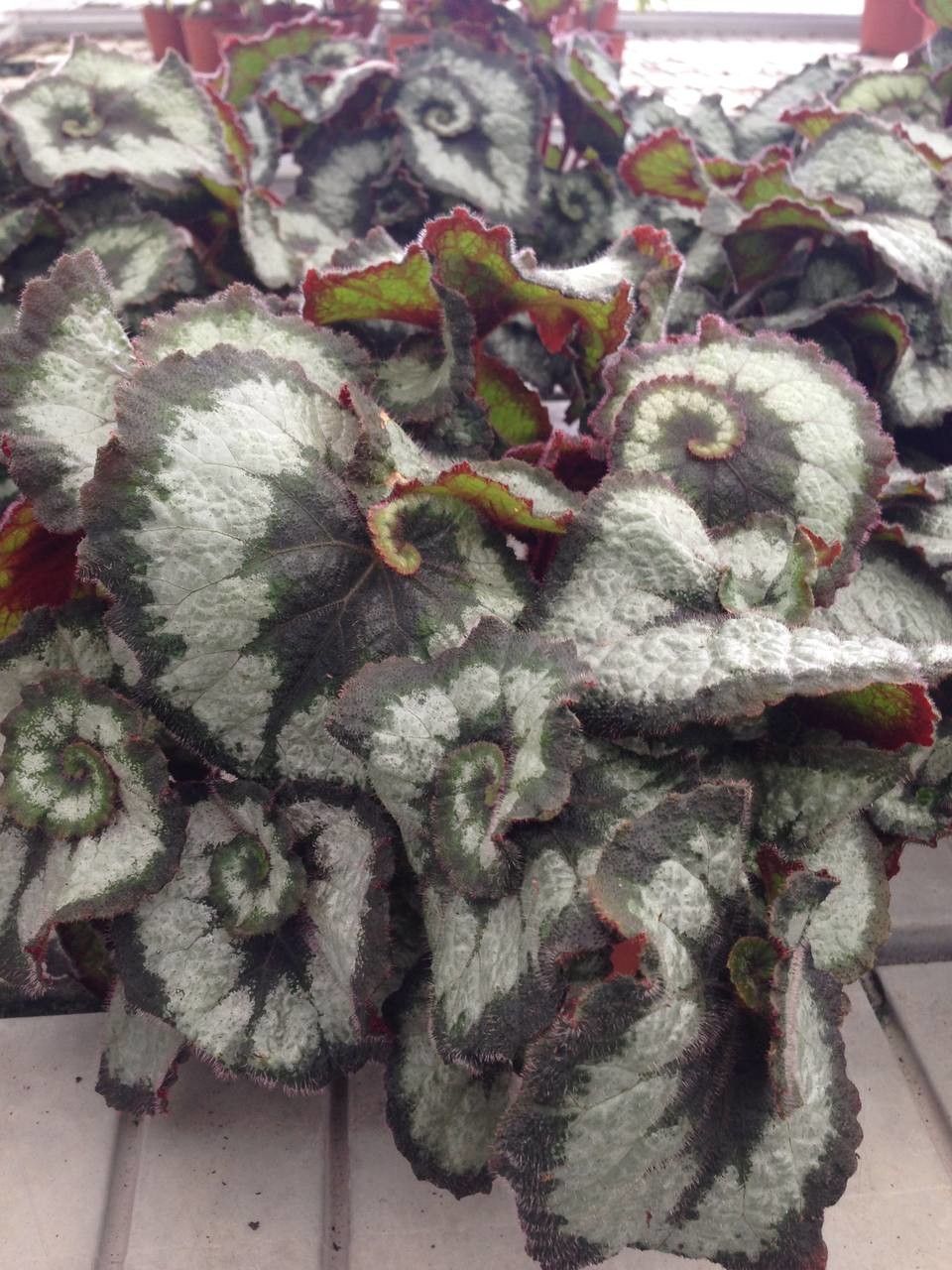
Frequently cited cultivars include 'Escargot', with spiraled silver and dark green leaves, and 'Comtesse Louise Erdody', an old selection with curled foliage. 'Silver Cloud' and 'Inca Fire' are other familiar names. These identify horticultural selections, rather than separate species or botanical varieties. 2 8
Other patterned-leaf rhizomatous begonias account for most identification difficulties, especially when a nursery plant’s exact cultivar is uncertain. Look for the low clump arising from a rhizome, absence of climbing stems, green-and-silver patterning and reddish leaf undersides. A decorative leaf alone cannot reliably identify a particular cultivar. 5 4
Main sources
- Plants of the World Online / Kew, Begonia rex Putz. ex K.Koch
- Royal Horticultural Society, Begonia rex - king begonia
- ASPCA, Rex Begonia toxicity entry
- Missouri Botanical Garden Plant Finder, Begonia rex-cultorum
- NC State Extension, Begonia - Rex Types (Painted Leaf Begonia)
- University of Connecticut Home & Garden Education Center, Rex Begonia
- Wikipedia (EN), Begonia rex
- Wikipedia (FR), Begonia rex
- American Begonia Society, Begonia rex Putzeys
- Camfield & Hughes (2018), A revision of Begonia in Northeast India, European Journal of Taxonomy 396
- International Plant Names Index, Begonia rex Putz. ex K.Koch
Frequently asked questions
Is king begonia toxic?
Yes. ASPCA lists rex begonia as toxic to cats, dogs and horses because it contains soluble calcium oxalates. Signs include salivation and vomiting, with possible kidney failure in grazing animals. Underground parts are the most toxic.
Why does my king begonia lose leaves in winter?
In low winter light, Begonia rex may become dormant and shed leaves. This is often normal. Reduce watering, keep the growing medium barely moist and wait for growth to resume in spring.
How much light does king begonia need?
Bright, indirect light, such as near an east-facing window, is suitable. Hot direct sun fades and scorches the leaves. A few hours of gentle morning sun can be tolerated.
Is Begonia rex a species or a hybrid?
Begonia rex is a wild species from the eastern Himalayas, described in 1857. The Rex Cultorum Group includes hundreds of cultivars bred from crosses involving it. These are horticultural plants rather than the wild species.
How can I prevent brown leaf tips?
Brown tips and edges often indicate air that is too dry. Increase humidity with a tray of damp clay pebbles rather than misting, which encourages powdery mildew.
Can I propagate king begonia from a leaf?
Yes. Leaf cuttings are a standard method: a healthy leaf laid on moist growing medium can produce new plantlets. The rhizome can also be divided when repotting.
Similar plants
If you are unsure about a plant’s toxicity, ask a botanist or veterinarian for advice.