
Dragon blood tree (Dracaena cinnabari, )
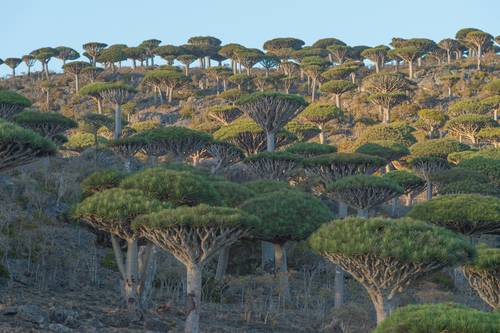


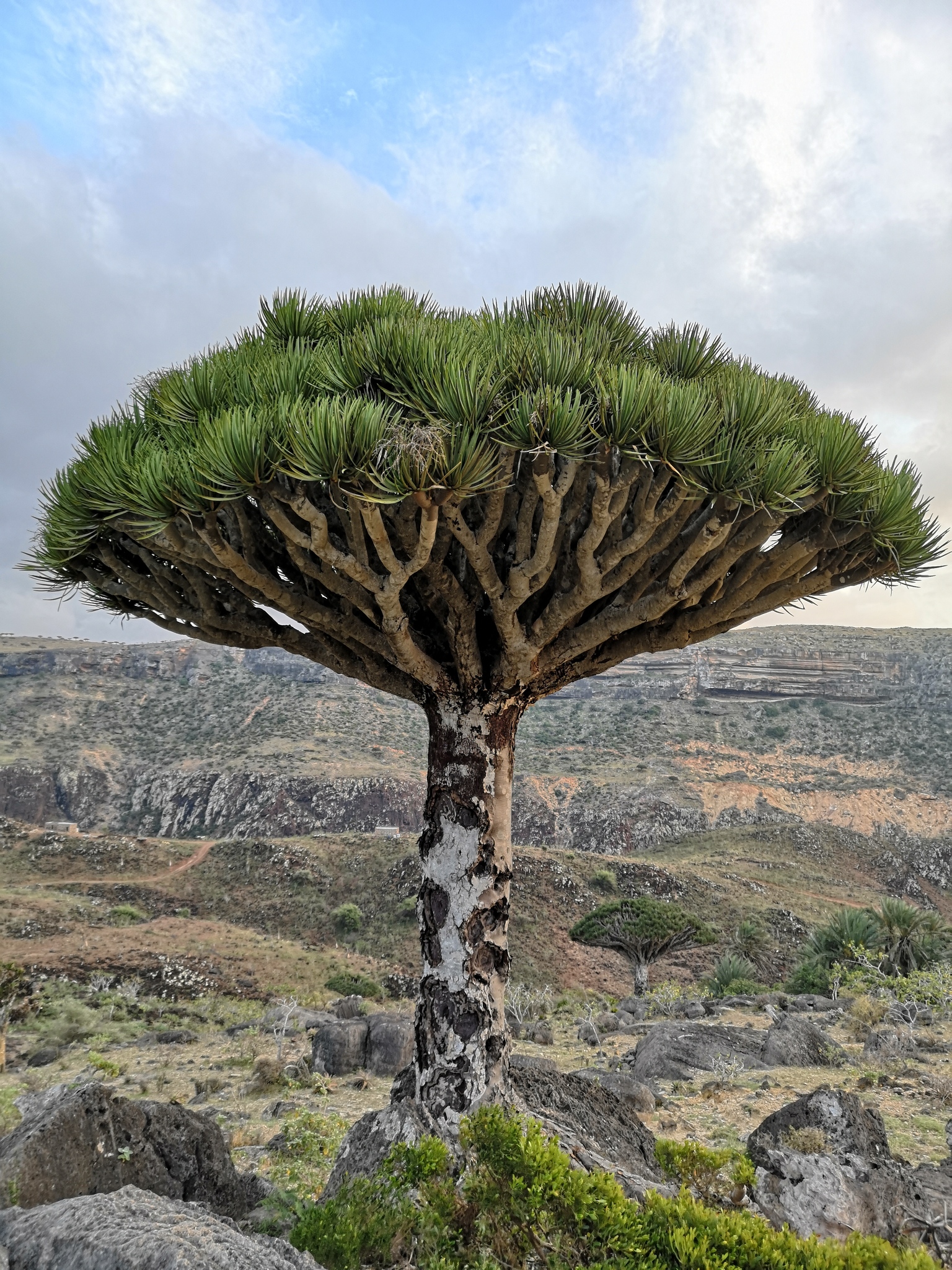
Dragon blood tree (Dracaena cinnabari) is a monocotyledonous tree in the Asparagaceae, endemic to Yemen’s Socotra archipelago in the Arabian Sea. Its distinctive inverted umbrella crown develops through repeated dichotomous branching after flowering. Wounded bark releases a red resin called dragon’s blood, harvested since antiquity.
Read moreDragon blood tree, Socotra dragontree and Socotra dragon tree
Place in full sun, with intense direct light all day long.



© photo
Morten Ross · cc-by
(c) julianjvr, some rights reserved (CC BY-NC) · cc-by-nc
Manuel Schwarz · cc-by-nc
© copyright of the Board of Trustees of the Royal Botanic Gardens, Kew.


Global distribution
Dracaena cinnabari is strictly endemic to Yemen’s Socotra archipelago in the Arabian Sea. No native population is known elsewhere; records beyond this range concern cultivated botanical collections, never naturalized populations.
Identity
Dragon blood tree (Dracaena cinnabari Balf.f., 1882), also known as Socotra dragon tree or dragon’s blood tree, is a monocotyledonous member of Dracaena in the Asparagaceae. The epithet cinnabari refers to cinnabar, the vivid red mineral, evoking the resin that seeps from wounded bark. 1 5
Strictly endemic to Yemen’s Socotra archipelago in the Arabian Sea, it is also Yemen’s national tree. Its inverted umbrella crown, unusual among trees, develops through repeated dichotomous branching at each flowering cycle. 8
Recognition
Adult trees commonly reach 6–10 m (20–33 ft) high, with reports up to 12 m (39 ft), and a crown that can spread 12 m (39 ft) across. The thick trunk sometimes exceeds 1.5 m (4.9 ft) in diameter at human height in the oldest trees. 2 8
Narrow, stiff leaves reach 60 cm (24 in) long but only 3 cm (1.2 in) wide. They occur in dense rosettes at branch tips, never along the trunk. The canopy stays evergreen, with individual leaves replaced every three to four years. 8
Small, fragrant greenish-white flowers appear in terminal panicles, around early spring on Socotra. The fleshy berries that follow turn from green to black before ripening orange-red, each containing one to four seeds 4–5 mm (0.16–0.2 in) across. 2
Useful taxonomy
The accepted name is Dracaena cinnabari Balf.f., described by Scottish botanist Isaac Bayley Balfour in 1882 during his scientific work on Socotra. Lieutenant Wellsted had already recorded it in 1835, mistakenly placing it in Pterocarpus. The only recognized homotypic synonym is Draco cinnabari (Balf.f.) Kuntze. 1 8
Of the 60–100 species in Dracaena, only six have a tree-like habit, including Dracaena cinnabari. A chloroplast-genome study places it genetically closer to Dracaena serrulata, the other Arabian dragon tree, than to Canary Island dragon tree, Dracaena draco, despite the similar umbrella crowns of all three. 9 6
Habitat and range
Its native range is confined to the Socotra archipelago, Yemen. Trees occupy arid limestone plateaus and mountain slopes at 150–1,600 m (490–5,250 ft) above sea level, chiefly above 600 m (1,970 ft). Monsoon fog, locally called khareef, supplies moisture that offsets the archipelago’s low rainfall. 3 8
Populations are concentrated at a few key sites, including the Firmihin plateau. This occupies only about 2% of the species’ potential range but is thought to hold more than 40% of living trees, averaging close to 300 years old. 8
Outside Socotra, Dracaena cinnabari is known only in cultivation, in botanical gardens or private collections. No naturalized population has been documented elsewhere, distinguishing it from many widely introduced ornamental plants. 6
Life cycle and reproduction
Flowering varies with climate but generally occurs around early spring on Socotra, often after several decades of juvenile growth on a single, unbranched trunk. Each flowering exhausts the terminal bud, which then divides into two new shoots. Successive flowering cycles gradually build the umbrella crown. 2
Goat browsing is the main obstacle to renewal of wild populations. Seedlings and young shoots are eaten before they grow beyond the livestock’s reach, explaining the aging structure of many dragon-tree woodlands. 3
In horticulture, propagation is almost exclusively by seed. Germination takes a few weeks in a warm, freely draining medium, followed by extremely slow growth over decades. Adult trees consequently remain rare away from their native island. 2
Uses and risks
The trunk’s red resin, dragon’s blood, has been used since antiquity as a dye, varnish and traditional remedy for digestive complaints, fevers and wounds. Socotrans also use it to color wool, glue pottery and make traditional lipstick. 7 8
ASPCA lists Dracaena spp. as toxic to cats and dogs and identifies saponins as the toxic principle. Reported signs after ingestion include vomiting, sometimes blood-stained, excessive salivation and lethargy. The entry concerns Dracaena spp. without a separate assessment of Dracaena cinnabari. 4
IUCN has classified the species as Vulnerable since 2004. Goat overgrazing, progressive drying of the climate, unsustainable resin harvesting and violent cyclones, including one that uprooted several thousand trees in 2015, jointly threaten regeneration. 3
Varieties, look-alikes and related plants
Dracaena cinnabari has no established horticultural cultivar. Rare cultivated trees are wild-origin seedlings or ex situ conservation plants linked to particular Socotran populations rather than garden selections. A nursery description such as Firmihin origin identifies a source population, not a separate botanical status. 8
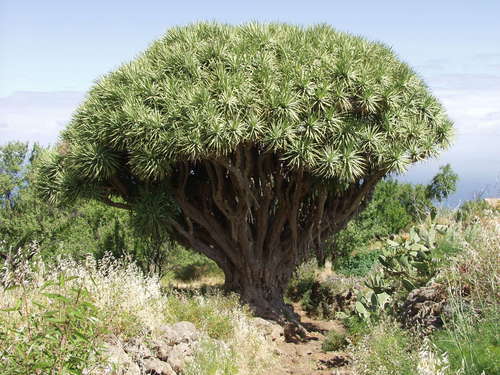
The main confusion is with Canary Island dragon tree, Dracaena draco (L.) L.: both have umbrella crowns, but a separation of more than 3,000 km (1,860 miles) prevents natural mixing between the populations. A recent genomic study instead links Dracaena cinnabari more closely to Dracaena serrulata Baker, a less conspicuous dragon tree from Oman and Saudi Arabia. The trade name dragon’s blood creates further confusion because it also denotes red resins from Daemonorops, a Southeast Asian rattan, and certain South American Croton, botanically unrelated to Dracaena. 9 7
Main sources
- Plants of the World Online / Kew, Dracaena cinnabari Balf.f.
- Royal Horticultural Society, Dracaena cinnabari - Dragon's blood tree
- IUCN Red List, Dracaena cinnabari assessment 2004
- ASPCA, Dracaena (Dragon Tree) toxicity entry
- Encyclopaedia Britannica, dragon tree
- GBIF, Dracaena cinnabari Balf.f. species record
- Gupta, Bleakley & Gupta 2008, Dragon's blood - botany, chemistry and therapeutic uses
- Sanjay Saraf 2023, Dragon's Blood Tree (Dracaena cinnabari) - A Cenozoic Relict, IntechOpen
- Complete chloroplast genome sequencing and comparative analysis of Dracaena serrulata and Dracaena cinnabari, PMC9537188
Frequently asked questions
Is Socotra dragontree the same as Canary Island dragon tree?
No. Dracaena cinnabari shares an umbrella crown with Dracaena draco, but they are distinct species in the same genus, separated by more than 3,000 km (1,860 miles). A genomic study even places Dracaena cinnabari closer to Dracaena serrulata, the other Arabian dragon tree, than to Dracaena draco.
Why does Socotra dragontree have an umbrella shape?
Its dense, flattened crown results from repeated dichotomous branching after each flowering. The canopy reduces evaporation from the soil surface and shelters seedlings beneath the adult tree, an advantage in an arid climate.
Does dragon’s blood always come from this species?
No. The trade name also covers red resins from botanically unrelated plants, including Daemonorops rattans in Southeast Asia and some South American Croton species.
Is Socotra dragontree toxic to pets?
ASPCA lists Dracaena spp. as toxic to cats and dogs and identifies saponins, with vomiting, excessive salivation and lethargy after ingestion. Its entry does not provide a separate assessment of Dracaena cinnabari.
Why is Socotra dragontree classified as vulnerable?
IUCN has assessed Dracaena cinnabari as vulnerable since 2004. Goat grazing prevents seedlings from establishing, drying conditions reduce suitable habitat, and violent cyclones, including the 2015 storm, uproot thousands of adult trees.
How long does Socotra dragontree live?
Trees in the Firmihin forest average about 300 years old, with some exceeding 500 years. Secondary thickening of the trunk, unusual in monocots, nevertheless makes precise age estimates difficult.
Can Socotra dragontree be grown away from Socotra?
Yes, but it is rare and slow-growing in cultivation. In temperate climates it needs a frost-free greenhouse or conservatory, full sun and very freely draining soil. Its adult umbrella form takes several decades to develop.
Similar plants
If you are unsure about a plant’s toxicity, ask a botanist or veterinarian for advice.