
Japanese climbing-hydrangea (Hydrangea anomala, )
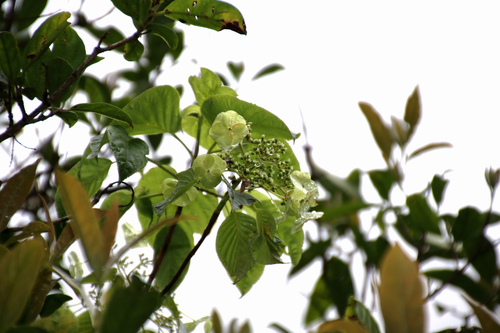

Japanese climbing-hydrangea (Hydrangea anomala D.Don) is a woody member of the Hydrangeaceae family from the Himalayas, China, Myanmar and Taiwan. It climbs by aerial roots and bears opposite, toothed leaves and white lacecap flower heads. In horticulture, the name often also covers the related Hydrangea petiolaris, long sold as H. anomala subsp. petiolaris.
Read moreJapanese climbing-hydrangea and climbing hydrangea
Place in indirect light or in a shaded room.
Partial or light shade; gentle sun if soil stays moist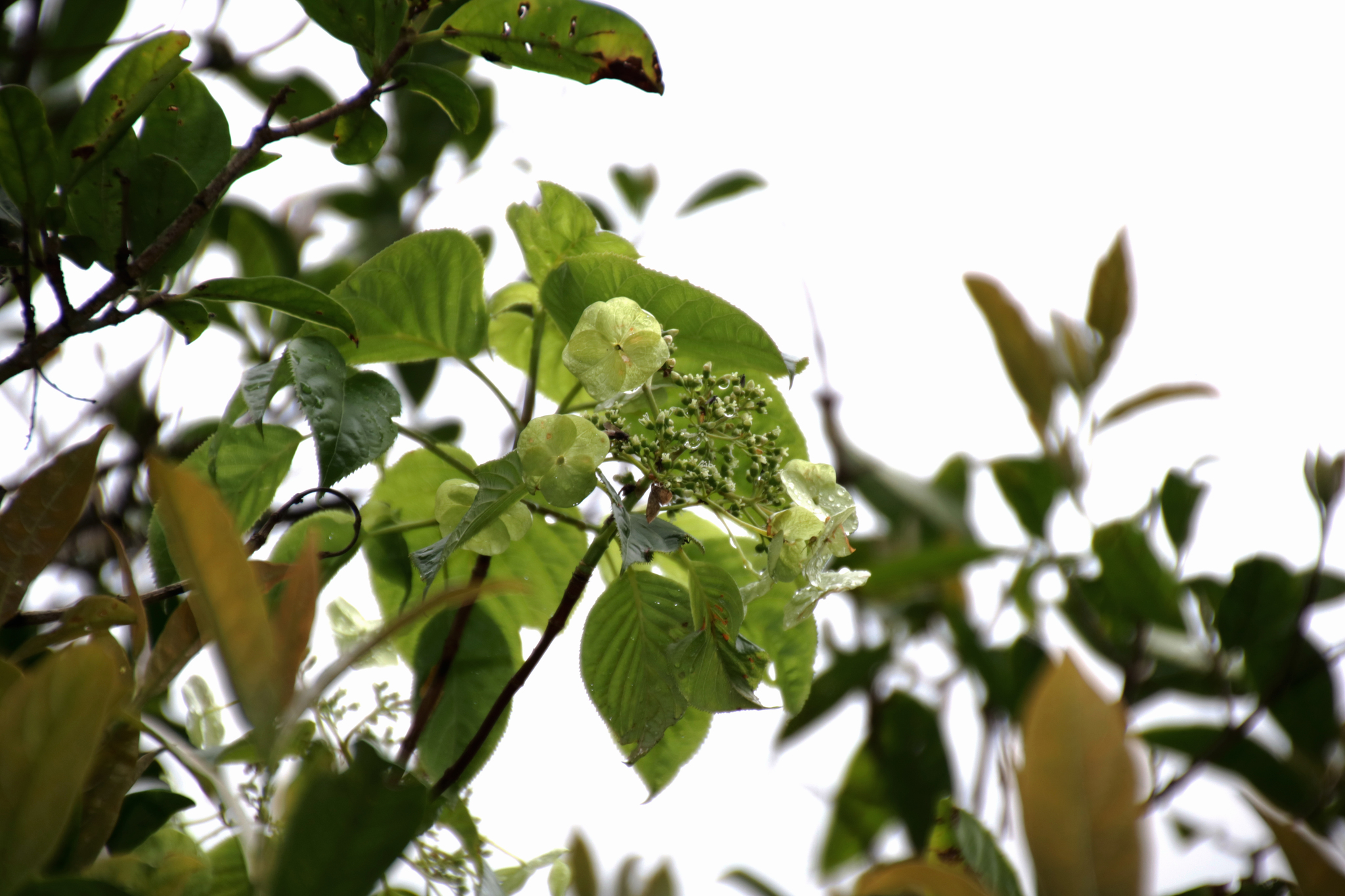


© photo
(c) 方伊琳(阿鈣), some rights reserved (CC BY-NC), uploaded by 方伊琳(阿鈣) · cc-by-nc
Wikimedia Commons · CC BY-SA or Public Domain
Wikipedia · CC BY-SA
© copyright of the Board of Trustees of the Royal Botanic Gardens, Kew.


Global distribution
POWO/Kew recognizes a native range for Hydrangea anomala from the Himalayas to central and southern China, Myanmar and Taiwan. European horticultural references often use climbing hydrangea for the petiolaris group, treated separately by POWO as Hydrangea petiolaris but still listed by the RHS as H. anomala subsp. petiolaris.
- Native7
- Eastern Himalayas
- Western Himalayas
- Nepal
- Assam
- Myanmar
- Central and southern China
- Taiwan
Hexagons: regions where the plant occurs. Green dots: native range.1
Identity
Japanese climbing-hydrangea (Hydrangea anomala D.Don, 1825) is an accepted species of Hydrangea in the Hydrangeaceae family. Kew's Plants of the World Online links the name to David Don's Prodromus Florae Nepalensis, published in 1825, and describes a climbing shrub or liana of the temperate biome. 1
The broader name climbing hydrangea needs some care when buying a plant. It can mean Hydrangea anomala in the strict sense or the closely related Hydrangea petiolaris, long treated or sold as H. anomala subsp. petiolaris. POWO now accepts H. petiolaris as a separate species, while the RHS retains a horticultural entry under H. anomala subsp. petiolaris. 2 4
The binomial Hydrangea anomala provides the clearest reference point, with related horticultural usage explained where it affects cultivation. Check the full label before choosing a plant: catalogs do not always use H. anomala, H. petiolaris and H. anomala subsp. petiolaris with the same precision. 3 6
Recognition
Aerial roots anchor this woody, deciduous climber, which can remain partly evergreen in some mild climates. The RHS gives Hydrangea anomala a potential height of 8–12 m (26–39 ft) in favorable conditions; Trees and Shrubs Online also describes a deciduous climber reaching around 12 m (39 ft). 3 9
Its green leaves are opposite, simple and toothed, ranging from ovate to elliptic or oblong-ovate, with conspicuous leaf stalks. Botanical descriptions of H. anomala in the strict sense commonly give leaf blades 6–17 cm (2.4–6.7 in) long and 3–10 cm (1.2–4 in) wide. Accounts of the petiolaris group often describe glossy, heart-shaped leaves instead. 9 6
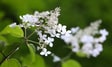
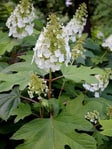
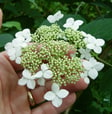
White or cream flowers form lacecap corymbs: small fertile flowers occupy the center, surrounded by larger, showier sterile flowers. The RHS describes broad, loose clusters in early summer for H. anomala. Horticultural references give the petiolaris group flat flower heads up to about 20 cm (8 in) across, sometimes larger depending on the taxon and growing conditions. 3 4 5
Older stems become brown to reddish brown and develop peeling bark. That bark adds winter interest and helps reveal the plant's age: a young container-grown specimen may look like little more than a leafy stem for a long time before developing the structure of an established climber. 5 8
Useful taxonomy
For botanical identification, retain the full name Hydrangea anomala D.Don. POWO lists Hydrangea altissima, H. glabra, H. glaucophylla and several infraspecific names among its synonyms. Such names may still appear in botanical literature or collections; without further context, they do not identify separate, commonly grown garden plants. 1
The important distinction is between anomala and petiolaris. POWO recognizes Hydrangea petiolaris Siebold & Zucc. as an accepted species. The RHS and several gardening references still use Hydrangea anomala subsp. petiolaris for the familiar climber grown against shaded walls. These are different taxonomic and horticultural treatments, rather than conflicting care instructions. 2 4 6
Both plants look similar enough to be confused in catalogs. Trees and Shrubs Online discusses H. anomala in comparison with H. petiolaris: stamen number, corymb size and geographic range provide more reliable distinctions than the overall appearance alone. 9
Habitat and range
Across Asia, the native range recognized by POWO runs from the Himalayas to central and southern China, Myanmar and Taiwan. Its detailed distribution includes Assam, the eastern and western Himalayas, Nepal, Tibet, several Chinese regions, Myanmar and Taiwan. 1
Botanical accounts place the species in valley forests, beside streams and on rocky mountain slopes, at roughly 500–2,900 m (1,640–9,500 ft) in the Flora of China material cited by Trees and Shrubs Online. In gardens, that habitat points to moisture-retentive soil, organic matter, drainage and shelter from drying winds, rather than harsh, exposed sun. 9 3
The petiolaris group has a different native range in current references. The RHS lists Japan and South Korea for its H. anomala subsp. petiolaris entry, while NC State's broader horticultural account lists Japan, Sakhalin, Korea, Taiwan and Himalayan or Chinese areas. Those accounts describe neighboring taxonomic or horticultural concepts and should not be combined into a single range. 4 6
Cultivation and training
Patience matters most during the first few years. Missouri Botanical Garden describes climbing hydrangea as slow to establish but vigorous afterward. NC State makes the same point for H. petiolaris, which may also take time to flower after transplanting. 5 6
Provide a strong support before the stems attach themselves. Although the plant climbs by aerial roots or rootlike holdfasts, it often needs guidance at first. A sound wall, mature trunk, sturdy fence or durable trellis can work; gutters, crumbling mortar, fragile siding and young trees are poor choices. 3 5
Keep the soil moist, fertile and well drained. The RHS recommends moisture-retentive soil rich in organic matter for H. anomala, with protection from cold, drying winds. It also accepts sun for the petiolaris group where moisture is reliable. Otherwise, partial or light shade is the safer choice. 3 4
In a dry climate or a container, 10–20 mm (0.4–0.8 in) per week during dry weather provides a watering reference: less when the soil stays moist, more in a freely draining container or during a heat wave. Leaf mold or compost mulch helps retain moisture without leaving the roots waterlogged. 3 5
Prune after flowering, mainly to control the plant's size. The RHS places the petiolaris group in an after-flowering pruning group and gives similar guidance for H. anomala. Hard or late pruning can reduce the following year's flowers, so small annual corrections are preferable to cutting back an overgrown plant all at once. 3 4
Uses and risks
Shaded walls, cool facades, mature tree trunks, urban courtyards, banks and large supported containers are its main ornamental settings. White flower heads brighten partial shade, and older stems remain attractive for their peeling bark. The RHS also notes pollinator value for the petiolaris group. 4 5
No food or medicinal use is recommended. Trees and Shrubs Online records traditional uses of H. anomala in parts of Asia, but these ethnobotanical reports do not establish safe household use: the taxon, plant part, preparation and dose cannot simply be transferred to a family garden. 9
The toxicity risk calls for clear, proportionate advice. The ASPCA's Hydrangea entry names Hydrangea arborescens and lists it as toxic to dogs, cats and horses, with cyanogenic glycosides and mainly digestive signs: vomiting, depression and diarrhea. That species entry is distinct from Merck Veterinary Manual's account of Hydrangea species, which supports caution with other hydrangeas and notes that severe poisoning in small animals is rare unless substantial amounts are eaten. 10 11
In its human-toxicity section, NC State's genus page specifies that only H. macrophylla is known to be toxic before describing low severity, hydracyanosides and nausea, abdominal pain, vomiting and sweating especially after large quantities are eaten. This passage does not provide a human-toxicity assessment specific to H. anomala. As a precaution, avoid tasting the plant, keep it away from young children and animals that chew plants, and seek professional advice after a significant ingestion. 7
Varieties, look-alikes and related plants
Cultivars of H. anomala in the strict sense are less common than those of the petiolaris group. Trees and Shrubs Online describes 'Crûg Coral', whose sterile flowers open pinkish or coral, and 'Winter Glow' or 'Winter Surprise', associated with colored or partly evergreen winter foliage in mild climates. 9
Nursery names such as 'Miranda', 'Silver Lining' and other variegated selections often belong to the petiolaris group. They can be excellent garden plants, but the names identify horticultural cultivars of the taxon being sold, rather than wild forms of H. anomala in the strict sense. 4 6
The most familiar look-alike is Schizophragma hydrangeoides, often called Japanese hydrangea vine. It also climbs in shade and has large white bracts, but it is not a Hydrangea. Other useful comparisons include Hydrangea petiolaris, less hardy evergreen climbing hydrangeas and, from a distance, some viburnums with flat flower heads. 6 3
Main sources
- Plants of the World Online / Kew, Hydrangea anomala D.Don
- Plants of the World Online / Kew, Hydrangea petiolaris Siebold & Zucc.
- Royal Horticultural Society, Hydrangea anomala
- Royal Horticultural Society, Hydrangea anomala subsp. petiolaris
- Missouri Botanical Garden Plant Finder, Hydrangea anomala
- NC State Extension Gardener Plant Toolbox, Hydrangea petiolaris
- NC State Extension Gardener Plant Toolbox, Hydrangea
- Oregon State University Landscape Plants, Hydrangea anomala var. petiolaris
- Trees and Shrubs Online, Hydrangea anomala D.Don
- ASPCA, Hydrangea toxicity entry
- Merck Veterinary Manual, cyanogenic glycoside plants including Hydrangea spp.
- GBIF Backbone Taxonomy, Hydrangea anomala D.Don
Frequently asked questions
Is Hydrangea anomala the same as Hydrangea petiolaris?
Not in POWO's current treatment: H. anomala and H. petiolaris are two accepted species. In horticulture, H. petiolaris was long known as H. anomala subsp. petiolaris, which explains the confusion.
Will Japanese climbing-hydrangea damage a wall?
It attaches by aerial roots. On a sound wall, its weight is the main management issue; on crumbling mortar, cracks, siding or gutters, it can worsen existing defects and needs pruning.
Why is my Hydrangea anomala not flowering?
The plant takes time to establish. Dense shade, summer drought or late pruning can also reduce or prevent flowering.
Can I plant it in full sun?
Only if the soil stays reliably moist. The RHS accepts sun for climbing hydrangeas where moisture is dependable, but partial shade is easier to manage in hot or dry gardens.
Is it toxic to cats and dogs?
Treat it as toxic as a precaution. The ASPCA's Hydrangea entry names H. arborescens, listed as toxic to dogs, cats and horses. Merck covers the genus Hydrangea among cyanogenic plants, with mainly digestive signs after small exposures; that genus-level account supports caution with H. anomala.
Is it invasive in France?
No invasive designation is retained for metropolitan France. Outside its Asian range it is treated as a cultivated plant, with normal monitoring for suckers and any seedlings. That French assessment does not establish its status elsewhere.
Similar plants
If you are unsure about a plant’s toxicity, ask a botanist or veterinarian for advice.