
smooth hydrangea (Hydrangea arborescens, )
smooth hydrangea (Hydrangea arborescens L.) is a deciduous shrub in the Hydrangeaceae family, native to the north-central and eastern United States. It differs from bigleaf hydrangeas by flowering on the current season's wood, with white or pinkish corymbs, good cold hardiness and well-known cultivars such as 'Annabelle'.
Read moresmooth hydrangea, wild hydrangea, sevenbark and hills of snow
Place in indirect light or in a shaded room.
Partial shade; gentle sun if soil stays moist


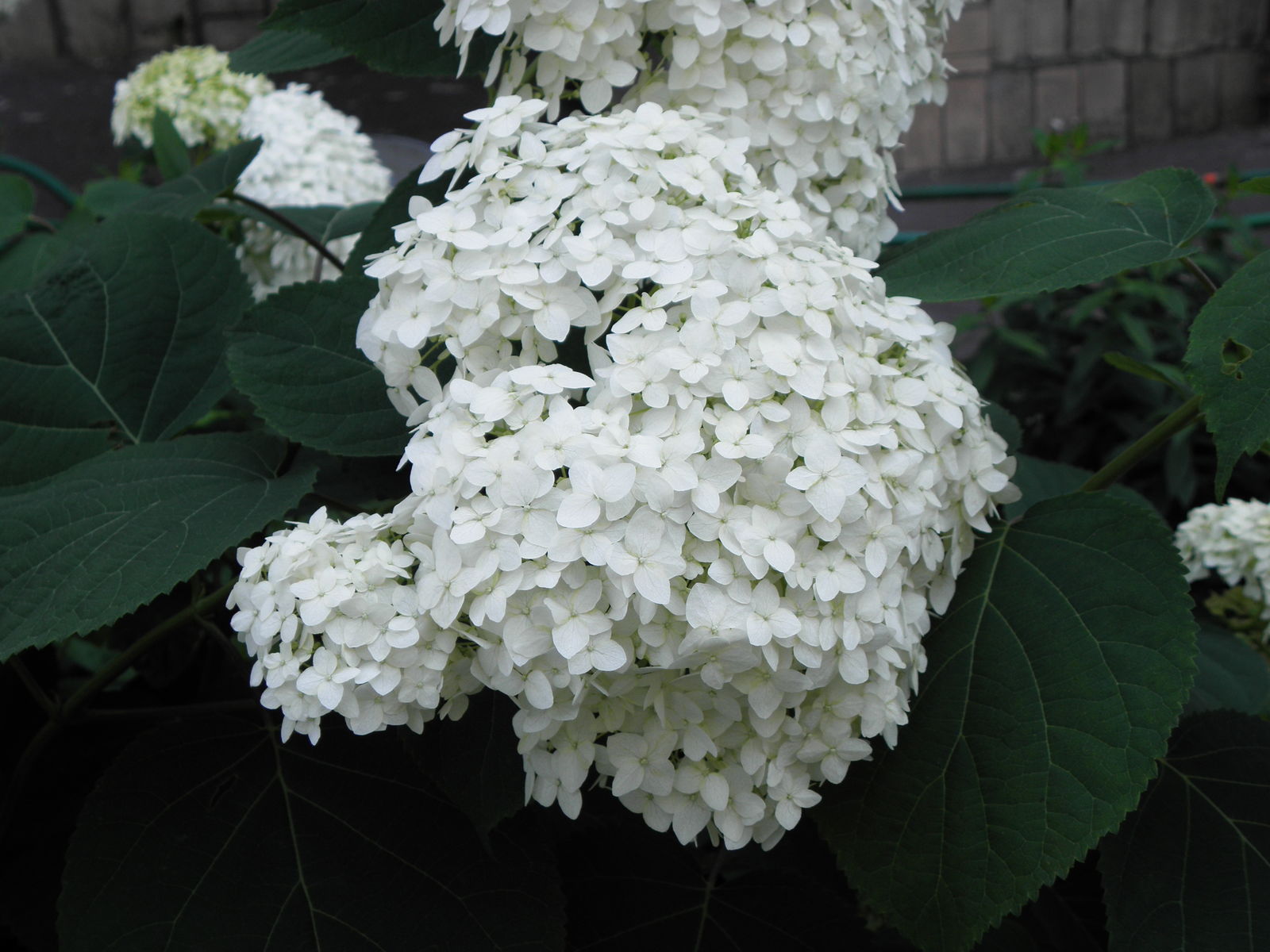
© photo
(c) Link Davis, some rights reserved (CC BY-NC), uploaded by Link Davis · cc-by-nc
Mark Eanes · CC BY-NC
Andrew Conboy · cc-by
Taken May 21, 2022 by Taylor (cc-by-sa)
Taken Sep 7, 2022 by Jim Knopf (cc-by-sa)
Taken Apr 20, 2022 by Jacques Patenet (cc-by-sa)
Taken Apr 18, 2022 by Anil Bhardwaj (cc-by-sa)
Taken Oct 14, 2022 by Jim Knopf (cc-by-sa)
© copyright of the Board of Trustees of the Royal Botanic Gardens, Kew.




Global distribution
POWO places the native range in the north-central and eastern United States. Flora of North America notes that some records farther northeast, including Connecticut, Massachusetts, New Brunswick and Nova Scotia, represent garden escapes rather than the strict native range.
- Native10
- Introduced4
- Alabama
- Arkansas
- Georgia
- Illinois
- Kentucky
- Missouri
- New York
- North Carolina
- Tennessee
- Virginia
- Connecticut
- Massachusetts
- New Brunswick
- Nova Scotia
Hexagons: regions where the plant occurs. Green dots: native range.1
Identity
The smooth hydrangea (Hydrangea arborescens L., 1753) is an accepted species of Hydrangea in the Hydrangeaceae family. POWO traces the name to Species Plantarum in 1753 and places its native range in the north-central and eastern United States. GBIF likewise recognizes the species rank and Linnaeus's original publication. 1 2
English names include wild hydrangea, sevenbark and hills of snow, although their meanings are not always interchangeable. Smooth hydrangea and wild hydrangea usually refer to the species; hills of snow is often associated with garden forms bearing large white flower heads. These names describe a plant whose wild form can look quite different from its best-known cultivars. 2 12
The epithet arborescens suggests a treelike habit, but the plant is chiefly a low, multistemmed shrub capable of regrowing from its base. The name sevenbark refers to the gray-brown bark that peels from older stems in thin layers. 7 5
Recognition
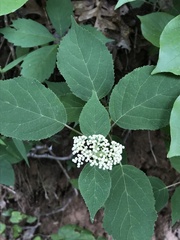
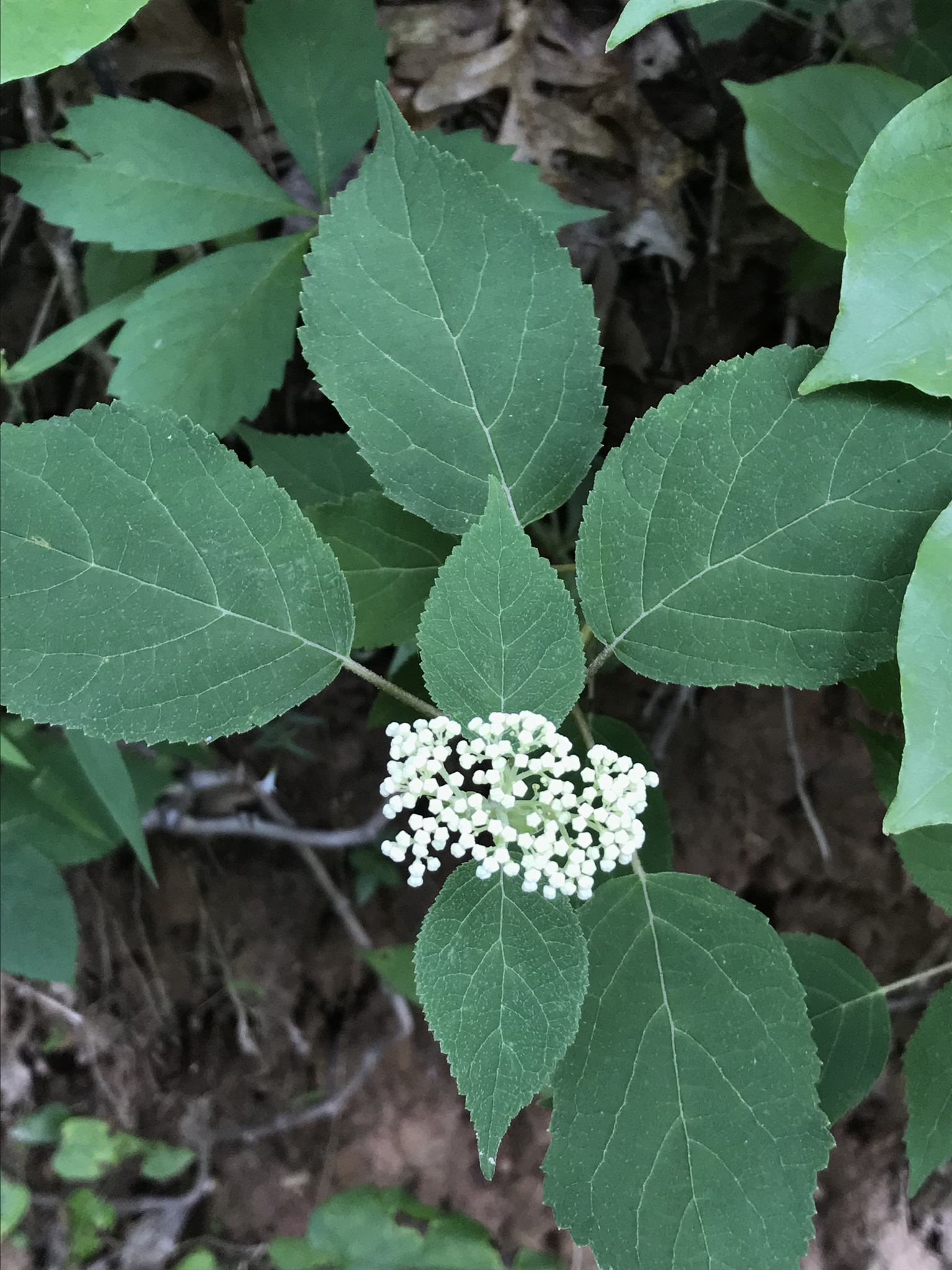
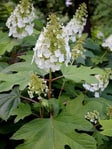
Wild plants form deciduous woodland shrubs with a spreading rather than rigidly upright outline. Flora of North America describes shrubs around 1–3 m (3–10 ft) tall, with variably hairy twigs, opposite leaves and toothed, ovate to broadly ovate blades commonly 6–17.8 cm (2.4–7 in) long. 4
The simple, opposite leaves are green above and paler beneath. They often yellow in fall, though the color display does not last particularly long. NC State and Missouri Botanical Garden emphasize the strongly toothed leaf margins and the gray-brown stems supporting the broad foliage. 6 7
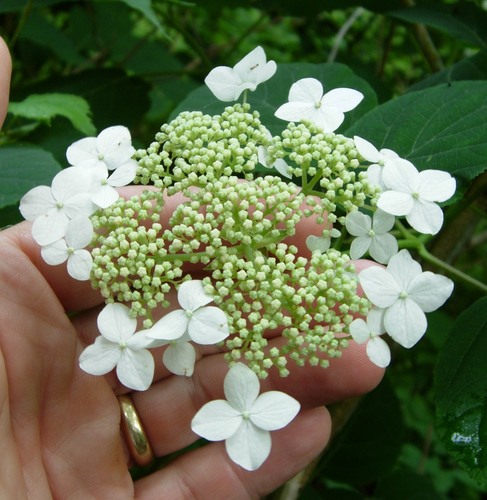
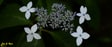
Wild flower heads differ considerably from the familiar image of Annabelle. The species mainly bears small, fertile white flowers in flat to domed corymbs, often 5–12 cm (2–5 in) across or slightly larger, sometimes with a few larger sterile flowers at the edge. Mophead cultivars turn this arrangement into white or pink globes 20–30 cm (8–12 in) across. 4 5 6
Taxonomy and related species
Historical names are best read against the accepted binomial Hydrangea arborescens L. POWO lists numerous synonyms, including Hydrangea cordata, Hydrangea frutescens, Hydrangea viburnifolia and Hydrangea vulgaris, as well as forms or varieties such as var. grandiflora and var. sterilis. Older catalogs may therefore list the same plant under a different name. 1
Its boundary with Hydrangea cinerea and Hydrangea radiata deserves closer attention. Flora of North America notes that both were once included within a broad concept of H. arborescens, before being treated as separate species on morphological, chemical, reproductive and geographic grounds. In a garden, the degree of gray coloring or hairiness on the leaf undersides offers a useful clue. 4 11
For pruning, confusion with Hydrangea macrophylla matters more. Smooth hydrangea flowers on the current season's shoots, while many traditional bigleaf hydrangeas flower on older wood. Cutting H. arborescens back in late winter can therefore leave its flowering cycle intact; the same treatment may remove the flower buds of H. macrophylla. 11 6
Habitat and range
North-central and eastern parts of the United States make up the native range recognized by POWO. Missouri Botanical Garden describes a range from New York to Florida, extending west to Iowa, Missouri, Oklahoma and Louisiana, and identifies the plant as native to Missouri. 1 7
Natural habitats are often moist, but not necessarily waterlogged: deciduous woods, shaded slopes, ravines, streambanks, cliff bases and rocky ground. Flora of North America includes both dry and wet forests, at elevations of about 70–2,000 m (230–6,560 ft). This breadth matters when interpreting the plant's woodland character; it does not imply a need for saturated soil. 4 5
Some records farther north represent garden escapes. Flora of North America identifies populations in Connecticut, Massachusetts, New Brunswick and Nova Scotia as nonnative. In metropolitan France the species is treated as cultivated, without an invasive designation in the references used here; that regional assessment does not establish its status elsewhere. 4 1
Life cycle and cultivation
Flowering on new wood is the species' main practical advantage. Terminal flower heads develop on new shoots, allowing the shrub to be shortened in late winter, sometimes almost to the ground, while retaining summer flowering. This treatment often produces large heads, although cultivars with weak stems may then flop after rain. 11 8
Choose moist partial shade for the most straightforward cultivation. NC State recommends filtered light, with sun tolerated where moisture remains reliable. Missouri Botanical Garden suggests partly shaded borders, woodland gardens and naturalized plantings. France's SNHF also stresses moist soil and shade for this species, advice whose usefulness depends on the site's actual conditions. 6 7 10
Water regularly while the shrub establishes and during dry summers. A practical starting range for plants in the ground is 15–25 mm (0.6–1 in) per week, adjusted for soil, mulch, exposure and container growing. The aim is consistent moisture with drainage, rather than permanently saturated soil. Check conditions at the roots instead of treating the weekly figure as a fixed dose for every garden. 10 6
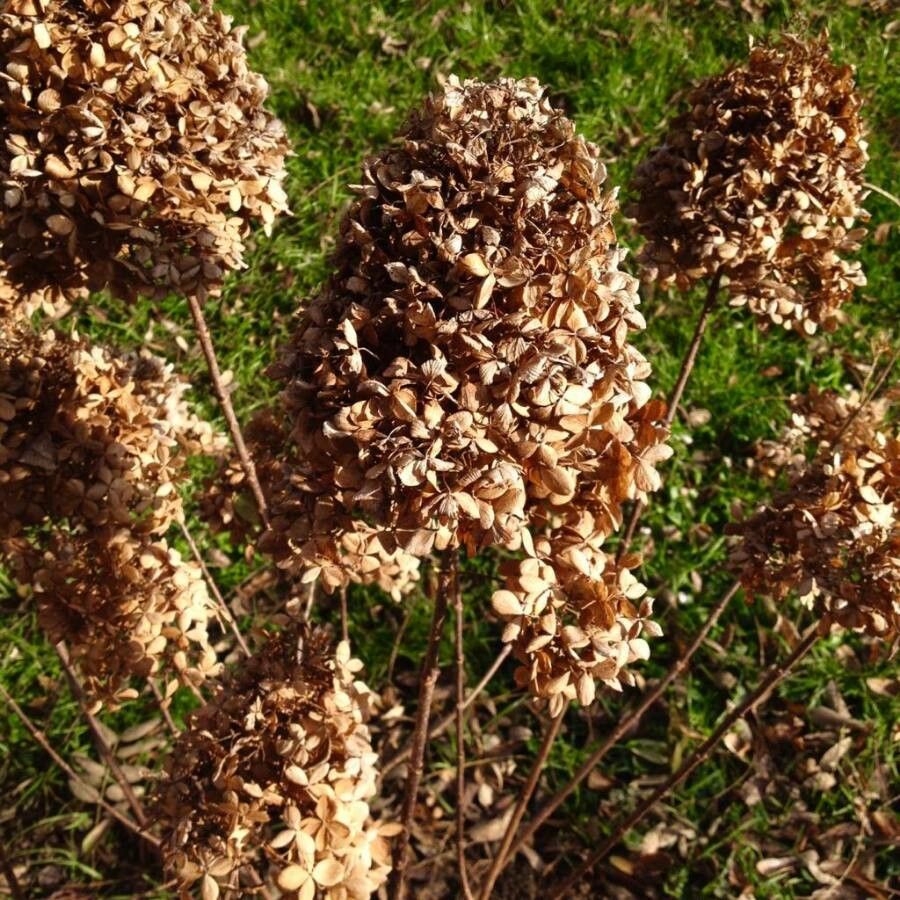
Unlike many bigleaf hydrangeas, Hydrangea arborescens does not change flower color in response to soil pH. NC State explicitly states that pH does not affect its flower color. Acidifying the soil will therefore not turn 'Annabelle' blue. 6
Uses and toxicity
Borders, perennial backdrops, woodland gardens, low hedges, rain gardens and dried arrangements are its main ornamental uses. Wild and lacecap forms retain more fertile flowers and offer greater pollinator interest; large mophead forms are chosen chiefly for their visual effect. The choice of cultivar therefore changes both the display and the flowers available to visiting insects. 7 6 11
Toxicity is established, though ordinary exposures are generally described as causing mainly digestive symptoms. The ASPCA's Hydrangea entry names Hydrangea arborescens and lists it as toxic to dogs, cats and horses. It identifies a cyanogenic glycoside as the toxic principle, with vomiting, depression and diarrhea, while noting that cyanide poisoning is rare. 12
Pet Poison Helpline reports cyanide-containing compounds in all parts of hydrangeas. Merck places hydrangeas among plants containing cyanogenic glycosides and notes that many small-animal exposures need only minimal supportive treatment for digestive upset. The usual risk is therefore described as low, but ingestion should be avoided and symptoms warrant veterinary advice. 13 14
Flora of North America records North American ethnobotanical uses of the bark or twigs. Those records do not establish a safe medicinal use: identification, preparation, dosage and toxicity require more than a historical account of how a plant was used. 4 12
Cultivars and look-alikes
'Annabelle' shapes many gardeners' idea of the species. Missouri Botanical Garden describes a rounded cultivar, often 0.9–1.5 m (3–5 ft) tall, with enormous, symmetrical white corymbs about 20–30 cm (8–12 in) across. It originated as a naturally occurring selection near Anna, Illinois. This highly ornamental selection should be distinguished from the wild form. 8
Other selections serve different purposes. 'Grandiflora' is an older white hills-of-snow form; Incrediball emphasizes stronger stems; Invincibelle Spirit and related lines brought pink flowers; White Dome and Haas' Halo retain lacecap heads with fertile flowers more accessible to insects. These are horticultural names, rather than botanical ranks. 11 6
Look beyond the flower ball when identifying a garden plant. A conical flower head suggests Hydrangea paniculata; lobed leaves point toward Hydrangea quercifolia; and large leaves with blue or pink flowers responsive to pH often indicate Hydrangea macrophylla. For H. arborescens, the most useful combination is opposite, unlobed leaves, stems arising from the base and summer flowering on new wood. 4 11
Main sources
- Plants of the World Online / Kew, Hydrangea arborescens L.
- GBIF Backbone Taxonomy, Hydrangea arborescens L.
- World Flora Online, Hydrangea arborescens L.
- Flora of North America, Hydrangea arborescens
- US Forest Service, Wild Hydrangea (Hydrangea arborescens L.)
- NC State Extension Gardener Plant Toolbox, Hydrangea arborescens
- Missouri Botanical Garden Plant Finder, Hydrangea arborescens
- Missouri Botanical Garden Plant Finder, Hydrangea arborescens 'Annabelle'
- Royal Horticultural Society, Hydrangea arborescens 'Annabelle'
- Société Nationale d'Horticulture de France, Hydrangea arborescens
- Trees and Shrubs Online, Hydrangea arborescens
- ASPCA, Hydrangea toxicity entry
- Pet Poison Helpline, Hydrangea
- Merck Veterinary Manual, toxicity to animals of cyanogenic glycoside plants
Frequently asked questions
Is Hydrangea arborescens the same as Annabelle?
No. Hydrangea arborescens is the species; 'Annabelle' is a famous cultivar with large white flower heads. A wild or lacecap plant can belong to the same species without looking like 'Annabelle'.
Should I prune it like Hydrangea macrophylla?
No. Smooth hydrangea flowers on the current season’s shoots, so late-winter pruning is possible. Traditional bigleaf hydrangeas often flower on older wood and need more cautious pruning.
Why do Annabelle stems flop?
The large sterile flower heads hold rain and become heavy. Less severe pruning, less nitrogen, a sheltered site and discreet support can reduce flopping.
Does soil pH change the flower color?
Not as it does in many bigleaf hydrangeas. White or pink Hydrangea arborescens cultivars will not turn blue simply because the soil is acidified.
How much water does it need in summer?
During dry weather, 15–25 mm (0.6–1 in) per week is often a useful starting point for plants in the ground, adjusted for heat, soil and exposure. Drooping leaves quickly reveal a lack of water.
Is it toxic to cats and dogs?
Yes. The ASPCA lists Hydrangea arborescens as toxic to dogs, cats and horses, with cyanogenic glycosides and mainly digestive signs. Severity is generally low to moderate, depending on the amount eaten.
Is it invasive in France?
No French invasive designation is retained in the references used here, which describe a North American species grown ornamentally in Europe. This regional assessment does not establish its status elsewhere.
Similar plants
If you are unsure about a plant’s toxicity, ask a botanist or veterinarian for advice.