
Oakleaf hydrangea (Hydrangea quercifolia, )
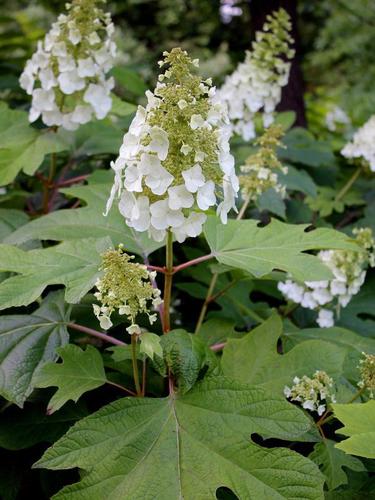
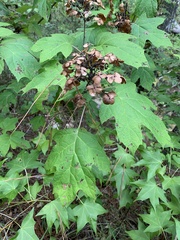
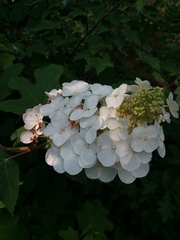
Oakleaf hydrangea (Hydrangea quercifolia W.Bartram) is a deciduous shrub in the Hydrangeaceae family, native to the southeastern United States. Large oak-like lobed leaves, white panicles aging to pink and brown, and cinnamon-colored peeling bark on older stems distinguish it.
Read moreOakleaf hydrangea and oak-leaf hydrangea
Give plenty of ambient light without direct sun on the leaves.
Partial shade, morning sun or full sun only with moist soil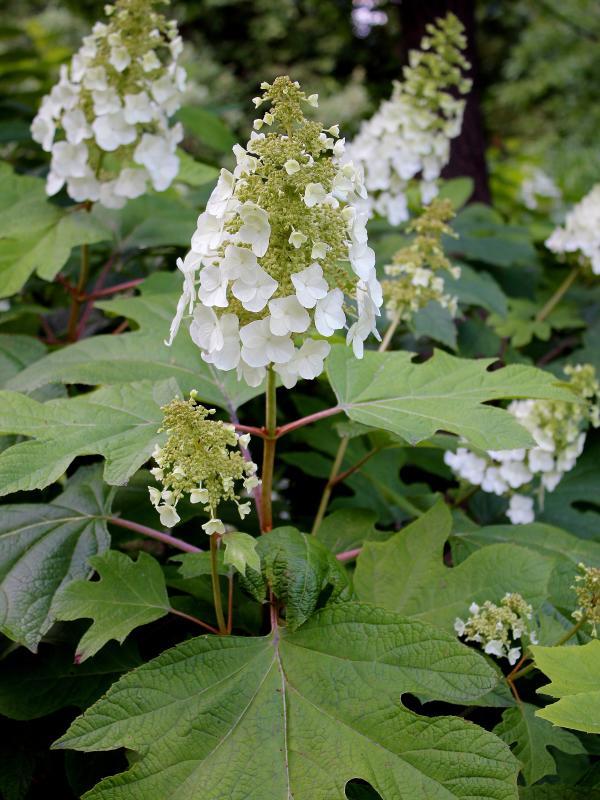



© photo
(c) Mauricio Mercadante, some rights reserved (CC BY-NC-SA) · cc-by-nc-sa
Laura Clark · cc-by
Will McFarland · cc-by
Taken Oct 3, 2019 by Rebekah Williams (cc-by-sa)
Taken Jun 20, 2020 by val Boud (cc-by-sa)
Taken Sep 28, 2019 by Barefoot (cc-by-sa)
Taken Jun 3, 2022 by yut miz (cc-by-sa)
Taken Oct 20, 2021 by Irmgard Groß (cc-by-sa)
© copyright of the Board of Trustees of the Royal Botanic Gardens, Kew.




Global distribution
POWO places the native range in the southeastern United States. WFO/WCVP details a native distribution centered chiefly on Alabama, Florida, Georgia, Louisiana, Mississippi, South Carolina and Tennessee; horticultural references often summarize it as Southeastern United States.
- Native7
- Introduced1
- Alabama
- Florida
- Georgia
- Louisiana
- Mississippi
- South Carolina
- Tennessee
- Connecticut
Hexagons: regions where the plant occurs. Green dots: native range.1
Identity
Oakleaf hydrangea (Hydrangea quercifolia W.Bartram) is an accepted species of Hydrangea in the Hydrangeaceae family. POWO links the name to William Bartram's publication in Travels Carolina in 1791, and World Flora Online also treats it as accepted. 1 2
The name describes the large, lobed leaves, which resemble those of an oak. GBIF records the English spelling oak-leaf hydrangea as well as oakleaf hydrangea and the corresponding French name. Missouri Botanical Garden and Oregon State explain the epithet quercifolia as a reference to Quercus, the oak, and folia, foliage. 3 5 6
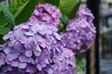
This species should be distinguished from bigleaf hydrangea (Hydrangea macrophylla). Both are garden hydrangeas, but H. quercifolia is recognized by its lobed leaves, elongated flower panicles and strong fall color, rather than blue or pink rounded heads whose color responds to soil pH.
Recognition
Broad and often rounded, this deciduous woody shrub has many stems and may produce suckers. Size varies with the cultivar and the reference: NC State gives roughly 1.2–2.4 m (4–8 ft) tall and 1.2–3 m (4–10 ft) wide, while Missouri Botanical Garden gives about 1.8–2.4 m (6–8 ft) for the cultivated type on its page. 4 5
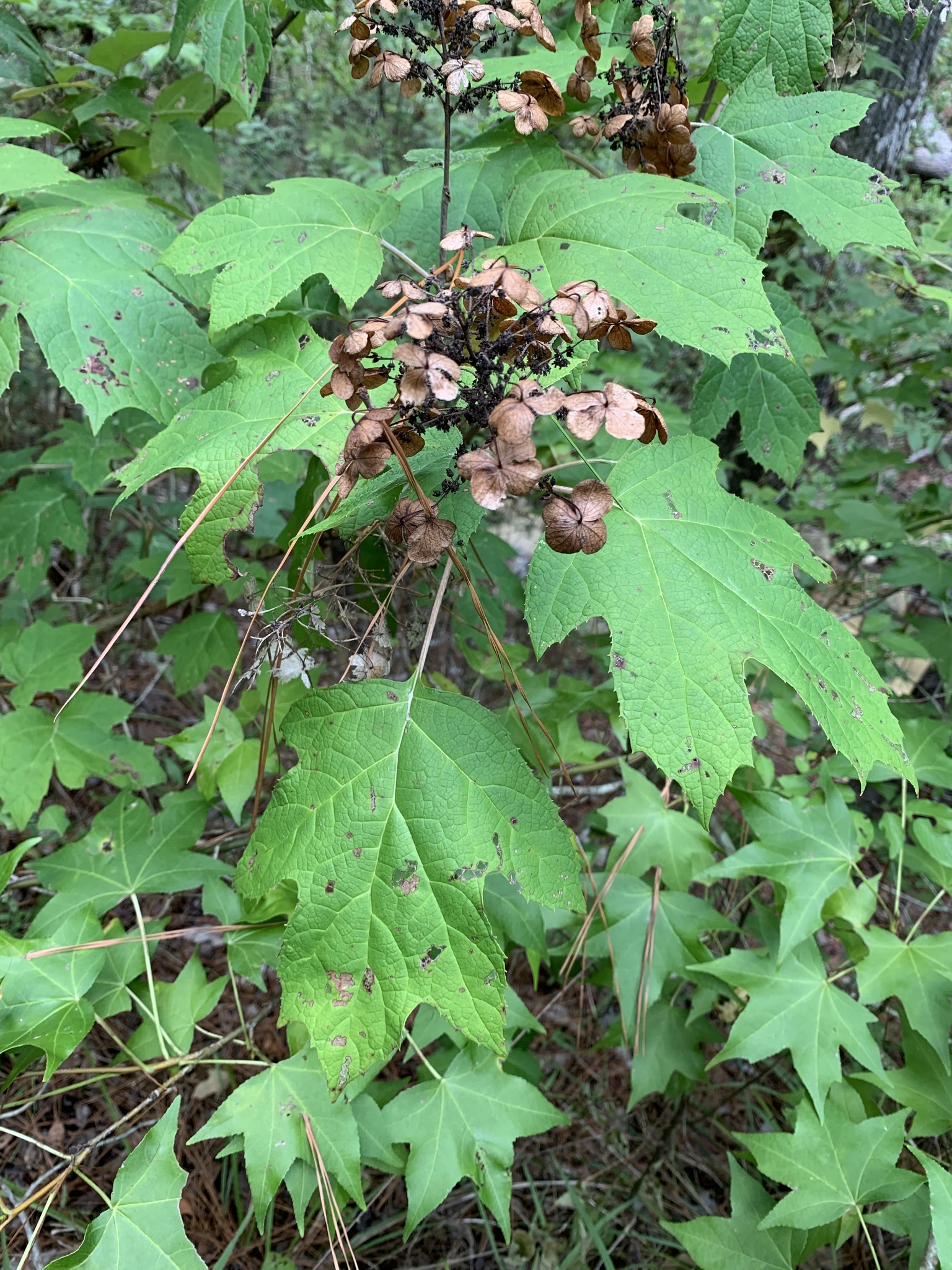
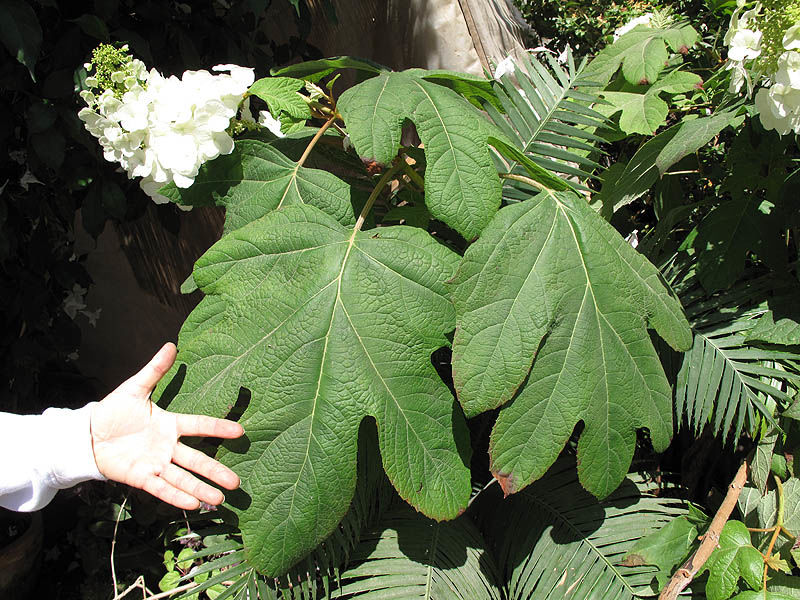
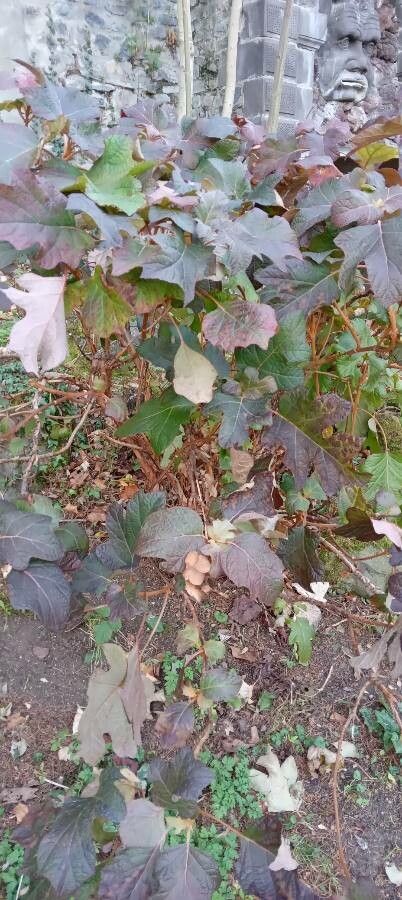
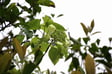
The leaves are opposite, simple and broad, with 3–7 lobes and coarsely toothed edges. WFO describes blades reaching about 26 cm (10 in), grayish and hairy to felted underneath. Purdue summarizes the field characters as large, opposite, deeply lobed leaves resembling red oak leaves, with a whitish, felted underside. 2 7
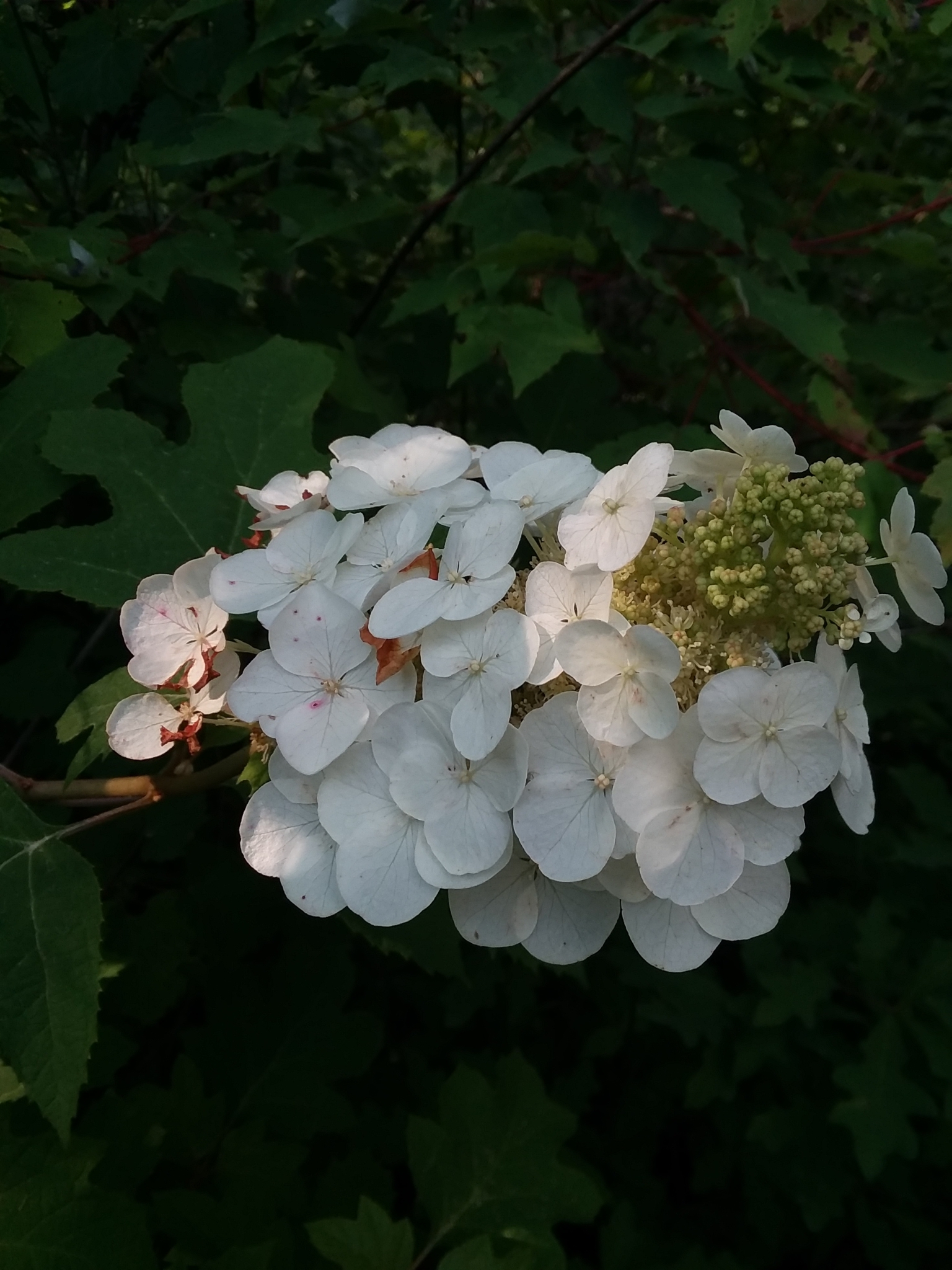
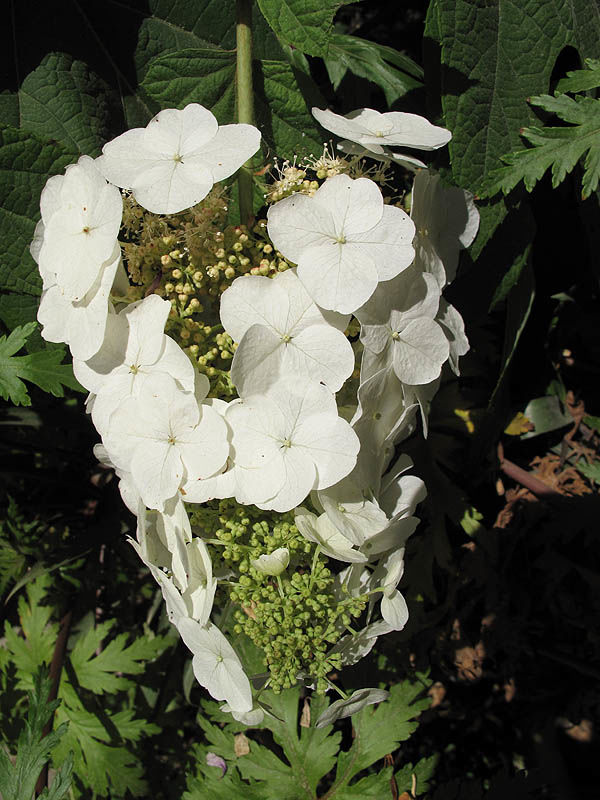
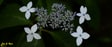
Flowering comes in late spring and early summer. The terminal panicles start white, then develop pinkish, purplish or brown tones as they age. WFO describes conical or egg-shaped inflorescences about 9–32 cm (3.5–12.5 in) long; Purdue gives panicles around 10–30 cm (4–12 in), with conspicuous large sterile flowers around smaller fertile ones. 2 7
Older stems provide a winter identifying feature: cinnamon to orange-brown bark that peels away. In fall, the foliage turns red, orange, brown or purple. This combination of foliage, flowers and mature bark gives the shrub interest across all four seasons. 6 5
Useful taxonomy
Hydrangea quercifolia W.Bartram remains the reliable botanical name. GBIF and WFO include Hydrangea angulata Tausch and Hydrangea quinquefolia D.Dietr. among its synonyms; those older names do not alter the identity of the shrub sold as oakleaf hydrangea. 3 2
Hydrangea alone is a broad label. It may refer to H. macrophylla, H. paniculata, H. arborescens, H. serrata or H. quercifolia. For this species, lobed leaves, white conical panicles and peeling bark are more reliable than a nursery label giving only the genus.
Flower color also needs a different reading from bigleaf hydrangea. The panicles of H. quercifolia naturally age from white to pink, purplish or brown. This is not a species grown for blue flowers produced by acidifying the soil. 5 7
Habitat and range
The southeastern United States is the native range given by POWO. WFO/WCVP details a distribution centered chiefly on Alabama, Florida, Georgia, Louisiana, Mississippi, South Carolina and Tennessee, with some records of introduction elsewhere. Southeastern United States is therefore a more accurate description than North America as a whole. 1 2
Its natural and cultivated habitats include moist woods, ravines, slopes, banks and woodland edges with organic soil. Missouri Botanical Garden describes native sites on bluffs, in moist woods and ravines, and along streams from Georgia to Florida and Louisiana. NC State identifies it as a southeastern US native suited to woodland and rain gardens. 5 4
For cultivation, the useful combination is rich, moist, well-drained soil with partial shade or gentle sun. Missouri Botanical Garden recommends organically rich soil with medium moisture, in full sun to partial shade, and highlights summer mulch as a way to retain moisture. Exposure should be chosen for the site's heat and water supply. 5
In mainland France, oakleaf hydrangea is grown as an ornamental shrub, with no invasive status assigned. Its native range lies in North America, while its presence in French gardens chiefly reflects horticultural planting. This regional account does not assign a native or invasive status elsewhere.
Life cycle, flowering and pruning
Suckers or stolons can gradually extend this deciduous woody perennial into a colony wider than it is tall. That spreading habit is useful along woodland edges, provided the shrub has room to develop rather than being confined by neighboring plants. 5 7
Flowers develop on wood from the previous growing season. Missouri Botanical Garden therefore recommends pruning, when needed, immediately after flowering; heavy spring pruning often removes flower buds. Winter-damaged stems can be removed in spring once dead wood has been identified. 5
In cold climates, survival does not always mean good flowering. Purdue notes that severe cold can kill aboveground growth, including flower buds formed in fall. A shrub may consequently produce leaves after a hard winter but few flowers that year. The severity of the winter at the planting site matters more than a calendar date. 7
Uses, biodiversity and toxicity
Garden planting is the main use: as a specimen, foundation shrub, woodland-edge group, informal hedge or part of a woodland garden. Missouri Botanical Garden emphasizes the winter color and texture of mature bark. NC State lists pollinator gardens, rain gardens, borders, hedges and naturalized plantings among its landscape uses. 5 4
Its value to small wildlife depends on the form planted. NC State reports that the flowers attract butterflies and other insects, while birds eat the seeds. Very double or heavily selected ornamental cultivars need to be assessed individually: a showier flower head does not necessarily offer the same access to fertile flowers. 4
Toxicity needs to remain visible. The ASPCA classifies Hydrangea as toxic to dogs, cats and horses, with cyanogenic glycosides and chiefly digestive signs. The Merck Veterinary Manual includes Hydrangea spp. among cyanogenic ornamental plants and notes that severe poisoning in small animals is uncommon unless a large amount is eaten. 8 9
Pet Poison Helpline describes generally mild toxicity in animals, chiefly involving lethargy, vomiting and diarrhea. France's CAPAE Ouest states that all hydrangea parts are toxic, especially leaves and flower buds, and also notes possible allergic skin reactions in people. 11 10
No part of oakleaf hydrangea should be treated as edible. If a child, dog, cat, horse or another animal eats it, seek medical or veterinary advice appropriate to the amount and the symptoms. Its ornamental value does not make it a food plant. 8 10
Cultivars, look-alikes and buying
Cultivar choice chiefly changes mature size, panicle density and how quickly the flowers change color. 'Alice' is a large selection with substantial panicles and strong fall color; 'Snowflake' is known for double flowers; 'Snow Queen' carries more upright panicles. 'Pee Wee' and 'Sike's Dwarf' offer smaller plants for small gardens. 5 7
Recent selections offer more compact growth or faster color changes. 'Munchkin' and 'Ruby Slippers' came from the U.S. National Arboretum's breeding work; 'JoAnn', sold as Gatsby Pink, is described by Missouri Botanical Garden as a selection with large flower heads changing from white to pink. 5
Before buying, check the cultivar, expected mature height, tendency to sucker, flower form and suitability for the site's winters. A compact nursery plant does not necessarily represent the eventual habit: some cultivars remain low, while others become substantial shrubs.
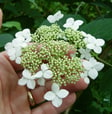
The most useful distinctions are from other hydrangeas. H. paniculata also bears panicles, but its leaves are not oak-lobed. H. macrophylla produces familiar rounded or lacecap heads and responds more strongly to soil pH; H. arborescens often has rounded white corymbs. Lobed leaves and peeling bark remain the quickest clues to H. quercifolia. 6 7
Main sources
- Plants of the World Online / Kew, Hydrangea quercifolia W.Bartram
- World Flora Online, Hydrangea quercifolia W.Bartram
- GBIF Backbone Taxonomy, Hydrangea quercifolia Bartram
- NC State Extension Gardener Plant Toolbox, Hydrangea quercifolia
- Missouri Botanical Garden Plant Finder, Hydrangea quercifolia
- Oregon State University Landscape Plants, Hydrangea quercifolia
- Purdue Arboretum Explorer, Hydrangea quercifolia
- ASPCA Animal Poison Control, Hydrangea toxicity entry
- Merck Veterinary Manual, cyanogenic glycoside plants including Hydrangea spp.
- Centre Antipoison Animal et Environnemental de l'Ouest, L'hortensia
- Pet Poison Helpline, Hydrangea
Frequently asked questions
Does Hydrangea quercifolia have blue flowers?
No. Oakleaf hydrangea mainly produces white panicles that age to pink, purple or brown. Unlike Hydrangea macrophylla, it is not grown for a pH-related change to blue.
When should oakleaf hydrangea be pruned?
Immediately after flowering, if pruning is needed. The species flowers on wood from the previous season; heavy pruning in spring often removes the buds.
Is it toxic to animals?
Yes. Poison-control sources classify hydrangeas as toxic to dogs, cats and horses because of cyanogenic glycosides, with chiefly digestive signs. Discuss any substantial ingestion with a veterinarian or animal poison-control service.
Can it grow in full sun?
Yes, in mulched soil that stays reliably moist, especially with morning sun. Partial shade is more dependable in dry soil or hot climates.
Is it invasive in France?
No invasive status is assigned in mainland France, where it is treated as a cultivated ornamental shrub. This regional account does not establish its status elsewhere.
Why are there no flowers after a hard winter?
Flower buds are carried on the previous season's wood. Severe frost can kill buds or shoots, leaving the shrub to produce leaves but few flowers that year.
Similar plants
If you are unsure about a plant’s toxicity, ask a botanist or veterinarian for advice.