
mountain hydrangea (Hydrangea serrata, )
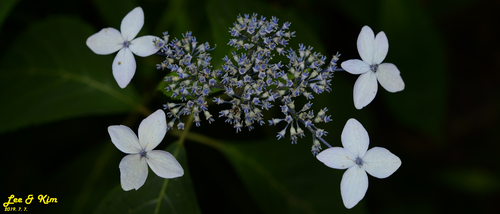

Mountain hydrangea (Hydrangea serrata (Thunb.) Ser.) is a deciduous shrub in the Hydrangeaceae family, native to Japan and Korea. More compact than many bigleaf hydrangeas, it has opposite, toothed leaves and summer flower heads that are often flat, with small fertile flowers surrounded by larger sterile flowers.
Read moremountain hydrangea, sawtooth hydrangea, tea of heaven and amacha
Place in indirect light or in a shaded room.
Partial shade, dappled light or gentle sun with moist soil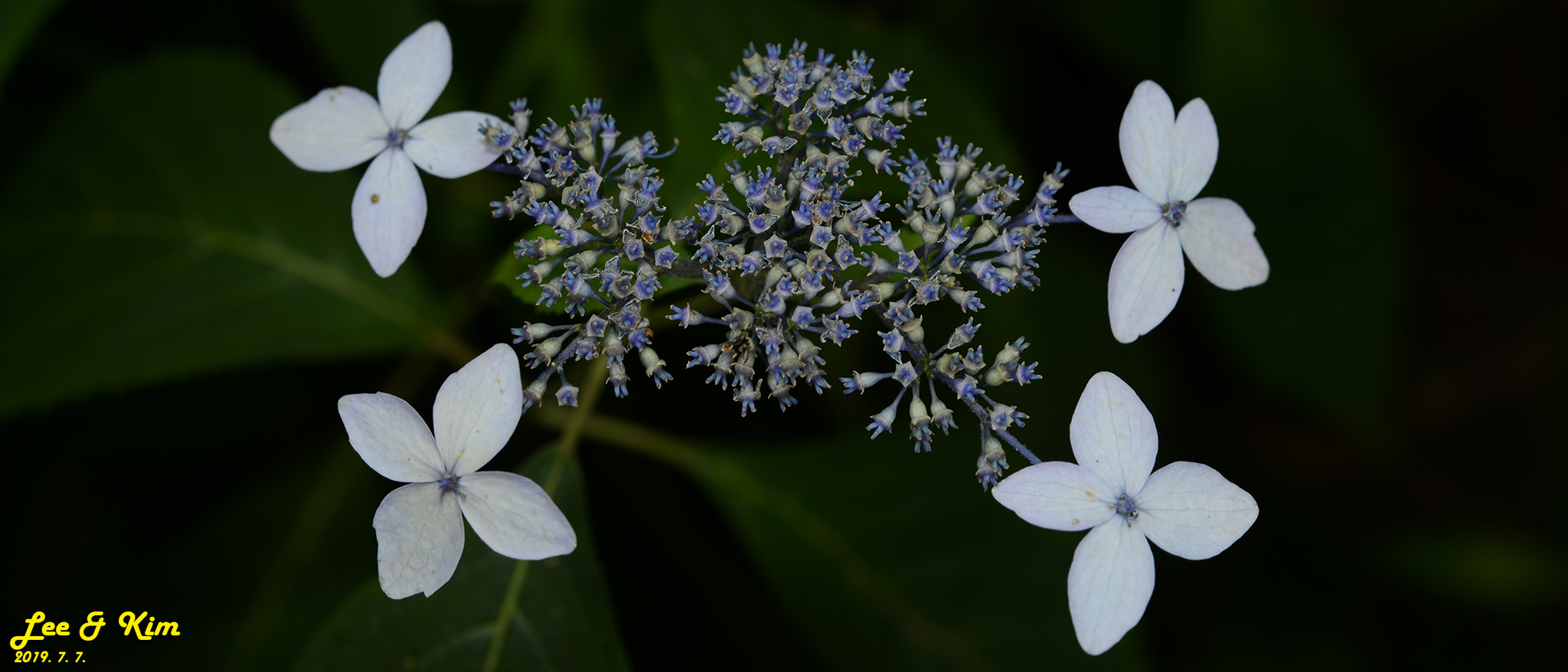


© photo
(c) Kim, Hyun-tae, some rights reserved (CC BY), uploaded by Kim, Hyun-tae · cc-by
Wikimedia Commons · CC BY-SA or Public Domain
Wikipedia · CC BY-SA
© copyright of the Board of Trustees of the Royal Botanic Gardens, Kew.
Global distribution
POWO/WCVP places the native range of Hydrangea serrata in Japan and Korea. WFO records introduction in Assam; in mainland France it is described as a cultivated shrub, with no published invasive status assigned.
- Native2
- Introduced1
- Japan
- Korea
- Assam
Hexagons: regions where the plant occurs. Green dots: native range.1
Identity
Mountain hydrangea (Hydrangea serrata (Thunb.) Ser.) is an accepted species of Hydrangea in the Hydrangeaceae family. POWO/WCVP places its native range in Korea and Japan and describes it as a temperate-biome shrub. World Flora Online follows the same broad treatment and also records an introduction in Assam. 1 2
English references also use sawtooth hydrangea and tea of heaven. The French names emphasize its Japanese origin or mountain associations; GBIF records the French mountain name, while NC State lists the English names. The names refer to the same horticulturally familiar shrub rather than to three separate species. 3 5
The epithet serrata refers to the toothed leaf edge. That is a useful clue, but not a complete identification: many hydrangeas have toothed leaves. The more telling combination in H. serrata is compact growth, finer leaves and often flat flower heads. 4 5
Recognition
Rounded and bushy, mountain hydrangea is a deciduous shrub with a generally compact habit. The RHS describes it as usually under 1.2 m (4 ft) and often smaller, with an ultimate height and spread around 1–1.5 m (3–5 ft). NC State gives a usual range of about 0.6–1.2 m (2–4 ft) in both height and width. 4 5
Its opposite, simple leaves are oval to lance-shaped or elliptic, dark green and toothed to finely serrated. They are often smaller than those of bigleaf hydrangea. NC State gives blades about 8–15 cm (3–6 in) long and 2.5–8 cm (1–3 in) wide, with veins that may be hairy underneath. 5
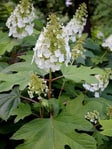
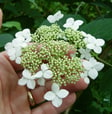
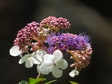
Flower heads appear from mid- to late summer. The typical arrangement is a lacecap, with small fertile flowers in the center and a few larger, ornamental sterile flowers around the edge. The RHS also describes domed or flattened heads, with colors from red to blue according to soil pH, and sometimes white. 4 5
Useful taxonomy
Seringe published the name Hydrangea serrata (Thunb.) Ser. in the Prodromus in 1830, according to POWO and GBIF. Older labels can nevertheless cause confusion because some horticultural and taxonomic treatments have placed it within or close to Hydrangea macrophylla. 1 3
WFO lists Hydrangea macrophylla subsp. serrata as a synonym, along with combinations under Hortensia or Hydrangea thunbergii. An old label reading “H. macrophylla var. serrata” therefore does not necessarily indicate a different plant: it may refer to the same group treated here as H. serrata. 2 5
The practical distinction from Hydrangea macrophylla still matters. H. serrata is generally more compact, with smaller leaves and flowers and a marked preference for cool conditions. A large garden hydrangea with broad leaves and heavy flower heads is more likely to be H. macrophylla or a hybrid cultivar. 4 5
Habitat and range
Japan and Korea form the native range given by POWO. The RHS gives the same range and specifically states that the species is not native to Great Britain or Ireland. Its Asian origin should be distinguished from its long history of cultivation in gardens elsewhere. 1 4
In cultivation, it favors moist soil and a sheltered position with filtered light: fertile, moist but well-drained ground, in partial shade or sun only where moisture is dependable. NC State adds that it prefers cool conditions and flowers better with regular summer watering, particularly in hot climates. 4 5
In mainland France, it is a cultivated shrub, rather than a native species, and no invasive status is assigned. The botanical references place its origin in Asia and record introduction separately from the native range. This French account does not establish an invasive status for other countries. 1 2
Color, pruning and cultivation
Pink or blue flowers need to be interpreted in relation to both soil and cultivar. The RHS and NC State describe color changes with soil pH: acidic soil and available aluminum favor blue, while less acidic soil favors pink. White-flowered cultivars and some other clones respond little to attempts to change the color. 4 5
Water supply is central to cultivation. In a temperate garden, a baseline of 15–25 mm/week (0.6–1 in/week) during dry periods can keep the root ball moist without saturating the ground. Watch plants more closely in containers, sandy soil, drying winds or a heat wave, and reduce watering when rainfall already meets the need. 4 5
Keep pruning light. NC State states that H. serrata flowers on the previous season's stems and recommends pruning after flowering. For propagation, the RHS recommends softwood cuttings in early summer or hardwood cuttings in winter. Heavy spring pruning can therefore remove much of the coming flower display. 5 4
Life cycle, uses and toxicity
As a deciduous woody perennial, Hydrangea serrata is grown chiefly for ornament in moist borders, open woodland edges, outdoor containers and sheltered patios, and for cut or dried flowers. Lacecap forms, with their visible central fertile flowers, can also attract bees to the garden. 5
Some Asian forms have a traditional use as a source of sweet leaf tea. POWO records the names amacha, kiamacha and sweet tea, while NC State notes the use of leaves for sweet tea or sweetening. That does not make an unidentified garden plant edible: species, varieties, preparations and quantities are not interchangeable. 1 5
Toxicity warrants clear but proportionate treatment. The ASPCA's Hydrangea entry names H. arborescens, listed as toxic to dogs, cats and horses because of cyanogenic glycosides, with mainly digestive signs. Pet Poison Helpline covers Hydrangea spp. and reports cyanide-containing compounds in all plant parts. That genus-level account supports caution with H. serrata without assigning another species' assessment to it. 6 7
The Merck Veterinary Manual includes Hydrangea among cyanogenic ornamental plants and states that small-animal exposures usually need only minimal digestive support, except after large ingestions. The usual risk is therefore low, but eating the plant is still discouraged. Seek veterinary advice if an animal eats leaves, flowers or buds. 8 7
Cultivars and look-alikes
Among the cultivars listed by NC State are 'Annie's Blue', 'Blue Billow', 'Intermedia' and 'Omacha Variegata'. These horticultural names identify selections or plants sold under particular labels, rather than separate species. Before buying, check the cultivar, flower-head form, suitability for local winters and pruning requirements. 5
Hydrangea macrophylla is the main look-alike. Both species can have lacecap heads and blue or pink flowers, but H. serrata is generally lower, finer and more compact, making it useful in small, cool gardens. A large rounded head does not rule out H. serrata, since mophead cultivars also exist. 4 5
Traditional use of amacha forms must also be distinguished from a hydrangea bought for the garden. A plant selected for its foliage, color or habit should not be eaten without reliable identification, a dedicated food source and qualified advice. A nursery name alone is insufficient to establish suitability for tea. 1 6
Main sources
- Plants of the World Online / Kew, Hydrangea serrata (Thunb.) Ser.
- World Flora Online, Hydrangea serrata (Thunb.) Ser.
- GBIF Backbone Taxonomy, Hydrangea serrata (Thunb.) Ser.
- Royal Horticultural Society, Hydrangea serrata
- NC State Extension Gardener Plant Toolbox, Hydrangea serrata
- ASPCA, Hydrangea toxicity entry
- Pet Poison Helpline, Hydrangea
- Merck Veterinary Manual, cyanogenic glycoside plants and Hydrangea spp.
Frequently asked questions
Is Hydrangea serrata different from Hydrangea macrophylla?
Yes. POWO and WFO treat Hydrangea serrata as an accepted species, although older names have placed it closer to Hydrangea macrophylla.
Why do the flowers change color?
In many cultivars, color responds to soil pH and available aluminum: more blue in acidic soil, more pink in less acidic soil. White flowers and some other cultivars change little.
When should mountain hydrangea be pruned?
Prune just after flowering to avoid removing buds carried on old wood. In spring, limit pruning to dead or damaged stems.
How much water does it need?
During dry periods, a baseline of 15–25 mm/week (0.6–1 in/week) often suits plants in the ground. Adjust for rain, mulch, soil, exposure and container growing.
Can Hydrangea serrata be used for tea?
References describe sweet leaf tea made from certain Asian forms, but an unidentified garden plant should not be eaten, especially given the known toxicity of the genus Hydrangea.
Is Hydrangea serrata toxic?
Treat it as toxic as a precaution. The ASPCA's Hydrangea entry names H. arborescens, listed as toxic to dogs, cats and horses. Genus-level veterinary accounts support caution with H. serrata. Common signs are digestive, but seek veterinary advice after a substantial ingestion.
Similar plants
If you are unsure about a plant’s toxicity, ask a botanist or veterinarian for advice.