
rough-leaf hydrangea (Hydrangea aspera, )
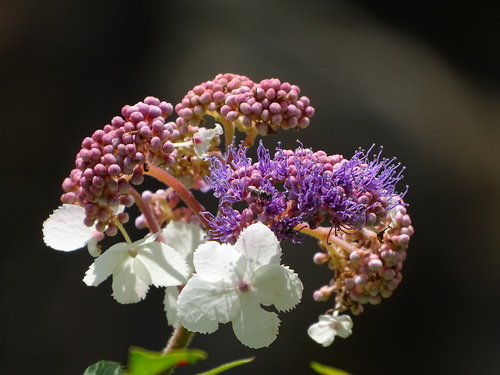

rough-leaf hydrangea (Hydrangea aspera Buch.-Ham. ex D.Don) is a large deciduous shrub in the Hydrangeaceae family from the Himalayas, China, Indochina and Taiwan. Opposite leaves with rough or velvety undersides and flat late-summer flower heads distinguish it: purple to bluish fertile flowers occupy the center, ringed by white, pinkish or purplish sterile flowers.
Read morerough-leaf hydrangea, rough-leaved hydrangea, rough leaf hydrangea and Chinese hydrangea
Place in indirect light or in a shaded room.
Partial or light shade; morning sun in moist soil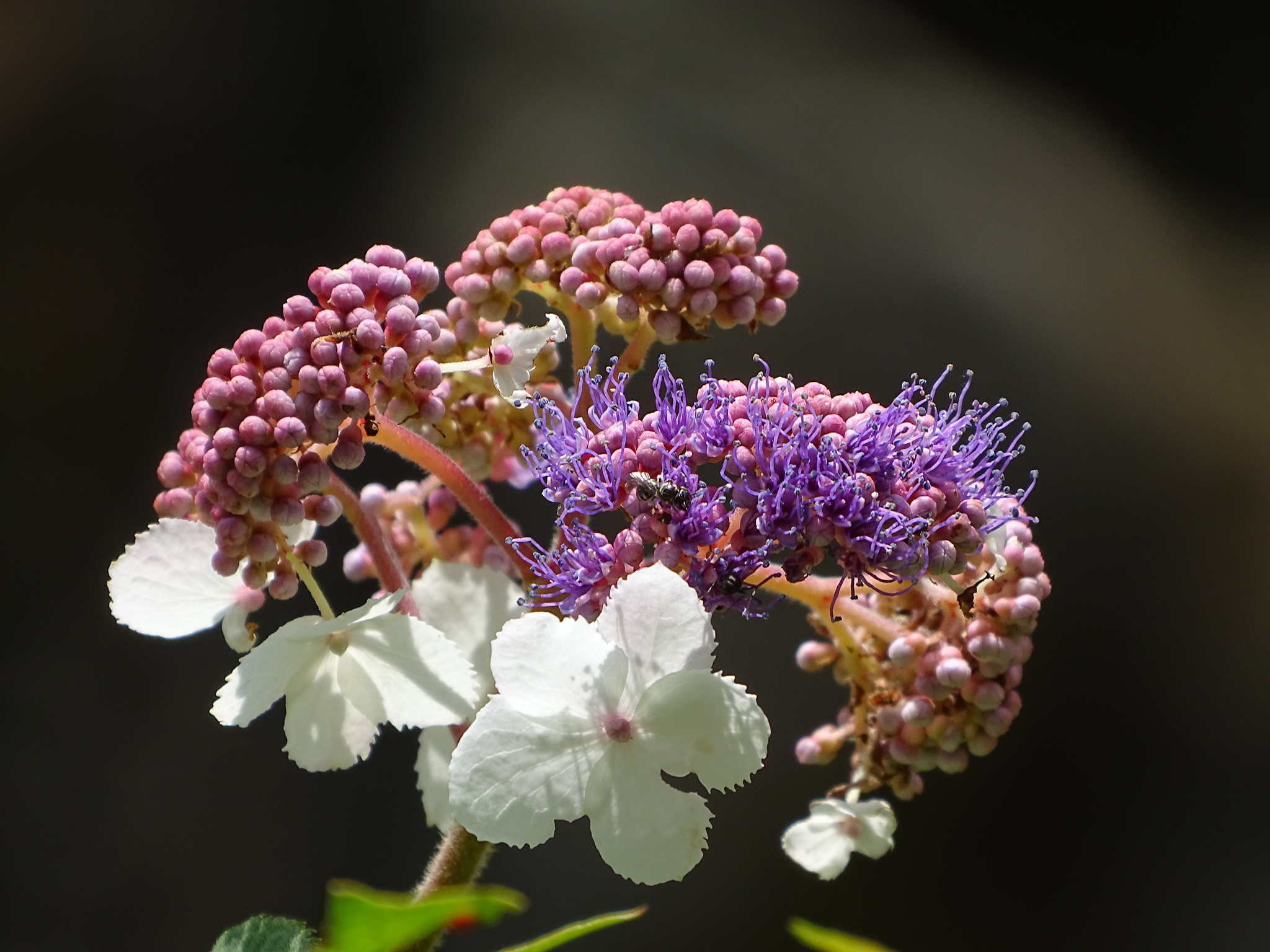


© photo
no rights reserved, uploaded by 葉子 · cc0
Wikimedia Commons · CC BY-SA or Public Domain
Wikipedia · CC BY-SA
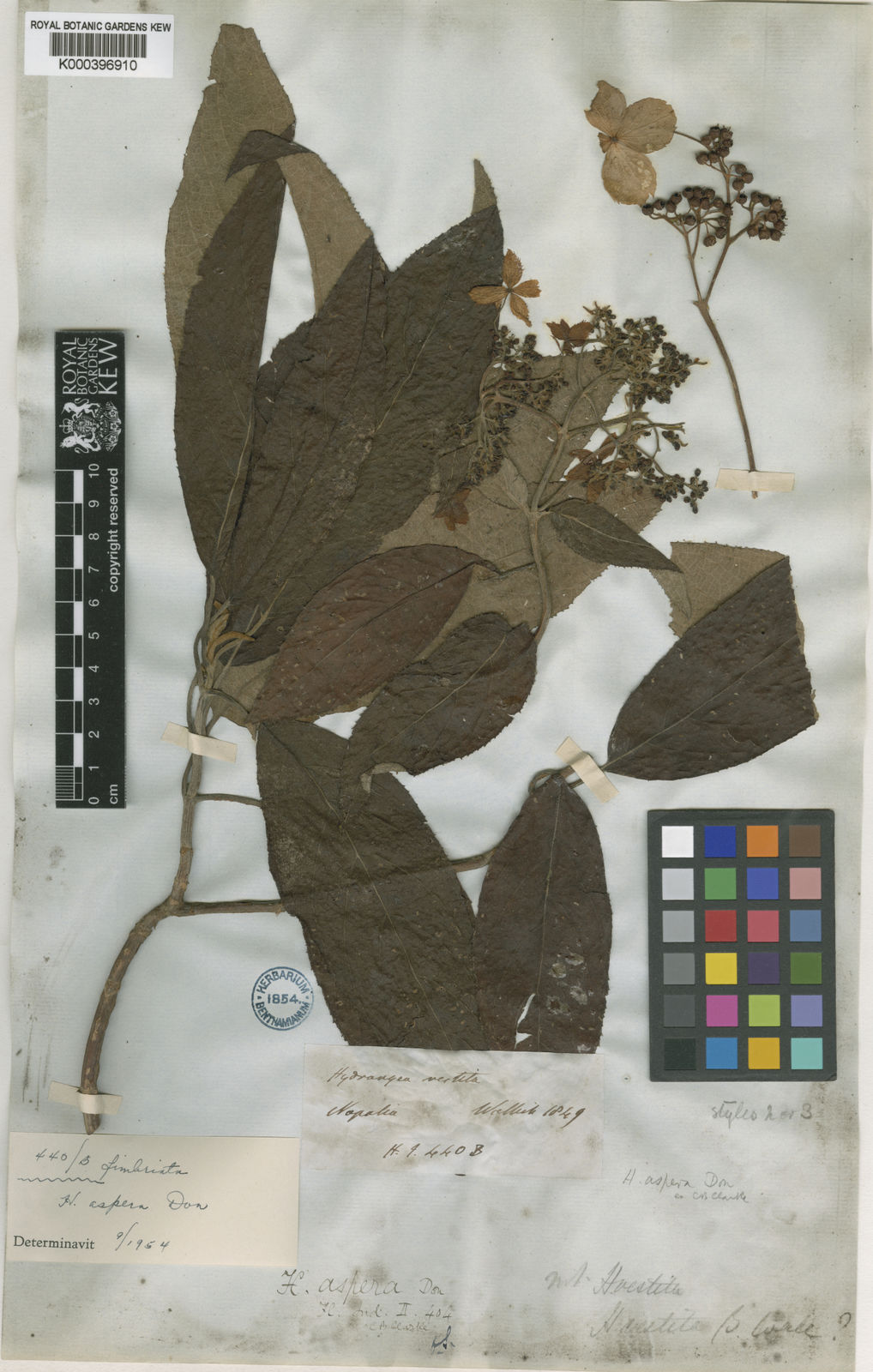
© copyright of the Board of Trustees of the Royal Botanic Gardens, Kew.




Global distribution
POWO places the native range of Hydrangea aspera from the Himalayas to central and southern China, Indochina and Taiwan. Broader horticultural references to mountainous Asia are summaries for cultivation, rather than a precise distribution map.
- Native10
- Western Himalayas
- Eastern Himalayas
- Nepal
- Northeastern India
- North-central China
- South-central China
- Southeastern China
- Myanmar
- Vietnam
- Taiwan
Hexagons: regions where the plant occurs. Green dots: native range.1
Identity
The rough-leaf hydrangea (Hydrangea aspera Buch.-Ham. ex D.Don, 1825) is an accepted species of Hydrangea in the Hydrangeaceae family. POWO links the name to David Don's Prodromus Florae Nepalensis in 1825, and World Flora Online retains the same binomial and author citation. 1 2
Names such as rough-leaved hydrangea, rough leaf hydrangea and Chinese hydrangea help distinguish this plant from more familiar garden hydrangeas. Its hairy or rough foliage, tall upright branches and flat, often late-season flower heads give it a different appearance from the common bigleaf types. 4 6
The epithet aspera refers to a rough surface. That feature varies: depending on origin and horticultural name, the underside of a leaf may be grayish, downy, velvety or covered in stiffer hairs. This variability is one reason labels within the aspera group can be difficult to interpret. 5 7
Recognition
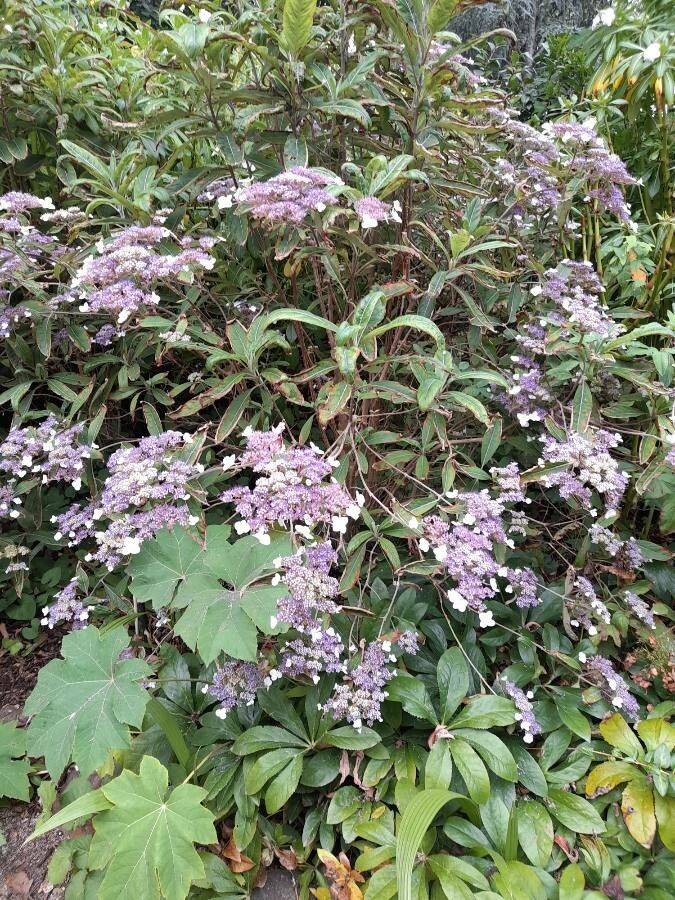
Upright, deciduous growth gives Hydrangea aspera a substantial garden presence, usually 2.5–4 m (8–13 ft) tall and 1.5–2.5 m (5–8 ft) wide. World Flora Online and Flora of China describe the species in its broad sense as a shrub or small tree that can exceed those dimensions in its native range. 4 2
The leaves are opposite, simple and toothed, with lance-shaped, ovate or oblong blades. Botanical descriptions commonly give a length of 5–25 cm (2–10 in), with densely downy to long-haired undersides. The RHS summarizes the garden character as soft, hairy, lance-shaped leaves up to 25 cm (10 in) long. 2 4
Flower heads have a lacecap arrangement: a flat center of small fertile flowers, often purple, pink or violet-blue, ringed by larger white, pinkish or purplish sterile flowers. Terminal flower heads reach 8–25 cm (3–10 in) across in botanical and horticultural descriptions. Their flat shape is as useful for recognition as their color. 2 5 4
Bloom comes relatively late for a hydrangea. Accounts from Northern Hemisphere gardens place it mainly from midsummer into early fall, with late summer particularly characteristic; timing shifts with climate and hemisphere. The fruits are small brown capsules, botanically useful for understanding the genus but seldom a main ornamental attraction. 2 4
Useful taxonomy
The accepted name Hydrangea aspera anchors an extensive history of names. POWO lists synonyms including Hortensia aspera, Hydrangea alba, Hydrangea glabripes, Hydrangea kawakamii, Hydrangea oblongifolia, Hydrangea pubescens and Hydrangea villosa. These names need to be read in the context of the taxonomic reference being used. 1 3
In practice, villosa, sargentiana, strigosa and robusta may appear as species, subspecies, horticultural groups or sales names, depending on the source. Trees and Shrubs Online describes H. aspera as the center of a variable, incompletely resolved complex. That history helps explain apparently contradictory nursery labels. 5 7
For gardeners, the uncertainty does not change the basic requirements of these deciduous shrubs: moist woodland conditions, often large hairy leaves, regular water and a sheltered position. It does change how a label should be read. Hydrangea aspera 'Macrophylla' is not Hydrangea macrophylla, and Hydrangea villosa may be treated separately or included within the aspera complex. 6 5
Habitat and range
From the Himalayas through central and southern China, Indochina and Taiwan, POWO records a broad Asian native range. Its detailed list includes the western and eastern Himalayas, Nepal, Myanmar, Vietnam, several Chinese regions and Taiwan. The geographic breadth helps explain why cultivated material can vary so much. 1 11
Floristic accounts associate the plant with dense forests and thickets in valleys or on mountain slopes, often at 700–4,000 m (2,300–13,120 ft). This ecology helps explain its behavior in gardens: it tolerates moderate cold, but drying soil, dry heat and winds that damage the large leaves are greater concerns. Conditions at the planting site matter more than a broad regional label. 2 5
In metropolitan France, the references used here assign no invasive status. Hydrangea aspera is treated as a cultivated ornamental shrub for moist gardens, parks and large partly shaded borders. That regional assessment does not establish a problematic naturalization elsewhere or provide a universal invasive classification. 6 3
Garden cultivation
Moisture-retentive soil and filtered light underpin successful cultivation. Aim for moist, humus-rich, well-drained soil. The RHS recommends partial shade, with sun possible where soil moisture is dependable. The SNHF favors acidic, rich, moist soil and suggests improving heavy ground with mature compost. These recommendations concern moisture without stagnation, rather than a permanently wet root zone. 4 6
Water more regularly than you would a drought-adapted Mediterranean shrub. During dry weather, 15–25 mm (0.6–1 in) per week provides a starting reference for plants in the ground. Check the growing medium more often in containers, on exposed banks or during heat waves. Apply water at the base: repeated overhead watering favors leaf spots and can damage flower heads. 6 4
Keep pruning light. The RHS places the species in a minimal-pruning group, and the SNHF chiefly recommends removing spent flowers and dead stems. Hard pruning can remove much of the plant's structure, delay the ornamental display and cut away some wood that would otherwise carry flowers. 4 6
Potential problems include aphids, capsid bugs, scale insects, vine weevils, leaf spots, powdery mildew, botrytis and, less commonly, honey fungus. Useful preventive care is straightforward: maintain healthy soil, mulch, water at the base, allow air to circulate and remove badly affected growth. These ordinary measures address the growing conditions without promising complete freedom from pests or disease. 4 6
Life cycle, uses and risks
Seasonal growth begins with spring budbreak in this deciduous woody perennial. Foliage develops into early summer, flowering comes mainly in late summer, and winter dormancy follows leaf fall in climates with a distinct growing season. Horticultural propagation relies chiefly on softwood or semi-ripe cuttings to preserve the characteristics of named forms. 4 6
Its principal role is ornamental: the back of a moist border, a woodland edge, a bank that is not waterlogged, a shaded courtyard or a large sheltered container. Lacecap forms retain visible fertile flowers at the center, potentially offering greater pollinator value than highly sterile mopheads, although this depends on the form being grown. 6 8
Toxicity advice should be cautious and proportionate. The RHS identifies Hydrangea aspera as a potential skin allergen and harmful to dogs and cats if eaten. The ASPCA's Hydrangea entry concerns H. arborescens: it lists cyanogenic glycosides, vomiting, depression and diarrhea, with cyanide poisoning described as rare. Pet Poison Helpline covers the genus Hydrangea and reports cyanide-containing compounds in all plant parts; that genus-level account supports caution without being a specific assessment of H. aspera. 4 9 10
No food or medicinal use is recommended for people. In its human-toxicity section, NC State's genus page specifies that only H. macrophylla is known to be toxic before describing low severity especially after large quantities are eaten; it does not provide an assessment specific to H. aspera. Pet Poison Helpline covers animals. These distinct scopes do not establish a garden hydrangea as a safe household remedy or food plant. 8 10
Cultivars and look-alikes
Among the useful horticultural names are 'Macrophylla', Villosa Group, Sargentiana, Strigosa, 'Hot Chocolate', 'Mauvette' and 'Peter Chappell'. They mainly distinguish size, hairiness, foliage color or flower heads. A different horticultural name does not automatically mean a different species, especially within this variable group. 6 5
The word Macrophylla frequently causes confusion with Hydrangea macrophylla. In H. aspera 'Macrophylla', it denotes a large-leaved form within the aspera complex; in Hydrangea macrophylla, it is part of another species' scientific name. The complete name on the label is essential to distinguish them. 6 1
When buying, assess the plant's habit, leaf undersides, lacecap flower structure, root condition and provenance. A specimen sold only as a hairy hydrangea or as "aspera villosa" may be beautiful, but a vague name deserves the same caution as an uncertain cultivar label. Observe the actual plant before drawing conclusions from its name alone. 7 5
Main sources
- Plants of the World Online / Kew, Hydrangea aspera Buch.-Ham. ex D.Don
- World Flora Online, Hydrangea aspera Buch.-Ham. ex D.Don
- GBIF Backbone Taxonomy, Hydrangea aspera Buch.-Ham. ex D.Don
- Royal Horticultural Society, Hydrangea aspera
- Trees and Shrubs Online, Hydrangea aspera
- Société Nationale d'Horticulture de France, Hydrangea aspera
- University of Arkansas Extension, Hydrangea aspera
- NC State Extension Gardener Plant Toolbox, Hydrangea
- ASPCA, Hydrangea toxicity entry
- Pet Poison Helpline, Hydrangea
- EPPO Global Database, Hydrangea aspera
Frequently asked questions
Is Hydrangea aspera a typical garden hydrangea?
It is a hydrangea, but differs from the familiar bigleaf type. It has a more botanical appearance, often grows larger, and bears hairy leaves and flat lacecap flower heads.
Why is it called rough-leaf hydrangea?
The name refers to the texture of the leaves, especially beneath. Within the aspera complex, they may feel rough, downy or velvety.
Should I prune it like Hydrangea paniculata?
No. Hydrangea aspera needs only light pruning. The hard late-winter pruning used for some panicle hydrangeas can remove much of its structure and delay flowering.
Can Hydrangea aspera grow in full sun?
Only where the soil stays reliably moist. Partial shade or morning sun is usually safer, particularly in dry climates or containers.
Is it toxic to animals?
Treat it as toxic. The RHS identifies Hydrangea aspera as harmful to dogs and cats if eaten. The ASPCA's Hydrangea entry, naming H. arborescens, describes cyanogenic glycosides with vomiting, depression and diarrhea; Pet Poison Helpline's genus-level account also supports caution.
Is Hydrangea aspera invasive in France?
No invasive designation is retained for metropolitan France. It is treated as a cultivated ornamental shrub, whose water needs and eventual size deserve particular attention. This does not establish its status elsewhere.
Similar plants

If you are unsure about a plant’s toxicity, ask a botanist or veterinarian for advice.