
bracted hydrangea (Hydrangea involucrata, )
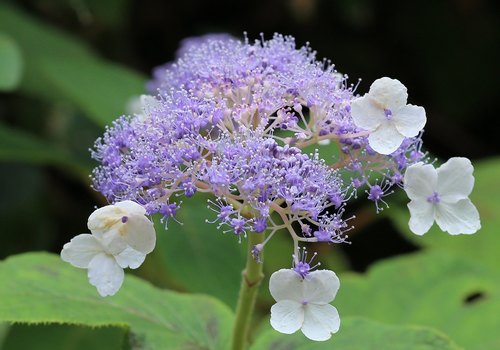

Bracted hydrangea (Hydrangea involucrata Siebold) is a deciduous Japanese shrub in the Hydrangeaceae family. Its almost spherical flower buds are enclosed in large bracts, opening into late lacecap heads that are often blue, mauve, pink or white.
Read morebracted hydrangea and tama-ajisai
Place in indirect light or in a shaded room.
Partial shade, light shade or morning sun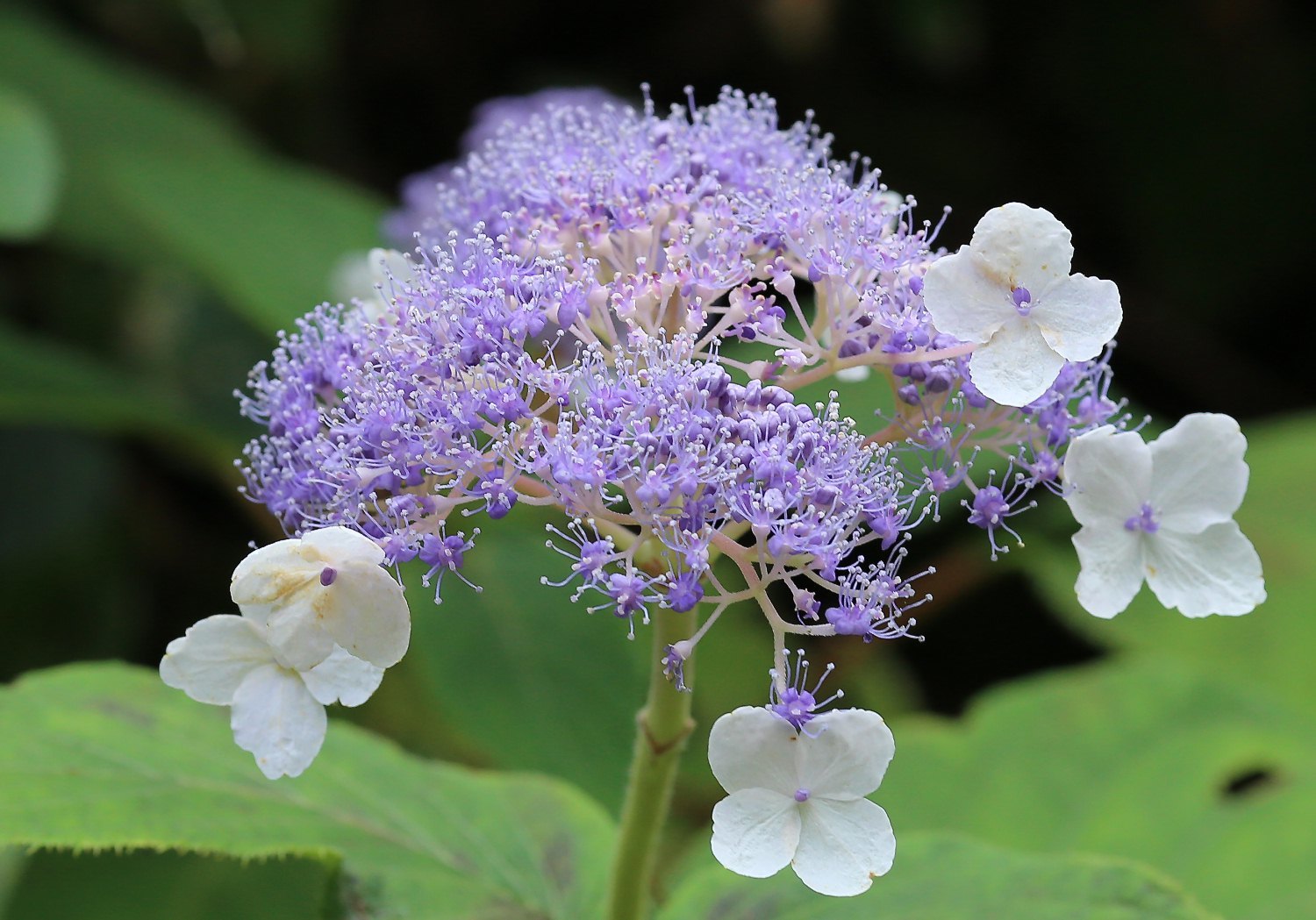


© photo
(c) 空猫, some rights reserved (CC BY-NC), uploaded by 空猫 · cc-by-nc
Wikimedia Commons · CC BY-SA or Public Domain
Wikipedia · CC BY-SA
Taken Aug 12, 2022 by manuseitz (cc-by-sa)


Global distribution
POWO places the native range in eastern Japan; Trees and Shrubs Online specifies chiefly the Pacific side of Honshu. Older records from Taiwan often reflect the inclusion of Hydrangea longifolia, now treated by several references as a distinct relative.
- Native4
- Japan
- Eastern Honshu
- Pacific side of Honshu
- Izu Peninsula and nearby islands
Hexagons: regions where the plant occurs. Green dots: native range.1
Identity
Bracted hydrangea (Hydrangea involucrata Siebold) is an accepted species of Hydrangea in the Hydrangeaceae family. Kew's Plants of the World Online links the name to Siebold's publication and places its native range in eastern Japan, describing it as a shrub of the temperate biome. 1 3
The common name points to its most useful identifying feature: before flowering, large pale bracts enclose each flower head in a tight ball. The Japanese name tama-ajisai refers to that rounded outline. Both names draw attention to the unopened head, rather than simply to the flowers that follow. 5 4
Descriptions of this hydrangea as dwarf need some qualification. The RHS describes a plant often around 0.5–1 m (1.5–3 ft) tall, while botanical descriptions and some cultivars allow for 1.5–2 m (5–6.5 ft) under favorable conditions. Its size depends on the selection and growing conditions. 4 5
Recognition
A compact or rounded deciduous shrub, Hydrangea involucrata ranges from low-growing to medium-sized. Young shoots, leaf stalks and flower heads are hairy; older stems may develop grayish bark that peels in patches. The hairs give it a duller, rougher appearance than many bigleaf hydrangeas. 5 6
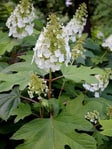
Opposite leaves are oval to obovate, toothed and dark green, often looking thick because of their covering of hairs. Trees and Shrubs Online gives leaf blades 10–25 cm (4–10 in) long and 4–12 cm (1.5–5 in) wide, with a finely toothed margin and visible veins. 5
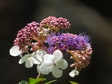
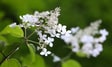
The unopened flower head is the strongest clue. Almost spherical at first, the terminal inflorescence is tightly wrapped in several large bracts. These fall as it opens, exposing a domed corymb or lacecap head: small fertile flowers in the center, often blue to mauve, and showier sterile flowers around the edge. The outer flowers may be white, pinkish, bluish or greenish, depending on the clone. 5 4 6
Useful taxonomy
For a consistent botanical identity, use Hydrangea involucrata Siebold. POWO and horticultural references treat it as an accepted species, although its boundaries with related taxa have been interpreted differently by different floras and at different times. 1 2
Taiwan is the main source of confusion. Some older accounts and web summaries extend the range there because they include Hydrangea longifolia within H. involucrata. Trees and Shrubs Online instead treats H. longifolia as a distinct Taiwanese relative; the Japanese range is therefore retained for H. involucrata. 1 5
Another name worth recognizing is Platycrater involucrata (Siebold) H.Ohba & S.Akiyama, listed as a synonym by Trees and Shrubs Online. In gardens, names such as Hortensis, Plena, Sterilis, Viridescens and Yoraku mainly distinguish mutations or cultivars, rather than separate species. 5
Habitat and range
Eastern Japan, particularly the Pacific side of Honshu, forms the core range in modern taxonomic accounts. Trees and Shrubs Online describes natural habitats in sunny rocky places or open mountain woods, from low elevations to about 1,500 m (4,900 ft). 1 5
In a garden, that background suggests good light without scorching heat, and steady moisture without waterlogging. The RHS recommends moist but well-drained soil in partial shade, allowing sun where soil moisture remains reliable. The Société Nationale d'Horticulture de France also emphasizes shade, cool moist soil and sensitivity to drought, especially in containers. 4 6
In mainland France, it is chiefly a cultivated ornamental for collections, cool woodland gardens or large outdoor containers, with no invasive status assigned. That regional description does not make it native there: it remains a Japanese shrub grown in gardens. It does not establish its status in other countries. 1 6
Cultivation and care
Watering is better understood as a depth of water than as a few small glasses. During growth and bud formation, a baseline of 15–25 mm/week (0.6–1 in/week), excluding rain, can help keep the soil moist; adjust it to soil texture, mulch, temperature and plant size. In a container, that amount may need to be split between waterings because the root ball dries more quickly. 4 6
The preferred soil is rich in organic matter, humus-rich, moist and well drained. The RHS accepts acid, neutral or alkaline soils but recommends improving chalky ground with organic matter. The SNHF advises improving excessively heavy soils and watching plants in calcareous ground. In practice, mature compost, mulch and watering at the base matter more than abrupt attempts to acidify the soil. 4 6
Pruning is more flexible than with many Hydrangea macrophylla. Trees and Shrubs Online notes that H. involucrata can flower on the current year's shoots, allowing it to bloom again after frost damage or cutting back to the base. That ability does not make hard pruning necessary. Remove dead wood in late winter, then make light corrections after flowering if the shape becomes unbalanced. 5 4
Life cycle, flowering and uses
Late flowering gives this shrub a different place in the garden from many other hydrangeas. The Japanese floras cited by Trees and Shrubs Online describe summer to early-autumn flowering; the RHS describes flowers throughout summer, and the SNHF extends the season from early summer to the first frosts, depending on conditions and cultivar. In cool temperate gardens, late summer is often its main season, as round buds and opening corymbs follow other shrubs. 5 4 6
The RHS recommends softwood cuttings in early summer or hardwood cuttings in winter for propagation. The species can also be raised from seed, but seedlings do not reliably preserve the characteristics of a double-flowered, green-flowered or especially compact cultivar. 4
A cool woodland border is a natural setting, alongside ferns, hostas, astilbes, Japanese maples and other plants suited to light shade. Lacecap forms retain visible fertile flowers. The more spectacular, densely double or mophead forms are best regarded primarily as ornamentals. 6 5
Uses and risks
Eating Hydrangea involucrata is not recommended. The ASPCA's Hydrangea entry names H. arborescens, listed as toxic to dogs, cats and horses, with cyanogenic glycosides, vomiting, depression and diarrhea. Pet Poison Helpline covers Hydrangea spp. and reports cyanide-containing compounds in all plant parts. That genus-level account supports caution with H. involucrata without assigning another species' assessment to it. 7 8
The Merck Veterinary Manual includes Hydrangea among cyanogenic ornamental plants and associates severe poisoning mainly with large ingestions, while most small-animal exposures chiefly require digestive support. The usual risk is therefore low, but leaves, flowers, buds and shoots should still be kept out of an animal's mouth. 9 7
For people, direct information chiefly concerns garden hydrangeas such as Hydrangea macrophylla. NC State describes low-severity poisoning after large quantities, linked to hydracyanosides, with nausea, abdominal pain, vomiting and sweating. As a precaution, no food or medicinal use is recommended for H. involucrata. 10
Cultivars and look-alikes
Naming can be difficult among the many cultivars of Hydrangea involucrata. Trees and Shrubs Online includes 'Hortensis', 'Gyokudanka', 'Handemari', 'Late Love', 'Plena', 'Sterilis', 'Viridescens', 'Wim Rutten' and 'Yoraku'. Double-flowered forms are particularly confusing because a single clone may circulate under a Japanese name, a Western name and a trade name. 5
The most useful comparisons are with Hydrangea aspera, another hairy hydrangea that is often larger, and with Hydrangea serrata or some lacecap H. macrophylla. Round buds tightly enclosed in large bracts are the feature that points back to H. involucrata. 5 4
Before buying, check for a credible cultivar name, a moist but unsaturated root ball and buds that have not dried out. A compact plant in a nursery pot will not necessarily remain dwarf. Conversely, a vigorous cultivar may stay low where its stems freeze or are cut back each winter. 4 6
Main sources
- Plants of the World Online / Kew, Hydrangea involucrata Siebold
- World Flora Online, Hydrangea involucrata
- GBIF Backbone Taxonomy, Hydrangea involucrata
- Royal Horticultural Society, Hydrangea involucrata
- Trees and Shrubs Online, Hydrangea involucrata
- Société Nationale d'Horticulture de France, Hydrangea involucrata
- ASPCA Animal Poison Control, Hydrangea
- Pet Poison Helpline, Hydrangea
- Merck Veterinary Manual, houseplants and ornamentals toxic to animals
- NC State Extension Gardener Plant Toolbox, Hydrangea macrophylla
Frequently asked questions
Is Hydrangea involucrata native to Japan or Taiwan?
Its principal native range is in Japan, particularly eastern Honshu and its Pacific side. Records from Taiwan often reflect the former inclusion of Hydrangea longifolia, which several recent references treat separately.
Why is it called bracted hydrangea?
Before opening, the flower head is enclosed in large bracts that create a distinctive round bud. The bracts fall as the corymb opens.
Should it be pruned like Hydrangea macrophylla?
Not exactly. Hydrangea involucrata can flower on the current year's shoots, giving more flexibility than a hydrangea flowering strictly on old wood. Keep pruning light: remove dead wood and make minor corrections to the shape.
Can it grow in shade?
Yes. Light shade and partial shade suit it well. Very dense shade may reduce vigor in some clones, but hot sun is often more troublesome than too little sun.
Does soil pH control the color as it does in familiar blue hydrangeas?
The response is less central than in Hydrangea macrophylla. Cultivars of H. involucrata often have their own characteristic color, with variations linked to light, cultivar and growing conditions.
Is Hydrangea involucrata toxic?
Treat it as toxic as a precaution. The ASPCA's Hydrangea entry names H. arborescens, listed as toxic to dogs, cats and horses. Veterinary accounts of the genus identify cyanogenic glycosides and support caution with H. involucrata. Signs are usually digestive, but eating any part is not recommended.
Similar plants
If you are unsure about a plant’s toxicity, ask a botanist or veterinarian for advice.