
Shasta daisy (Leucanthemum × superbum, )


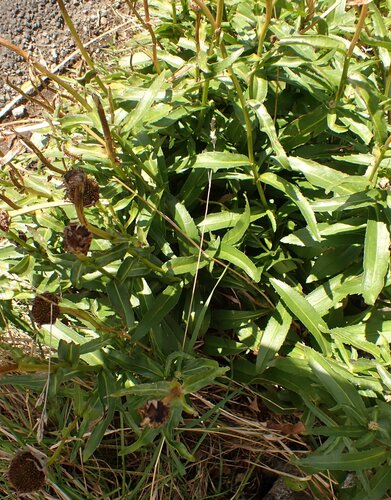
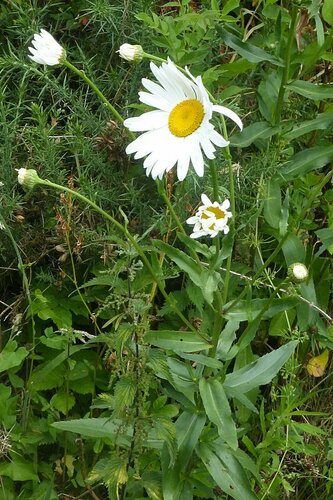
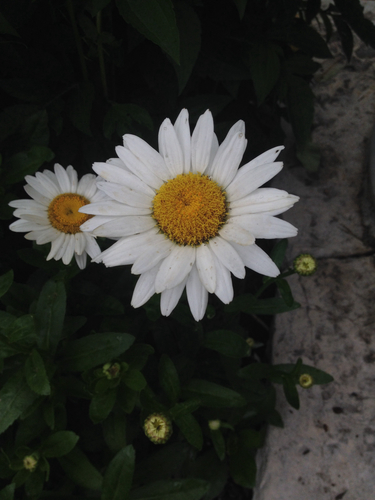
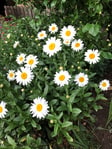
Shasta daisy (Leucanthemum ×superbum (Bergmans ex J.W.Ingram) D.H.Kent) is an herbaceous garden perennial in the Asteraceae. Upright clumps of dark green leaves carry large white heads with yellow centers in summer, usually single but sometimes double or fringed according to cultivar.
Read moreShasta daisy and Max daisy
Place in full sun, with intense direct light all day long.


© photo
Wikimedia Commons · CC BY-SA or Public Domain
(c) Jon Mortin, some rights reserved (CC BY) · cc-by
no rights reserved · cc0
Global distribution
Leucanthemum ×superbum has no native range comparable to a wild species: it is a garden hybrid. POWO treats it as an artificial hybrid and GBIF as an accepted name. French records represent observations, cultivation or local escapes rather than evidence of native occurrence.
- Introduced2
- Auvergne-Rhône-Alpes
- Germany
Hexagons: regions where the plant occurs. Green dots: native range.1
Identity
Broad white flower heads mark Shasta daisy (Leucanthemum × superbum (Bergmans ex J.W.Ingram) D.H.Kent), a garden Asteraceae rather than a native French wild daisy. POWO treats it as an artificial hybrid, published under this combination in Watsonia in 1990, and lists Chrysanthemum × superbum as a homotypic synonym. 1 2
Its common name comes from American horticultural history. Luther Burbank introduced the Shasta daisy in 1901 after lengthy selection work with large white daisies; Mount Shasta supplied the image of whiteness behind its name. This garden history explains why it is better understood as a horticultural group than as a straightforward native species. 9 8
The French word marguerite, like English “daisy,” is ambiguous: it can refer to Bellis perennis, Leucanthemum vulgare, Argyranthemum frutescens, bouquet chrysanthemums or Shasta cultivars. Max daisy is another name associated with Shasta, but the reliable botanical reference is Leucanthemum × superbum. 1 6
Recognition
Upright herbaceous clumps often spread 30 cm–1 m (1–3.3 ft) according to cultivar. RHS describes a robust, clump-forming perennial with thick, narrow, dark green leaves and single or double white heads up to about 10 cm (4 in) across. NC State gives a broader cultivated height range of 30 cm–1.2 m (1–4 ft), with heads often 5–12 cm (2–4.7 in) wide. 5 7
Simple leaves alternate along the stems. Lanceolate to oblanceolate, dark green and often glossy, they have coarsely toothed edges and become smaller toward the top of the stem. This outline helps distinguish a Shasta from the low lawn daisy, but separating it from wild oxeye daisy may also require the flower head and cultivation context. 7 13
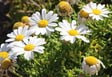
The apparent “flowers” are Asteraceae heads: white rays surround a yellow disc of small tubular florets. Cultivars greatly expand their appearance, with double heads, fringed petals, compact plants, tall cutting stems and pale yellow flowers in some modern selections. The familiar single white-and-yellow head represents only part of this horticultural variety. 5 7
Taxonomy and garden origins
Use the accepted name Leucanthemum × superbum (Bergmans ex J.W.Ingram) D.H.Kent. POWO identifies an artificial hybrid with the formula L. lacustre × L. maximum × L. vulgare. GBIF likewise places it in Leucanthemum, Asteraceae, with the English common name Shasta Daisy. 1 3
Horticultural accounts add a historical layer. Burbank is said to have worked with oxeye daisy, L. maximum and L. lacustre, followed by a Japanese parent often named Nipponanthemum nipponicum. The taxonomic formula used by POWO and the breeding history recounted by horticultural sources should therefore be distinguished, rather than merged into one unqualified account. 1 9 8
The synonym Chrysanthemum × superbum explains many old labels. NC State also notes its former placement in Chrysanthemum. That history is useful when reading earlier sources, but should not automatically transfer the toxicity or cultivation of modern florist's chrysanthemums to Shasta daisies. 1 7
Habitat, range and status
Shasta daisy has no native range of its own. It is a garden plant for perennial borders, cottage gardens, sunny beds, containers and cutting gardens. NC State describes it as a non-native hybrid, while RHS marks it as not native to Britain or Ireland. Neither classification makes garden cultivation a native wild occurrence. 7 5
In France, records therefore concern cultivation or local escapes rather than a native daisy. GBIF returns French occurrences, and TaxRef/INPN mirrors list the name in their reference data. Such records establish presence or observation, not native status throughout the country. Their meaning depends on the observation context as well as the name. 4 14
Invasive status also requires distinguishing the plants. Oxeye daisy, Leucanthemum vulgare, can be a troublesome weed in several regions outside Europe. Its management guide specifically separates the taller, larger-flowered ornamental Shasta from problematic oxeye daisy. The French assessment remains non-invasive, while poorly identified “daisy” seed mixtures are best avoided. These territorial distinctions do not establish a universal legal status. 13 1
Cultivation, life cycle and propagation
Sun, drainage and renewal underpin successful cultivation. RHS recommends moderately fertile, moist but well-drained soil in full sun or partial shade, with staking where tall forms need support. NC State adds that the plant tolerates average to dry garden soils where drainage is good. Moisture should therefore be considered together with drainage rather than as a reason to keep the crown saturated. 5 7
Water moderately. During establishment, in containers or through drought, 10–20 mm/week (0.4–0.8 in/week) is a practical guide, followed by less once the clump establishes and the soil retains some moisture. Saturated soil is more dangerous than brief dryness, encouraging a soft crown, root rot and Phytophthora-related decline. Adjusting to rainfall and the plant's condition matters more than applying water regardless of the soil. 7 5
Flowering chiefly runs from early summer into early fall, depending on climate and cultivar. Deadheading extends the display by limiting early investment in seed and maintaining flowering side shoots. At the end of the local season, cut the stems to the base and leave the rootstock to rest. 5
Division in spring or late summer is the most dependable propagation method and an important maintenance task. After several years, the clump's center weakens and flowering diminishes. Seed propagation is possible, but seedlings do not always reproduce the characteristics of double, compact or colored cultivars faithfully. Division retains the selected plant's character while renewing the clump. 5 7
Growing conditions help prevent leaf disease. The Pacific Northwest Pest Management Handbook describes Shasta leaf spots caused by organisms including Septoria leucanthemi and Alternaria, favored by splashing water, prolonged leaf wetness and infected debris. Watering at the base, spacing clumps and removing affected leaves matter more than routine treatment. 10
Uses and toxicity
Its main role is ornamental: cut flowers, summer beds, white borders, cottage gardens and pollinator planting. NC State records butterfly interest and use in borders, containers, cutting gardens and naturalized gardens; RHS likewise lists beds, cut flowers and informal gardens. The selected cultivar determines the height and flower form best suited to each use. 7 5
Toxicity needs careful wording. ASPCA's “Daisy” entry concerns Chrysanthemum species, toxic to dogs and cats, and its broader Chrysanthemum entry is often cited for dogs, cats and horses. Leucanthemum × superbum is no longer placed in Chrysanthemum, although the historical synonym encourages confusion. The named taxon in a toxicity reference therefore matters. 11 1
A low-level precaution, rather than a claim of no risk, is appropriate: prevent ingestion, keep it away from animals that chew plants, and watch for vomiting, diarrhea, excessive salivation or dermatitis after contact or ingestion. Pet Poison Helpline notes that pyrethrins derive from Chrysanthemum flowers or plants, reinforcing the value of correctly identifying “daisies” in bouquets. 12 11
Cultivars and look-alikes
The group's garden appeal owes much to its cultivars. NC State names 'Becky', 'Crazy Daisy', 'Lancaster Darling Daisy' and 'Snow Lady', with differences in form or disease resistance. RHS lists many selections, including doubles such as 'Wirral Supreme' and 'T.E. Killin', and pale yellow cultivars such as 'Goldfinch'. 7 5
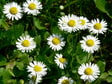
The most consequential confusion is with Leucanthemum vulgare. Both have white heads with yellow centers, but Shasta is a large-headed horticultural selection with many cultivars, while wild oxeye daisy can be difficult to manage outside its native range. On a seed mixture, the full label matters more than “daisy.” 13 6
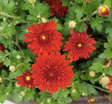
Toxicity confusion follows the same pattern. Chrysanthemum species, Bellis perennis, Argyranthemum frutescens and Leucanthemum × superbum may all be called “daisy” in some contexts, but they have different accepted names and risk profiles. For animal exposure, a photograph of a bouquet alone is insufficient: identify the genus. 11 12
Main sources
- Plants of the World Online / Kew, Leucanthemum × superbum (Bergmans ex J.W.Ingram) D.H.Kent
- World Flora Online, Leucanthemum superbum
- GBIF Backbone Taxonomy, Leucanthemum ×superbum
- GBIF occurrence search, Leucanthemum ×superbum in France
- Royal Horticultural Society, Leucanthemum × superbum
- Royal Horticultural Society, Leucanthemum genus guide
- North Carolina Extension Gardener Plant Toolbox, Leucanthemum x superbum
- Missouri Botanical Garden Plant Finder, Leucanthemum × superbum
- Luther Burbank Home & Gardens, Shasta Daisy
- Pacific Northwest Pest Management Handbooks, Shasta Daisy leaf spot
- ASPCA, Daisy toxicity entry for Chrysanthemum species
- Pet Poison Helpline, pyrethrins and pyrethroids
- Colorado / Weld County, Oxeye Daisy identification and management
- Préservons la Nature, TaxRef/INPN 17 source for Leucanthemum ×superbum
Frequently asked questions
Is Shasta daisy a wild species?
No. POWO treats it as an artificial hybrid and NC State as a non-native hybrid. It is a garden plant, even though some parents are wild Leucanthemum species.
Why is Leucanthemum ×superbum written with a ×?
The × indicates hybrid status. The current accepted name is Leucanthemum ×superbum, with Chrysanthemum × superbum as its historical homotypic synonym.
How does it differ from Leucanthemum vulgare?
Leucanthemum vulgare is the wild oxeye daisy, sometimes invasive outside its native range. Leucanthemum ×superbum is a generally larger garden Shasta daisy with many cultivars.
Does it need full sun?
Yes, for dense flowering and strong stems. RHS also accepts partial shade, but plants flower less well there and can flop.
How much water does it need?
In the ground, about 10–20 mm/week (0.4–0.8 in/week) is enough while establishing or during dry spells, provided the soil drains. Once established, the clump tolerates slight dryness better than a waterlogged crown.
Is it toxic to cats and dogs?
Low-level caution is preferable. No exact ASPCA entry for Leucanthemum ×superbum has been identified, but ASPCA lists Chrysanthemum daisies as toxic, and the former name Chrysanthemum × superbum encourages confusion. Contact a veterinarian after substantial ingestion or if symptoms appear.
Why divide the clump?
Shasta daisies age from the center. Division every 2–4 years keeps young, freely flowering sections that are less vulnerable to crown decline.
Similar plants
If you are unsure about a plant’s toxicity, ask a botanist or veterinarian for advice.