
golden-ray lily (Lilium auratum, )
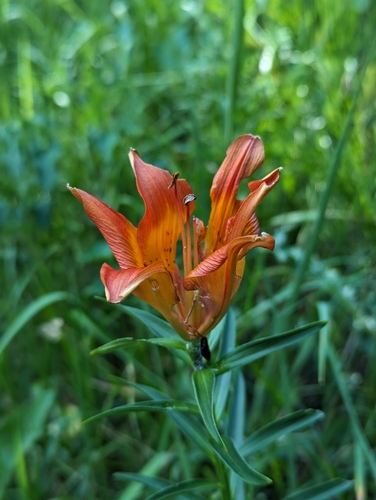
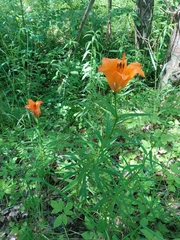
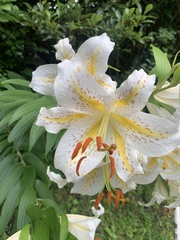
Golden-ray lily (Lilium auratum Lindl.) is a Japanese bulbous perennial in the Liliaceae, celebrated for large, fragrant white flowers with a golden central band and often dark red spots. Grown as a garden bulb or cut flower, it needs moist, well-drained, preferably acidic soil. Keep it out of homes and gardens visited by cats.
Read moregolden-ray lily, golden-rayed lily of Japan, gold-band lily, goldband lily, mountain lily and yama-yuri
Give plenty of ambient light without direct sun on the leaves.
Full sun to light partial shade, with the base shaded


© photo
Tobias Schönberg · cc0
Maria Kohanovskaya · cc-by
岸本年郎 · cc-by
© copyright of the Board of Trustees of the Royal Botanic Gardens, Kew.


Global distribution
POWO and WFO accept Lilium auratum as a species native to Japan. GBIF records Lilium auratum Lindl. and common names including the French lis doré, gold-band lily and yama-yuri. Mainland France is a region of horticultural cultivation, without a published invasive status.
- Native3
- Japan
- Northern and central Honshu
- Izu Shotō
Hexagons: regions where the plant occurs. Green dots: native range.1
Identity
A golden stripe running through each white tepal gives golden-ray lily (Lilium auratum Lindl.) its distinctive appearance. This accepted true lily belongs to the Liliaceae. POWO/Kew records its publication in the Gardeners' Chronicle in 1862, its Japanese origin and its life form as a bulbous geophyte of the temperate biome. 1
The French names lis doré and lys doré du Japon describe that same central golden band. Established English names include gold-band lily, golden-rayed lily of Japan, mountain lily and the spelling goldband lily; the Japanese name yama-yuri also appears in horticultural and taxonomic references. These names refer to the large white flowers rather than a separate yellow-flowered species. 4 3
Membership in the true Lilium group matters for both cultivation and safety. A true lily is neither lily-of-the-valley, peace lily nor Peruvian lily. Its danger to cats cannot automatically be transferred to every plant with “lily” in its common name. Botanical identity, rather than the name on a bouquet, determines which risk applies. 6 10
Recognition
A scaly bulb produces an upright, leafy stem that is usually unbranched. Dark green, lance-shaped leaves line the stem. Horticultural accounts generally describe cultivated plants 0.6–1.5 m (2–5 ft) tall, with taller stems possible in favorable conditions or in French horticultural descriptions. These are garden dimensions, not a fixed height every plant must reach. 4 5 7
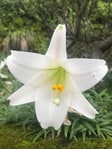
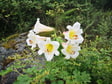
The flower is the strongest identifying feature: large, fragrant, open-bowled or outward-facing, with six white tepals that often curl back. A golden yellow band runs along the center of each tepal; dark red or crimson spots vary between forms. RHS describes flowers from mid-July onward, while Missouri Botanical Garden gives July through August, both Northern Hemisphere references to summer flowering. 4 5
Like many true lilies, it produces abundant pollen that stains. This also has a practical safety consequence: a cat can brush against pollen and swallow it while grooming. Cut flowers therefore remain a hazard, even when the plant is being used only as decoration. Fallen pollen and contact with the flowers need the same attention as the leaves. 10 11
Taxonomy and varieties
For identification, use Lilium auratum Lindl. POWO and WFO accept this name within the Liliales and Liliaceae. WFO also records the identifier wfo-0000685209 and the 1862 bibliographic origin. A shared accepted name makes it possible to compare garden accounts without treating every old catalog label as a different species. 1 2
Two infraspecific taxa are accepted by POWO: Lilium auratum var. auratum and Lilium auratum var. platyphyllum Baker. Kew associates the latter with the Izu archipelago. These botanical names are more precise than broad trade labels such as “gold band lily” or “oriental lily,” which do not by themselves establish the identity of a bulb being sold. 1
Historical names in the synonymy of the varieties include rubrovittatum, rubrum, tricolor, wittei and macranthum. They may reappear in older books, catalogs or collections. Their presence in those sources does not make them separate species; they need to be read within the botanical treatment to which they belong. 1
Origin and range
Its native range is Japan. POWO gives that country as the species' native area, and WFO places it in temperate Asia, eastern Asia, Japan. GBIF uses the same binomial in its taxonomic backbone and records several common names, including the French lis doré. Different vernacular names should not be mistaken for different geographical origins. 1 2 3
In mainland France, Lilium auratum is a cultivated plant, chiefly sold as bulbs, potted plants or cut flowers. No French invasive status is published, and the references do not establish it as a problematic naturalized plant there. That French assessment is regional; it does not supply an invasive classification for another country. 1 4
A word such as “Asian” is too broad to describe its growing conditions. Garden recommendations instead converge on moist but well-drained soil rich in organic matter, with the stems in good light and the base kept cool. The SNHF includes L. auratum among lilies that appreciate acidic soils. Drainage and a cool root zone remain distinct needs. 4 5 7
Growing golden-ray lily
Plant it as a true lily with a scaly bulb. RHS recommends fall planting in moist, well-drained soil enriched with organic matter, with bulbs about 15 cm (6 in) deep. Missouri Botanical Garden gives about 10–15 cm (4–6 in), a similar approach that varies with bulb size. Use the local fall season rather than transferring a Northern Hemisphere planting month to another climate. 4 5
Water regularly during growth. A practical starting point in open ground without rain is 10–20 mm/week (0.4–0.8 in/week), with more attention needed in a hot container. Avoid a water-filled saucer or persistently sodden soil. The bulb needs moisture to grow and flower, but water standing around its scales encourages rot. Adjust the supply to rainfall and soil rather than treating the figure as an automatic dose. 5 6
Good light or light partial shade suits the plant. Horticultural advice often expresses the balance as sun on the upper growth and shade or cool conditions at the roots. A light mulch, low perennials or a deep pot can help keep the base cool without depriving the bulb of air. The aim is a cool, drained root zone, not a permanently wet one. 4 5
After flowering, remove spent blooms if seed is not wanted, but leave stems and foliage until they yellow. The leaves rebuild the bulb's reserves for the following season. Separate offsets after the foliage dies back to propagate the plant. Bulb scaling and seed are also possible, but are slower ways to establish new plants. 4 5
Common problems
Spectacular flowers do not make this lily immune to disease. Missouri Botanical Garden lists lily mosaic virus, bulb rot and botrytis among potential problems. NC State also notes that aphids can transmit viruses and that excessively wet soils encourage rot. A weak plant therefore needs an assessment of its health and drainage, rather than simply more water or fertilizer. 5 6
RHS lists familiar lily pests: lily beetles, aphids, slugs, snails, thrips, larvae and vine weevils in containers. Start inspecting plants early. Lily beetles can quickly strip young stems, while aphids matter beyond their direct feeding damage because they can carry viruses. The particular pests present will depend on the growing site. 4 7
Tall stems may need discreet stakes, especially in windy sites, overly rich soil or too much shade. Poor flowering can follow a small or weak bulb, leaves cut too early in the previous year, waterlogged winter soil or insufficient light. These possibilities involve different causes; supporting a stem alone will not correct an unhealthy bulb. 5 7
Toxicity and bouquets
Cats face the principal safety risk. ASPCA lists Lilium species as toxic to cats, with kidney failure as the clinical sign, and non-toxic to dogs and horses. The FDA describes true lilies and daylilies as highly dangerous to cats, including their stems, leaves, flowers, pollen and vase water. The hazard persists when flowers are cut and brought indoors. 8 10
Pet Poison Helpline warns that even small amounts of petals or leaves, pollen or vase water can cause severe acute kidney failure in cats. Merck Veterinary Manual likewise describes feline nephrotoxicity from true lilies and recommends prompt care with renal monitoring. Suspected exposure should be treated as urgent rather than waiting to see whether a cat becomes visibly ill. 11 12
The distinction for other animals matters. The FDA says dogs that eat lilies may have minor stomach upset but do not develop the kidney failure typical of cats. ASPCA's Lilium species entry lists horses as non-toxic. These specific statements should not be replaced with a claim that all pets face the same feline renal hazard. 8 10
Keep Lilium auratum bouquets out of homes with cats, prevent access to vase water, and avoid pollen on surfaces where a cat walks. If exposure is suspected, call a veterinarian or animal poison control center immediately. Removing a vase after contact is not a substitute for seeking advice about the exposure that has already occurred. 9 10
Look-alikes and buying bulbs
Garden plants sold as Lilium auratum can be confused with Oriental hybrids that share aspects of its appearance: large, fragrant flowers in white, pink or yellow, with spots or colored bands. NC State notes that Oriental hybrids descend in part from L. auratum, L. speciosum and other species. A familiar flower pattern alone does not establish that a plant is the species. 6
Before buying, look for the exact binomial, horticultural group, expected height, actual flower color, fragrance and hardiness. Above all, consider whether cats can enter the home or garden. A plant sold as an “oriental lily” may be a hybrid, but it retains the feline hazard associated with true Lilium. Its commercial label does not provide a safety exception. 6 9
Other plants called lilies need separate identification. Lily-of-the-valley (Convallaria) is dangerous because of cardiac glycosides; peace lilies and callas irritate through oxalates; Peruvian lilies (Alstroemeria) do not cause the same feline kidney injury as true lilies. These profiles should not be combined. Lilium auratum is a true lily and must be handled accordingly. 10
Main sources
- Plants of the World Online / Kew, Lilium auratum Lindl.
- World Flora Online, Lilium auratum Lindl.
- GBIF Backbone Taxonomy, Lilium auratum Lindl.
- Royal Horticultural Society, Lilium auratum
- Missouri Botanical Garden Plant Finder, Lilium auratum
- NC State Extension Gardener Plant Toolbox, Lilium
- Société Nationale d'Horticulture de France, Lis
- ASPCA, Lily toxicity entry
- ASPCA, Which Lilies Are Toxic to Pets?
- U.S. FDA, Lovely Lilies and Curious Cats
- Pet Poison Helpline, Lilies
- Merck Veterinary Manual, Toxicity to Animals of Lilies
Frequently asked questions
Is golden-ray lily a true lily?
Yes. It is an accepted species of Lilium in the Liliaceae. Do not confuse it with plants called lilies only by common name, such as calla, peace lily, Alstroemeria or lily-of-the-valley.
Where does golden-ray lily come from?
POWO and WFO list Lilium auratum as native to Japan. POWO recognizes two varieties, var. auratum and var. platyphyllum.
When does Lilium auratum flower?
Horticultural references place flowering mainly from mid-July through August in their Northern Hemisphere context. The large, fragrant white flowers have a central yellow band and red spots.
What soil does it need?
Moist, humus-rich, well-drained soil. The SNHF includes it among lilies that appreciate acidic soil; RHS and Missouri Botanical Garden emphasize steady moisture without waterlogging.
Is it toxic to cats?
Yes, severely. As a true Lilium, it must be treated as dangerous to cats: leaves, flowers, pollen and vase water can cause a veterinary emergency.
Is it toxic to dogs and horses?
The ASPCA entry for Lilium species lists lilies as toxic to cats and non-toxic to dogs and horses. The FDA notes that dogs may have minor stomach upset without the kidney failure typical of cats.
Can it grow in a pot?
Yes, in a deep pot with drainage holes and a rich but freely draining growing medium. Container plants often stay smaller and need closer attention to watering.
Why does my golden-ray lily disappear after a few years?
Plants can be short-lived in cultivation if soil becomes too dry, stays waterlogged, overheats at the base or suffers from viruses or botrytis. Propagating offsets or bulb scales helps maintain the stock.
Similar plants

If you are unsure about a plant’s toxicity, ask a botanist or veterinarian for advice.