
tiger lily (Lilium lancifolium, )


Tiger lily (Lilium lancifolium Thunb.) is an Asian bulbous perennial in the Liliaceae. Its nodding orange flowers have strongly recurved, heavily spotted tepals. Dark bulbils in the leaf axils explain its easy propagation and sometimes aggressive spread in gardens. Like all true Lilium, it must be kept out of bouquets and gardens accessible to cats.
Read moretiger lily, lance-leaved tiger lily and devil lily
Allow a few hours of direct sun per day, preferably morning or evening.
Full sun to light partial shade
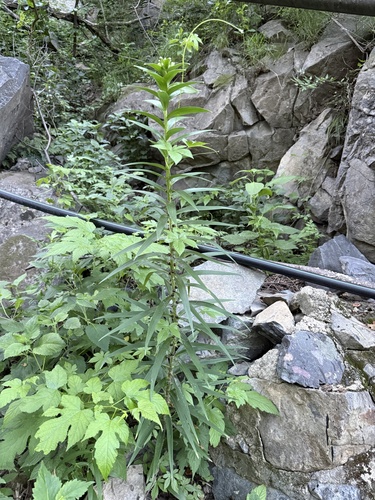


© photo
Kim, Hyun-tae · cc-by
Jane Charlen · cc-by
Wikimedia Commons · CC BY-SA or Public Domain
Taken Jul 6, 2022 by John Davies (cc-by-sa)
Taken Aug 3, 2020 by J fry (cc-by-sa)
Taken Jul 5, 2020 by James Smith (cc-by-sa)
© copyright of the Board of Trustees of the Royal Botanic Gardens, Kew.


Global distribution
POWO accepts Lilium lancifolium Thunb. and gives a native range from the Russian Far East to Japan and Tibet, listing China, Korea, Japan, the Kuril Islands, Manchuria, Primorye, Sakhalin and Tibet. It is also introduced or naturalized in several temperate regions. In mainland France it is cultivated horticulturally, with no published national invasive status.
- Native5
- Introduced2
- China
- Korea
- Japan
- Russian Far East
- Tibet
- Eastern North America
- Temperate Europe
Hexagons: regions where the plant occurs. Green dots: native range.1
Identity
tiger lily (Lilium lancifolium Thunb.) is an accepted species of true lily in the Liliaceae. POWO/Kew links the name to Thunberg's 1794 publication and describes the species as a bulbous geophyte of the temperate biome. 1 3
The older name Lilium tigrinum can be misleading. Still common in nurseries, older books and toxicity references, it is treated by POWO and GBIF as a synonym of Lilium lancifolium. The reference name is therefore L. lancifolium, while L. tigrinum is a historical name worth recognizing on labels. 1 3
Its spotted orange flowers explain the name tiger lily; lance-leaved tiger lily and devil lily are other names. A common name alone cannot identify the plant, since “tiger lily” is used for several lilies or daylilies in different regions. Dark bulbils in the upper leaf axils provide a much more useful character for confirming Lilium lancifolium. 6 7
Recognition
A scaly bulb sends up an upright stem, often green to dark purple. Narrow, lance-shaped, stalkless leaves alternate densely along it. Horticultural references generally describe plants 1–1.5 m (3.3–4.9 ft) tall in cultivation, with specimens approaching 1.8 m (5.9 ft) in rich soil. 4 5
Axillary bulbils are a distinctive garden feature. RHS describes purple-black bulbils in the upper leaf axils; Go Botany also uses them to distinguish this species from similar North American lilies. These small structures are not seeds: they produce clones and fall readily to the ground. 4 7
Flowering falls mainly between late summer and early fall, depending on climate. The nodding orange flowers have a turban shape, with six strongly recurved tepals heavily marked inside with brown-purple to black spots. NC State describes nodding flowers with recurved tepals, about 8–15 cm (3.1–5.9 in) across, and protruding anthers and stigma. 5 6
Taxonomy and names
The accepted binomial is Lilium lancifolium Thunb. POWO places it in Liliales, Liliaceae and Lilium, and lists several historical or horticultural synonyms: Lilium tigrinum, L. tigrinum var. splendens, L. lancifolium var. flaviflorum, fortunei, splendens and L. leopoldii. 1
WFO and GBIF also recognize Lilium lancifolium at species rank. For gardeners, the distinction is practical: a plant sold as L. tigrinum is not a different species in this context, and a double or yellow form does not remove its cultivation requirements or the risk to cats. 2 3
The most widespread garden form is often a sterile triploid clone propagated by bulbils. Fertile diploids occur in wild populations or specialist collections. This helps explain differences among references: horticultural accounts often describe a plant that does not fruit, whereas floras may record capsules in fertile forms. 5 6 8
Origin and distribution
POWO gives a broad native range from the Russian Far East to Japan and Tibet, listing China, Korea, Japan, the Kuril Islands, Manchuria, Primorye, Sakhalin and Tibet. RHS summarizes the horticultural range as eastern China, Japan and Korea. Its origin is East Asian, with a long cultivation history that can blur the boundary between wild, cultivated and naturalized plants. 1 4
Across North America it is widely cultivated and often escapes around homes, banks, railways and roadsides. Flora of North America describes it as introduced and sporadic but readily recognizable in the east and northeast of the continent, often spreading through bulbils. 6 7
In mainland France, tiger lily is a cultivated garden or cut-flower plant, with no published French invasive status. Garden precautions concern local control of bulbils and keeping it away from cats, rather than a national invasive-species alert. That French assessment does not establish its status elsewhere. 1 3
Life cycle, bulbils and cultivation
As a bulbous geophyte, tiger lily grows in spring, flowers in late summer, then replenishes its bulb before dying back for winter. More tolerant in cultivation than many lilies, it still needs the essentials of the genus: light, moist soil during growth, strict drainage around the bulb and foliage left in place until it yellows. 4 5
RHS recommends moist but well-drained soil enriched with organic matter, preferably acidic but tolerating some lime. NC State specifies full sun to partial shade, good drainage, humus-rich or loamy soil and USDA zones 5–8. A useful watering baseline is 10–20 mm/week (0.4–0.8 in/week) during growth when rainfall is insufficient, reduced sharply after the foliage yellows. 4 5
Bulbil production needs management. The bulbils form on the stem, ripen, fall and produce plants genetically identical to their parent. This makes a cultivar easy to propagate, but can also crowd a flower bed. In a small garden, collect them before they fall or remove surplus young plants. 4 7
Offsets, bulb scales and seed offer other propagation methods, depending on the stock. Familiar triploid forms produce few or no viable seeds; fertile forms are of greater botanical or breeding interest. The same precaution applies beyond French gardens: buy healthy, correctly identified bulbs or plants rather than moving unidentified lilies. 5 8
Common problems
Easy cultivation has a drawback: tiger lily can be difficult to contain. NC State describes aggressive or weedy behavior in gardens because bulbils produce numerous clones. This behavior is distinct from a French invasive designation, but does require active management of a planting. 5
Pests are those familiar on lilies: lily beetles, aphids, slugs, snails, thrips, larvae, soil-dwelling worms and vine weevils in containers. RHS also lists gray mold and viruses among possible diseases. Aphids cause a further problem because they can help spread viruses between lilies. 4 5
Tiger lily is sometimes said to carry viruses without declining severely itself. The Lilium Species Foundation notes that traditional clones have been implicated as reservoirs of lily mosaic viruses, although modern clean-stock practices reduce this risk. As a precaution, do not propagate distorted, mosaic-marked or weakened plants near susceptible lilies. 8 4
Toxicity and cut flowers
Cats face the central safety risk. The ASPCA lists Lilium species as toxic to cats, with kidney failure as a clinical sign, and non-toxic to dogs and horses. The FDA explicitly names tiger lily, Lilium tigrinum or Lilium lancifolium, among lilies that are highly dangerous to cats. 9 10
For cats, every part matters: stems, leaves, flowers, pollen and even vase water. The FDA states that a small amount of leaf or petal, a few grains of pollen licked off during grooming, or water from a vase can cause fatal kidney failure in less than three days. Pet Poison Helpline gives the same advice: contact a veterinarian immediately if exposure is suspected. 10 11
The risk to dogs must be described separately. The FDA reports possible minor digestive upset after lily ingestion, without the kidney failure characteristic of cats. For horses, no direct tiger-lily toxicity is published; the ASPCA's Lilium species entry lists them as non-toxic. This is not a reason to feed lilies to them, but avoids wrongly extending the feline risk to other animals. 9 10
The practical rule is strict: no tiger-lily bouquets in a home with cats, no accessible cut stems, no pollen on tables or ledges visited by cats, and no accessible vase water. The same caution applies outdoors to roaming cats, including neighbors' pets. 10 12
Uses, look-alikes and buying plants
Ornamental planting is its main use: borders, open woodland edges, deep pots and cut flowers in homes without cats. Some North American botanical references report that the large bulbs have been eaten in Asia, but that record is not dietary advice. A garden plant that has been identified, treated, hybridized or improperly prepared is not automatically food. 6 7
Likely look-alikes include orange daylilies, Lilium bulbiferum, Lilium martagon, Lilium superbum and other American lilies also called tiger lilies. Go Botany distinguishes L. lancifolium from L. superbum particularly by its alternate leaves and axillary bulbils, which the latter lacks. 7 6
Before buying, check four points: the scientific name, expected height, likely bulbil production and whether cats could be exposed. A label reading Lilium tigrinum, “tiger lily,” “Flore Pleno” or “Splendens” may be horticulturally valid, but changes neither the need for drainage nor bulbil management nor the feline risk. 4 3
Main sources
- Plants of the World Online / Kew, Lilium lancifolium Thunb.
- World Flora Online, Lilium lancifolium Thunb.
- GBIF Backbone Taxonomy, Lilium lancifolium Thunb.
- Royal Horticultural Society, Lilium lancifolium (IXc/d)
- NC State Extension Gardener Plant Toolbox, Lilium lancifolium
- Flora of North America, Lilium lancifolium
- Native Plant Trust Go Botany, Lilium lancifolium
- Lilium Species Foundation, Lilium lancifolium
- ASPCA, Lily toxicity entry
- U.S. FDA, Lovely Lilies and Curious Cats
- Pet Poison Helpline, Lilies
- Merck Veterinary Manual, houseplants and ornamentals toxic to animals
Frequently asked questions
Are Lilium lancifolium and Lilium tigrinum the same plant?
Yes in these database treatments: Lilium lancifolium Thunb. is the accepted name, and Lilium tigrinum Ker Gawl. is a widely used historical synonym.
How can I recognize a true tiger lily?
Look for the combination of nodding, heavily spotted orange flowers, recurved tepals, alternate lance-shaped leaves and dark bulbils in the upper leaf axils.
Are the bulbils seeds?
No. They are small vegetative organs that produce clones of the parent plant. They explain tiger lily’s rapid spread in gardens.
Is tiger lily toxic to cats?
Yes, highly. The FDA lists tiger lily, Lilium tigrinum or Lilium lancifolium, among true lilies dangerous to cats. Flowers, leaves, pollen and vase water are all involved.
Is it toxic to dogs and horses?
The ASPCA lists Lilium species as toxic to cats but non-toxic to dogs and horses. The FDA notes that dogs may develop minor digestive upset, without the kidney failure characteristic of cats.
Can tiger-lily bulbs be eaten?
Some botanical references report Asian food uses of the bulbs, but that is not culinary advice. Identification, plant part, preparation and health context need documentation from a specialist food reference.
Is tiger lily invasive in France?
It has no recorded French invasive status. It is treated as cultivated in mainland France, with attention to garden bulbils rather than a national invasive alien species alert.
Similar plants



If you are unsure about a plant’s toxicity, ask a botanist or veterinarian for advice.