
Orange lily (Lilium bulbiferum, )

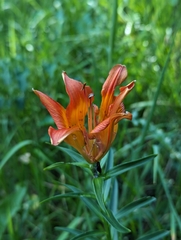
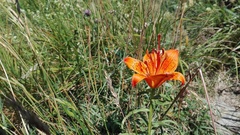
Orange lily (Lilium bulbiferum L.) is a European bulbous perennial in the Liliaceae, with upright stems and large orange flowers in early summer. French floras chiefly record the western var. croceum, which can lack bulbils despite the species name. Like other true lilies, it must be kept away from cats.
Read moreOrange lily, fire lily and bulb-bearing lily
Allow a few hours of direct sun per day, preferably morning or evening.
Full sun or light partial shade


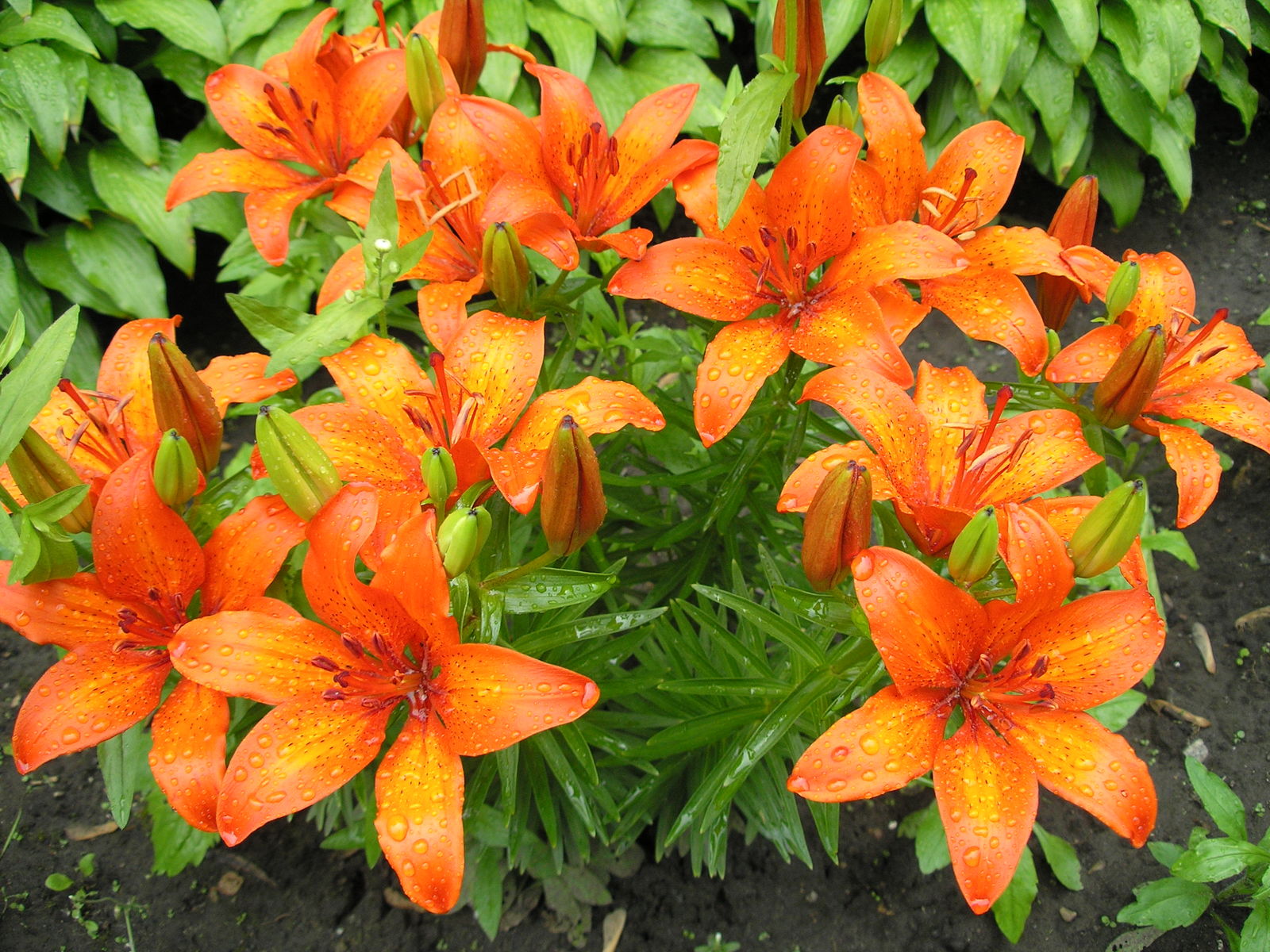


© photo
(c) sunoochi, some rights reserved (CC BY) · cc-by
Tobias Schönberg · cc0
Ruben Ciantia · CC BY-NC
Taken Aug 5, 2019 by Nadine boulanger (cc-by-sa)
Taken Mar 26, 2022 by Annemarie Ahrens-Stehle (cc-by-sa)
Taken Jul 9, 2006 by Andrzej Konstantynowicz (cc-by-sa)
Taken Jun 17, 2020 by Pl@ntNet (cc-by-sa)
© copyright of the Board of Trustees of the Royal Botanic Gardens, Kew.




Global distribution
POWO accepts Lilium bulbiferum L., with a native range from central Europe to Romania and Corsica. French floristic sources chiefly record Lilium bulbiferum var. croceum in mountain woods and meadows of the Jura, Alps and Corsica. No French invasive status is recorded.
- Native7
- Central Europe
- Romania
- Alps
- Apennines
- Northern Balkans
- Corsica
- Mainland France
Hexagons: regions where the plant occurs. Green dots: native range.1
Identity
Bright, upright orange flowers distinguish orange lily (Lilium bulbiferum L.), a European true lily in the Liliaceae. POWO/Kew accepts the name and traces it to Linnaeus's publication of 1753, with a native range centered on central Europe through Romania and Corsica. The established English names fire lily and bulb-bearing lily also refer to this species. 1 4
Its scientific name is informative but potentially misleading. Bulbiferum means “bearing bulbs,” referring to bulbils that may develop in the upper leaf axils. French references, however, chiefly record the western Lilium bulbiferum var. croceum, known there as lis faux safran or lis safrané. This form may have no visible bulbils at all. The name does not promise that every plant will produce them. 3 5
In gardens, treat it as an outdoor species lily: a scaly bulb, an upright stem, early-summer orange flowers, a need for drainage and a winter rest. It is not a permanent houseplant, although flowers can be cut for a home without cats. Its seasonal growth should be understood before choosing a planting position or using it indoors. 2
Recognition
From its scaly bulb, orange lily raises an upright stem in spring, remaining leafy through flowering. Descriptions show considerable size variation: Coste's flora, reproduced by Tela Botanica for var. croceum, gives about 25–70 cm (10–28 in), while RHS describes cultivated plants reaching 1–1.5 m (3.3–5 ft). These accounts concern different contexts, rather than one guaranteed garden height. 3 2
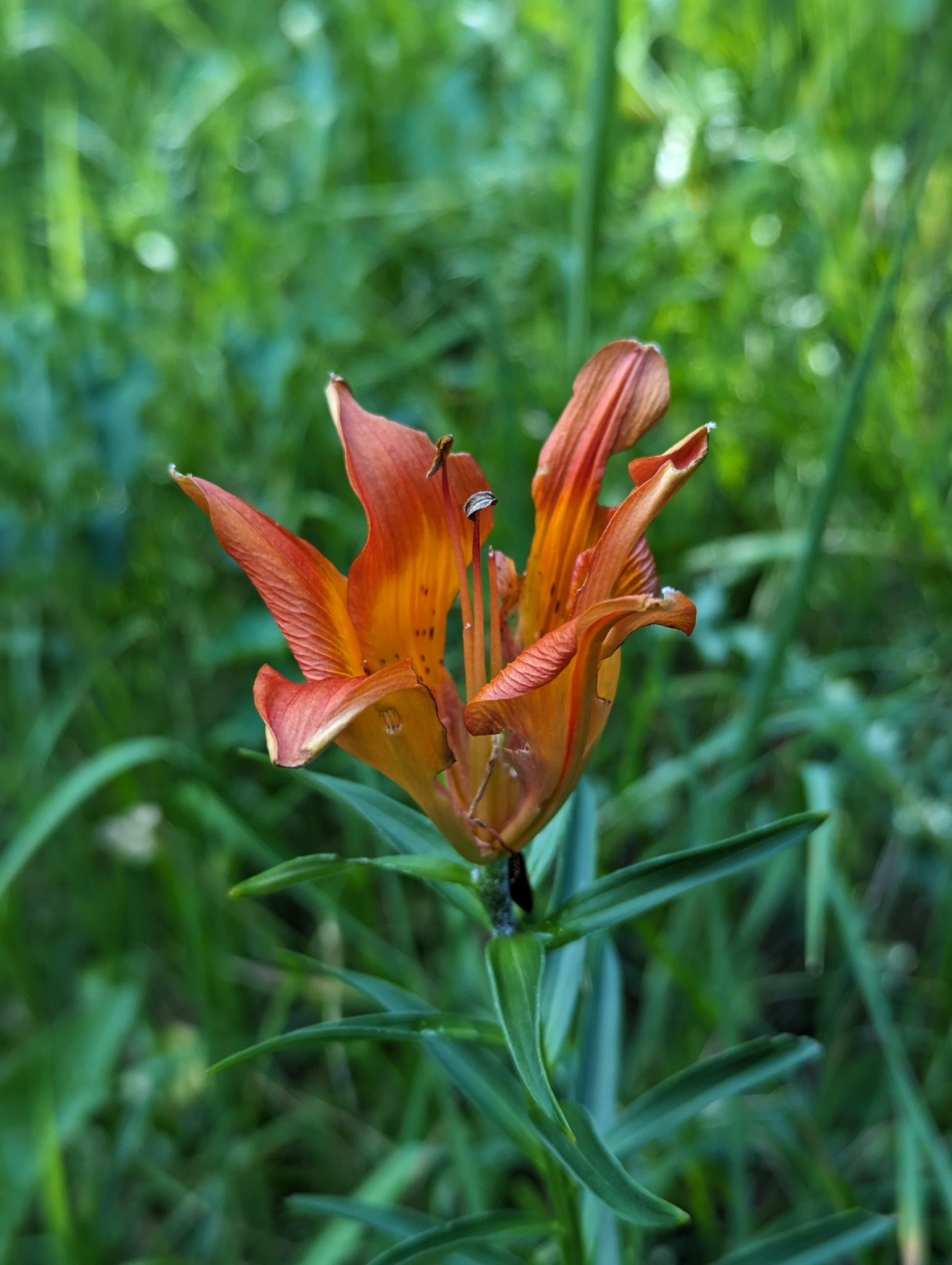
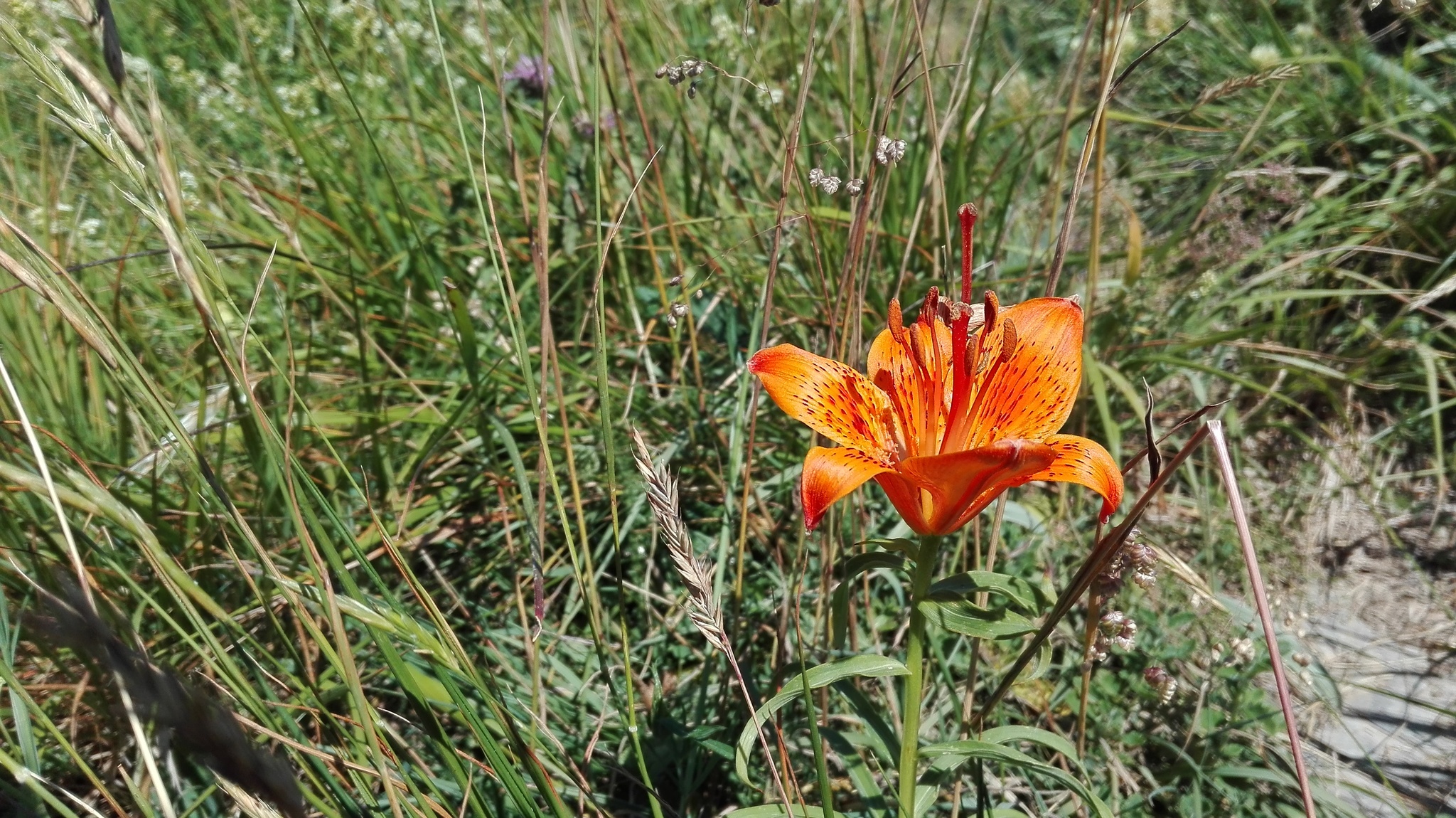
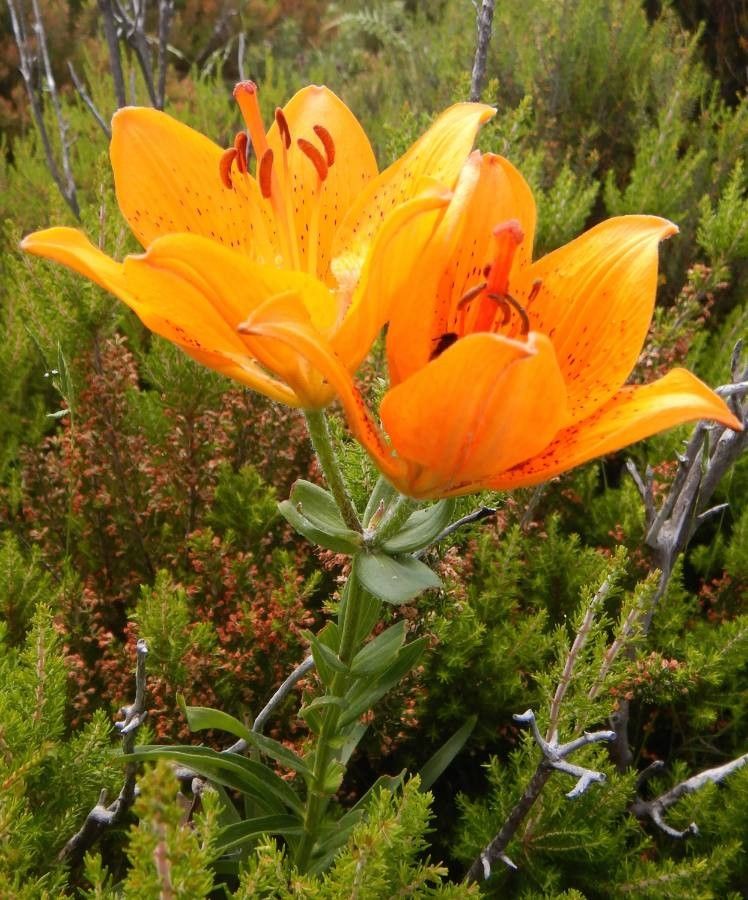
The numerous green leaves range from lance-shaped to narrowly lance-shaped and are often held upright and outward. Flowers provide the clearest clue: large, upright or slightly outward-opening, orange to red-orange, sometimes dark-spotted near the base. RHS describes orange, spotted, upward-facing bowl-shaped flowers from June through August in its Northern Hemisphere summer season. 2 3
Bulbils are not an absolute test. Their presence fits certain forms of L. bulbiferum, but their absence does not exclude the western orange lily. In the French Alps, plants are often called var. croceum, historically Lilium croceum. There, the upright orange flower and leafy stem are more dependable clues than an expectation that the plant must carry bulbils. 3 5
Taxonomy and forms
Use the binomial Lilium bulbiferum L. when comparing references. GBIF places it at species rank within the Liliales and Liliaceae, and records numerous historical synonyms, including Lilium aurantiacum, Lilium croceum and several combinations involving var. croceum. Older names in a catalog therefore need not indicate a separate species. 4
French accounts require two levels of interpretation. In the broader treatment, L. bulbiferum is the species accepted by POWO. Within the French floristic treatment, Tela Botanica uses Lilium bulbiferum var. croceum for the plant called lis faux safran, with Lilium croceum Chaix as its basionym. Keep the species treatment distinct from the name retained by a regional flora. 1 3
The Lilium Species Foundation describes two forms useful to gardeners: a central European bulbiferum form with axillary bulbils, and a western and Italian croceum form often lacking them. This simplified distinction does not replace a local flora. It does explain why two similar orange-flowered plants may offer different opportunities for vegetative propagation. 5
Habitat and range
Europe is its native home. POWO summarizes the range as central Europe to Romania and Corsica. The Lilium Species Foundation gives a broader horticultural account encompassing the Alps, Apennines, northern Balkans and scattered populations in central and southern Europe. Regional records and broad garden descriptions should be compared with their geographical scope in mind. 1 5
For France, Tela Botanica's account of var. croceum is particularly useful: mountain woods and meadows in the east, including the Jura, the Alps of Savoie, Dauphiné and Provence, and Corsica, with flowering in June and July. That source also records protection, regulations and Red List assessments that vary by territory. These French listings are not regulations for every English-speaking reader, but they show why collecting wild bulbs should not be treated casually. 3
Its habitat helps explain cultivation. Orange lily appreciates open light, but not soil that becomes hot and dry in spring. Hay meadows, open edges and well-drained slopes can keep the bulb cool while allowing the flowering stem enough sunlight. In a garden, light for the stem and suitable conditions around the bulb need to be considered together. 3 2
Life cycle and cultivation
As a bulbous geophyte, it emerges above ground in spring, flowers chiefly in June and July in the French mountain context, then declines after replenishing its bulb. RHS recommends fall planting about 15 cm (6 in) deep in moist but well-drained soil enriched with organic matter. Follow the local fall season; the French flowering months describe their original Northern Hemisphere setting. 2 3
Water according to growth rather than the calendar alone. During stem extension and flowering, 10–20 mm/week (0.4–0.8 in/week) from rain or irrigation is often enough in well-drained garden soil. Once the foliage yellows, excess water becomes a risk. A dormant bulb in cold, saturated growing medium is more likely to rot than resume growth. Do not keep watering simply because the same amount suited an actively growing stem. 2
Separating offsets after the foliage dies down is the simplest propagation method. Bulb scaling and seed are possible but slower. Axillary bulbils can also be harvested when present; they should not be promised on every plant sold or found under this species name. Check the plant itself and the form concerned before relying on bulbils as the route to more plants. 2 5
Toxicity and look-alikes
Cats face a severe hazard. ASPCA lists Lilium species as toxic to cats, with an unknown toxic principle and kidney injury. The FDA warns that true lilies and daylilies can cause fatal kidney failure after exposure to leaves, flowers, pollen or vase water. Flowers brought indoors remain part of that risk even after they have been separated from the bulb. 6 7
Pet Poison Helpline and Merck Veterinary Manual likewise identify Lilium and Hemerocallis as particularly dangerous to cats, with vomiting, appetite loss and lethargy followed by acute kidney injury. Keep orange lilies out of bouquets and gardens accessible to cats, and seek veterinary attention immediately after suspected contact or ingestion. Waiting for renal signs can lose valuable treatment time. 8 9
The evidence for dogs and horses is different. ASPCA's Lily entry lists Lilium species as non-toxic to both, while the FDA mentions possible stomach upset in dogs without the kidney failure typical of cats. Ingestion should still be discouraged, but these statements do not justify assigning dogs and horses the same renal toxicity as cats. 6 7
Common names add another layer of confusion. “Tiger lily” often means Lilium lancifolium, “daylily” means Hemerocallis, while lily-of-the-valley and peace lily are outside Lilium. These plants do not all share the same toxic profile. For cats, however, true lilies and daylilies are both groups to exclude from the outset. An imprecise florist's label is not a sound basis for deciding otherwise. 7 9
Responsible cultivation in France
In a mountain meadow, orange lily can look like a garden flower growing wild. That appeal is a reason for restraint. French wild populations, especially those called var. croceum, appear in local conservation and regulatory listings. Gardeners should buy nursery-propagated bulbs rather than move a bulb found in the wild. These conservation and regulatory listings concern the French territories in question. 3
In borders, its appeal comes from a simple outline: a vertical stem, narrow leaves and a relatively brief display of orange flowers. Low perennials suit it better than a crowded, heavy planting. Companions should lightly shade the base without depriving the flowering stem of light. This arrangement reflects the balance between a cool bulb and well-lit upper growth. 2
In a bouquet, orange pollen can stain and needs the same care as that of other lilies. The greater concern is the cat rather than the tablecloth: one stem in a vase makes the water, anthers and fallen petals potential sources of exposure. The practical rule is straightforward: no true lilies in a home with cats. 7 8
Main sources
- Plants of the World Online / Kew, Lilium bulbiferum L.
- Royal Horticultural Society, Lilium bulbiferum (IXa/b)
- Tela Botanica eFlore, Lilium bulbiferum var. croceum
- GBIF Backbone Taxonomy, Lilium bulbiferum L.
- Lilium Species Foundation, Lilium bulbiferum
- ASPCA, Lily toxicity entry
- U.S. FDA, Lovely Lilies and Curious Cats
- Pet Poison Helpline, Lilies
- Merck Veterinary Manual, toxicity to animals of lilies
- Supplementary botanical data, Lilium bulbiferum
- ASPCA, dog, cat and horse toxicity data for Lilium
Frequently asked questions
Does orange lily always produce bulbils?
No. Bulbiferum refers to bulbils carried by some forms, especially the more eastern typical form. French floras often record var. croceum, which may not produce visible axillary bulbils.
Is orange lily toxic to cats?
Yes. As a true lily in Lilium, it must be treated as dangerous to cats: flowers, leaves, pollen and vase water can cause acute kidney failure.
Is it toxic to dogs and horses?
ASPCA lists Lilium species as non-toxic to dogs and horses; the FDA chiefly notes possible stomach upset in dogs. Ingestion is still discouraged, without published canine or equine kidney toxicity.
Where does it grow in France?
French sources chiefly record Lilium bulbiferum var. croceum in eastern mountain woods and meadows, notably the Jura, Alps, Dauphiné, Alpine Provence and Corsica.
Can I dig up a wild bulb?
No. Buy nursery-propagated bulbs of traceable origin. Wild populations may be covered by local protection or regulations, and collecting weakens their colonies.
How does it differ from tiger lily?
Tiger lily often means Lilium lancifolium, with strongly recurved, heavily spotted tepals. Orange lily has more upright to outward-opening flowers; the presence or absence of bulbils alone is not decisive.
Similar plants

If you are unsure about a plant’s toxicity, ask a botanist or veterinarian for advice.