
Martagon lily (Lilium martagon, )

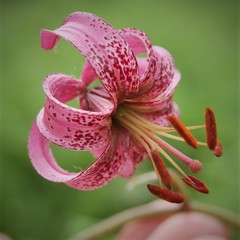

Martagon lily (Lilium martagon L.) is a true perennial lily in the Liliaceae, recognized by its nodding, turban-shaped pink to purple flowers with dark spots. Native to Europe and Asia, including France, it favors open woodland, edges and cool mountain meadows. Garden plants should come from nurseries and grow in humus-rich, well-drained soil. Keep it away from homes visited by cats.
Read moreMartagon lily, Martagon and Turk's cap lily
Give plenty of ambient light without direct sun on the leaves.
Light partial shade to gentle sun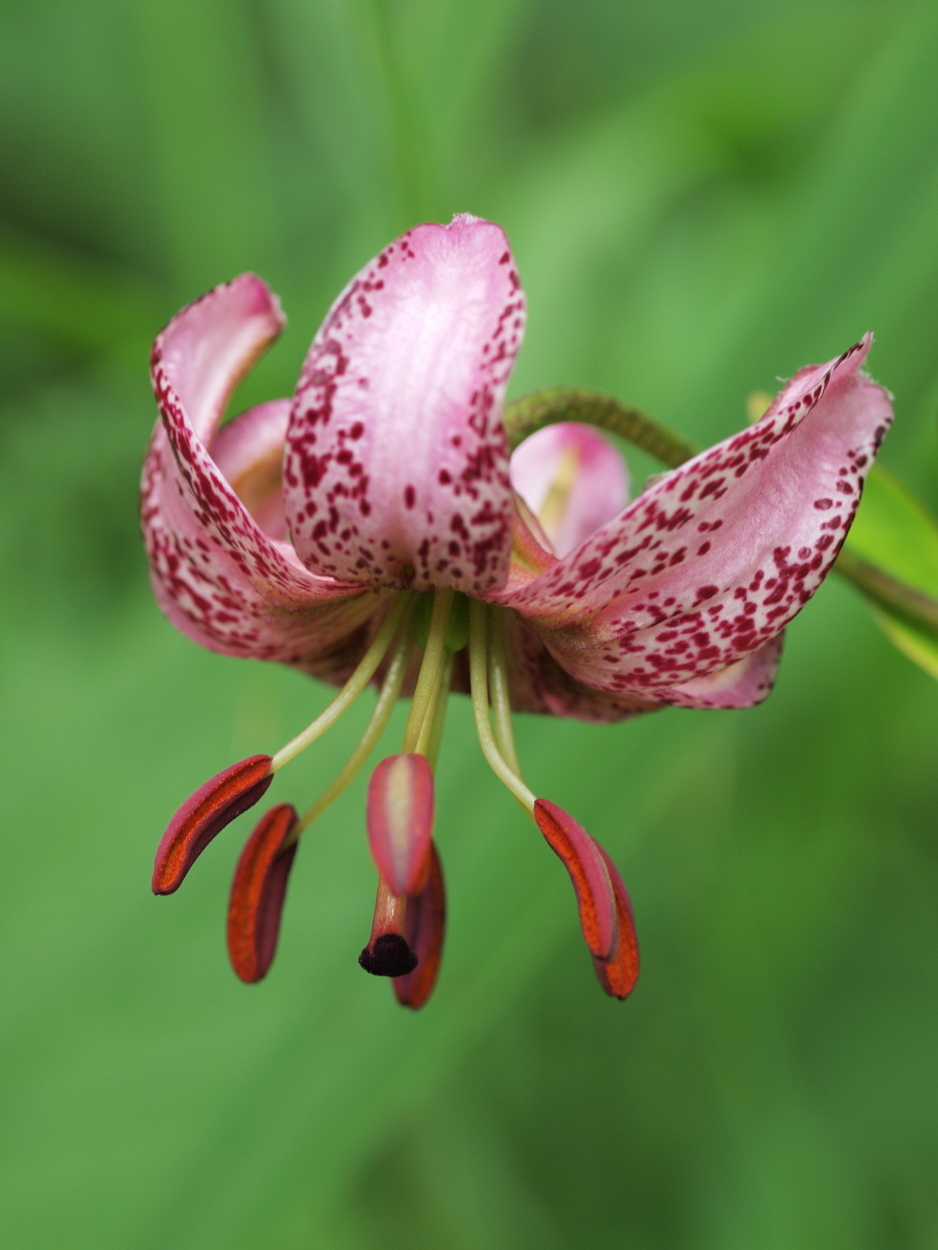


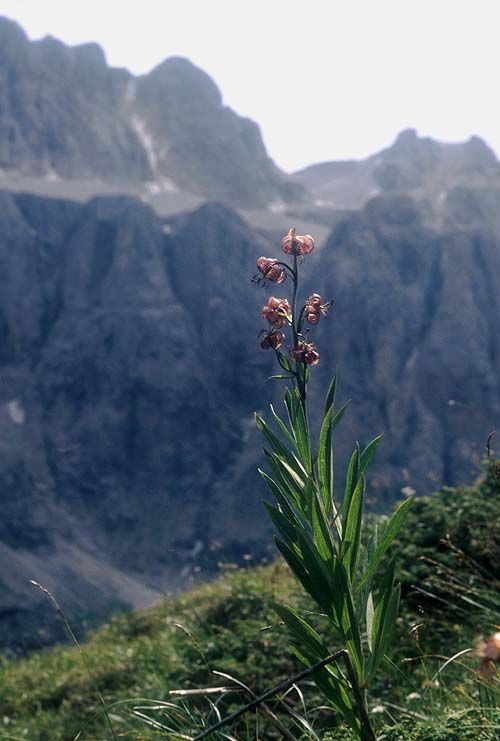
© photo
(c) Hermann Falkner, some rights reserved (CC BY-NC) · cc-by-nc
Alexander Dubynin · cc-by
Katrin Simon · cc-by
Taken Jun 12, 2014 by Tela Botanica − Françoise CARLE (cc-by-sa)
Taken Feb 18, 2017 by Yoan MARTIN (cc-by-sa)
Taken Jul 10, 2020 by Piwwo (cc-by-sa)
Taken Jul 2, 2022 by Christine Neumann (cc-by-sa)
© copyright of the Board of Trustees of the Royal Botanic Gardens, Kew.




Global distribution
POWO accepts Lilium martagon L. and places its native range from southwestern and central Europe to Mongolia. Tela Botanica and INPN treat it as native to mainland France, with protection or regulatory status varying by territory. No invasive status is reported for France.
- Native9
- Mainland France
- Alps
- Jura
- Massif Central
- Pyrenees
- Central Europe
- Caucasus
- Western Siberia
- Mongolia
Hexagons: regions where the plant occurs. Green dots: native range.1
Identity
Martagon lily (Lilium martagon L.) is a true lily in the Liliaceae. POWO/Kew accepts this Linnaean binomial, published in 1753, and places the species from southwestern and central Europe to Mongolia. Its botanical name distinguishes it from the many unrelated flowers called lilies. 1 3
The shorter name martagon describes a particular outline: an upright stem, often whorled leaves, nodding flowers and strongly recurved tepals. Its other English name, Turk's cap lily, evokes that turban-shaped flower. These names are more informative than the broad word lily when identifying plants in a garden or nursery. 4 5
Membership of the true Lilium group matters for cultivation and especially for safety. True lilies must be distinguished from plants that carry lily only in their common names, including lily of the valley, peace lilies and daylilies. A shared common name does not establish a shared botanical identity or set of care requirements. 6 12
Recognition
Beneath the upright stem lies a scaly bulb, without a continuous dry tunic. The usually unbranched stem bears lance-shaped to oval-lance-shaped leaves, often arranged in whorls. French descriptions commonly give a height of 50 cm–1 m (1.6–3.3 ft), while English-language horticultural accounts often describe 1.2–1.8 m (4–6 ft) under good growing conditions. 7 4 5
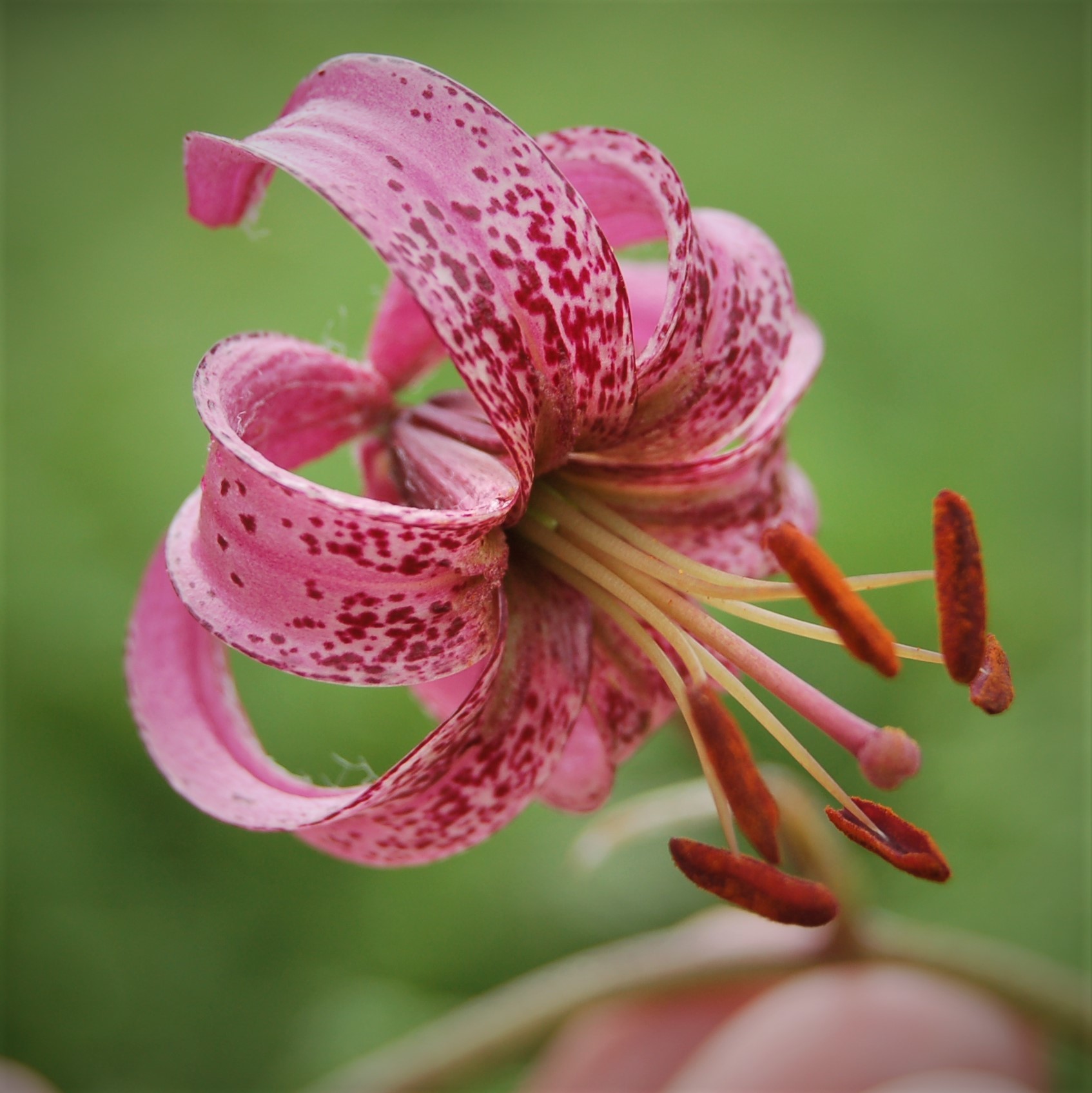
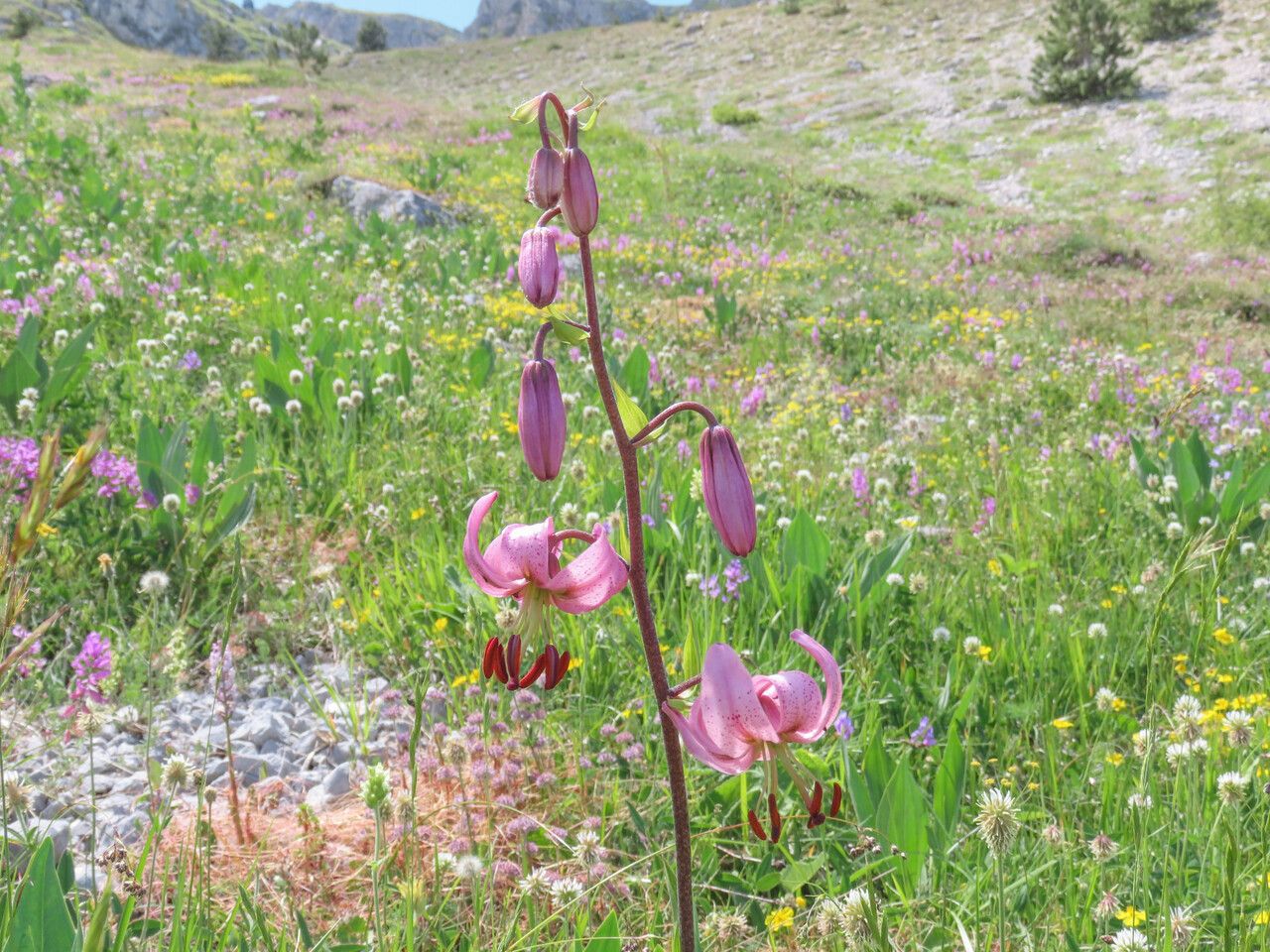
Nodding flowers provide the strongest identification clue. They hang in loose clusters, each with six tepals curled sharply backward into a turban shape. The usual color ranges from pink to purple with a violet cast and dark spots. White forms also occur in cultivation and sometimes in the wild. 4 7
Established stems may carry several flowers, but a young plant or recently moved bulb can remain modest for several seasons. Identify the plant by its combined features rather than flower abundance alone: whorled leaves, the habit of a true lily, nodding blooms, recurved tepals and spotting. A small display does not by itself exclude martagon lily. 5 7
Taxonomy and forms
Compare botanical accounts under Lilium martagon L., its accepted name in POWO within the Liliales and Liliaceae. GBIF likewise records it at species rank. WFO also documents the typical variety, Lilium martagon var. martagon, useful when checking the range and synonyms associated with that taxon. 1 3 2
Names attached to forms and varieties require care. References may list infraspecific taxa or white, darker or paler garden forms, but the underlying identity remains a true Lilium with a scaly bulb and turban-shaped flowers. A color description alone does not settle the plant's precise taxonomic or horticultural name. 1 4
Nursery martagon hybrids can closely resemble the wild species. Before buying or labeling one, distinguish the species Lilium martagon, a named cultivar and a hybrid in the martagon group. This avoids assigning a garden plant the native or regulatory status of a wild French population to which it does not belong. 4 8
Habitat and range in France
Eurasia holds the species' native range. POWO summarizes it as southwestern and central Europe to Mongolia; GBIF records the binomial in its taxonomy, and WFO places the typical variety in an area including France, Corsica, central Europe, the Caucasus, western Siberia and Mongolia. These are botanical range statements rather than a promise of local garden suitability. 1 3 2 15
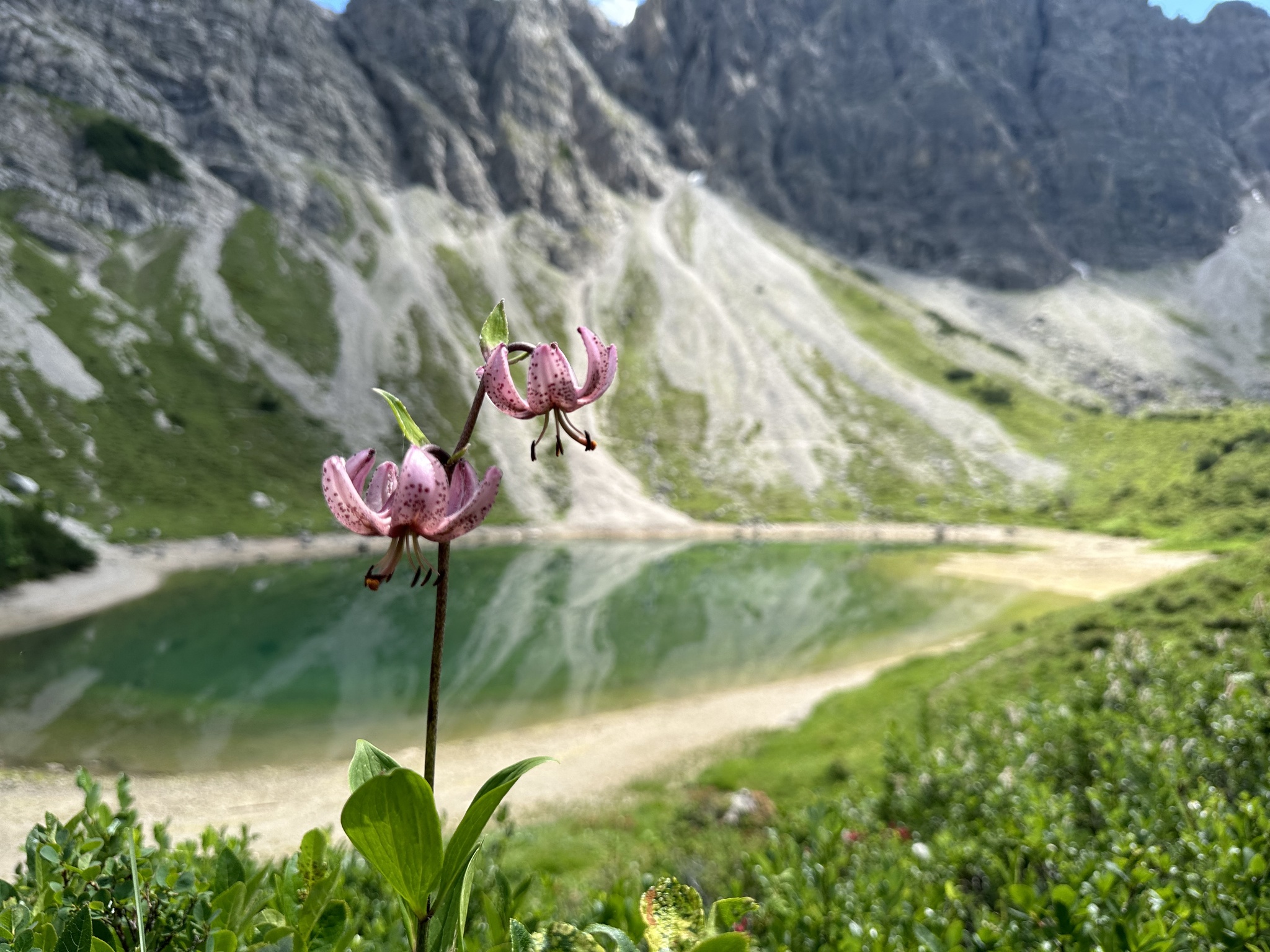
Within France, martagon lily is native, particularly in open woods, woodland edges, meadows and cool mountain habitats. Tela Botanica records it in the mountains and woods of many regions, flowering in the Northern Hemisphere summer. INPN and national park records also document its presence in French floristic references. 7 9 10
Wild occurrence in France does not mean unrestricted collecting. Conservation and regulatory listings vary by territory; some sites are sensitive, and removing a bulb destroys the individual plant. For garden planting, buy nursery-grown stock rather than transplanting a wild plant. The French listings concern their stated territories, rather than establishing rules for every English-speaking reader. 8 9
Growing martagon lily
Woodland-edge conditions suit martagon lily better than a hot, exposed border. RHS and Missouri Botanical Garden recommend rich, moist but well-drained soil in gentle sun or light partial shade. Missouri also emphasizes its slow establishment and dislike of repeated disturbance. Choose a position where the bulb can remain for several seasons. 4 5
Watering should support stem growth. In humus-rich garden soil, 10–20 mm/week (0.4–0.8 in/week) from rain or irrigation during active growth is often sufficient. After flowering and the yellowing of foliage, excess water becomes more dangerous than dryness: a dormant bulb readily rots in cold, compacted soil. Adjust watering to the plant's stage and actual soil moisture. 5 6
Plant preferably in the local fall season, directly in the intended permanent position. The bulb should stay cool and moist without sitting in a pocket of water. A light leaf mulch, low perennials or a shrub edge help conserve moisture while still allowing light to reach the growing stem. 4 5
Spent flowers may be removed, but keep the leaves while green. During this period the bulb rebuilds its reserves for the following cycle. Seed propagation is slow. Dividing small bulbs should be infrequent, since repeated disturbance interrupts establishment; it is not a plant that benefits from being lifted simply for routine rearrangement. 4 5
Common problems
Lily beetles, aphids, slugs, botrytis, viruses and bulb rots also affect martagon lily. NC State highlights aphid-transmitted viruses and rots encouraged by excess moisture. RHS lists the usual lily pests, including lily beetles, aphids, slugs, snails and thrips. Leaf damage and poor growth therefore need to be assessed alongside drainage and growing conditions. 6 4
Check early for lily beetles. Both adults and larvae can strip leaves from young stems, compromising flowering and the bulb's replenishment. In a small woodland-edge collection, manual inspection, removal of larvae and a varied planting are often more appropriate first responses than intensive treatments. Protecting the leaves helps preserve the plant's capacity to flower again. 4 6
A missing flower does not necessarily indicate disease. A martagon that was moved, planted recently, heavily shaded or stripped of its leaves the previous year may wait several seasons before flowering. Check drainage, spring light, slug damage and root competition before deciding that the bulb has died. Slow establishment should be considered alongside these possible problems. 5
Toxicity and bouquets
For households with cats, the principal concern is severe kidney toxicity. ASPCA lists Lilium species as toxic to cats, with kidney damage, and non-toxic to dogs and horses. The FDA warns that true lilies and daylilies can cause fatal kidney failure in cats after exposure to leaves, flowers, pollen or vase water. 11 12
Pet Poison Helpline and Merck Veterinary Manual likewise describe severe acute kidney failure in cats after small exposures to true lilies. Keep martagon lily bouquets out of homes with cats, prevent access to vase water, and seek veterinary advice immediately if exposure is suspected. Cut flowers retain the danger associated with the living plant. 13 14
Dogs and horses should not automatically receive the same toxicity classification as cats. ASPCA lists Lilium species as non-toxic to both; the FDA describes possible digestive upset in dogs after lily ingestion, without the kidney failure typical of cats. Avoiding ingestion remains sensible, while keeping those differences in the evidence clear. 11 12
Responsible cultivation in France
Fine stems, tiered foliage and recurved early-summer flowers give martagon lily a woodland outline that few garden lilies closely reproduce. It has particular significance in France as both a garden ornamental and a native wild plant. Appreciating that outline in a border should go together with respect for its wild populations. 4 7
Garden cultivation should remain separate from wild collecting. Natural populations belong to local habitats, sometimes subject to protection or regulations, and regenerate slowly. They are not a supply of bulbs for gardens. Nursery-propagated stock is the responsible choice, preserving the distinction between growing an ornamental and removing a plant from its wild site. 8 9
A restrained approach works best in the garden: move it rarely, avoid excessive watering and exposed soil that heats up, and use low companions to protect the base without crowding the stem. Martagon lily rewards patience rather than the expectation of an immediate display. Leave an establishing bulb time to settle before disturbing it again. 5 4
Main sources
- Plants of the World Online / Kew, Lilium martagon L.
- World Flora Online, WFO Plant List, June 2026: Lilium martagon var. martagon (accepted variety)
- GBIF Backbone Taxonomy, Lilium martagon L.
- Royal Horticultural Society, Lilium martagon
- Missouri Botanical Garden Plant Finder, Lilium martagon
- NC State Extension Gardener Plant Toolbox, Lilium
- Tela Botanica, Flore de Coste: Lilium martagon L., description
- Écrins National Park, Le sentier des canaux: martagon lily (Lilium martagon), flora note
- INPN, Lilium martagon L. species record
- Biodiv’Écrins / Écrins National Park, Lilium martagon
- ASPCA, Lily toxicity entry
- U.S. FDA, Lovely Lilies and Curious Cats
- Pet Poison Helpline, Lilies
- Merck Veterinary Manual, Toxicity to Animals of Lilies
- Royal Botanic Gardens, Kew, WCVP v16.0 (4 June 2026): Lilium martagon var. martagon, original distribution data, taxon 311869 (ChecklistBank 2232)
Frequently asked questions
Is martagon lily native to France?
Yes. Tela Botanica and INPN treat it as native to mainland France, particularly in cool woodland edges, open woods and mountain habitats. Local protection or regulations mean it should not be collected.
Can I pick or dig up a wild martagon lily?
Responsible gardeners should not. The species may be protected or regulated in particular French departments and territories. Buy nursery-propagated plants or bulbs instead.
What exposure does it need in the garden?
Light partial shade is the safest choice. Martagon lily tolerates gentle sun if the soil stays moist, but flowers poorly in dense shade and suffers in hot, dry soil.
Why is my martagon lily not flowering?
It often establishes slowly. A recently moved, young or heavily shaded bulb, or one deprived of its leaves after flowering, may take several seasons to flower well again.
Is martagon lily toxic to cats?
Yes. As a true lily in the genus Lilium, it must be treated as dangerous to cats. Leaves, flowers, pollen and vase water can cause acute kidney failure.
Is it toxic to dogs and horses?
Their risk is different from that of cats. ASPCA lists Lilium species as non-toxic to dogs and horses, while the FDA chiefly describes possible digestive upset in dogs.
Can martagon lily grow in a pot?
Yes, in a deep, well-drained pot kept cool. It is generally more lasting in a woodland-edge bed, where its bulb can remain undisturbed for years.
Similar plants



If you are unsure about a plant’s toxicity, ask a botanist or veterinarian for advice.