
Alfalfa (Medicago sativa, )
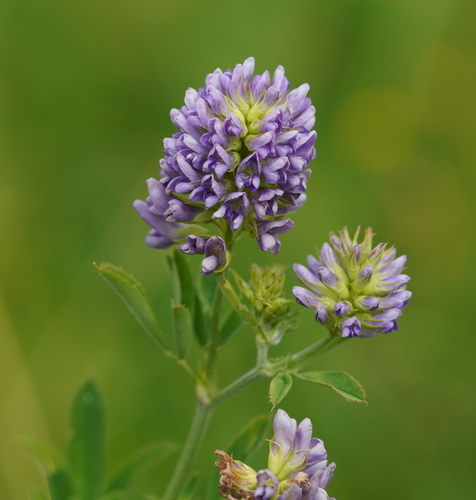
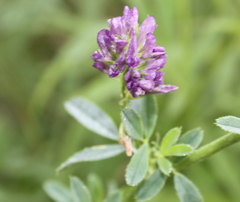
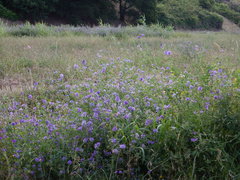
Alfalfa (Medicago sativa) is a perennial legume in the Fabaceae, cultivated since antiquity as a leading forage crop. Its purple flowers develop into spirally coiled pods, a clear distinction from clovers. A deep taproot provides drought resistance, while symbiotic bacteria enable atmospheric nitrogen fixation, making it a valued green manure in crop rotations.
Read moreAlfalfa and lucerne

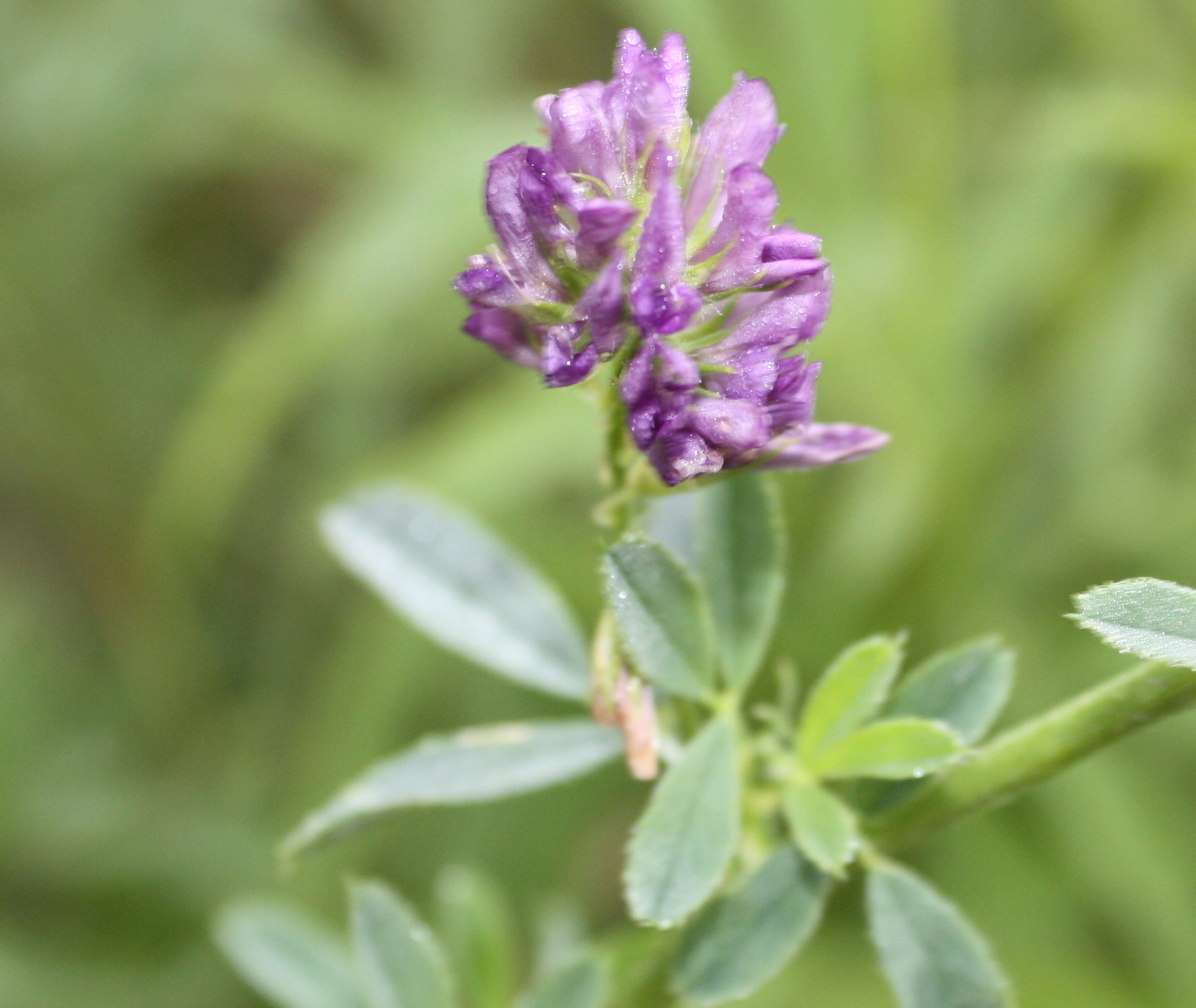
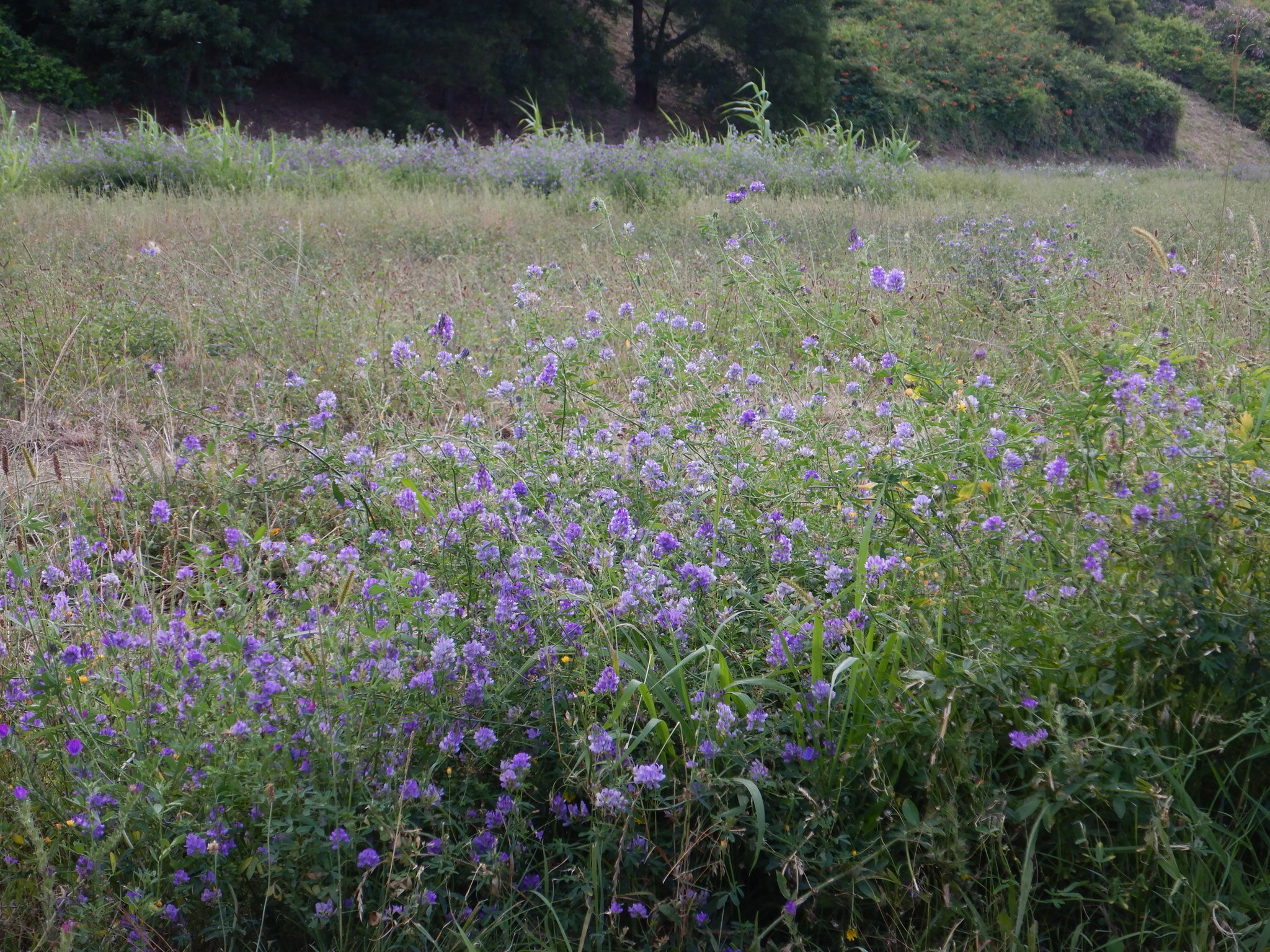


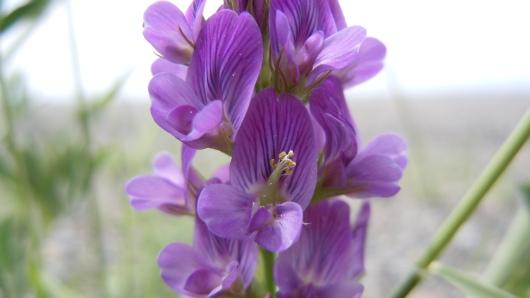

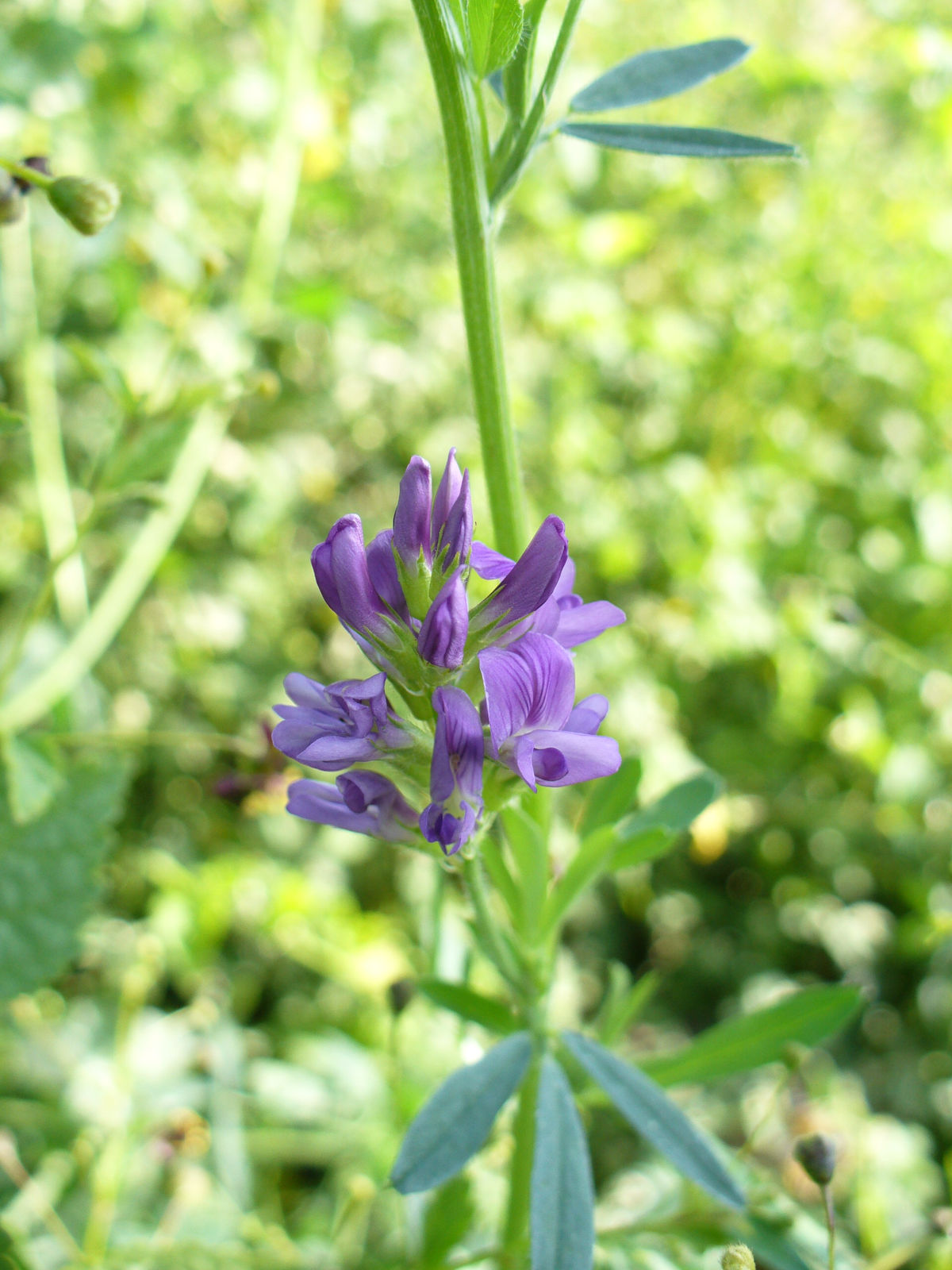
© photo
(c) Wolfgang Bacher, some rights reserved (CC BY-NC), uploaded by Wolfgang Bacher · cc-by-nc
Scott Loarie · cc0
Duarte Frade · cc-by
Taken Sep 5, 2020 by Giode Tonpino (cc-by-sa)
Taken Jun 19, 2020 by Mehmet Basbag (cc-by-sa)
Taken Sep 2, 2020 by Giode Tonpino (cc-by-sa)
Taken Sep 30, 2021 by cscoq (cc-by-sa)
Taken Nov 14, 2017 by Mehmet Basbag (cc-by-sa)
© copyright of the Board of Trustees of the Royal Botanic Gardens, Kew.


Global distribution
According to POWO/WCVP, the native range of Medicago sativa extends from the Mediterranean Basin to Central Asia and Iran. Domesticated early in the Near East, it followed trade routes to Greece and Rome before the Christian era, then to Spain and the Americas. It is now cultivated across the temperate continents and is not listed among invasive alien plants in France.
- Native4
- Iran
- Türkiye
- Armenia
- Kazakhstan
Hexagons: regions where the plant occurs. Green dots: native range.1
Identity
Alfalfa (Medicago sativa L., 1753), also known as lucerne, is a perennial legume in the Fabaceae, subfamily Faboideae. Cultivated since antiquity for livestock hay, grazing and silage, it is known in agriculture as the “queen of forage crops,” a title reflecting its nutritional value and its ability to enrich soil with nitrogen over time. 1 2
The French name luzerne comes from Provençal luzerno, literally “glowworm” or “lamp,” an image associated with the shine of ripe seeds and the old word luiserne (“lamp”), recorded as early as the twelfth century. The spellings lauserne (1566) and then luzerne (1600, in Olivier de Serres’s Le Théâtre d’agriculture) established the modern name. 5
Recognition
A partly buried woody crown gives rise to several upright, branching stems with trifoliate leaves and narrow leaflets. The leaflets are toothed only in their upper third, unlike clovers (Trifolium), whose teeth extend around the entire margin: a feature that separates the genera at a glance. Typical height is 30–90 cm (12–35 in). 2 3
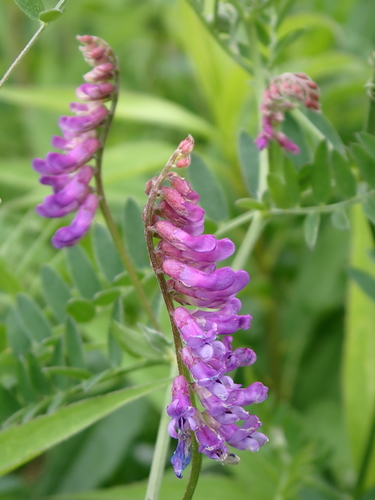
Small flowers cluster in short racemes in the leaf axils. Their purple to blue-violet color immediately distinguishes cultivated alfalfa from yellow-flowered black medick (Medicago lupulina) or sickle medick (Medicago falcata). After fertilization, each flower produces a spirally coiled pod with two to three turns, a feature almost unique to Medicago that clearly separates it from the straight pods of clover. 2
Below ground, the taproot reaches 90 cm (3 ft) after just two months and 1.80 m (6 ft) after five months; in loose soil, plants over twenty years old sometimes exceed 15 m (49 ft) in rooting depth. This explains the drought tolerance of established alfalfa, whereas young seedlings still depend on regular watering. 2
Useful taxonomy
Cultivated alfalfa readily hybridizes with its close yellow-flowered relative Medicago falcata L.. Crosses produce populations with blue, purple or yellow-green flowers, sometimes called hybrid alfalfa or Medicago sativa nothosubsp. praefalcata (Sinskaya) C.R.Gunn. Natural hybridization explains why flower color alone cannot reliably distinguish the two species in the field. 1
Other related plants can also be confused in grassland: black medick (Medicago lupulina L.) has small yellow flowers and black, kidney-shaped, uncoiled pods, while Medicago falcata L. produces crescent-shaped pods rather than a complete spiral.
The genus name Medicago, adopted by Linnaeus in 1753, is thought to preserve a reference to ancient Media, a region of present-day Iran that Greek authors associated with the plant’s introduction to Europe. 2
Habitat and range
From the Mediterranean Basin to Central Asia and Iran lies the native range recorded by POWO/WCVP. The plant grows spontaneously on waste ground, dry grassland, banks and roadsides, in calcareous, well-drained soils; it distinctly avoids acidic or waterlogged ground. 1 3
Domesticated early in the Near East, alfalfa followed trade routes to Greece and Rome before the Christian era, then reached Spain and the Americas through colonization. The Spanish name alfalfa, derived from Arabic, largely displaced the French term in everyday usage there. Today it is cultivated in more than eighty countries, across over 30 million hectares (74 million acres), and ranks among the most valuable forage crops in the United States. 2 8
Life cycle and reproduction
Alfalfa roots host symbiotic bacteria of the genus Rhizobium in nodules. These fix atmospheric nitrogen and enrich the soil, an advantage used in crop rotations and green manure. 2
Cultivated alfalfa is autotetraploid (2n = 32 chromosomes) and self-incompatible: a flower cannot fertilize itself, requiring cross-pollination by insects and complicating conventional plant breeding. 8
Flowering falls in June–July in the temperate Northern Hemisphere, followed by fruiting in July–September; seasonal timing shifts with hemisphere and climate. After each mowing, new stems quickly regenerate from the crown, allowing up to thirteen hay cuts per season depending on climate and irrigation. 3 2
Dense sowings in an old alfalfa field nevertheless germinate poorly: older roots release compounds that inhibit young seedlings, a phenomenon documented as soil autotoxicity. Growers therefore rest the field or insert another crop before sowing alfalfa in the same place again. 3
Uses and risks
Alfalfa hay, rich in protein (about 16%) and vitamins A, D, E and K, remains a standard feed for dairy cattle, horses and rabbits. People also eat young shoots and sprouted seeds raw in salads. 2 3
The main risk concerns ruminant livestock. In fresh, pure pasture, alfalfa’s soluble proteins and saponins form a stable foam that prevents belching and causes potentially fatal bloat. Feeding hay before turnout or choosing varieties with slow initial digestion reduces this risk. 4
In humans, sprouts contain L-canavanine, an amino acid associated with lupus flare-ups in susceptible people. Separately, children, older adults and people with weakened immune systems should avoid raw sprouts because of the risk of foodborne illness. Veterinary databases do not classify the alfalfa plant as toxic to cats or dogs; that classification does not assess raw-sprout food safety. 3 6
Varieties, look-alikes and related plants
Agricultural varieties are classified mainly by winter dormancy class, a North American numerical scale, rather than horticultural names. LIRD varieties (low initial rate of digestion) reduce the risk of bloat during grazing. 4
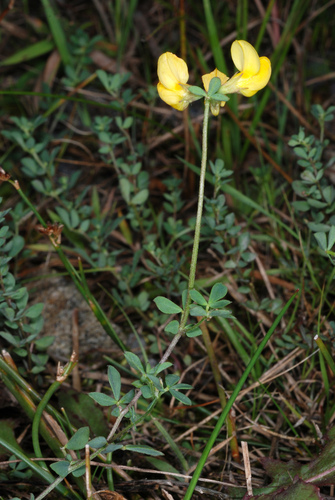
In the field, the most frequent confusion is with white clover (Trifolium repens) and lesser trefoil (Trifolium dubium): both have leaflets toothed around the whole margin and short, uncoiled pods hidden in the calyx. Bird’s-foot trefoil (Lotus corniculatus), with rounder leaflets and fingerlike pods arranged as a “bird’s foot,” is another possible grassland look-alike. Despite these variations in leaflets and pods, a ripe pod with two to three spiral turns is more reliable than flower color alone, even on a plant no longer in flower.
Main sources
- Plants of the World Online / Kew, Medicago sativa L.
- Encyclopaedia Britannica, alfalfa
- Plants For A Future, Medicago sativa
- Merck Veterinary Manual, Bloat in Ruminants
- CNRTL, etymology of “luzerne”
- ASPCA, Toxic and Non-Toxic Plants database
- WCVP / Plants of the World Online, Medicago sativa
- Chen et al., genome assembly of cultivated alfalfa, PMC
Frequently asked questions
Is alfalfa a clover?
No. Alfalfa belongs to Medicago, a different genus from the clovers, Trifolium. The most reliable feature is the ripe pod: spirally coiled in alfalfa, straight or curved in clover.
Is alfalfa toxic to animals?
It is not classified as toxic to cats or dogs, but fresh, pure stands expose grazing ruminants to bloat. Sprouted seeds also contain L-canavanine, associated with lupus flare-ups in susceptible people. This sensitivity is distinct from foodborne illness. People with weakened immune systems should avoid raw sprouts.
Why can alfalfa be cut several times a year?
Its partly buried woody crown quickly produces new stems after each cut, allowing up to thirteen hay harvests per season depending on climate and irrigation.
Can alfalfa be reseeded in an old alfalfa field?
This is not recommended in the short term. Older roots release compounds that inhibit young seedlings, a phenomenon documented as soil autotoxicity.
How does alfalfa differ from black medick?
Black medick (Medicago lupulina) has small yellow flowers and black, kidney-shaped pods without coils, whereas alfalfa has purple flowers and a fully spiral pod.
Where does the name lucerne come from?
It comes from the Provençal luzerno, “glowworm,” referring to the shine of ripe seeds. The English name alfalfa derives from Arabic through Spanish.
Does alfalfa really enrich the soil?
Yes. Its roots host Rhizobium bacteria that fix atmospheric nitrogen in nodules, a mechanism widely used in crop rotations and green manure.
Similar plants
If you are unsure about a plant’s toxicity, ask a botanist or veterinarian for advice.