
Narrow-leaved paperbark (Melaleuca alternifolia, )
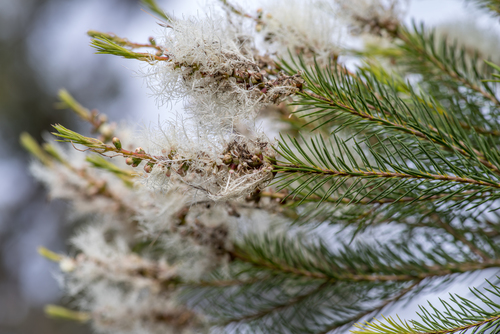

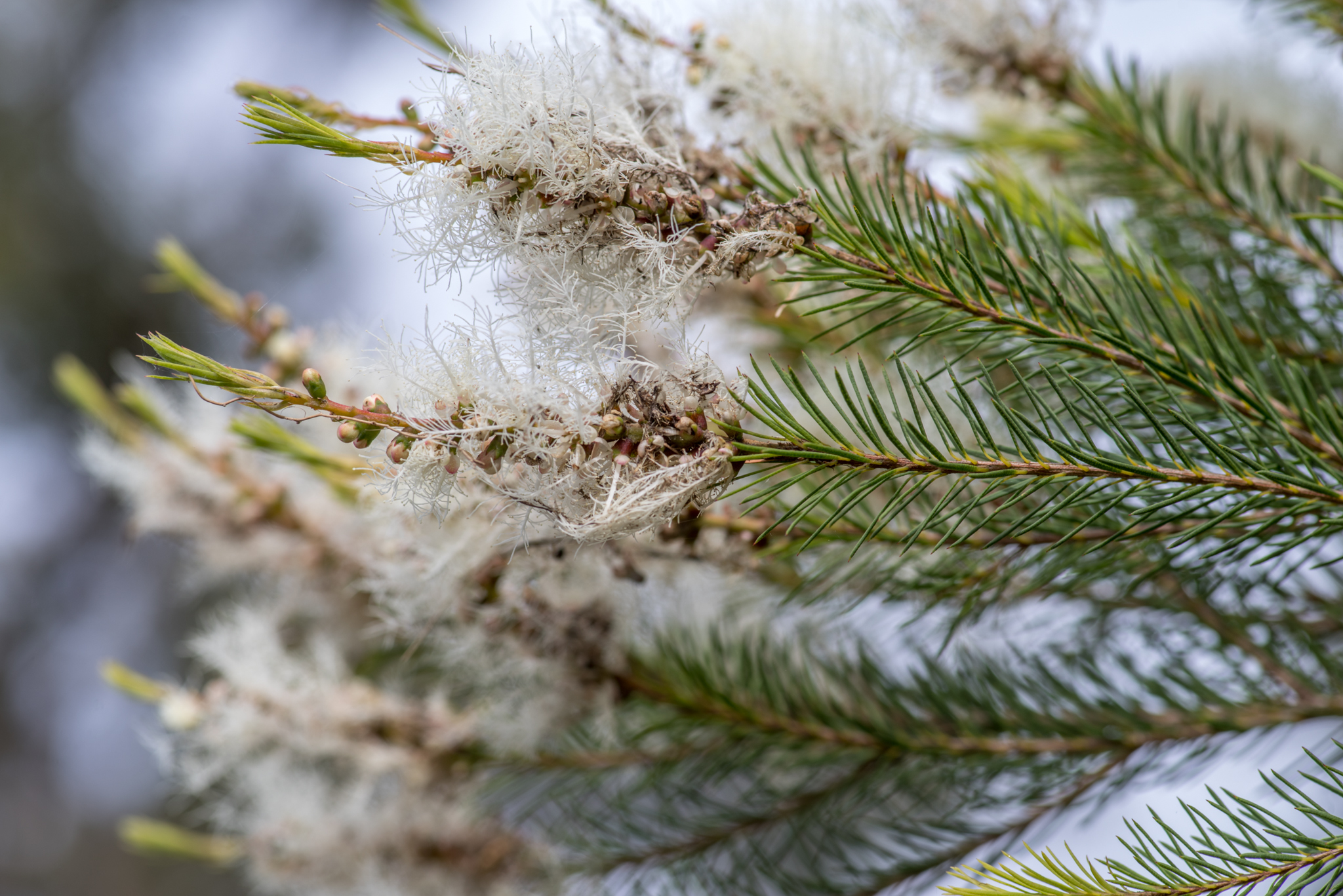
Narrow-leaved paperbark (Melaleuca alternifolia) is an evergreen shrub or small tree in the Myrtaceae, native to northeastern New South Wales and southeastern Queensland, Australia. It grows beside streams and on swampy coastal plains, where whitish papery bark and cream-white flower spikes distinguish it from other Melaleuca. Its leaves are rich in terpinen-4-ol essential oil, the source of tea tree oil widely used in cosmetics and antisepsis.
Read moreNarrow-leaved paperbark, Tea tree, Narrow-leaved tea-tree and Narrow-leaf teatree


© photo
(c) Bruce Cathie, some rights reserved (CC BY), uploaded by Bruce Cathie · cc-by
Wikimedia Commons · CC BY-SA or Public Domain
Wikipedia · CC BY-SA
© copyright of the Board of Trustees of the Royal Botanic Gardens, Kew.




Global distribution
The native range of Melaleuca alternifolia is restricted to a narrow strip of northeastern New South Wales, from the Grafton district, and southeastern Queensland. Commercial plantations have developed in the same region since the 1970s–1980s to supply the essential-oil industry. Outside Australia, the species is grown mainly in mild climates without prolonged frost.
Identity
Narrow-leaved paperbark (Melaleuca alternifolia (Maiden & Betche) Cheel, 1924), also called tea tree or narrow-leaved tea-tree, belongs to Melaleuca in the Myrtaceae. Joseph Maiden and Ernst Betche first described it as a variety in 1904, before Edwin Cheel raised it to species rank in 1924 in the proceedings of the Royal Society of New South Wales. Twenty years thus separate the varietal description from recognition as a full species. 1 8
The name tea tree is thought to date to Captain James Cook’s expeditions in 1770, when his crew reportedly infused aromatic leaves of several Melaleuca and Leptospermum species in a tea-like drink. The epithet alternifolia combines alternus and folium, describing alternate leaves along the branches. 2
Recognition
An evergreen shrub or small tree, Melaleuca alternifolia reaches 1.5–7 m (5–23 ft) depending on age and growing conditions. Its grayish-white papery bark peels in thin overlapping layers, a feature shared by many Melaleuca known as paperbarks; narrow-leaf teatree is another name for this species. 4 2
Narrow, linear leaves measure just 10–35 mm (0.4–1.4 in) long and about 1 mm (0.04 in) wide, arranged irregularly along the branches. Crushing them releases a characteristic camphor-like scent from the numerous oil glands visible when light passes through the blade. 4
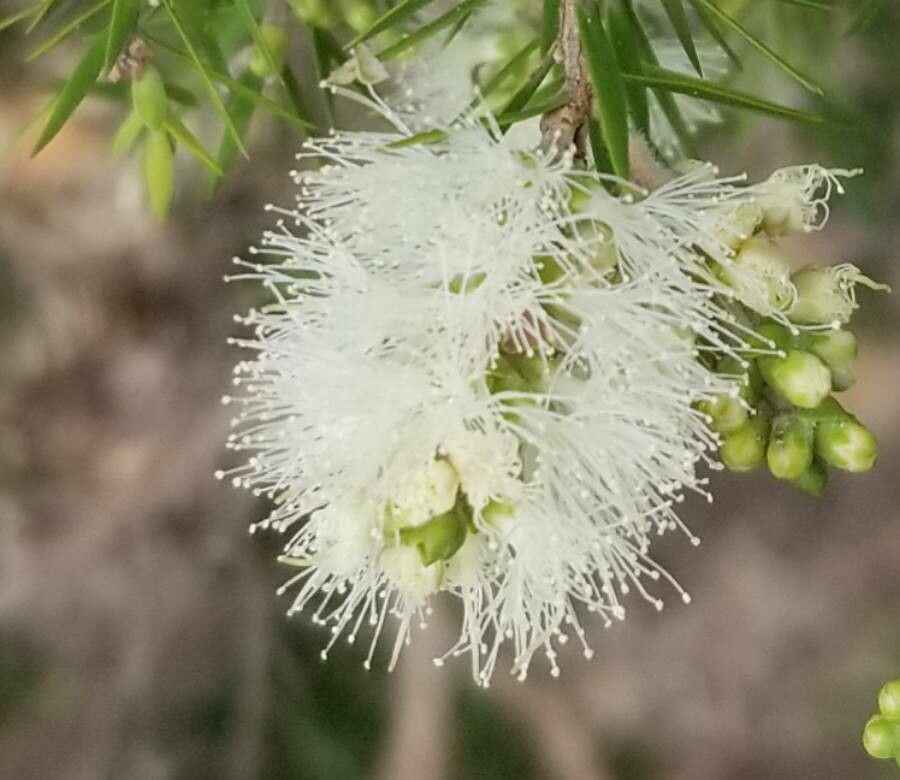
Cream-white flowers form dense spikes 3–5 cm (1.2–2 in) long along the stem rather than at its tip: unlike some other shrubs with clustered flowers, the branch continues growing after flowering. The stamens are grouped in bundles of 30–60. The fruit is a small woody, cup-shaped capsule 2–3 mm (0.08–0.12 in) across, grouped in dozens and persisting on the stem. 4
Useful taxonomy
Kew accepts Melaleuca alternifolia. Its only recognized homotypic synonym is the basionym Melaleuca linariifolia var. alternifolia Maiden & Betche, published in 1904 before Cheel raised it to species rank. 1 8
The most frequent confusion concerns the common name “tea tree,” rather than botanical synonymy. Several Melaleuca species and the genus Leptospermum, including New Zealand manuka, share it. Melaleuca alternifolia is a principal commercial source of terpinen-4-ol-type tea tree oil. Other plants sold as tea tree can yield oils of different composition; the shared name alone does not establish their composition or safety. 5
Habitat and range
A narrow strip of northeastern New South Wales, from the Grafton district, and southeastern Queensland forms its native range. The species grows beside streams and on swampy coastal plains, in soil waterlogged for much of the year, often forming dense stands. 4
Since the 1970s–1980s, commercial plantations have developed in the same region, around Lismore in New South Wales, to supply an essential-oil industry previously dependent on harvesting wild stands. Outside Australia, the species is cultivated mainly in mild climates without prolonged frost, as a specimen or in containers. 5 2
Life cycle and reproduction
Flowering takes place in the Southern Hemisphere spring. The nectar-rich spikes attract pollinating insects, a common feature of Melaleuca species with flowers grouped in dense spikes. 4
Nurseries propagate it by surface sowing on moist growing medium, with germination in 2–4 weeks under constant warmth, or by semi-ripe heel cuttings taken in summer. Commercial nurseries use selected seed for production of the terpinen-4-ol chemotype sought by the essential-oil industry. 3
Essential oil extracted from the foliage contains about a hundred compounds, mainly monoterpenes and sesquiterpenes. The cited 2006 review describes the ISO 4730 specification then in use as requiring at least 30% terpinen-4-ol and no more than 15% 1,8-cineole. These compositional limits do not guarantee safety or clinical effectiveness. Some wild populations naturally yield oil richer in cineole or terpinolene, considered of lower commercial value. 5
Uses and risks
The main use is production of tea tree essential oil, steam-distilled from the foliage. Australian chemist Arthur Penfold documented its antiseptic properties in the 1920s, launching the commercial industry now concentrated in New South Wales. 5
Its antimicrobial action involves making cell membranes permeable: bacteria lose potassium ions and their cellular respiration is inhibited, an effect documented in many bacteria, yeasts and fungi. Despite this effectiveness in diluted external use, the oil is toxic if swallowed. In rats, the median lethal dose is 1.9–2.6 ml/kg (about 0.03–0.04 US fl oz/lb); human poisonings have also been reported, with recovery after treatment in the cases described in the cited review. 5 7
For cats and dogs, tea tree oil is toxic even after topical application at high concentrations or accidental ingestion. Reported signs include drooling, tremors, ataxia, hypothermia and, in cats, a risk of liver damage. Pure tea tree oil must never be applied to an animal. A low concentration alone does not establish that an animal product is safe. 6
Varieties, look-alikes and related plants
No horticultural cultivar is widely distributed for this species. Selection focuses mainly on high-oil-yielding clones or a stable terpinen-4-ol chemotype, chosen for industry rather than ornamental horticulture. 5
Common look-alikes include:
- Melaleuca linariifolia Sm., of which M. alternifolia was once considered a mere variety;
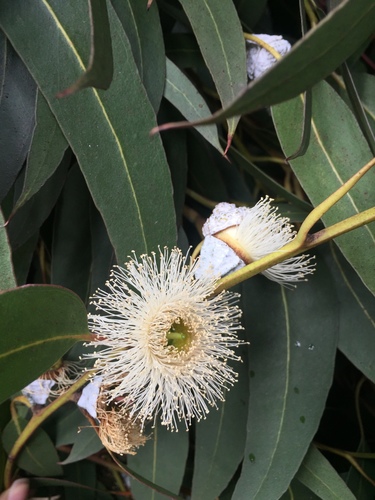
- Melaleuca dissitiflora F.Muell., another Australian species sold as “narrow-leaved tea tree”;
- Leptospermum, whose species, especially New Zealand manuka, share the commercial name “tea tree” while belonging to a different genus.
The shared commercial name “tea tree” is not a reliable botanical identification. Oil composition and the plant’s scientific name should be distinguished rather than treating compliance with a chemical specification as proof of species identity.
Main sources
- Plants of the World Online / Kew, Melaleuca alternifolia (Maiden & Betche) Cheel
- Royal Horticultural Society, Melaleuca alternifolia
- Plants For A Future, Melaleuca alternifolia
- PlantNET NSW Flora Online, Royal Botanic Gardens Sydney, Melaleuca alternifolia
- Carson, Hammer & Riley, 2006, Melaleuca alternifolia (Tea Tree) Oil, a Review of Antimicrobial and Other Medicinal Properties, Clinical Microbiology Reviews
- Pet Poison Helpline, Tea Tree Oil toxicity in cats and dogs
- National Center for Complementary and Integrative Health (NIH), Tea Tree Oil
- International Plant Names Index, Melaleuca alternifolia Cheel
Frequently asked questions
Why is Melaleuca alternifolia called tea tree?
The name is thought to date to Captain James Cook’s expeditions in 1770, when his crew reportedly infused aromatic leaves of several Melaleuca and Leptospermum species to make a tea-like drink.
Is tea tree essential oil dangerous to cats and dogs?
Yes. Swallowed or applied undiluted, it can cause drooling, tremors, ataxia and hypothermia; veterinary poison centers also report a risk of liver damage in cats.
How does Melaleuca alternifolia differ from other “tea trees”?
The name tea tree covers several Melaleuca species and Leptospermum. Melaleuca alternifolia is a principal commercial source of terpinen-4-ol-type tea tree oil; the common name alone does not establish oil composition.
Can Melaleuca alternifolia be grown outdoors in a cool climate?
It tolerates brief frosts to about −7 °C (19 °F), restricting outdoor cultivation in France to the Mediterranean coast. In colder locations, grow it in a container brought under cover for winter.
Why does its bark peel in layers?
The grayish-white papery bark renews itself in thin overlapping layers, a feature shared by many Melaleuca known as “paperbarks.”
What is the composition of tea tree essential oil?
The cited 2006 review describes the ISO 4730 specification then in use as requiring at least 30% terpinen-4-ol and no more than 15% 1,8-cineole. These are historical compositional limits, not a guarantee of safety.
Is Melaleuca alternifolia invasive?
No invasive behavior outside its native range is documented in the cited sources. Its native range is Australian, and commercial plantations are concentrated in New South Wales; it is also cultivated elsewhere in mild climates.
Similar plants
If you are unsure about a plant’s toxicity, ask a botanist or veterinarian for advice.