
Japanese banana (Musa basjoo, )
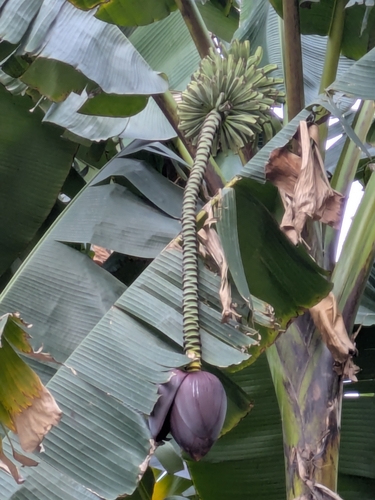

Japanese banana (Musa basjoo) is an herbaceous perennial in the Musaceae, long thought native to the Ryukyu Islands but now traced to Sichuan in subtropical southern China. Unlike most ornamental bananas, its underground rhizome survives severe frost, making it the hardiest banana grown outdoors in temperate climates.
Read moreJapanese banana, Japanese fiber banana and Hardy banana
Allow a few hours of direct sun per day, preferably morning or evening.
Full sun, in a warm sheltered position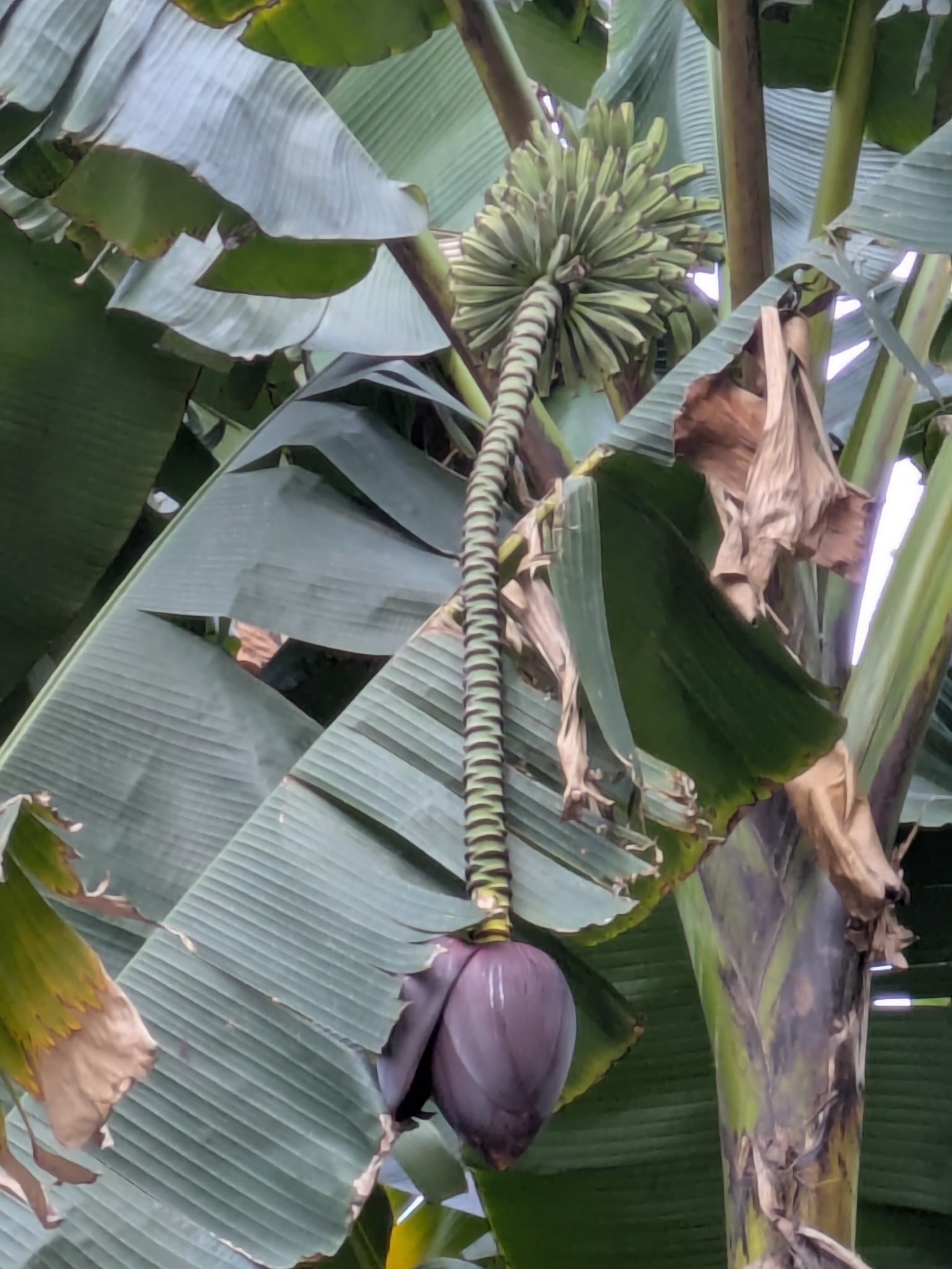


© photo
Sorrel · cc-by
Wikimedia Commons · CC BY-SA or Public Domain
Wikipedia · CC BY-SA
Taken Jun 12, 2016 by Daniel Barthelemy (cc-by-nc)
Taken Sep 12, 2021 by Robin N (cc-by-sa)
Taken Jun 16, 2022 by Bryan Cannoy (cc-by-sa)
© copyright of the Board of Trustees of the Royal Botanic Gardens, Kew.




Global distribution
Musa basjoo is native only to subtropical forest edges and wooded slopes in Sichuan, southern China. Cultivated in Japan for centuries, especially on Okinawa, it became so firmly established there that it was long mistaken for a native species before its Chinese origin was recognized.
- Native1
- Introduced3
- China (Sichuan)
- United Kingdom
- Southeastern United States
- Southern Canada
Hexagons: regions where the plant occurs. Green dots: native range.1
Identity
Japanese banana (Musa basjoo Siebold ex Miq., 1867), also called hardy banana or Japanese fiber banana, is an herbaceous perennial in the Musaceae. Long considered native to the Ryukyu Islands south of Japan, where it was first described in cultivation, it is now recognized as native to Sichuan in subtropical southwestern China. 1 7
The epithet comes directly from the Japanese name bashō (芭蕉), used long before the Chinese origin was established. Unlike edible banana, Musa acuminata, whose pseudostem freezes and dies without regrowth, Musa basjoo survives down to -12 °C (10 °F). Its underground rhizome protects it from frost while the aboveground foliage disappears each winter. 4 5
Recognition
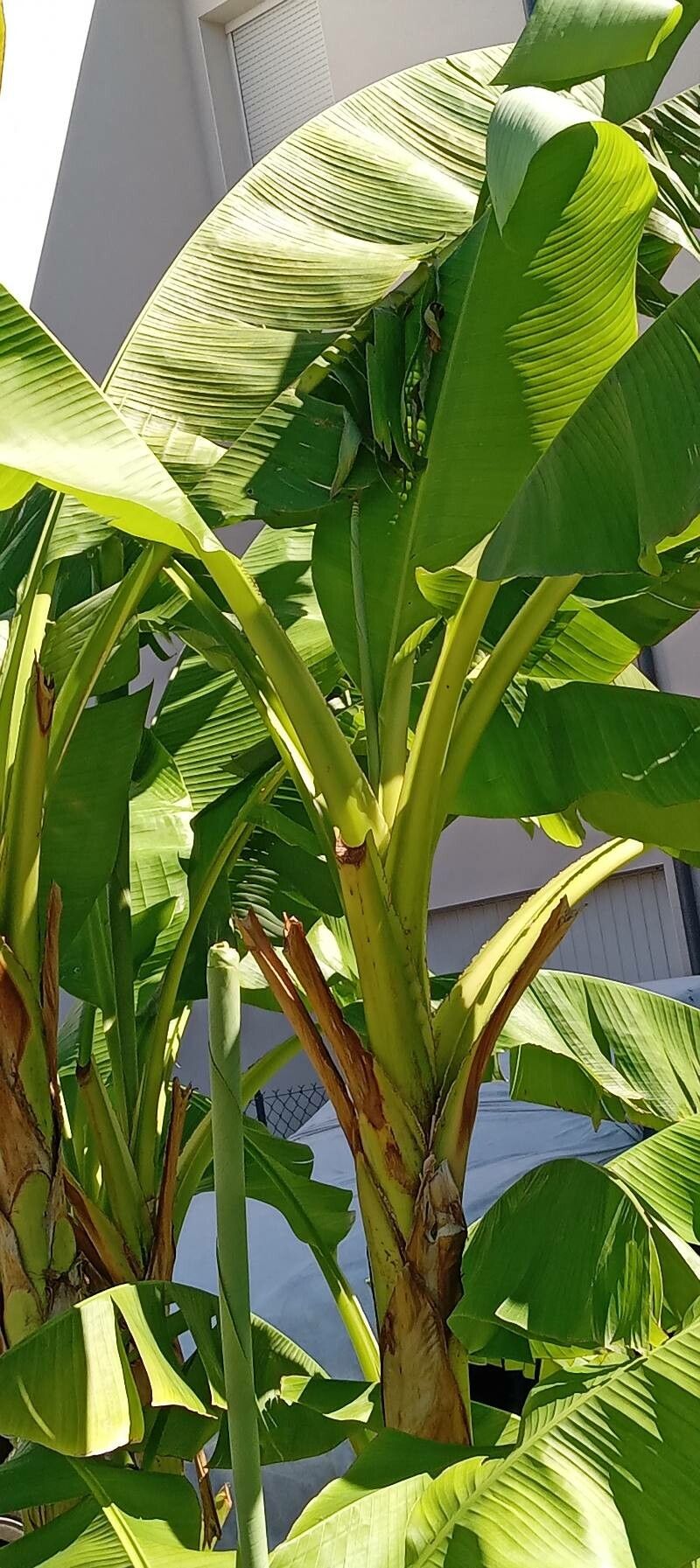
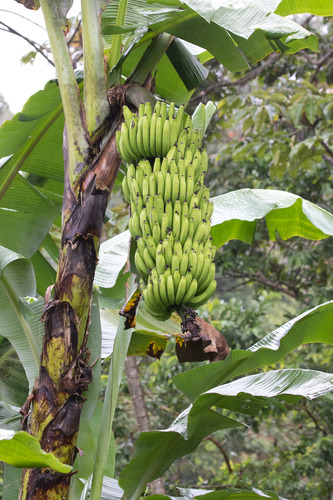
Tightly overlapping leaf sheaths form the pseudostem, usually 2–4 m (6.5–13 ft) tall, with a clump spread of 1.5–3 m (5–10 ft). Large, paddle-shaped, clear green leaves reach 2 m (6.5 ft) long and 70 cm (28 in) wide. Wind readily splits them along the central midrib. 3 4
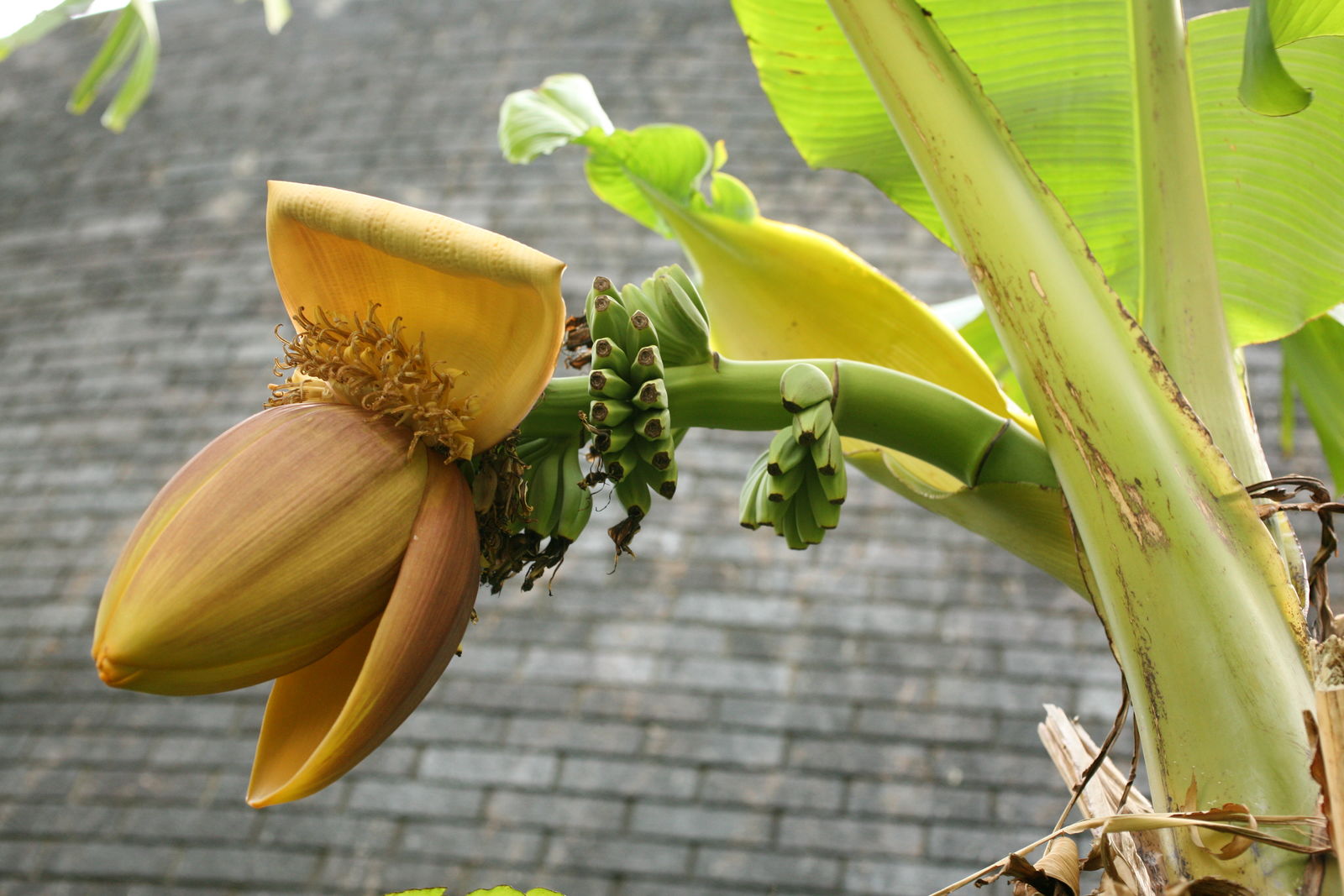
A hanging inflorescence more than 1 m (3 ft) long bears cream to yellowish flowers protected by purple bracts. It develops only on a mature pseudostem, a stage reached after 5–10 years in cool temperate climates. The greenish fruits, 5–10 cm (2–4 in) long, remain dry and packed with black seeds. Unlike edible bananas, they cannot be eaten. 5 3
Useful taxonomy
Published in 1867, Musa basjoo Siebold ex Miq. remains the name accepted by Plants of the World Online. Philipp Franz von Siebold never validly published it himself; Dutch botanist Friedrich Anton Wilhelm Miquel completed valid publication, explaining “ex” in the botanical authority. 1 2
The principal listed homotypic synonym is Musa japonica Sallier, 1896, an illegitimate name. Plants of the World Online also accepts three Chinese varieties: Musa basjoo var. basjoo, Musa basjoo var. lushanensis and Musa basjoo var. luteola, the last two restricted to Sichuan. Taiwan banana, long linked to a variety formosana of Musa basjoo in horticultural literature, is now placed by Kew under Musa itinerans var. formosana. This distinct species needs attention when comparing older references. 1 2 8
Habitat and range
Sichuan’s subtropical forest edges and wooded slopes in southern China form the native range of Musa basjoo. Wild populations were documented only well after the first botanical description based on Japanese cultivated plants. 7 1
Centuries of cultivation in Japan, especially Okinawa, made the plant so firmly established that it was long mistaken for a native species. Introduced to Western horticulture in the late 19th century, it spread through milder temperate parts of Europe, the United States and southern Canada, helped by unusual hardiness for a banana. 4 3
Unprotected outdoor cultivation in the United Kingdom is limited to the mildest regions; elsewhere, a sheltered sunny position is needed. This hardiness depends almost entirely on the rhizome, which survives frost while the aboveground pseudostem does not. 3
Life cycle and reproduction
Japanese banana divides the risk of freezing between two organs with different responses. Its tender aboveground pseudostem dies in the first substantial frosts, but the well-mulched underground rhizome tolerates temperatures down to -12 °C (10 °F), allowing outdoor cultivation as far as USDA zone 6a. The trade-off is that foliage does not carry over from year to year under these conditions: it grows back from the base each spring. 5 3
Once a pseudostem has flowered, it dies, as in all bananas. New suckers immediately take over from the same rhizome and gradually form a dense clump. This ability to replace shoots, together with rhizome hardiness, lets the species survive temperate winters despite losing all its foliage each year. 4
Spring division of suckers produces plants true to the parent, establishing in 3–6 weeks. Seeds take 2–24 weeks to germinate at 22 °C (72 °F), followed by several years under cover before young plants face outdoor conditions. 4
Uses and risks
Tropical-looking foliage makes Musa basjoo chiefly an ornamental plant for temperate gardens. It provides that silhouette without requiring the whole plant to be brought indoors every winter, as most other container-grown bananas do. 5
Japanese textile production has long used fibers from the plant. Pseudostems are cut into strips, beaten, bleached and dried to supply material for handwoven fabric used in kimonos, mats and Japanese paper. Traditional Chinese medicine also attributes diuretic properties to the stem, flowers, leaves and rhizome. 4
The ASPCA lists the genus Musa as having no known toxicity to cats, dogs or horses; Musa basjoo has no identified toxicity. Its main threats are pests, including banana weevils, aphids and scale insects, and fungal diseases such as anthracnose, rather than any toxic compound. 6
Varieties, look-alikes and related plants
Botanical details separate the three varieties accepted by Plants of the World Online: basjoo, lushanensis and luteola. Differences mainly involve pigmentation and the size of floral organs rather than garden use; the typical variety overwhelmingly dominates the nursery trade. 1
Other banana-like plants that can cause confusion include:
- Musa acuminata, edible banana, produces sweet fruit and tolerates much less cold;
- Musa itinerans var. formosana, Taiwan banana, was long confused with a variety of Musa basjoo in horticultural literature;
- Ensete ventricosum, Abyssinian banana, has a similar habit but no spreading rhizome capable of producing usable suckers.
After a temperate winter destroys the entire aboveground pseudostem, Musa basjoo regrows a full canopy from its rhizome the next spring. That recovery distinguishes it from Musa acuminata and Ensete ventricosum, which lack comparable underground hardiness and cannot survive equivalent freezing without substantial protection. 3 5
Main sources
- Plants of the World Online / Kew, Musa basjoo Siebold ex Miq.
- International Plant Names Index, Musa basjoo Siebold ex Miq.
- Royal Horticultural Society, Musa basjoo details
- Plants For A Future, Musa basjoo
- Missouri Botanical Garden Plant Finder, Musa basjoo
- ASPCA, Banana (Musa) toxicity entry
- NCBI Taxonomy, Musa basjoo (taxid 133197)
- Tropicos / Missouri Botanical Garden, Musa basjoo Siebold ex Miq.
Frequently asked questions
Is Japanese banana really hardy in France?
The aboveground pseudostem freezes in the first substantial cold, but the underground rhizome, well mulched, tolerates temperatures down to -12 °C (10 °F). It then produces a full canopy again the following spring, allowing outdoor cultivation across much of metropolitan France.
Does Japanese banana really come from Japan?
No. The species was first described from cultivation in Japan’s Ryukyu Islands, hence its common name, but current evidence places its native range in Sichuan in subtropical southwestern China.
Can you eat Japanese banana fruit?
No. Unlike Musa acuminata, the ancestor of dessert bananas, Japanese banana fruit stays dry, sparsely fleshy and full of hard black seeds. Only the male flowers are sometimes eaten in Asia.
How do you protect a Japanese banana rhizome in winter?
A thick layer of fallen leaves or straw, 30–50 cm (12–20 in) deep, applied at the first frosts generally protects the rhizome. The aboveground pseudostem can freeze and blacken without preventing regrowth.
How does Japanese banana differ from Musa acuminata?
Musa acuminata is the frost-sensitive edible banana behind almost all dessert bananas. Japanese banana has no edible fruit but withstands much colder conditions because its rhizome is hardy.
Is Japanese banana toxic to cats and dogs?
No. The ASPCA lists Musa among plants with no known toxicity to cats, dogs and horses; Japanese banana has no identified toxicity.
Similar plants
If you are unsure about a plant’s toxicity, ask a botanist or veterinarian for advice.