
Oriental poppy (Papaver orientale, )
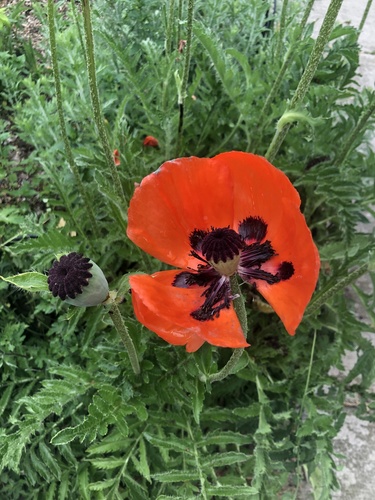

Oriental poppy (Papaver orientale) is a perennial in the Papaveraceae family, grown for large, crumpled flowers in orange, red, pink, white, or purple, depending on the cultivar. Adapted to cool temperate climates, it forms a hairy rosette, flowers from late spring into early summer, and often dies back during summer dormancy.
Read moreOriental poppy and Eastern poppy
Place in full sun, with intense direct light all day long.



© photo
Robert M Hallock · CC BY-NC
Wikimedia Commons · CC BY-SA or Public Domain
Wikipedia · CC BY-SA
Taken Jun 2, 2022 by francois tissot (cc-by-sa)
Taken May 11, 2022 by Fabrice Rubio (cc-by-sa)
Taken Apr 9, 2022 by Annemarie Ahrens-Stehle (cc-by-sa)
Taken Jun 7, 2020 by Annemarie Ahrens-Stehle (cc-by-sa)
Taken May 9, 2022 by Fabrice Rubio (cc-by-sa)
© copyright of the Board of Trustees of the Royal Botanic Gardens, Kew.




Global distribution
POWO places the native range from eastern Turkey to northern Iran. Kew and WFO also detail the Caucasus, Transcaucasia, Georgia, Armenia, Azerbaijan, and northwestern Iran. In France it is chiefly an ornamental plant recorded in botanical references, with no national invasive alien status established.
- Native7
- Introduced6
- Eastern Turkey
- Georgia
- Armenia
- Azerbaijan
- Northern Iran
- North Caucasus
- Transcaucasia
- Great Britain
- Finland
- Sweden
- Romania
- Ontario
- Temperate United States
Hexagons: regions where the plant occurs. Green dots: native range.1
Identity
Oriental poppy (Papaver orientale L., 1753) is an accepted species of Papaver in the Papaveraceae family. Kew/POWO traces its name to Species Plantarum in 1753 and places its native range from eastern Turkey to northern Iran; WFO and GBIF confirm its species rank within Ranunculales. 1 2 3
The established English names Oriental poppy and Eastern poppy refer to this ornamental perennial. “Oriental” is a historical horticultural name, rather than a broad label for every Asian poppy. 3 5
Western European gardens have grown the plant since the early eighteenth century, according to Kew, following collections associated with Tournefort's journey in eastern Anatolia. This history also explains the French name referring to Tournefort, while Papaver orientale L. remains the modern botanical reference. 1 10
Recognition
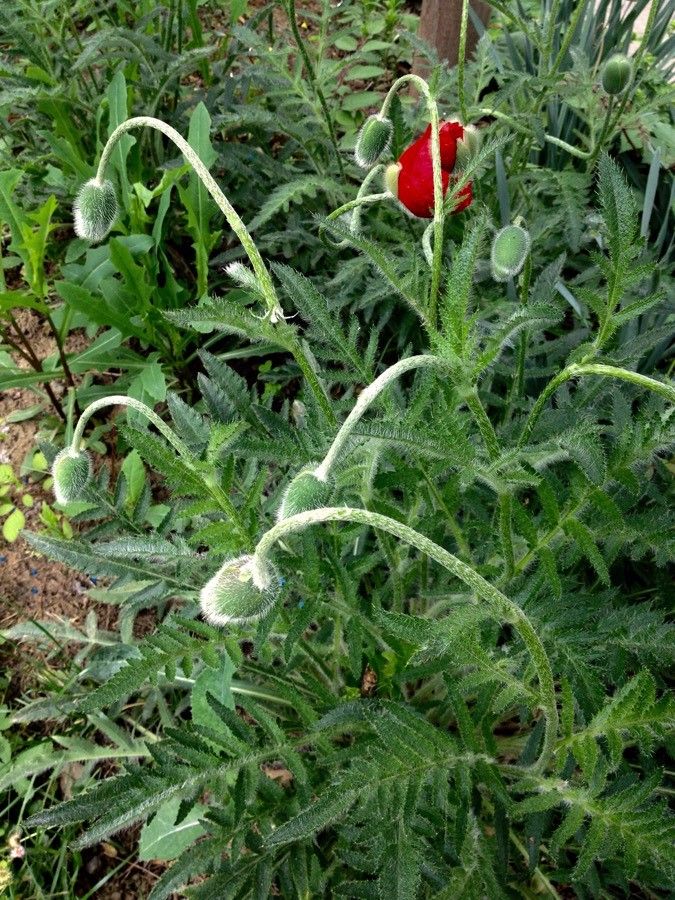
A deep taproot anchors this long-lived herbaceous perennial. Kew describes predominantly basal, deeply toothed, bristly leaves. RHS adds dark green foliage with silvery hairs, forming a clump with hairy flowering stems reaching about 90 cm (35 in). 1 5
Its changing foliage gives the plant a distinctive seasonal appearance. NC State describes finely divided gray-green leaves that soften the spring planting, then disappear after flowering; a basal rosette may return in fall and remain through winter before spring growth. 6
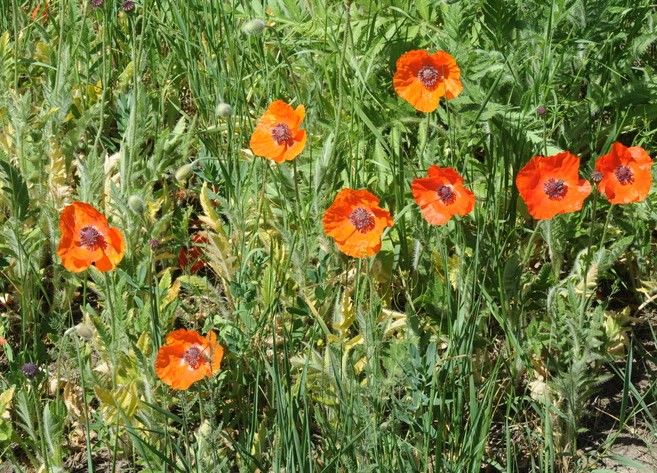
Large, bowl-shaped flowers usually stand singly at the stem tips. RHS describes orange-red flowers up to 15 cm (6 in) across, with small purple-black blotches at the petal bases. FNA describes bristly plants up to 10 dm (3.3 ft) tall, pale orange to orange-red petals with or without spots, and glaucous capsules up to 2.5 cm (1 in) long. 5 4
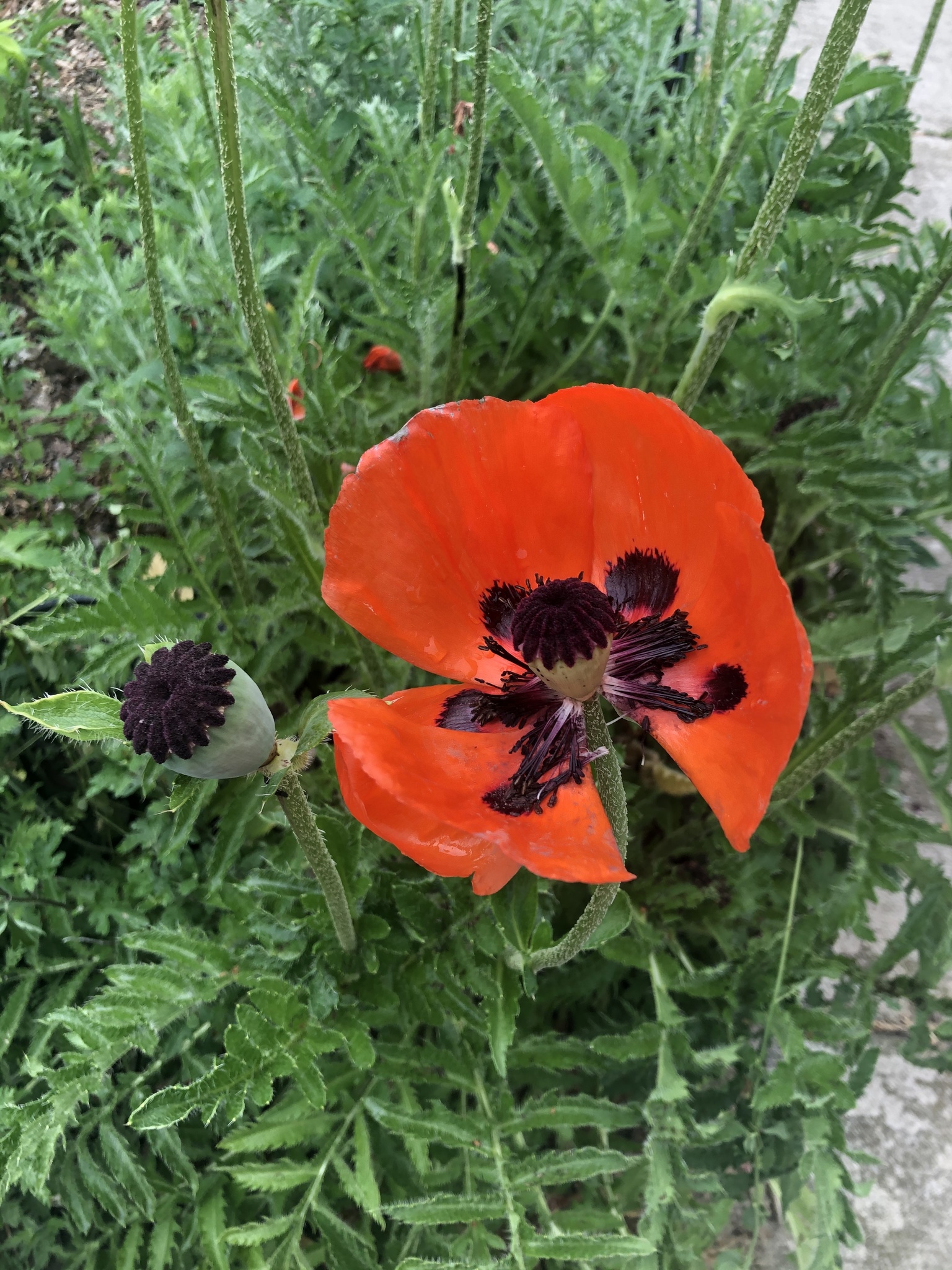
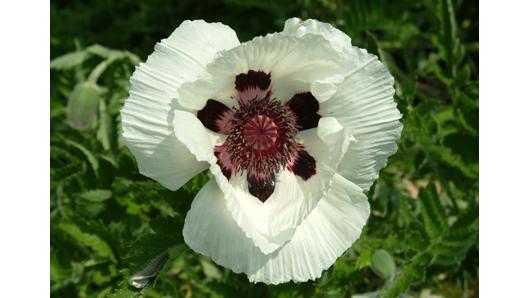
Cultivars expand the palette to white, pink, purple, dark red, salmon, and bicolors. Color alone therefore cannot identify the plant: look for a deeply divided hairy rosette, large late-spring or early-summer flowers, a short capsule, and summer dormancy after flowering. 1 6
Taxonomy and look-alikes
Botanical references accept Papaver orientale L. GBIF includes Calomecon orientale, Papaver dzeghamicum, Papaver grandiflorum, and Papaver spectabile among its synonyms. WFO also lists historical and infraspecific names that may still occur in botanical literature. 3 2
The broader Oriental poppy group creates the main horticultural confusion. Kew explains that many cultivated varieties are hybrids between P. orientale and P. bracteatum. A plant sold as Oriental poppy may therefore belong to a horticultural group rather than a pure wild population. 1
The related Papaver bracteatum is more robust, according to FNA and Kew, with large flowers often bearing six petals, bracts beneath the flower, and larger capsules. These differences matter especially in botanical collections and detailed identification; in gardens, the cultivar name and plant source remain essential. 4 1
Distinguish this perennial from Papaver somniferum, the opium poppy. Papaver orientale is an ornamental plant; its identity does not establish any safe food, medicinal, extraction, or homemade preparation use. 1 12
Habitat and range
Eastern Turkey to northern Iran forms the broad native range given by POWO. Kew details northeastern Turkey, Georgia, Armenia, Azerbaijan, and northwestern Iran in subalpine and alpine areas. WFO also lists the North Caucasus and Transcaucasia, Turkey, and Iran within the native distribution. 1 2
Mountain meadows and scree provide its natural setting, according to Kew, rather than beds kept wet all summer. FNA describes an alpine species in its native range, widely cultivated for ornament and sometimes persisting after escaping cultivation in North America. 1 4
French records require careful interpretation. Tela Botanica lists Papaver orientale under the French name pavot d'Orient and INPN identifier 112342; INPN has a reference page under that number. Inclusion in these references does not establish that it is native throughout France or nationally invasive. 10 11
For mainland France, the sources used establish no national invasive alien designation. Oriental poppy is chiefly a garden plant that may escape or persist locally, but those occurrences do not support a national invasive classification. 4 10
Life cycle and cultivation
Successful cultivation rests on full sun, drainage, and a lasting planting position. RHS recommends a sunny site in most well-drained soils, preferably moderately fertile, humus-rich, and not too acidic. Illinois Extension likewise calls for full sun, moist but well-drained soil, and particularly good winter drainage. 5 7
Moving an established Oriental poppy is difficult. NC State emphasizes its deep taproot and warns against overwatering because of rot; SNHF notes that established plants tolerate relocation poorly and that root cuttings are a widely used propagation method. 6 9
Keep watering restrained and seasonal. After planting or during establishment, about 5-15 mm/week (0.2-0.6 in/week) is a practical guide in a dry spring, adjusted for rainfall, soil, and containers. Once flowering ends and the leaves yellow, avoid keeping the rootstock warm and waterlogged. 5 6
Summer dormancy belongs to its normal cycle. Kew notes that stems and leaves can be cut back after flowering, with leaves emerging again in fall or early spring. Missouri Botanical Garden describes the gap left in early to midsummer as plants rest, suggesting a planting alongside later-developing perennials. 1 8
Heat and humidity limit its performance. NC State reports poor results under hot, humid conditions, especially south of USDA zone 7 in its North American context, and a need for a cold period for good germination. Illinois Extension likewise places these perennials in cool to temperate climates. 6 7
Uses and toxicity
Ornamental and pollinator planting is the established use: perennial beds, borders, cottage gardens, well-drained slopes, or small groups flowering prominently in late spring. RHS lists Papaver orientale as providing nectar and pollen for bees and other pollinating insects. 5
Occasional flowering stems may be cut, but the clump also needs its foliage after flowering to replenish the rootstock. In a lasting border, combine it with species that take over while it is dormant. 6 8
Alkaloids make ingestion unsafe. Kew describes Papaver orientale as poisonous if eaten and notes that grazing animals avoid it. NC State rates human poisoning severity as low, while treating all parts, including the latex, as toxic by comparison with related Papaver species. 1 6
Pet Poison Helpline lists poppies, including Papaver, as toxic to dogs and cats. Alkaloids differ between species, and ingestion can cause sedation or excitement with neurological or behavioral signs. The precautionary toxicity rating is moderate, with cats, dogs, and horses treated as at risk. 12
Keep capsules, seeds, leaves, flowers, roots, latex, and homemade preparations out of food and medicinal use. If a child, adult, or animal swallows part of the plant, contact a healthcare professional, veterinarian, or poison center and give the plant's name. 12 6
Cultivars and responsible growing
Named cultivars account for much of the horticultural appeal. Kew mentions white 'Perry's White', pink 'Mrs Perry', crimson 'Beauty of Livermere', and purple 'Patty's Plum'. Missouri Botanical Garden describes 'Fatima', a compact cultivar with white flowers edged in pink and marked with dark blotches. 1 8
NC State also mentions 'Patty's Plum', 'Peter Pan', 'Raspberry Queen', and 'Watermelon'. These names denote selections for flower color, height, or compactness, sometimes within a hybrid Oriental poppy complex, rather than separate species. 6 1
Seed-grown plants may be attractive without matching the parent's color. Root cuttings are more reliable for preserving a cultivar; seed can suit an ornamental meadow or informal bed if variation is acceptable. 5 6
Choose plants with a firm rootstock, a freely draining pot, healthy foliage, no soft crown, and a clear cultivar label. Allow room for summer dieback. A heavily flowering plant kept in warm, wet growing medium may decline rapidly after planting. 5 9
Main sources
- Plants of the World Online / Kew, Papaver orientale L.
- World Flora Online, Papaver orientale L.
- GBIF Backbone Taxonomy, Papaver orientale L.
- Flora of North America, Papaver orientale
- Royal Horticultural Society, Papaver orientale, oriental poppy
- NC State Extension Gardener Plant Toolbox, Papaver orientale
- University of Illinois Extension, Oriental Poppy
- Missouri Botanical Garden Plant Finder, Papaver orientale 'Fatima'
- Société Nationale d'Horticulture de France, Oriental poppy
- Tela Botanica eFlore, Papaver orientale L., CD_NOM 112342
- INPN / MNHN, Papaver orientale L., CD_NOM 112342
- Pet Poison Helpline, Poppy
Frequently asked questions
Is Oriental poppy a perennial?
Yes. Papaver orientale is a herbaceous perennial with a deep rootstock. It may disappear after flowering in summer, but this dormancy does not mean it has died.
Why does my Oriental poppy disappear in summer?
The foliage normally declines after flowering as the plant enters summer dormancy. Avoid trying to compensate with excessive watering.
How much water does it need?
Little once established. About 5-15 mm/week during a dry spring or early establishment is a useful guide; during summer dormancy, standing water is more dangerous than dryness.
Can I move an established Oriental poppy?
It is possible but risky because the taproot breaks easily. Plant young specimens, or propagate a cultivar using root cuttings.
Is this an opium poppy?
No. Oriental poppy is Papaver orientale, grown as an ornamental. It should not be used for food, medicine, or homemade poppy preparations.
Is it toxic to pets?
Yes, caution is necessary. Kew reports alkaloids, and Pet Poison Helpline lists poppies as toxic to dogs and cats. Prevent ingestion of all parts.
Is Oriental poppy invasive in France?
No national invasive alien status is established for mainland France. It is recorded in French botanical references and grown in gardens, but the sources used do not support a national invasive designation.
Similar plants
If you are unsure about a plant’s toxicity, ask a botanist or veterinarian for advice.