
Norway spruce (Picea abies, )
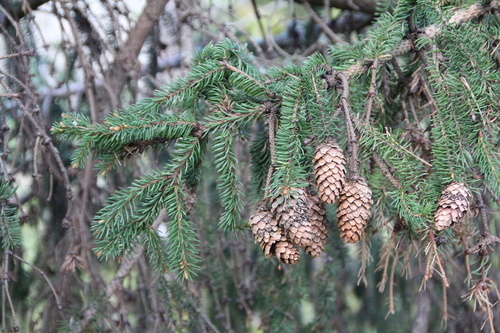
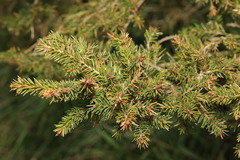
Norway spruce (Picea abies) is a large conifer in the Pinaceae family, native to mountain forests and taiga in northern, central and eastern Europe. Sharp needles borne individually on small woody pegs, reddish-brown bark and the longest hanging cones in the spruce genus identify it. Widely planted for timber and sold as a Christmas tree, it also supplies the tonewood valued by instrument makers.
Read moreNorway spruce and European spruce
© photo
Jens Ullenius · cc0
Stephen James McWilliam · cc0
Katrin Simon · cc-by
(c) Георгий Виноградов (Georgy Vinogradov), some rights reserved (CC BY) · cc-by
no rights reserved · cc0
Global distribution
The native range extends from the French Alps to northwestern Russia and from the Rhodope Mountains in northern Greece to the far north of Norway. It forms extensive mountain forests and is central to northern and eastern European taiga. Forestry plantations outside its natural elevation zone remain distinct from the few places where it has naturalized locally.
- Native8
- Introduced1
- Norway
- Sweden
- Finland
- Germany
- Austria
- Slovenia
- Metropolitan France
- Russia
- Canada
Hexagons: regions where the plant occurs. Green dots: native range.1
Identity
Norway spruce (Picea abies (L.) H.Karst., 1881), also called European spruce, is a large conifer in the Pinaceae family and genus Picea. Carl Linnaeus first described the species in 1753 as Pinus abies. Hermann Karsten transferred it to Picea in 1881, producing the combination accepted today. 1 2
The name Norway spruce reflects its historical use in Britain, where large numbers were imported and planted. Its native range actually covers much of Europe, far beyond Norway. Although familiar as a Christmas tree, it belongs to a different genus from the true firs (Abies), with which spruce is often confused. 5 7
Recognition
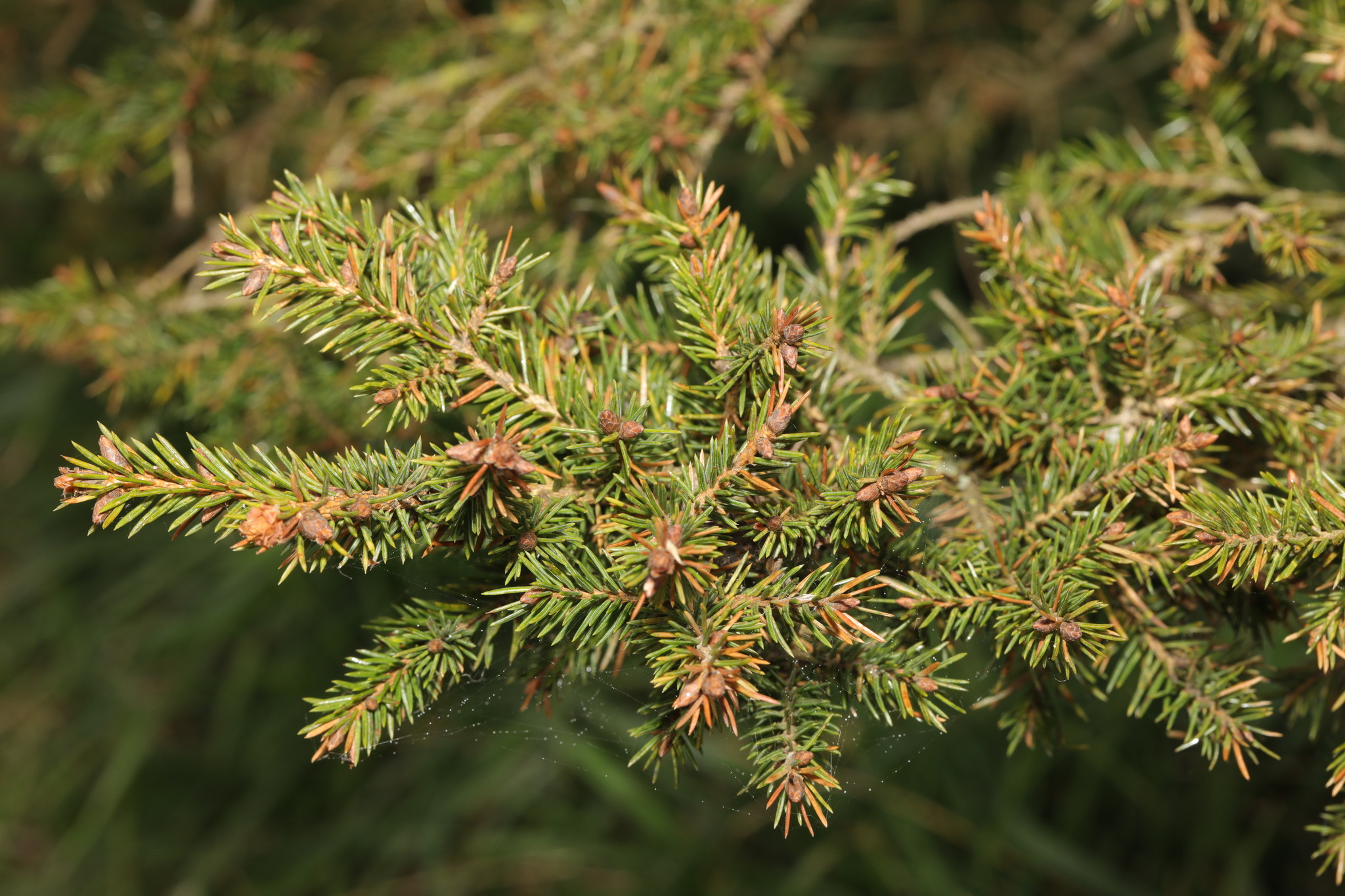
Sharp, dark green needles provide an immediate clue to identification. Measuring 1–2 cm (0.4–0.8 in), they have a square cross section and sit individually on small woody pegs called pulvini. Firs have flat needles attached directly to the twig. Once needles fall, a spruce twig stays rough, while a fir twig remains smooth. 7 5
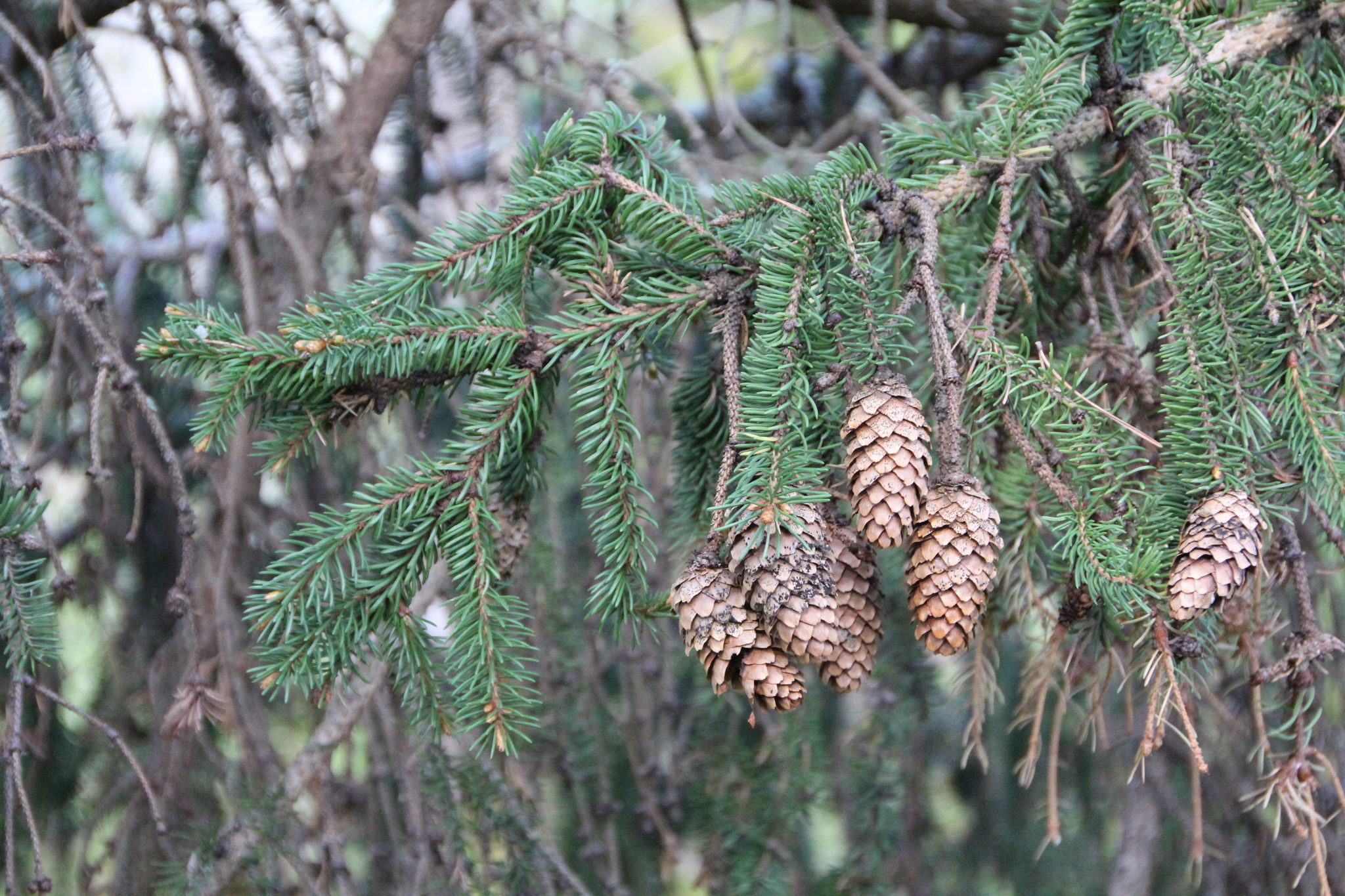
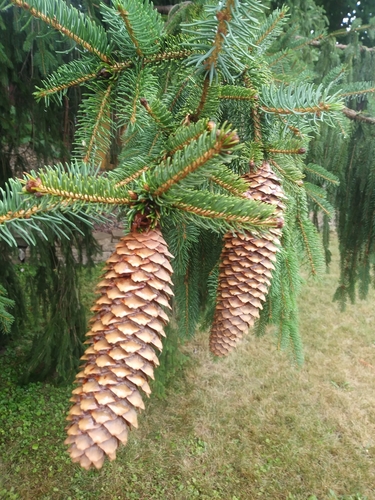
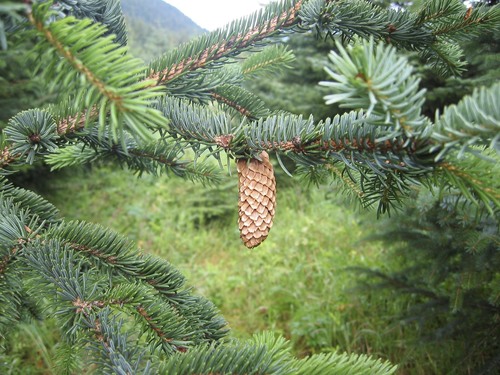
Young bark is thin and reddish brown, becoming thicker and breaking into small gray plates with age. Hanging, cylindrical cones commonly measure 10–16 cm (4–6 in) and occasionally 20 cm (8 in), the longest cones in the genus Picea. Silver fir (Abies alba) instead has upright cones that disintegrate on the tree rather than falling whole. 7 4
Typical trees reach 20–40 m (65–130 ft), with a measured record of 62.7 m (206 ft) in Slovenia. The root system remains shallow. Limited anchorage increases storm vulnerability despite the slender conical outline characteristic of a mountain forest tree. 7
Useful taxonomy
The combination Picea abies originated when Hermann Karsten moved Linnaeus’s 1753 Pinus abies into Picea in 1881. This species is the type of Picea, a genus of roughly thirty Northern Hemisphere conifers. Names encountered in older botanical works include:
- Pinus abies L., the basionym
- Picea excelsa (Lam.) Link, long widely used in Europe
- Picea vulgaris Link, another historical synonym
The accepted scientific name, Picea abies, remains the dependable reference. The variety Picea abies var. acuminata, associated with the Jura, Alps and Carpathians, is also recognized by the classification followed in the source. 1 2
Habitat and range
From the French Alps to northwestern Russia, and from the Rhodope Mountains of northern Greece to the far north of Norway, Norway spruce forms extensive mountain forests. It is also a central component of the taiga in northern and eastern Europe. 7 9
Cool conditions, moderate summers and cool, moist soil, generally acidic, suit the tree; the ideal soil pH is 4–6. Poor soil is tolerated, but limestone can cause chlorosis and slow growth. Shallow roots adapted to thin mountain soils also leave it vulnerable to wind and drought. 6 4
Forestry has spread the species well beyond its natural mountain elevation zone, including European lowlands where warming has exposed its fragility. Winter hardiness remains considerable: boreal trees withstand temperatures far below −30 °C (−22 °F). Heat and drought pose greater problems. Repeated droughts since 2018 have weakened millions of trees and helped drive a major European spruce bark beetle (Ips typographus) outbreak in central and eastern European forests. 13
Life cycle and reproduction
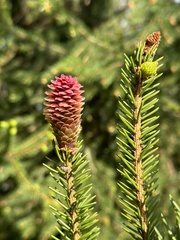
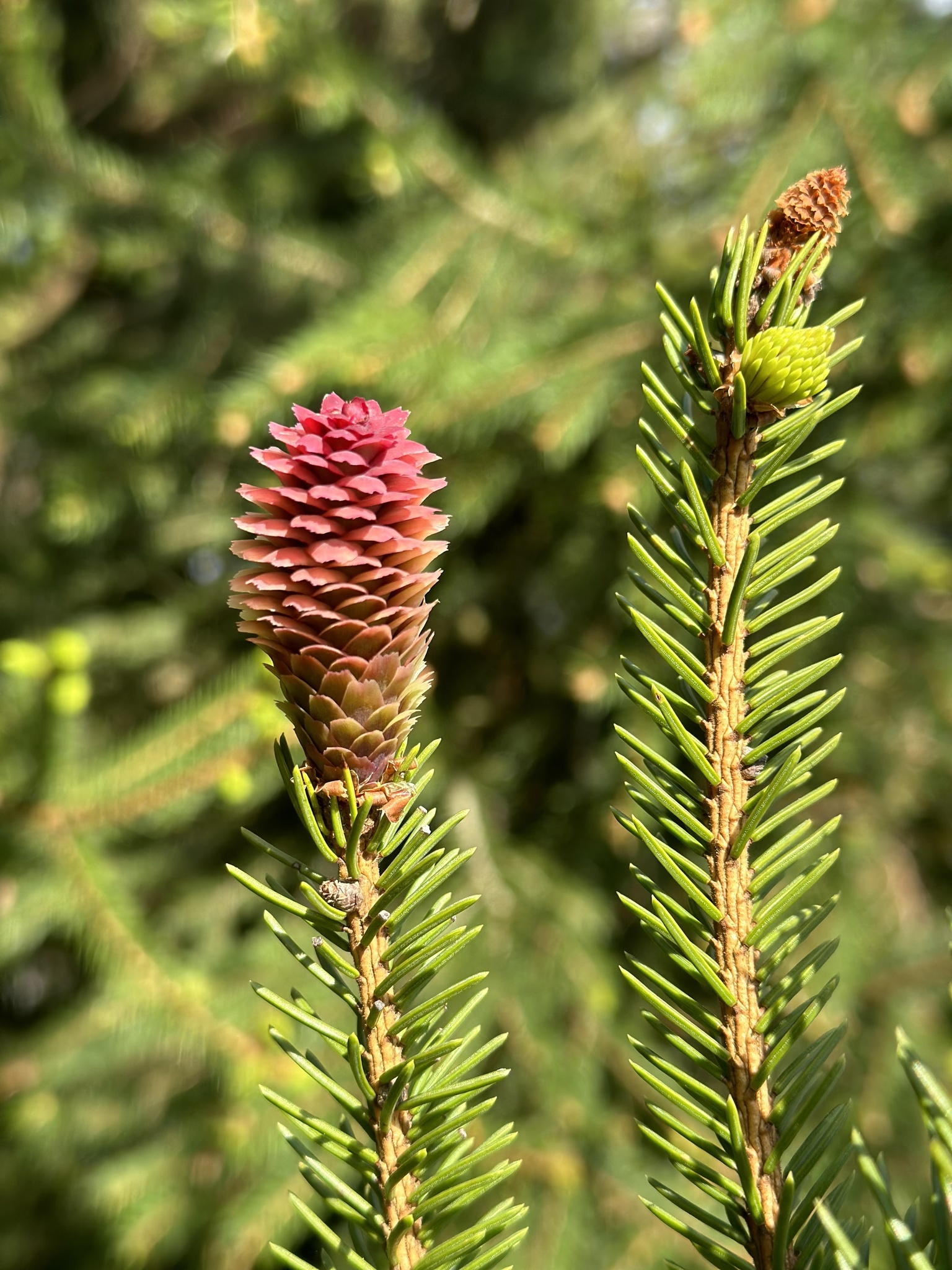
Norway spruce bears its male and female cones separately on the same tree, the defining arrangement of a monoecious gymnosperm. Wind carries the pollen. Reddish female cones initially point upward, then turn downward as they mature over about six months. They release winged seeds that travel away from the parent tree. 4 5
Individual trunks commonly survive for centuries, but vegetative cloning allows far greater longevity. When a trunk dies, the rootstock can regenerate a new stem from the same roots. Sweden’s Old Tjikko clonal root system has been radiocarbon dated to about 9,550 years, placing it among the oldest known living organisms. Its currently visible trunk is only a few centuries old. 11
Forestry propagation relies on seed, with cold stratification helping the winged seeds germinate. Ornamental cultivars are instead grafted onto rootstocks of the species, preserving their dwarf or weeping growth forms. 6
Uses and risks
Christmas trees, cut or container-grown, bring Norway spruce into European homes each winter. Its larger economic role is as a major forestry tree. Pale, soft wood supplies structural timber, joinery and paper pulp, making it a familiar material far beyond the forests where it grows. 6 5
Instrument making gives the wood another distinctive role as tonewood. High-elevation spruce, notably from Italy’s Val di Fiemme, has supplied violin soundboards for centuries, including those made by Stradivari. Slow, even growth produces closely spaced rings and the acoustic qualities sought by instrument makers. 12
Norway spruce is not poisonous when ingested; young shoots and immature cones are sometimes used for herbal tea or confectionery. Repeated contact with resin can irritate skin, and sharp needles pose a physical hazard. A larger ecological concern is the bark beetle crisis, intensified by drought since 2018, which has caused extensive forest dieback in central Europe. 6 13
Varieties, look-alikes and related plants
Garden selections include many dwarf and weeping cultivars: Nidiformis forms a flattened bird’s nest; Little Gem is miniature and very slow-growing; Inversa has weeping branches, often grafted on a standard; and Acrocona produces numerous decorative reddish cones even when young. These selections serve ornamental gardens rather than timber production. 3
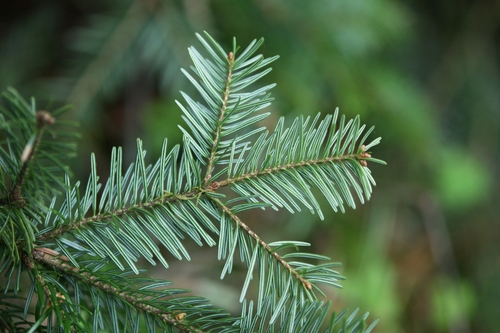
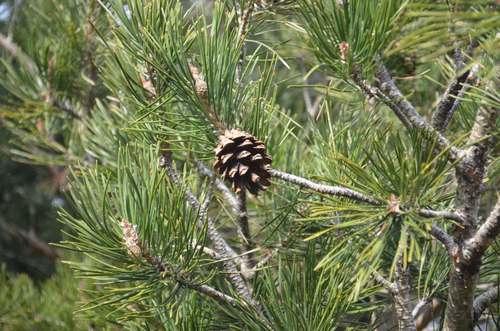
Silver fir (Abies alba) is the most frequent source of confusion. Its flat, round-tipped needles attach directly to the twig without pegs, and its upright cones disintegrate on the tree. Spruce cones hang and fall whole. Scots pine (Pinus sylvestris) differs in having needles in pairs and orange bark high in the crown. 5 7
Other cultivated spruces can also look similar, especially Picea sitchensis and Picea omorika. Needle pegs, cone shape and bark remain the most dependable features for confirming the identity of Picea abies.
Main sources
- Plants of the World Online / Kew, Picea abies (L.) H.Karst.
- International Plant Names Index, Picea abies (L.) H.Karst.
- Royal Horticultural Society, Picea abies - Norway spruce
- Encyclopaedia Britannica, Norway spruce
- NC State Extension, Picea abies (Norway Spruce)
- Plants For A Future, Picea abies
- Trees and Shrubs Online / International Dendrology Society, Picea abies
- Tela Botanica, eFlore BDTFX: Picea abies (L.) H.Karst., official nomenclatural record 75288
- INPN / MNHN–OFB, Picea abies (L.) H.Karst., 1881, CD_NOM 113432: original species notice, archived 3 October 2022
- IUCN Red List, Picea abies assessment
- ScienceNorway, world's oldest tree still growing near the Norwegian-Swedish border
- National Geographic, what makes a Stradivarius violin so special
- Sénécal et al. (2020), La crise des scolytes (Ips typographus) ravageurs de l’Épicéa commun (Picea abies) vue de l’intérieur, pp. 425–441; original PDF archived 29 September 2023
Frequently asked questions
Is Norway spruce a fir?
No. Picea abies belongs to the spruce genus Picea, distinct from Abies, the true firs. Needles on woody pegs and hanging cones that fall whole make the distinction straightforward, even when the tree is sold as a Christmas tree.
Is Norway spruce poisonous?
It is not considered poisonous when ingested; its young shoots are sometimes used in herbal tea. Resin can irritate skin with repeated contact, as with many resinous conifers.
Why have so many spruce forests been dying recently?
Repeated droughts since 2018 have weakened millions of trees in central Europe, allowing massive attacks by the European spruce bark beetle. This small beetle tunnels beneath the bark and can kill a tree in a few weeks.
How long can Norway spruce live?
An individual trunk commonly lives for several centuries. Vegetative regeneration from the rootstock can keep a clonal system alive much longer; Old Tjikko in Sweden has been dated to about 9,550 years.
Why is spruce wood used for violins?
Slow-growing, high-elevation spruce with regular growth rings has acoustic qualities valued for soundboards. Instrument makers, including Stradivari, obtained wood from places such as Italy’s Val di Fiemme.
How can you tell a spruce from a fir?
Spruce needles are borne individually on woody pegs, and its hanging cones fall whole. Fir needles are flat and attached directly to the twig; upright cones break apart on the tree.
Can Norway spruce grow in lowlands?
Yes. It is widely planted for forestry outside its natural mountain elevation zone. There it is more vulnerable to drought and summer heat, explaining its increasing fragility as the climate warms.
Similar plants
If you are unsure about a plant’s toxicity, ask a botanist or veterinarian for advice.