
Black poplar (Populus nigra, )
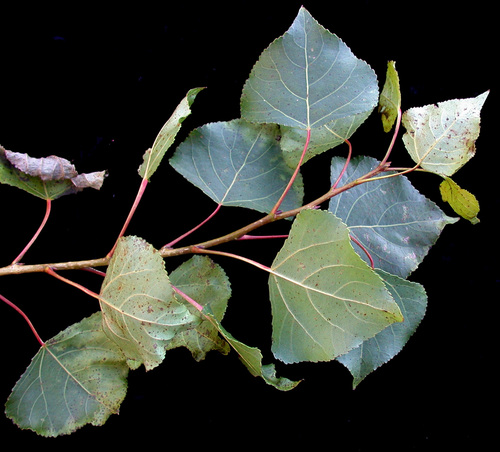
Black poplar (Populus nigra) is a large dioecious tree in the Salicaceae family, native to Europe, the Maghreb and western to central Asia. A riverbank pioneer, it colonizes gravel and sand exposed by floods. Its dark, longitudinally cracked bark explains its common name.
Read moreBlack poplar
Place in full sun, with intense direct light all day long.
Full sun; a light-demanding pioneer


© photo
(c) Ayotte, Gilles, 1948-, some rights reserved (CC BY-SA) · cc-by-sa
zebedeugalinha · cc-by
Francesco Santoro · cc-by
Taken Apr 9, 2022 by Rast (cc-by-sa)
Taken Nov 12, 2022 by Dominik Muczyński (cc-by-sa)
Taken May 20, 2021 by Jacques Zuber (cc-by-sa)
Taken Oct 22, 2022 by Dominik Muczyński (cc-by-sa)
Taken Dec 14, 2021 by Kai Best (cc-by-sa)
© copyright of the Board of Trustees of the Royal Botanic Gardens, Kew.


Global distribution
Populus nigra is native to Europe, the Maghreb and western to central Asia, reaching Xinjiang in China. It occurs throughout metropolitan France and Corsica, linked to rivers and wet places. Beyond this range it is planted ornamentally as the upright cultivar Italica and is a parent of most cultivated hybrid poplars.
- Native8
- France
- Spain
- Italy
- Germany
- United Kingdom
- Morocco
- Turkey
- China
Hexagons: regions where the plant occurs. Green dots: native range.1
Identity
Black poplar (Populus nigra L., 1753) is a large dioecious tree of the genus Populus in the Salicaceae family. POWO/WCVP accepts the name Populus nigra L. The epithet nigra refers to bark that becomes dark, almost black in old trees, contrasting with the pale trunk of white poplar. French regional names include peuplier commun noir and piboule. 1 2
French speakers also use liard, and France's INPN records the principal vernacular names peuplier noir and peuplier commun noir. This is a pioneer species with separate sexes: each tree bears either male or female flowers, never both together. 3
Recognition
Mature black poplars commonly stand 20–30 m (65–100 ft) tall, with trunks that can exceed 1 m (3 ft) in diameter in old specimens. Brownish-gray bark becomes almost black, cracking early into longitudinal fissures that form a characteristic diamond-shaped network. 2 1
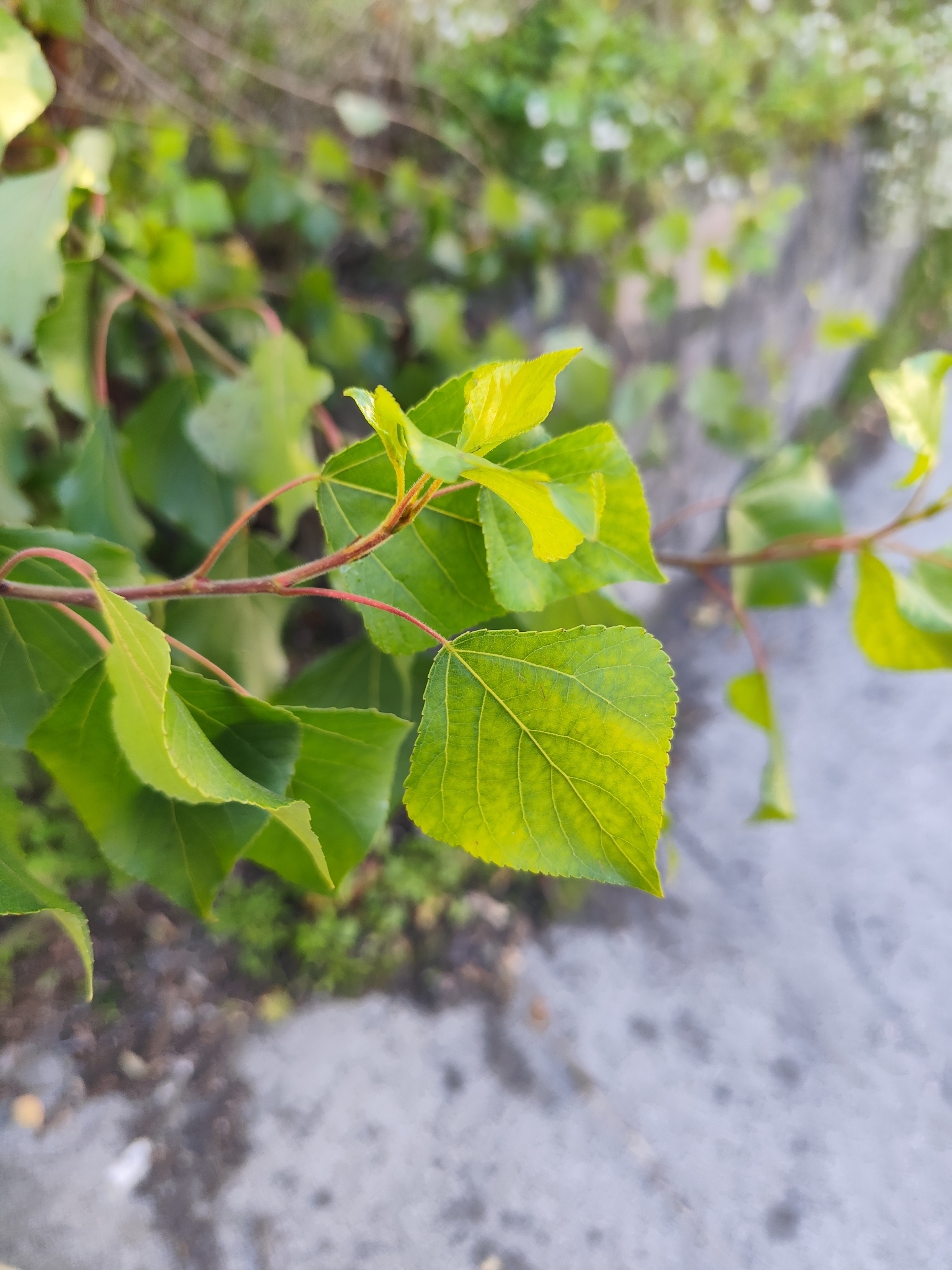
Alternate leaves have a stalk flattened near the blade, which is triangular to broadly oval-triangular, with a tapering tip and regularly scalloped teeth. Both surfaces are hairless and glossy. The compressed stalk lets the blade vibrate in the lightest breeze, helping identify a tree from a distance before examining its foliage closely. 2
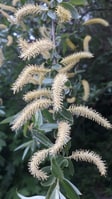
Being dioecious, black poplar flowers in early spring before the leaves emerge. Hairless male catkins have fringed scales and 12–20 stamens; the less conspicuous female flowers have 4 recurved yellow stigmas. Fertilized female flowers form egg-shaped capsules with four grooves, opening into two valves to release white cottony material carrying the seeds in spring. 2
Useful taxonomy
Within Salicaceae and the order Malpighiales, the accepted name remains Populus nigra L., 1753. Older floras may list Populus europaea Dode, Populus mulleriana Dode or Populus flexibilis Dode. These are historical synonyms of the same taxon, rather than distinct species. 3 2
Three subspecies divide the range: Populus nigra subsp. nigra predominates in central and eastern Europe; subsp. betulifolia occupies the cooler, wetter northwest; and subsp. caudina is confined to the Mediterranean region. Lombardy poplar is a cultivar, not a fourth subspecies: Populus nigra f. italica (Münchh.) A.Andersen. Propagation by cuttings rather than seed accounts for the genetic identity of trees planted under this name. 1 3
Habitat and range
Europe, the Maghreb and western to central Asia form black poplar's native range, extending east to Xinjiang in China. In France it occurs throughout the mainland and Corsica, consistently associated with rivers and damp ground. 1 2
As a pioneer, it colonizes bare, nitrogen- and base-rich gravel and sandbars exposed by natural river movements. This reliance on freely shifting rivers makes the species vulnerable: up to 99% of Europe's riparian forests have disappeared through river engineering, flood regulation and conversion to agriculture or urban land. 6
IUCN assesses Populus nigra as Data Deficient globally and in Europe because population sizes and actual decline remain insufficiently documented. France's national red list instead assigns Least Concern. A French genetic-resource conservation program began in 1991 under the Ministry of Agriculture, led by INRAE's UMR BioForA, to preserve remaining wild diversity before it is diluted by cultivated populations. 4 3 7
Life cycle and reproduction
Before new leaves appear in early spring, wind disperses pollen from male catkins to female flowers on separate trees. An isolated female without a nearby male cannot produce viable seed. 2
Once released, cottony seeds retain viability for only a short time. Establishment requires bare, wet ground, restricting natural regeneration to flood events that expose fresh river deposits at the right time. 5
Vegetative propagation predominates in horticulture and population restoration. Hardwood cuttings 20–40 cm (8–16 in) long, taken in late fall or early winter, root readily in open ground without rooting hormone. This ease of propagation also explains the high proportion of clonal trees along some engineered watercourses: up to 40% in certain heavily managed British, Irish and Dutch populations. 5 6
Uses and risks
Packaging and plywood use the soft, light wood where mechanical strength is less important; the bark historically served as a cork substitute. Extracts of young shoots, rich in natural auxins, stimulate rooting in other species and have been used as a gardening rooting treatment. 5
The buds contain salicin, a precursor of salicylic acid, associated with traditional treatment of bronchitis and joint pain. Stem bark was likewise used for rheumatic complaints. People sensitive to aspirin should avoid such preparations. 5
Extensive, aggressive roots actively seek moisture and can damage foundations and pipes; allow at least 12 m (40 ft) between black poplar and a building. 5 Brittle wood, recurrent pests and diseases, and falling branches also argue against closely spaced urban planting. 8 No documented toxic compound is identified for cats, dogs or humans, but the status for horses remains unknown.
Varieties, look-alikes and related plants
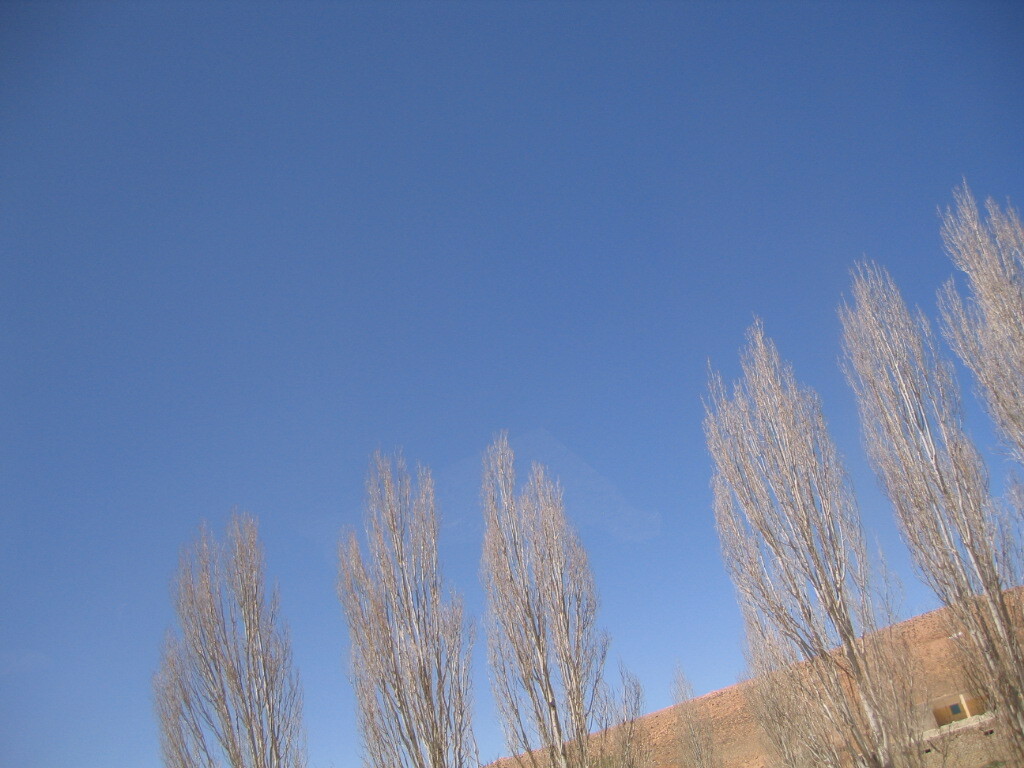
The narrow, columnar silhouette of Lombardy poplar (Populus nigra f. italica) contrasts with the spreading, irregular wild tree. Selected in Lombardy, this male clone avoids cottony seed fluff in towns, but often lives only 40–50 years. 2
Hybridization poses a conservation issue beyond everyday identification. Black poplar crosses readily with North American eastern cottonwood (Populus deltoides), producing most forestry hybrid poplars. Gene flow from nearby plantations threatens the genetic diversity of the remaining wild populations. 6
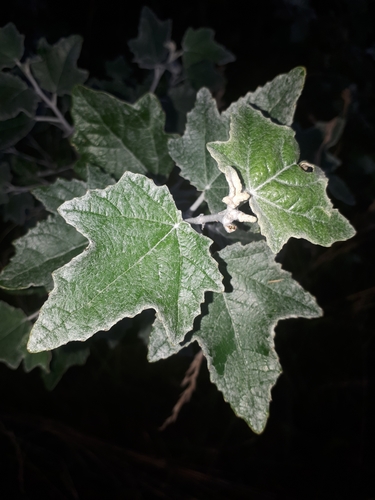
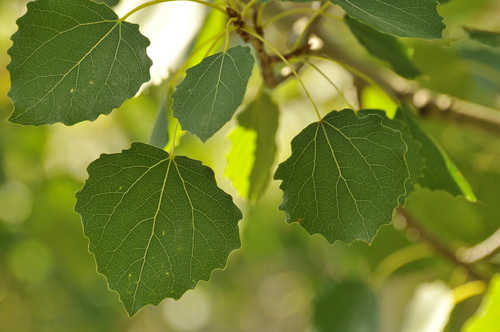
White poplar (Populus alba) differs in its white felted leaf undersides, absent in black poplar. European aspen (Populus tremula) has smaller, rounder leaves that tremble in the wind on similarly flattened stalks. These leaf features help separate the most common look-alikes. 2
Main sources
- Plants of the World Online / Kew, Populus nigra L.
- Tela Botanica, eFlore BDTFX: Populus nigra L., official nomenclatural record 52030
- INPN / MNHN–OFB, Populus nigra L., 1753, accepted-species notice CD_NOM 115145, archived 6 December 2022
- IUCN Red List of Threatened Species, Populus nigra assessment (Harvey-Brown et al., 2017)
- Plants For A Future, Populus nigra
- EUFORGEN European Forest Genetic Resources Programme, Populus nigra
- INRAE / UMR BioForA, Peuplier noir (Populus nigra), original conservation-program page; archived 6 March 2026
- NC State Extension, Populus nigra (Black Poplar, Lombardy Poplar)
Frequently asked questions
Is black poplar the same as Lombardy poplar?
Not exactly. Lombardy poplar (Italica) is a narrow, upright male cultivar selected from Populus nigra. It belongs to the same species but is a particular horticultural form, rather than the spreading wild tree.
Is black poplar toxic to cats and dogs?
No toxic compound is documented for this species in cats, dogs or humans. Its status for horses remains unknown because specific data are lacking.
Why is wild black poplar becoming rare?
River engineering, flood regulation and conversion to farmland have removed up to 99% of European riparian forests, its natural habitat. Cultivars remain common in towns, but wild trees are much less widespread.
Can I plant black poplar near a house?
This is not recommended. Its extensive, aggressive roots seek water and can damage foundations and pipes. Allow at least 12–15 m (40–50 ft) between the tree and a building.
How does black poplar differ from European aspen or white poplar?
White poplar has a white felted leaf underside, which black poplar lacks. European aspen has smaller, almost round leaves that tremble conspicuously on very flattened stalks.
Where does the white fluff in spring come from?
It is the cottony material surrounding seeds from fertilized female trees. Towns seeking to avoid it plant male clones such as Italica or Plantierensis.
Is black poplar invasive?
The wild species is not considered invasive; in Europe it is instead a tree under threat. Hybridization with cultivated poplars poses a genetic conservation problem rather than an invasion problem.
Similar plants
If you are unsure about a plant’s toxicity, ask a botanist or veterinarian for advice.