
Wild cherry (Prunus avium, )
Wild cherry (Prunus avium) is a deciduous tree in the Rosaceae, native from Europe to Afghanistan and North Africa. White spring flowers precede summer cherries; edible ripe flesh must be distinguished from cyanogenic stones, stalks, leaves and stems.
Read moreWild cherry, Sweet cherry, Gean and Mazzard cherry
Allow a few hours of direct sun per day, preferably morning or evening.


© photo
Stephen James McWilliam · cc0
zebedeugalinha · cc-by
Taken Apr 13, 2022 by Tristan Jaton-Maria (cc-by-sa)
Taken Nov 12, 2022 by Dominik Muczyński (cc-by-sa)
Taken Mar 25, 2021 by Joaquim Serra (cc-by-sa)
Taken May 3, 2021 by Alain Bigou (cc-by-sa)
Taken May 30, 2021 by Alain Bigou (cc-by-sa)
© copyright of the Board of Trustees of the Royal Botanic Gardens, Kew.




Global distribution
POWO/WCVP gives a native range from Europe to Afghanistan and North Africa, including France. Introductions occur outside that range, but no invasive status is published for France.
- Native10
- Introduced5
- France
- Corsica
- Great Britain
- Germany
- Spain
- Italy
- Türkiye
- Iran
- Afghanistan
- North Africa
- United States
- Canada
- New Zealand
- South Australia and Victoria
- Korea
Hexagons: regions where the plant occurs. Green dots: native range.1
Identity
Wild cherry (Prunus avium (L.) L.) is an accepted species of Prunus in the Rosaceae. Its name is associated with Linnaeus’s second edition of Flora Suecica, published in 1755. POWO/WCVP describes it as a tree of the temperate biome, encompassing both wild trees and cultivated sweet cherries. 1 2
Wild cherry is a useful name for the woodland form, while sweet cherry emphasizes its association with dessert cherries. It distinguishes the species from sour cherry, Prunus cerasus. These names describe different aspects of P. avium, rather than making its wild and cultivated forms separate species. 3 4
Cherry alone is a broad name: it may refer to P. avium, grafted sweet-cherry cultivars, P. cerasus, ornamental cherries or other local Prunus. The scientific name Prunus avium is the stable reference when those uses overlap.
Recognition
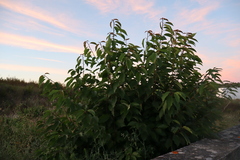
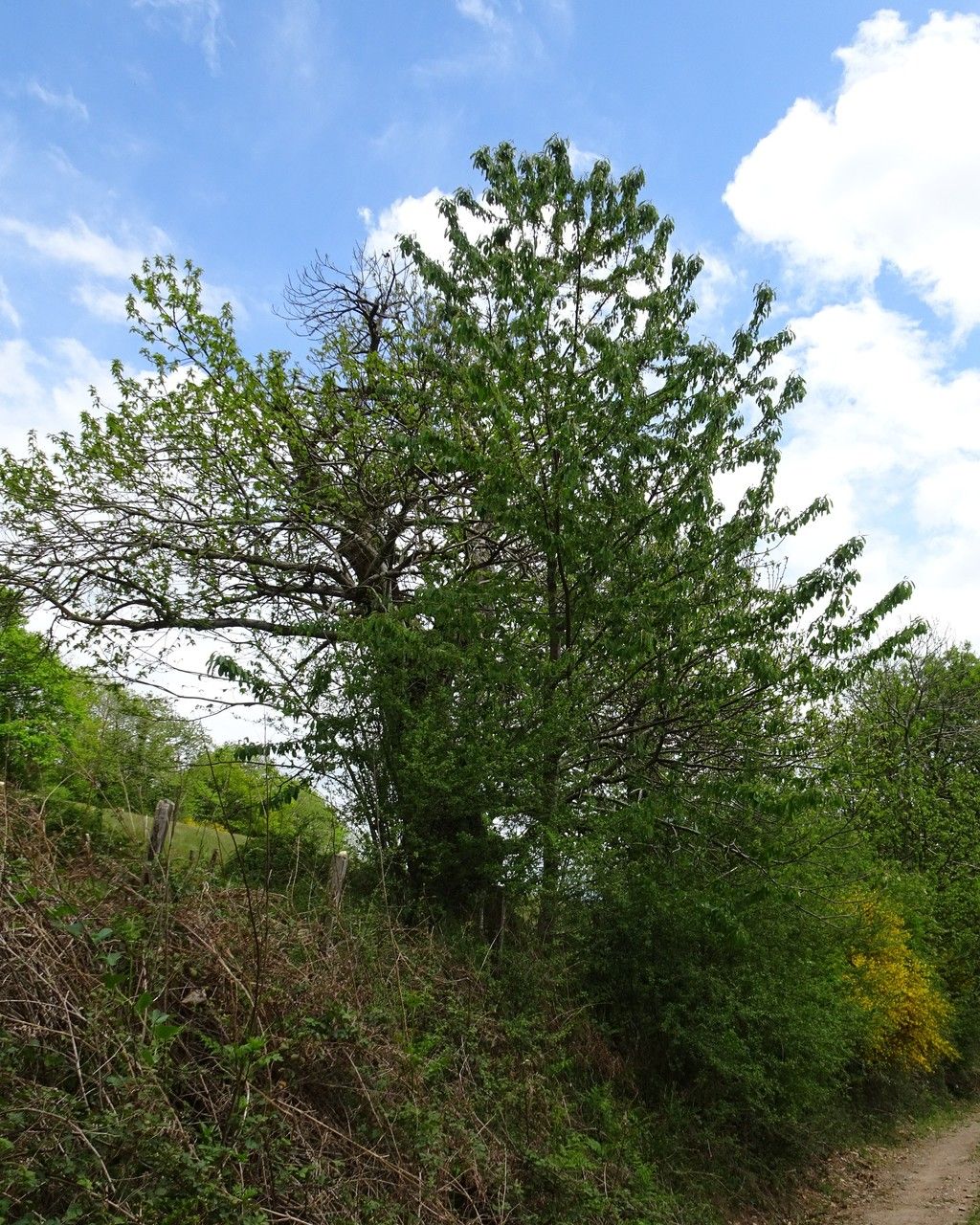
Deciduous growth and a potentially large mature size distinguish the free-growing tree from many grafted orchard cherries. RHS places it above 12 m (39 ft), while horticultural records often give lower heights for cultivated forms. Rootstock and training therefore matter when comparing the size of trees offered for gardens. 4 5
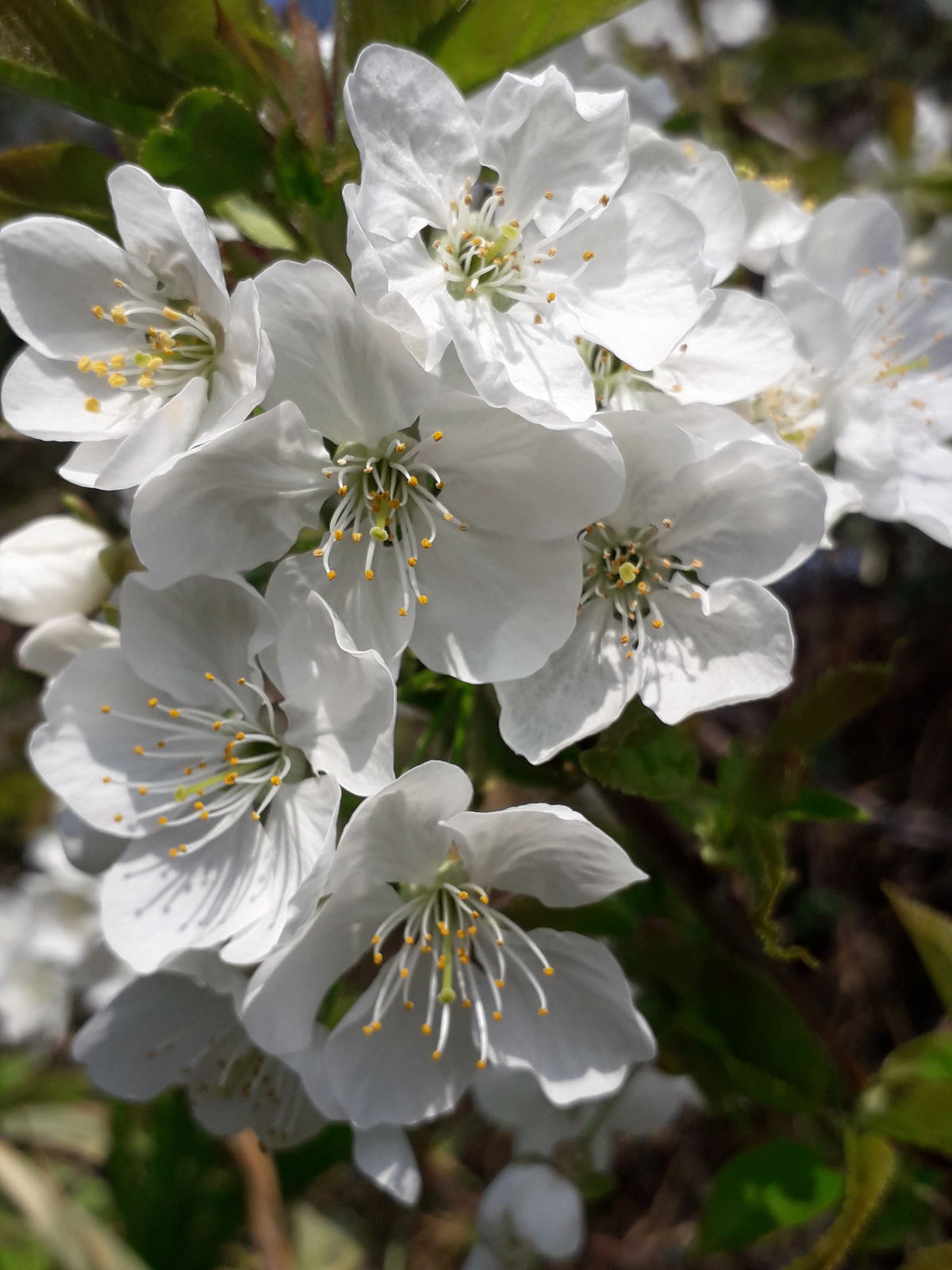
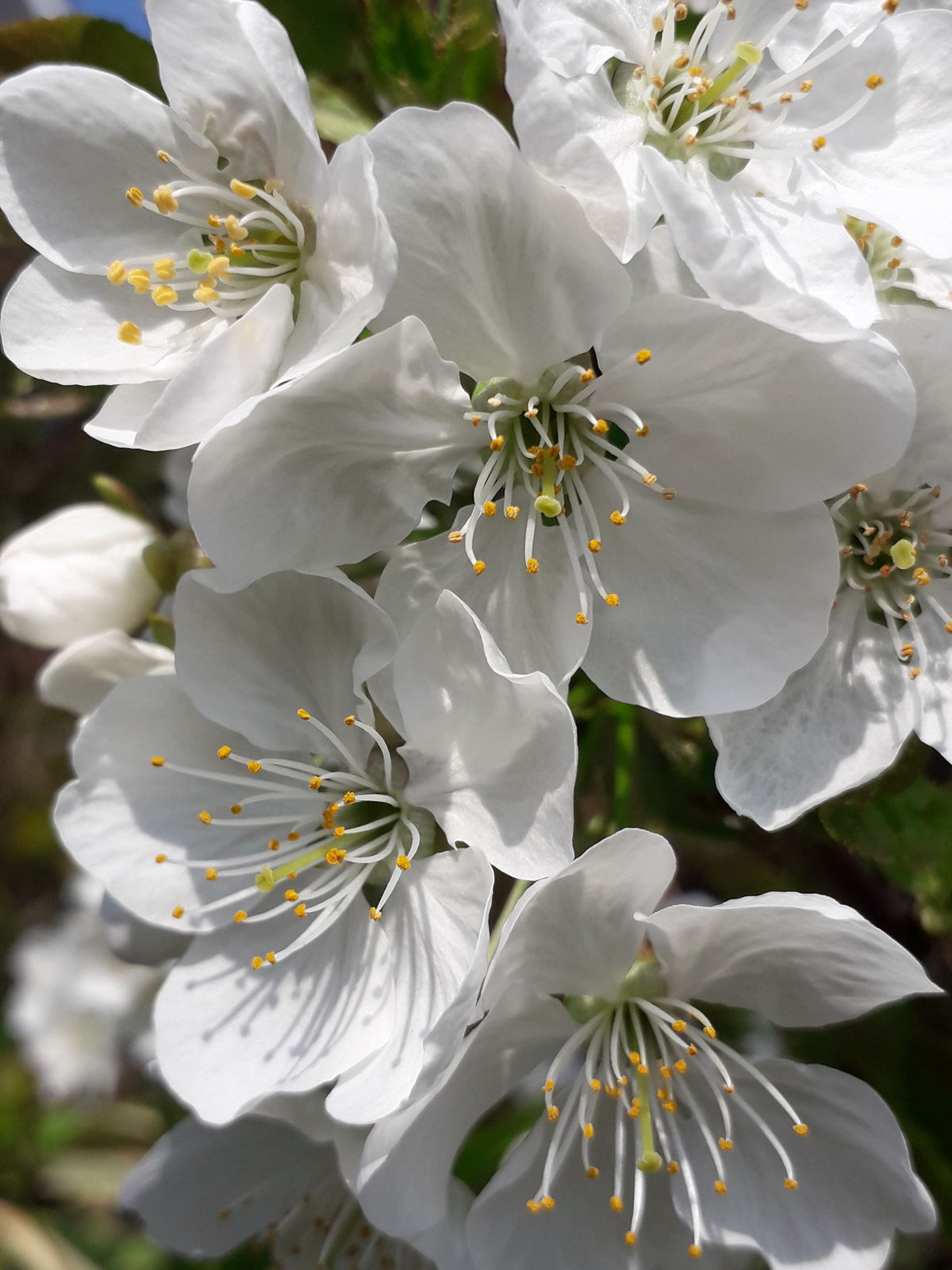
White, five-petaled flowers open in local spring, singly or a few together in small rounded clusters. RHS gives a diameter of about 2.5 cm (1 in); NC State gives 2.5–4 cm (1–1½ in). They emerge with the leaves or very close to budbreak, making flowers and newly opening foliage visible together. 4 5
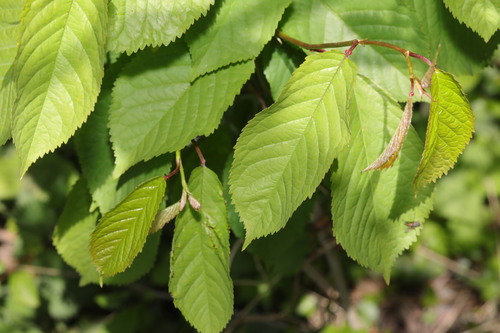
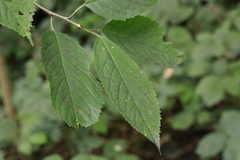
Leaves are simple, alternate, elliptical and toothed, green during growth and colored in autumn. Two small red or green glands near the blade base or on the leaf stalk provide a useful identifying detail. Young bark often has clear horizontal lenticels, becoming grayer and wrinkled as it ages. 5
The fruit is a drupe: yellow, red or reddish-purple flesh surrounds a hard stone, carried on a long stalk. Ripe flesh accounts for the food use of sweet cherry. The stone and other plant parts have a different safety profile and should not be treated as food merely because the flesh is edible. 5 6
Useful taxonomy
POWO accepts Prunus avium and lists numerous synonyms. Those most useful in older botanical or horticultural texts include Cerasus avium (L.) Moench, Druparia avium (L.) Clairv. and Prunus cerasus var. avium L. These names belong to the classification history of the accepted species. 1
Names such as duracina, juliana and sylvestris occur in synonymy and horticultural history. Their occurrence does not establish that a supermarket cherry, a wild tree and a grafted cultivar behave identically in cultivation. A shared species name can encompass different fruit selections and rootstock combinations. 1 2
Bird cherry requires particular care. RHS includes it among common names of P. avium, but other floras often use it for Prunus padus. The binomial is therefore necessary where identification or safety matters; a common name alone cannot reliably separate these different cherries. 4 3
Habitat and range
The native range recognized by POWO/WCVP extends across Europe to Afghanistan and includes North Africa. France and Corsica are within that native area. Sweet cherry is therefore indigenous in mainland France rather than an exotic tree there, irrespective of introductions recorded in other parts of the world. 1 3
Woodland edges, open woods, hedges, old orchards and bright gardens form its temperate settings. In cultivation, give it moderately fertile, well-drained soil and full sun. Drainage is particularly important: sweet cherry performs poorly in waterlogged ground, even though young plantings need dependable moisture while they establish. 4 5
Introductions outside the native range include North America, New Zealand, Australia, Korea and other regions. These records do not establish invasive status in France. Any concern about spread needs to remain geographically specific, since an introduced population and a native woodland tree have different regional contexts. 1
Life cycle, flowering and fruit
Sap rises in local spring, followed by white blossom, fruit set and summer cherry ripening. Autumn brings yellow, orange or red foliage before winter dormancy. The sequence gives sweet cherry both a fruiting role and a changing appearance through the temperate growing season. 4 5
Sweet cherries are drupes, not berries. Their fleshy yellow-to-red or reddish-purple fruits contain a large stone. Ripe flesh can be eaten raw or cooked, but that food use does not extend to the stone or vegetative parts. Separating these parts is central to both harvesting and handling the crop. 5
Fruit cultivars do not come true from seed. A stone can produce a young cherry tree, but not a guaranteed copy of 'Stella', 'Lapins' or 'Merchant'. Grafting or budding is the horticultural method used to maintain a chosen orchard cultivar and its known characteristics. 4 8
Cultivation and uses
Fruit production and landscape planting are the main uses. Sweet cherry supplies edible fruit and flowers that offer nectar and pollen to pollinators. It fits food gardens and spring-flowering plantings as well as orchards, although the size of an unrestrained tree differs from that of a trained fruit specimen. 4 5
Full sun favors fruiting. Keep soil moist but well drained, with moderate fertility. Fan training, a small-tree form or a suitable rootstock makes protection from birds and blossom frost, and eventual harvesting, easier. These management choices help determine how well the tree fits the available space. 4
Prune established trees sparingly around harvest or during local summer, reducing the need for large wounds during wet conditions. Problems to watch for include aphids, sawflies, spotted-wing drosophila, bacterial canker, brown rot, silver leaf, honey fungus and late-frost damage. These are separate from normal autumn leaf coloring. 4 5
Toxicity, animals and food precautions
Edible ripe fruit flesh does not make the whole plant safe. NC State lists sweet cherry as having medium toxicity while also identifying its ripe fruit as edible raw or cooked. The distinction concerns plant parts, rather than a contradiction between an edible crop and its wider toxicological profile. 5
Cyanogenic glycosides, including amygdalin and prunasin, account for the risk. Cyanogenic compounds are detectable in leaves, flowers, unripe and ripe fruit, and seeds, with the highest concentrations in seeds enclosed in stones and in fruit stalks. ASPCA lists Prunus cherries as toxic to dogs, cats and horses, particularly stems, leaves and seeds, with wilted foliage of special concern. 5 6
A person eating pitted cherry flesh does not establish safety of fallen fruit, stones, stalks or leaves for animals or children. Remove stones before crushing, blending or other mechanical processing, since breaking the hard shell exposes the seed. Treat discarded material separately from the edible flesh. 5 7
After substantial ingestion of foliage, twigs, crushed stones or wilted material, contact a veterinarian, poison center or health professional appropriate to the exposed person or animal. Do not rely on a home diagnosis of the amount or severity of cyanogenic exposure. 6
Cultivars, rootstocks and look-alikes
Named sweet-cherry cultivars include 'Merchant', 'Colney' and 'Hertford' in RHS records, with 'Stella', 'Lapins' and 'Thomas' STARK GOLD also represented in horticultural data. These names denote fruiting clones or commercial selections, not separate botanical species. The cultivar identity is useful alongside the species name when choosing a crop. 4 8
The most frequent confusion is with sour cherry, Prunus cerasus. P. avium is sweet cherry, commonly grown for dessert fruit, while P. cerasus is the sour or morello cherry. Other possible confusions involve Prunus padus under bird cherry, North American Prunus serotina, and ornamental cherries such as Prunus serrulata. 4 3
When buying, check the botanical name, cultivar, rootstock, vigor, flowering period, pollination compatibility and intended use. For a self-sown tree, combine white flowers, toothed leaves with glands, horizontal bark lenticels and drupes. Those visible characters are more useful than assuming every tree called cherry is the same fruit crop. 4 5
Main sources
- Plants of the World Online / Kew, Prunus avium (L.) L.
- WCVP taxon record, Prunus avium
- Trefle, species data, Prunus avium
- Royal Horticultural Society, Prunus avium wild cherry
- NC State Extension Gardener Plant Toolbox, Sweet Cherry Prunus avium
- ASPCA, Cherry toxicity entry
- ASPCA toxic plant list, sweet cherry
- Perenual plant data, Prunus avium
- Floristic record, Prunus avium
Frequently asked questions
Is wild cherry fruit edible?
Yes. NC State describes ripe flesh as edible raw or cooked, and RHS classes the species as an edible-fruit tree. This does not make the stone, stalk, leaves or stems edible.
Is wild cherry toxic to dogs and cats?
Yes. The ASPCA lists Prunus cherries as toxic to dogs, cats and horses, particularly stems, leaves and seeds. Edible fruit flesh alone does not establish animal safety.
Which parts present the greatest risk?
Do not ingest crushed stones, leaves, stems, fruit stalks or wilted material. NC State identifies seeds inside stones and fruit stalks as having the highest concentrations of toxic compounds.
Are Prunus avium and Prunus cerasus the same?
No. Prunus avium is sweet or wild cherry; Prunus cerasus is sour cherry. Both can have white flowers and red fruit, which can cause confusion.
Is wild cherry invasive in France?
No invasive status is published for France, where POWO/WCVP treats it as native. It can be introduced or naturalized elsewhere, requiring a local assessment.
Can you grow a cherry tree from a stone?
A stone can produce a young Prunus, but not a reliable copy of the cultivar. For a chosen fruit tree, use a grafted plant on an identified rootstock.
Similar plants
If you are unsure about a plant’s toxicity, ask a botanist or veterinarian for advice.