
Holm oak (Quercus ilex, )
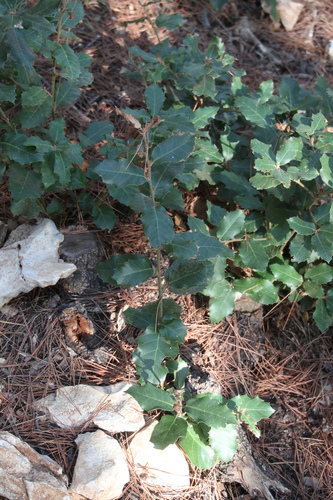
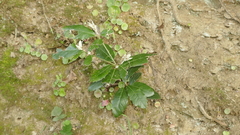
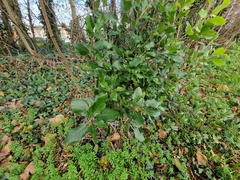
Holm oak (Quercus ilex) is an evergreen tree in the Fagaceae family, characteristic of evergreen oak woodland and garrigue around the Mediterranean. Dark, glossy foliage, flattened acorn-cup scales and acorns that ripen in a single season distinguish it from Kermes oak, which often grows in the same landscape.
Read moreHolm oak, Holly oak, Yeuse, Garric and Encina
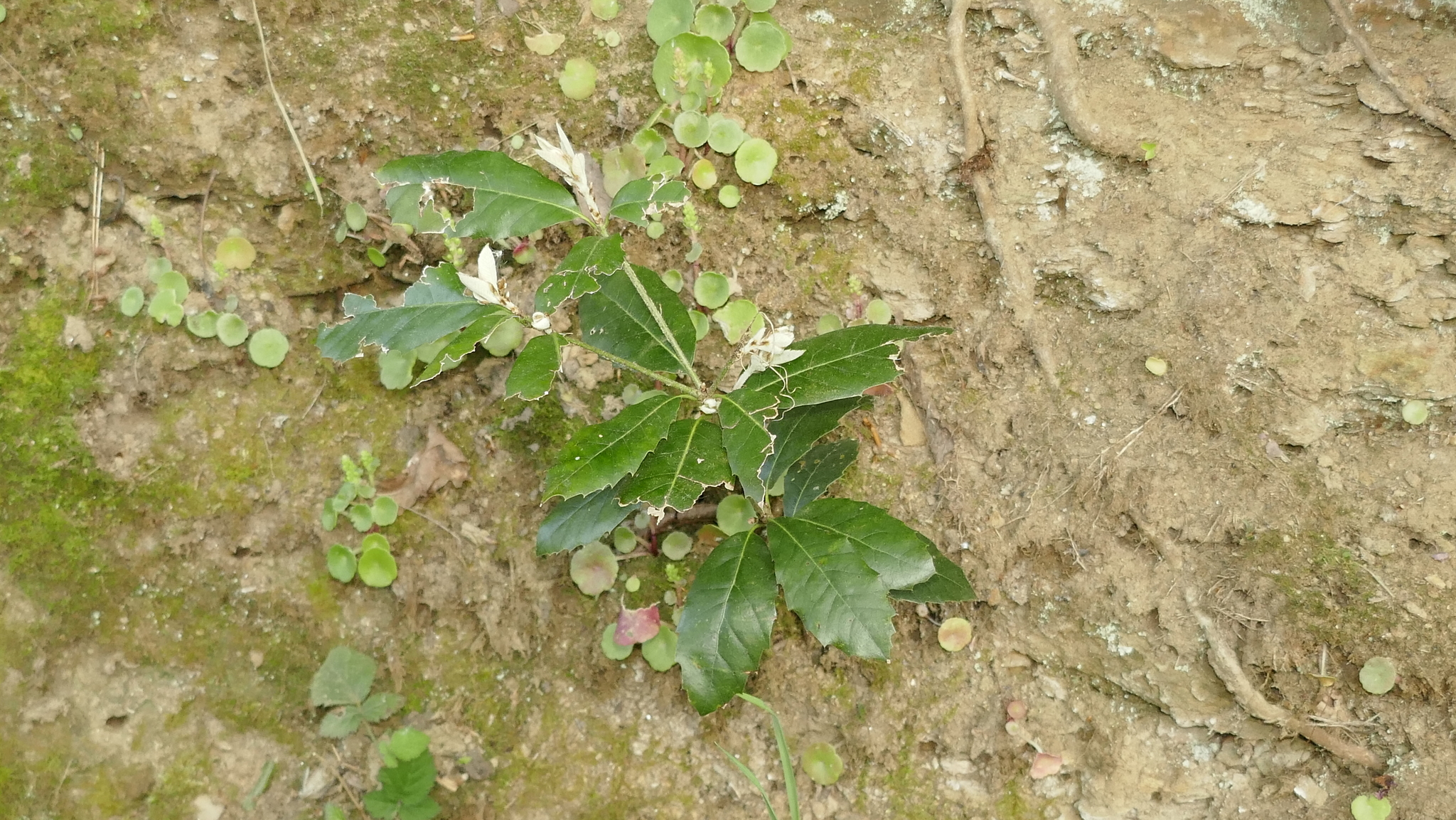
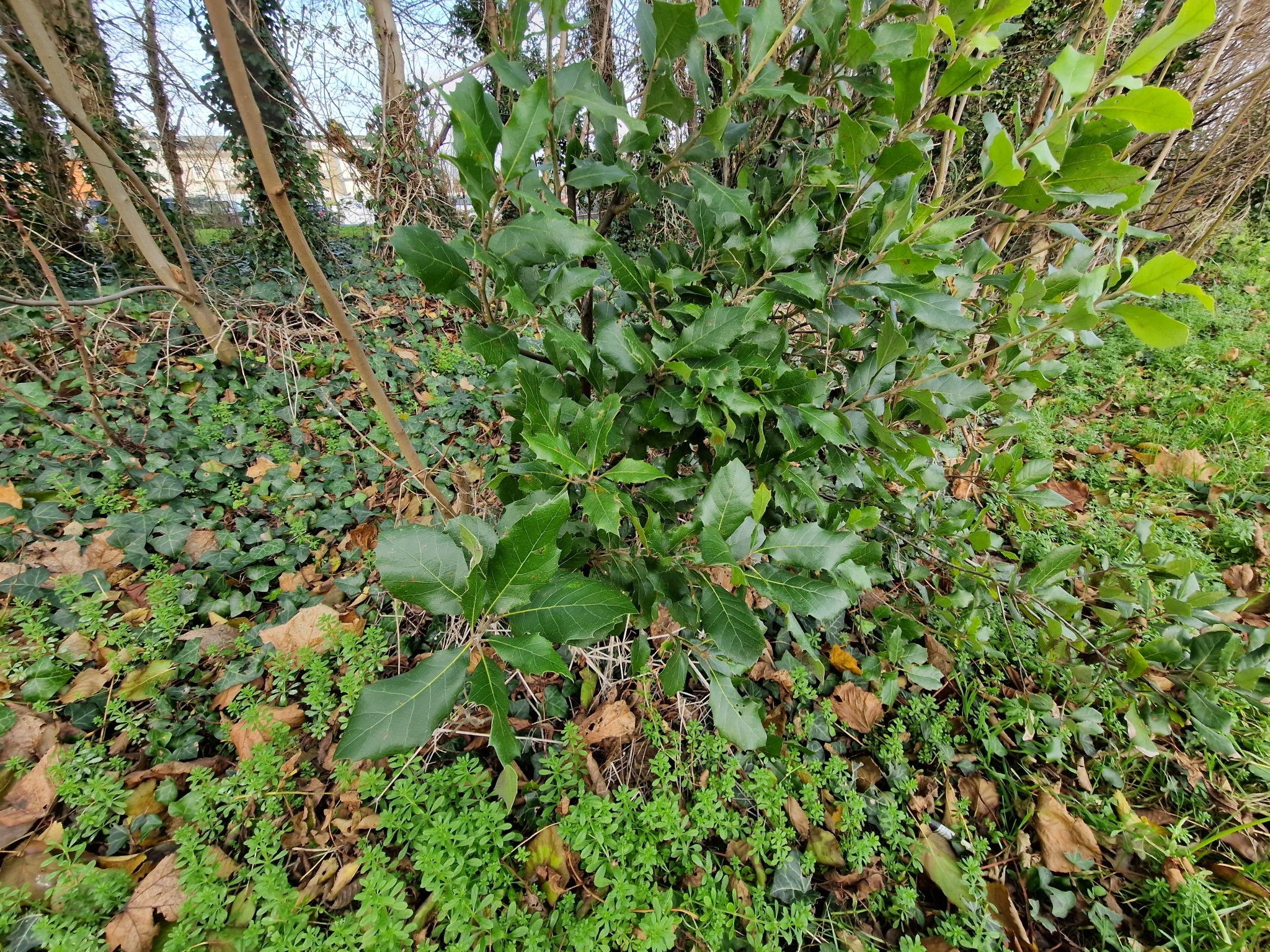


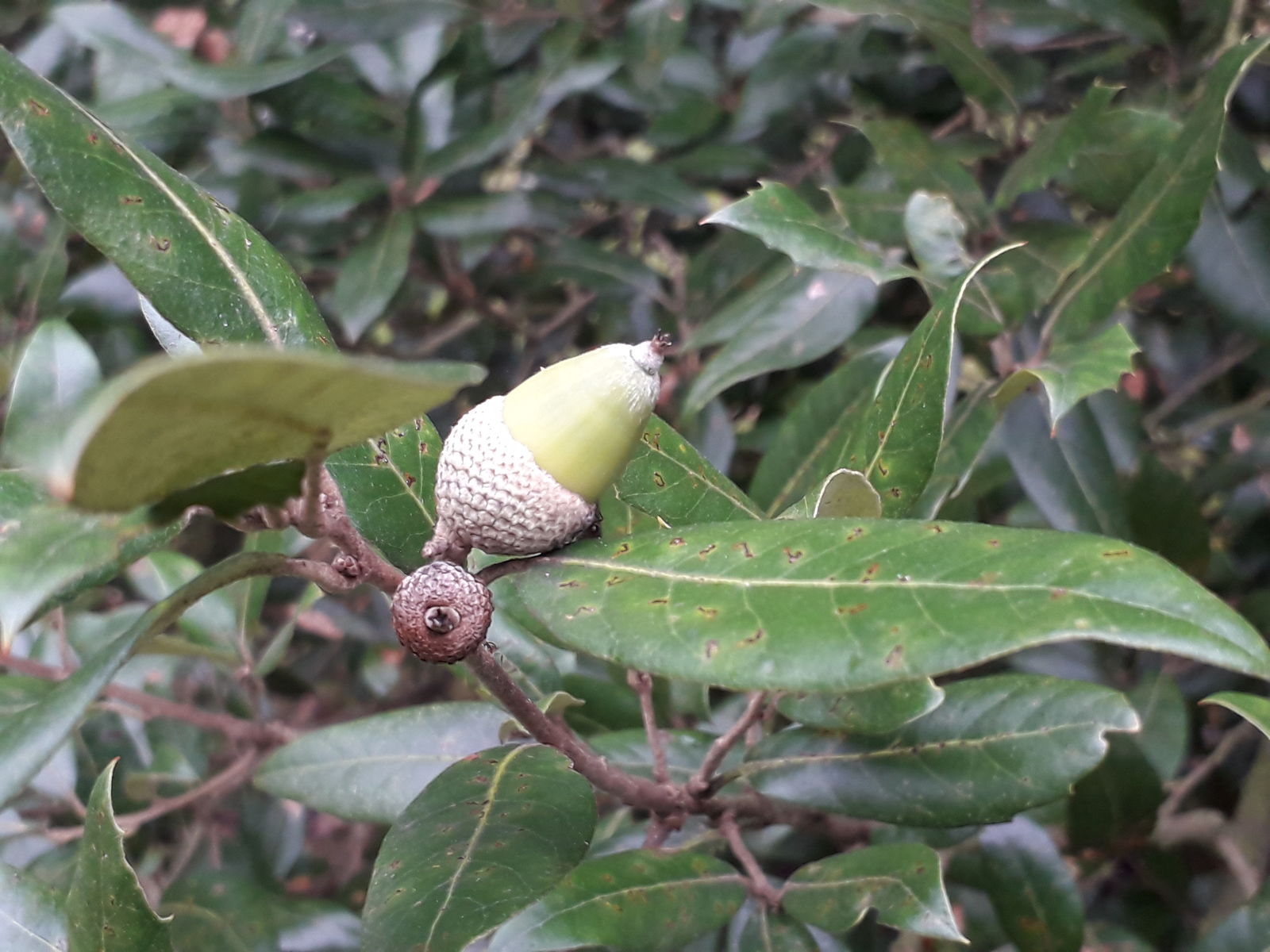

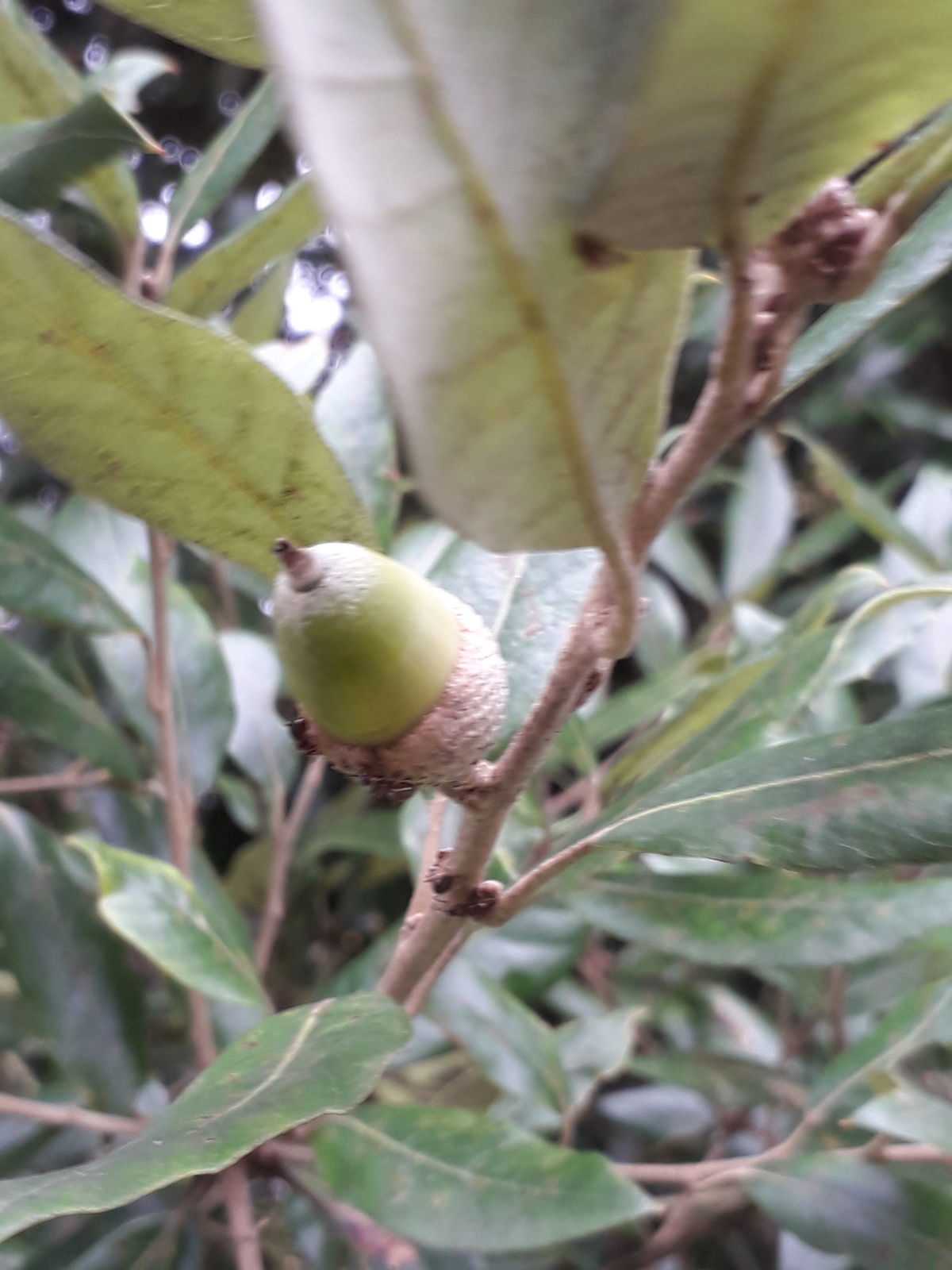
© photo
Paul Braun · cc0
Patrick Le Mao · cc0
Jens-Christian Svenning · cc0
Taken Sep 17, 2020 by Alain Bigou (cc-by-sa)
Taken Apr 6, 2020 by De Colli VINCE (cc-by-sa)
Taken Dec 11, 2019 by michèle van Panhuys-Sigler (cc-by-sa)
Taken May 17, 2022 by David (cc-by-sa)
Taken Sep 5, 2021 by Alain Bigou (cc-by-sa)
© copyright of the Board of Trustees of the Royal Botanic Gardens, Kew.




Global distribution
Quercus ilex is native across the wider Mediterranean basin, from Portugal and Spain to Türkiye and the Middle East, with populations in Morocco, Algeria, Tunisia and Libya in North Africa. It has been introduced as an ornamental tree well beyond this range, notably in California, where it naturalizes locally.
- Native9
- Introduced1
- France
- Spain
- Portugal
- Italy
- Greece
- Türkiye
- Morocco
- Algeria
- Tunisia
- United States
Hexagons: regions where the plant occurs. Green dots: native range.1
Identity
Holm oak (Quercus ilex L., 1753) is a Mediterranean evergreen tree in the Fagaceae family and the genus Quercus. Also called holly oak, and locally known as yeuse, garric or encina, it retains its foliage throughout the year. Carl Linnaeus described the species in 1753. 1 2
The epithet ilex was already the classical Latin name for this oak long before it became the botanical genus name for hollies. Stiff, prickly lower leaves resemble holly foliage and explain that curious reversal: the oak lent its Latin name to a plant that is botanically unrelated to it. 4 5
Recognition
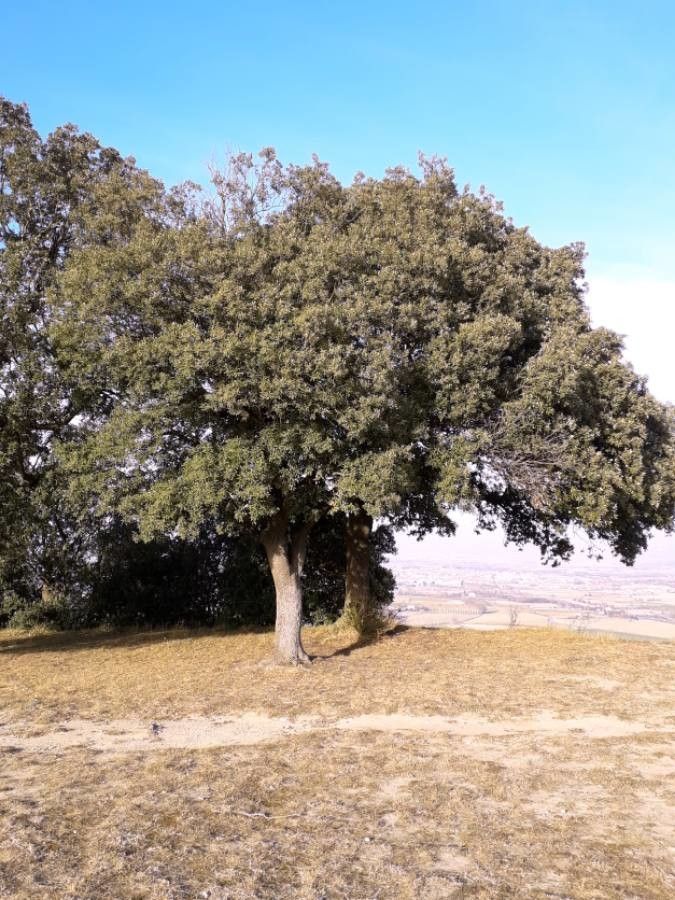
A broad, densely leafy crown marks mature holm oak, which reaches 12–25 m (39–82 ft) in sheltered woodland. Exceptional trees are reported to reach 28 m (92 ft) over several centuries. In garrigue repeatedly affected by fire or grazing, it often stays low and shrubby because disturbance prevents the development of a mature tree form. 2 4
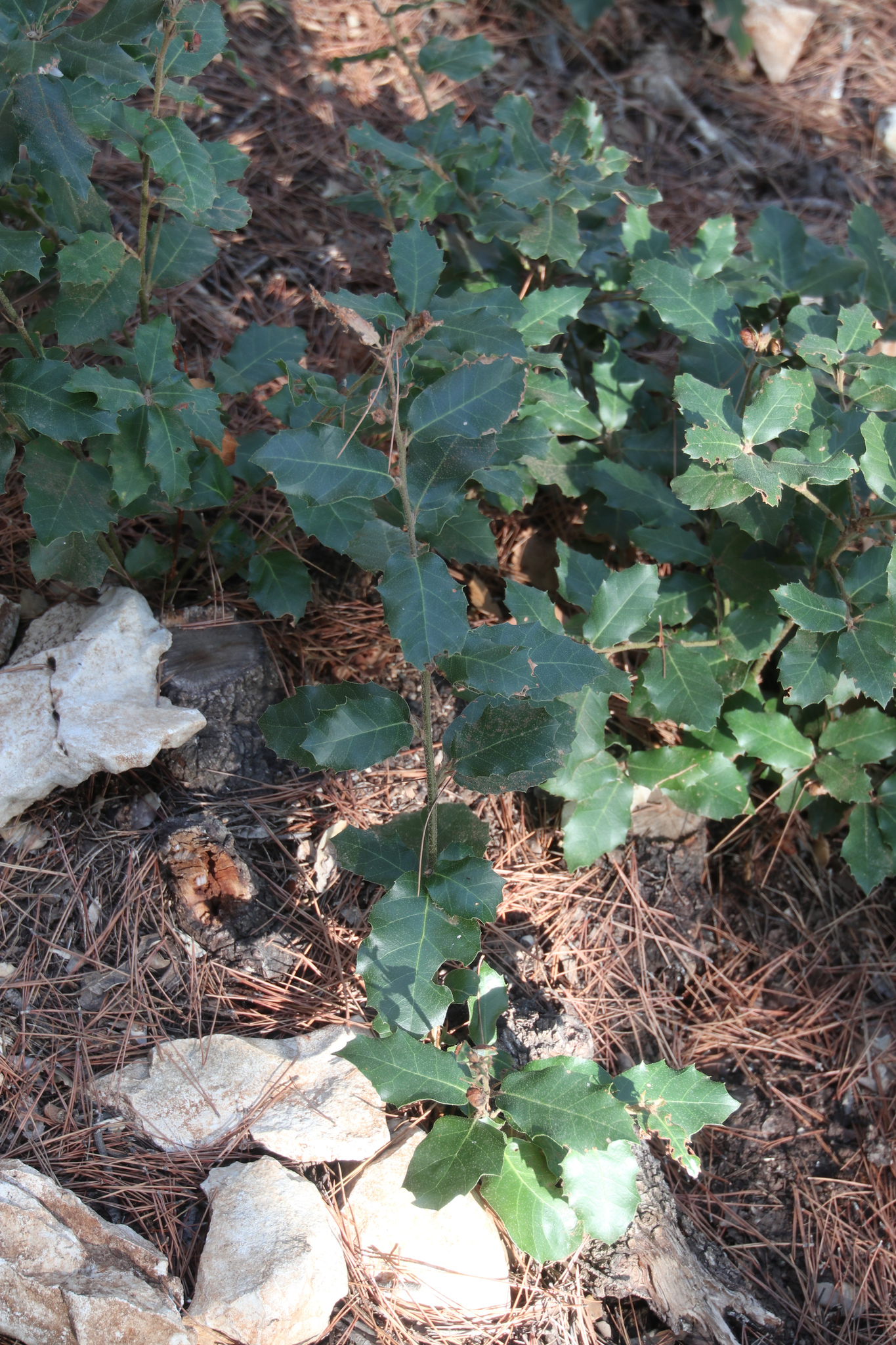
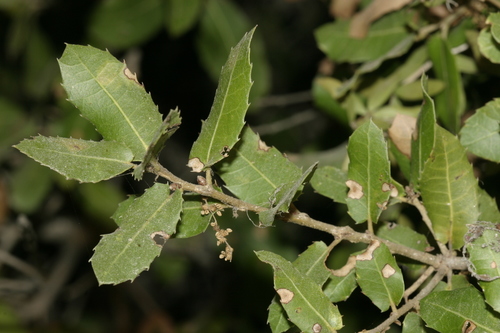
Upper adult leaves are oval, leathery, dark green and glossy above, with fine grayish down beneath. Lower or juvenile leaves provide the most useful comparison with Kermes oak (Quercus coccifera). Holm oak retains spines on low leaves and young growth, but loses them on the upper leaves as they age and become smooth-edged. Kermes oak stays prickly throughout the shrub, in both young and adult foliage. 2 3
Dark, almost black bark breaks into fine, small plates with age. This contrasts with the smooth gray bark seen on many other Mediterranean oaks. 2
Useful taxonomy
For holm oak, Plants of the World Online retains the accepted name Quercus ilex L., published in 1753 in the Fagaceae family. Its recorded range extends from south-central Europe across the Mediterranean basin. 1
Two names historically included under Quercus ilex deserve checking when buying a tree or interpreting an older text:
- Quercus ilex subsp. ballota (Desf.) Samp., long used for sweet-acorn Iberian forms;
- Quercus ilex subsp. rotundifolia (Lam.) O.Schwarz ex Tab.Morais, used for forms with rounder leaves.
Plants of the World Online now assigns both names to the separate species Quercus rotundifolia Lam., rather than to a subspecies of holm oak. A Spanish or Portuguese text using “encina” with the name Quercus ilex subsp. ballota may therefore refer either to holm oak in a strict sense or to the species now separated from it, depending on the taxonomic reference followed. 1 8
Habitat and range
Across the wider Mediterranean basin, the native range of holm oak runs from Portugal and Spain in the west through southern France and Italy to the Balkans, Türkiye and the Middle East. North African populations occur in Morocco, Algeria, Tunisia and Libya. 1 5
Holm oak grows on dry, often stony limestone or siliceous soils, from the coast to mid-elevation mountains. It forms evergreen oak woodland or dominates mature garrigue and maquis after a long period without disturbance. Ornamental planting has taken it far beyond its native range, including California from the mid-19th century, where it naturalizes locally along roads and in old parks. Beyond the Mediterranean, tolerance of about -15 °C (5 °F), given as RHS H4, helps explain its use across much of the United Kingdom and temperate Europe, provided the soil drains well. 4
The International Union for Conservation of Nature lists Quercus ilex as Least Concern globally. A broad distribution and ecological tolerance offset localized threats from repeated fires and some changes in agricultural land use. 6
Life cycle and reproduction
Flowering is a quiet spring event in holm oak. Pendulous yellow-green male catkins appear in mid- to late spring, while tiny female flowers remain inconspicuous in the axils of young leaves. 2 3
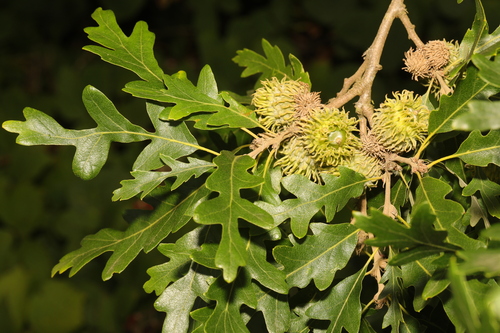
Acorns complete their cycle in a single season, unlike the two-year cycle of Kermes oak. A mid-spring flower becomes a ripe acorn by early to mid-fall of the same year. The cup covers one-third to one-half of the fruit and bears small, flattened scales rather than upright ones. 3 4
Propagation in cultivation relies on seed. Acorns rapidly lose viability if they dry out, so they should be sown fresh soon after falling, either directly in place or in deep pots. This protects the taproot, which begins establishing in the first few months, from disturbance. 4
Uses and risks
Dense, hard holm oak wood has been used since antiquity for beams, tools, cart axles and wine casks. The Latin writer Horace already referred to this use for a holm oak on his own farm. 4
Holm oak is now among the trees sought for truffle cultivation: its roots support a mycorrhizal association favorable to black truffles. Acorns, sweeter in some Iberian populations, traditionally feed livestock in dehesa and montado agroforestry systems. No toxicity is documented for humans, cats or dogs. The ASPCA does, however, list the genus Quercus as toxic to horses when they eat substantial amounts of tannin-rich leaves or acorns. 7 4
Varieties, look-alikes and related plants
Widely distributed horticultural cultivars are uncommon in holm oak. Nursery forms such as Fordii remain individual selections rather than established cultivar ranges. 2
The main identification comparisons involve the following plants:
- Quercus coccifera, Kermes oak, has prickly leaves throughout the shrub and bristly acorn cups, contrasting with holm oak’s smooth-edged upper leaves and flattened cup scales;
- Quercus rotundifolia, long treated as an Iberian subspecies of holm oak, is now accepted by Plants of the World Online as a separate species, with rounder leaves and often sweeter acorns;
- young European deciduous oaks shed their leaves in winter, whereas holm oak retains foliage year-round, a clearer distinction than subtle differences in leaf color.
To separate holm oak from Kermes oak, the loss of spines on upper leaves is more consistent than foliage color or gloss, both of which vary with exposure and shoot age. 2
At 12–25 m (39–82 ft) tall, the stature of a mature holm oak is also clearly different from the low, dense shrub typical of Kermes oak. 2
Main sources
- Plants of the World Online / Kew, Quercus ilex L.
- Royal Horticultural Society, Quercus ilex details
- Missouri Botanical Garden Plant Finder, Quercus ilex
- Plants For A Future, Quercus ilex
- INPN / MNHN, Quercus ilex L., 1753 — Holm oak
- IUCN Red List, Quercus ilex assessment
- ASPCA, Oak (Quercus) toxicity entry
- International Dendrology Society, Trees and Shrubs Online: Quercus ilex
Frequently asked questions
How can I distinguish holm oak from Kermes oak?
Holm oak loses the spines on its upper leaves, which become smooth-edged with age, while Kermes oak retains prickly leaves throughout the shrub. The acorn cup is another reliable feature: its scales lie flat in holm oak and stand out in Kermes oak.
Is holm oak toxic to dogs and cats?
No. Quercus ilex is not considered toxic to cats and dogs in standard databases. However, its leaves and acorns contain abundant tannins, which the ASPCA identifies as toxic to horses in large amounts.
Why do holm oak acorns ripen in one year while Kermes oak acorns take two?
The two species share a genus and much of their range, but have different reproductive cycles. In holm oak, a spring flower produces a ripe acorn by early to mid-fall of the same year; Kermes oak keeps its acorn green for another year.
Where does the scientific name Quercus ilex come from?
The epithet ilex comes from classical Latin, where it already denoted this oak before it was later adopted for the holly genus Ilex. The resemblance between the lower leaves of holm oak and holly explains this reversal.
Is Quercus rotundifolia the same tree as holm oak?
No longer. Long treated as an Iberian subspecies of holm oak under subsp. ballota or subsp. rotundifolia, Quercus rotundifolia is now accepted by Plants of the World Online as a separate species, with rounder leaves and often less bitter acorns.
Can holm oak tolerate cold outside a Mediterranean climate?
The Royal Horticultural Society rates the species H4, hardy down to about -15 °C (5 °F). It can therefore grow across much of the United Kingdom and temperate Europe, provided the soil drains well.
Can you eat holm oak acorns?
Some Mediterranean populations, particularly Iberian ones, produce acorns sweet enough to eat roasted after light leaching of tannins. Others remain too bitter without prior processing.
Similar plants
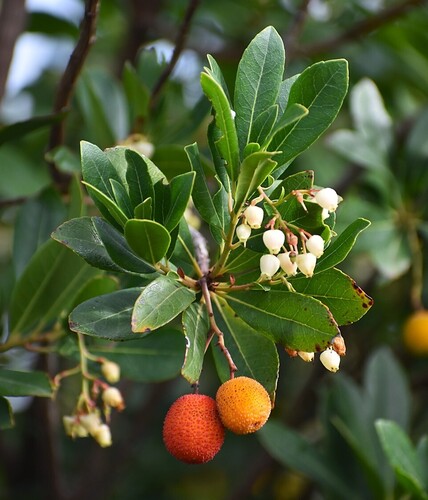
If you are unsure about a plant’s toxicity, ask a botanist or veterinarian for advice.