
Traveller's palm (Ravenala madagascariensis, )


Traveller's palm (Ravenala madagascariensis) is the historically sole member of Ravenala in the Strelitziaceae family, endemic to the humid eastern and southeastern coasts of Madagascar. Its giant leaves form a fan in one plane, and their sheaths hold rainwater, giving the plant its reputation for helping thirsty travelers.
Read moreTraveller's palm, Traveller's tree and Ravinala
Allow a few hours of direct sun per day, preferably morning or evening.


© photo
Wikimedia Commons · CC BY-SA or Public Domain
Taken Mar 6, 2013 by Daniel Barthelemy (cc-by-nc)
Taken Mar 7, 2013 by Daniel Barthelemy (cc-by-nc)
Taken Nov 6, 2015 by Tela Botanica − Hugo SANTACREU (cc-by-sa)
Taken Jul 25, 2022 by Anatas (cc-by-sa)
© copyright of the Board of Trustees of the Royal Botanic Gardens, Kew.


Global distribution
Ravenala madagascariensis is native only to humid coastal areas of eastern and southeastern Madagascar. Widely planted as an ornamental across tropical and subtropical regions, it has naturalized and sometimes become invasive on tropical islands outside its native range.
- Native1
- Introduced3
- Invasive1
- Madagascar
- Réunion
- Mayotte
- New Caledonia
- Hawaii
Hexagons: regions where the plant occurs. Green dots: native range.1
Identity
Traveller's palm (Ravenala madagascariensis Sonn., 1782), also called Traveller's tree or Ravinala, was described by French naturalist Pierre Sonnerat after a journey to the Indian Ocean. It became the type species of Ravenala, historically the sole representative of Strelitziaceae in Madagascar. 1
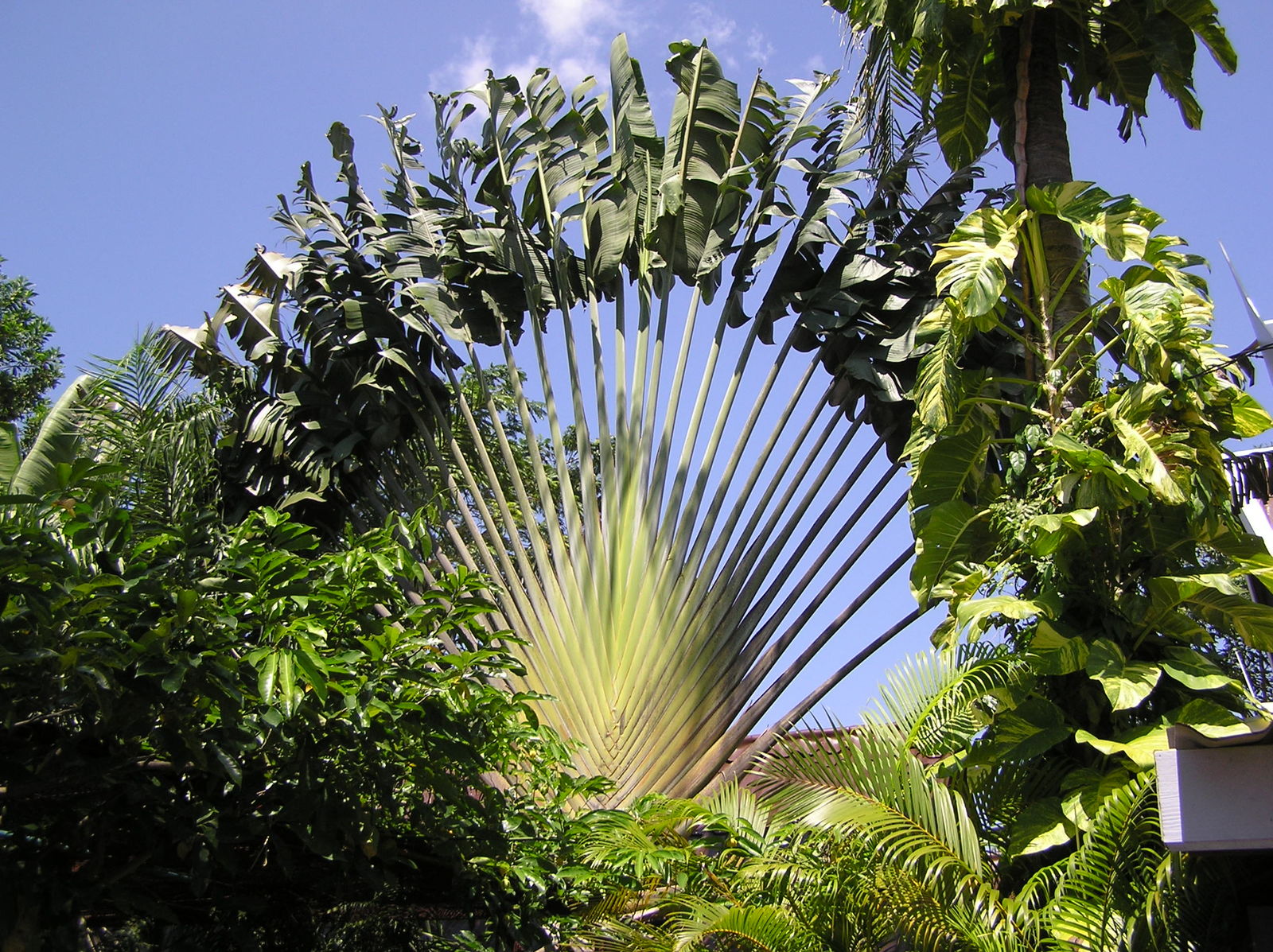
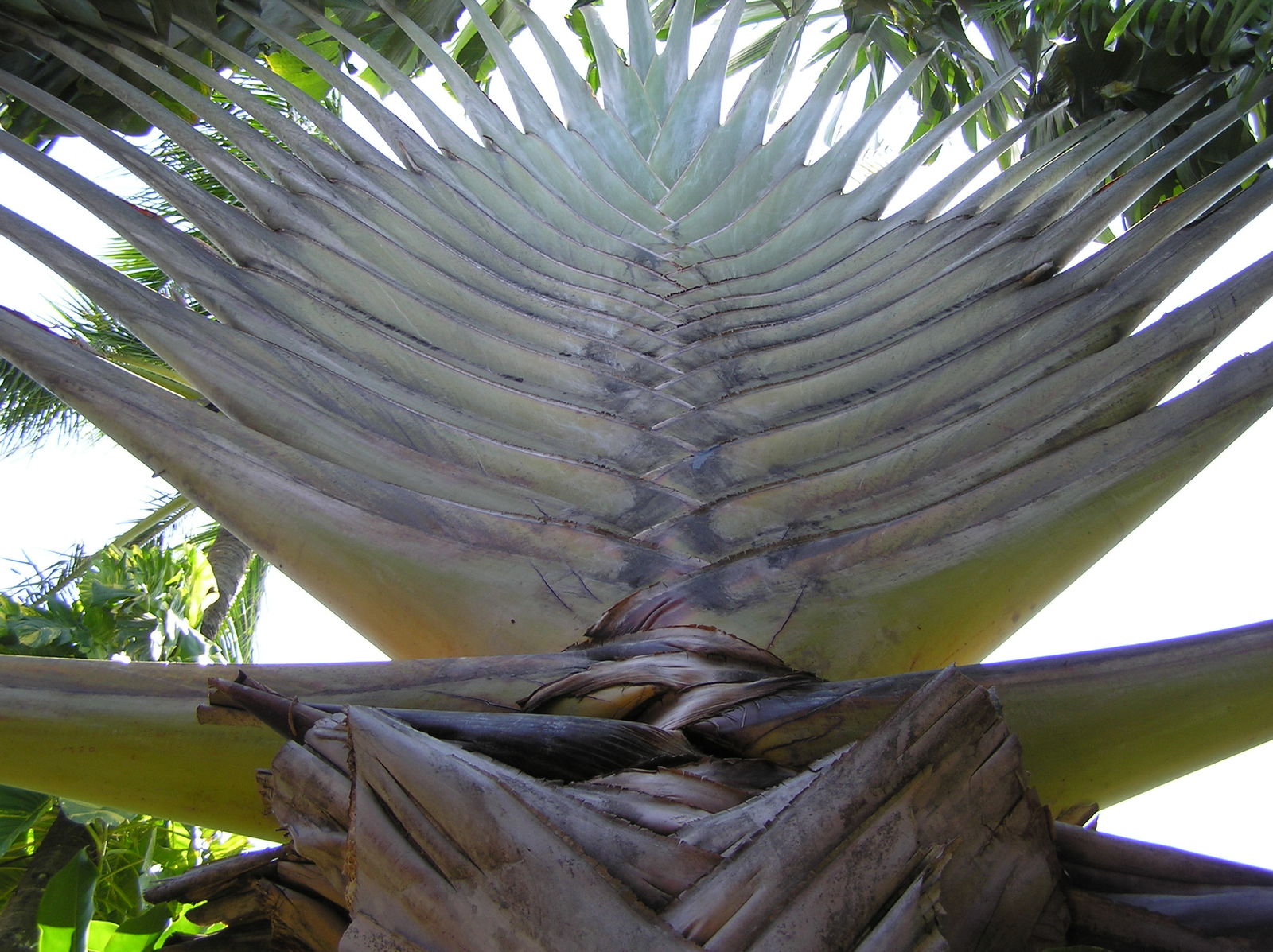
Water stored in the leaf sheaths explains the traveler's name. These cup-shaped sheaths retain up to 1 L (about 1 quart) of rainwater, which thirsty travelers tapped. The fan also often aligns east–west, inspiring its disputed reputation as a living compass. 9 8
Recognition
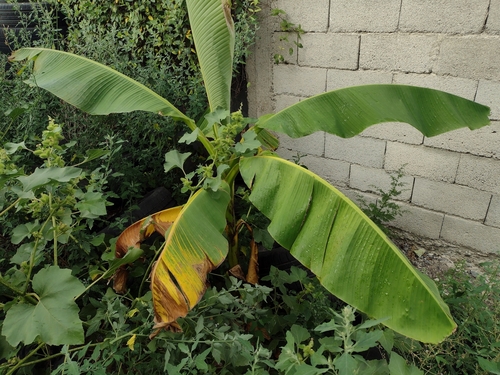
Despite its name, Traveller's palm is neither a true palm nor a banana. Its large paddle-shaped leaves grow in a single plane, forming a two-ranked fan, unlike the spiral arrangement of true palm leaves. 3
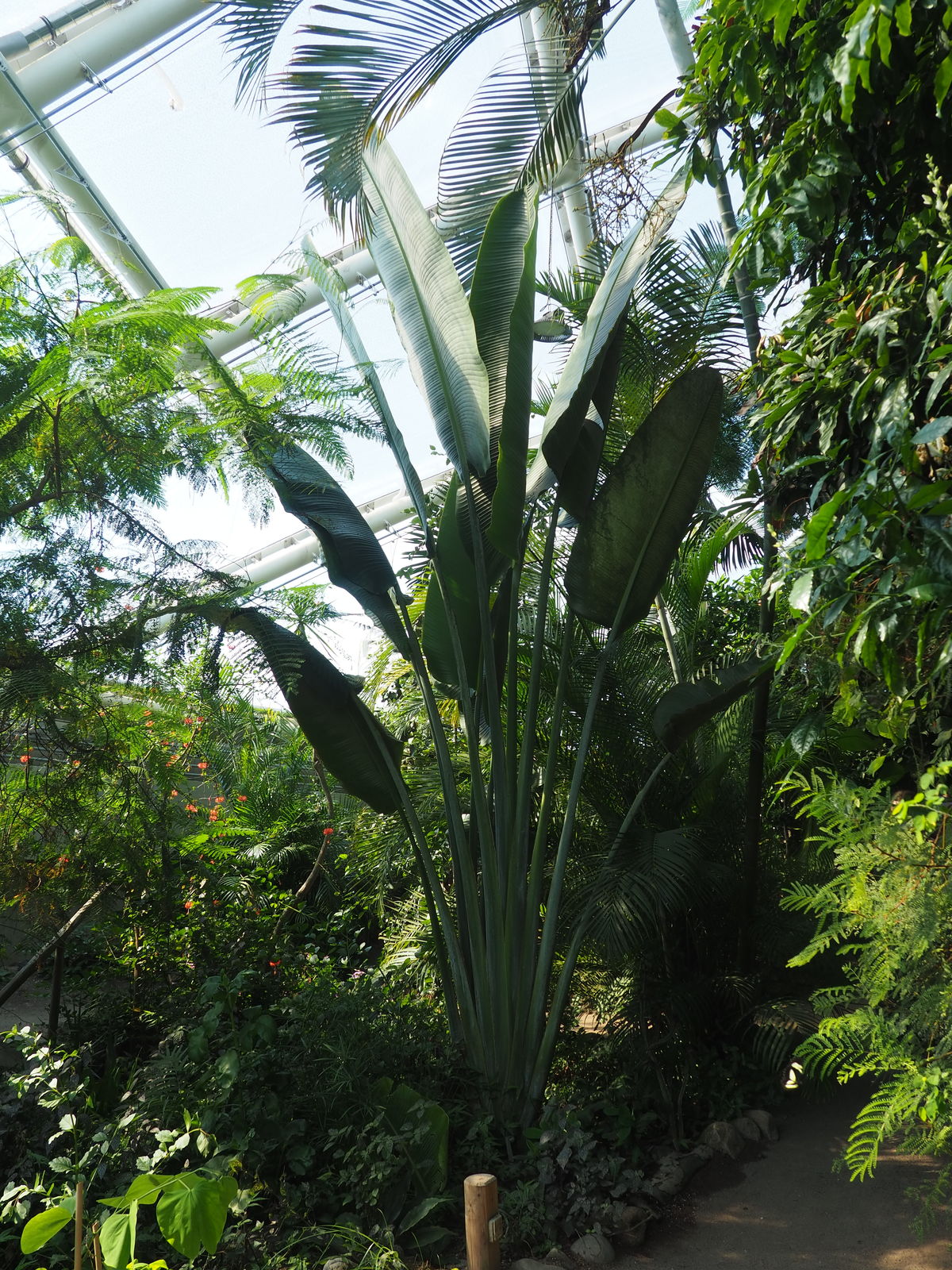
Cultivated specimens commonly reach 8–15 m (26–49 ft) tall and 4–8 m (13–26 ft) across. Some wild populations now assigned to separate sister species grow much taller. Each leaf sheath holds nearly 1 L (about 1 quart), an unusual feature among large tropical monocots. 4 5
Creamy white flowers emerge in the leaf axils inside rigid, boat-shaped bracts. The resulting woody capsule contains seeds covered with a vivid blue aril, an unusual color among tropical fruits. 3
Useful taxonomy
A 2021 revision transformed Ravenala from a genus thought to contain one species into a genus of six species, describing five additional species from wild Malagasy populations. 7
- Ravenala grandis Haevermans, J.Razanatsoa, A.Hladik & P.Blanc, the tallest member, reaching 20–30 m (66–98 ft) in eastern Madagascar
- Ravenala agatheae Haevermans & J.Razanatsoa, restricted to the island's northwest
- Ravenala blancii Haevermans, V.Jeannoda & A.Hladik, recognized by young leaves arranged in a torus
- Ravenala hladikorum Haevermans, J.Razanatsoa, V.Jeannoda & P.Blanc, another newly described species
- Ravenala menahirana Haevermans & J.Razanatsoa, another newly described species
Before that revision, several populations were sold or described as Ravenala madagascariensis. A precise scientific name is more reliable than a common name for placing a plant within the genus: ravinala can refer to any of the six species, whereas Ravenala grandis and Ravenala blancii each identify a distinct taxon. 7 1
Habitat and range
Humid coastal areas of eastern and southeastern Madagascar are the species' endemic home. It grows at wet forest edges and in lowland swamps. 1
Although confined naturally to Madagascar, its extent of occurrence exceeds 20,000 km² (about 7,700 square miles), above the IUCN range threshold discussed for Least Concern. The 2013 assessment documents its status more fully than those of several sister species described in 2021, still considered data deficient because field surveys are insufficient. 2 7
Tropical and subtropical gardens worldwide now grow Traveller's palm as an ornamental. It has also naturalized and become locally invasive in Réunion, Hawaii and New Caledonia, where dense stands of large leaves shade native vegetation. 8
Life cycle and reproduction
Flowering in cultivation usually takes many years. The RHS gives 10–20 years for maturity, with a well-developed trunk and possible flowering, in specimens planted in the ground in warm climates. 4
Wild pollination relies on an unusual partner: the black-and-white ruffed lemur (Varecia variegata). It forces the rigid bracts apart with its hands to reach sweet nectar, carrying pollen between flowers on its fur. Kress and colleagues documented this direct dependence in 1994: without lemur visits, wild flowers are not fertilized. Pollination by a non-flying mammal is considered archaic within Strelitziaceae. 6
Pollinated flowers develop into woody capsules that open at maturity, exposing seeds with vivid blue arils. The color attracts birds and lemurs that disperse the seeds. 3
Propagation in cultivation uses fresh seed, cleaned of its aril and sown in spring at 18–21 °C (64–70 °F), or division of rooted offsets produced at the trunk base. 4
Uses and risks
A dramatic specimen for parks, tropical gardens and large properties, Traveller's palm is grown chiefly for ornament. It is also a plant emblem of Madagascar, appearing in the visual identity of the country's airline. 5
Horticultural and veterinary databases consulted report no known toxicity to cats, dogs or humans. The status for horses remains uncertain because published information specific to this species is lacking. 3
Cold is the main cultivation hazard. Traveller's palm cannot withstand frost, suffers below 15 °C (59 °F), and sustains serious damage below 5 °C (41 °F), especially in containers. Strong winds also shred its leaves into strips, mainly a cosmetic problem. 3 4
Varieties, look-alikes and related plants
Three related genera make up Strelitziaceae: Madagascar's endemic Ravenala, South Africa's bird-of-paradise genus Strelitzia, and South American Phenakospermum. All have flowers protected by rigid bracts and share an affinity with bananas in Zingiberales. 1
The palm in the common name can mislead identification. Look for the two-ranked leaf fan: true palms instead have leaves arranged spirally around the trunk. 3
Following the 2021 revision, a plant sold as Ravenala madagascariensis may belong to one of its five sister species, especially the tallest, Ravenala grandis. Mature size is a useful field distinction: the latter reaches 20–30 m (66–98 ft), while cultivated R. madagascariensis tops out around 15 m (49 ft). Basal offset number and petiole color become useful only after geographic origin has been confirmed. 7
Main sources
- Plants of the World Online / Kew, Ravenala madagascariensis Sonn.
- IUCN Red List, Ravenala madagascariensis assessment (2013)
- Missouri Botanical Garden Plant Finder, Ravenala madagascariensis
- Royal Horticultural Society, Ravenala madagascariensis
- NC State Extension Gardener Plant Toolbox, Ravenala madagascariensis
- Kress, Schatz, Andrianifahanana & Morland, 1994, American Journal of Botany, pollination of Ravenala madagascariensis by lemurs
- Haevermans et al., 2021, Scientific Reports, description of five new species of the genus Ravenala
- University of Florida IFAS Extension, Ravenala madagascariensis, Travelers-Tree fact sheet
- Encyclopaedia Britannica, Traveler's tree
Frequently asked questions
Is Traveller's palm a true palm?
No. Traveller's palm belongs to Strelitziaceae, a family related to bananas, rather than the true palm family Arecaceae. Its leaves form a two-ranked fan in a single plane, immediately distinguishing it from a palm.
Why is it called Traveller's palm?
Its cup-shaped leaf sheaths hold nearly a liter of rainwater, once useful to thirsty travelers. The leaf fan also often follows an east–west axis, giving it a disputed reputation as a living compass.
Is Traveller's palm toxic to animals?
The horticultural and veterinary databases consulted report no known toxicity to cats, dogs or humans. Its status for horses remains uncertain because species-specific published data are lacking.
How many species are in Ravenala?
Six since 2021. Long regarded as having a single species, the genus was revised by Haevermans and colleagues, who described five additional species from wild Malagasy populations, including Ravenala grandis, the tallest member.
How is Traveller's palm pollinated in the wild?
The black-and-white ruffed lemur (Varecia variegata) forces open the rigid flower bracts with its hands to reach nectar, carrying pollen on its fur. This non-flying mammal pollination system is considered archaic within Strelitziaceae.
Can Traveller's palm grow outdoors in mainland France?
Not in the ground: the plant cannot withstand frost and already suffers below 15 °C (59 °F). Grow it in a large container in a heated greenhouse or conservatory, potting it on as the trunk develops.
Similar plants
If you are unsure about a plant’s toxicity, ask a botanist or veterinarian for advice.