
American black nightshade (Solanum americanum, )
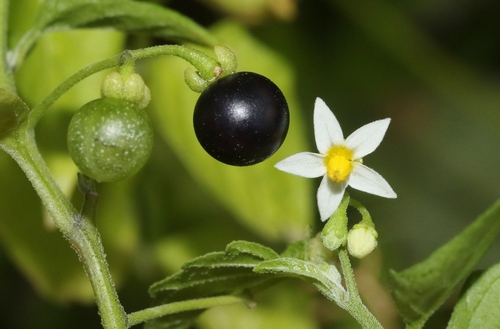
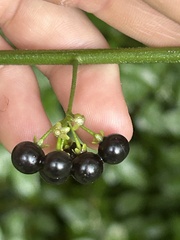
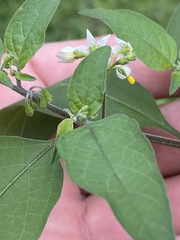
American black nightshade (Solanum americanum) is an annual herb in the Solanaceae family, native to the Americas and now widespread through the tropics and many temperate regions. White star-shaped flowers give way to small round berries that change from green to glossy black. Its leaves are eaten cooked in several cuisines, including as brède in the Indian Ocean region, but raw plant parts, especially unripe fruit, are toxic.
Read moreAmerican black nightshade, Glossy nightshade and Small-flowered nightshade



© photo
(c) James Bailey, some rights reserved (CC BY-NC), uploaded by James Bailey · cc-by-nc
John Kees · cc0
Frederick Nunley · cc-by
Taken Jul 3, 2021 by Fadilalalala Ben (cc-by-sa)
Taken Jul 8, 2019 by Gilbert ROEGEL (cc-by-sa)
Taken Oct 23, 2021 by Amy V.S. (cc-by-sa)
Taken May 27, 2019 by Cheese Lang (cc-by-sa)
© copyright of the Board of Trustees of the Royal Botanic Gardens, Kew.




Global distribution
Plants of the World Online places the native range in the Americas, from southern Canada into tropical and subtropical America. Some regional floras also include Melanesia, New Guinea and Australia, whereas Australian authorities describe the species as introduced in their territory. Its native status therefore remains disputed between sources.
- Native3
- Introduced2
- Canada
- United States
- Brazil
- Australia
- Mainland France
Hexagons: regions where the plant occurs. Green dots: native range.1
Identity
American black nightshade (Solanum americanum Mill., 1768), also called glossy nightshade and small-flowered nightshade, is an annual herb in the genus Solanum, family Solanaceae. In the Indian Ocean region its cooked greens are known as brède morelle. Plants of the World Online accepts the name published by Scottish botanist Philip Miller in his Gardener’s Dictionary in 1768. 1
The epithet americanum refers to the species’ continental origin, distinguishing it from Eurasian black nightshade, Solanum nigrum, with which it is often confused in the field. The French name morelle is thought to derive from Latin morum, referring to a small dark berry, in keeping with the ripe fruits of these nightshades. 6
Recognition
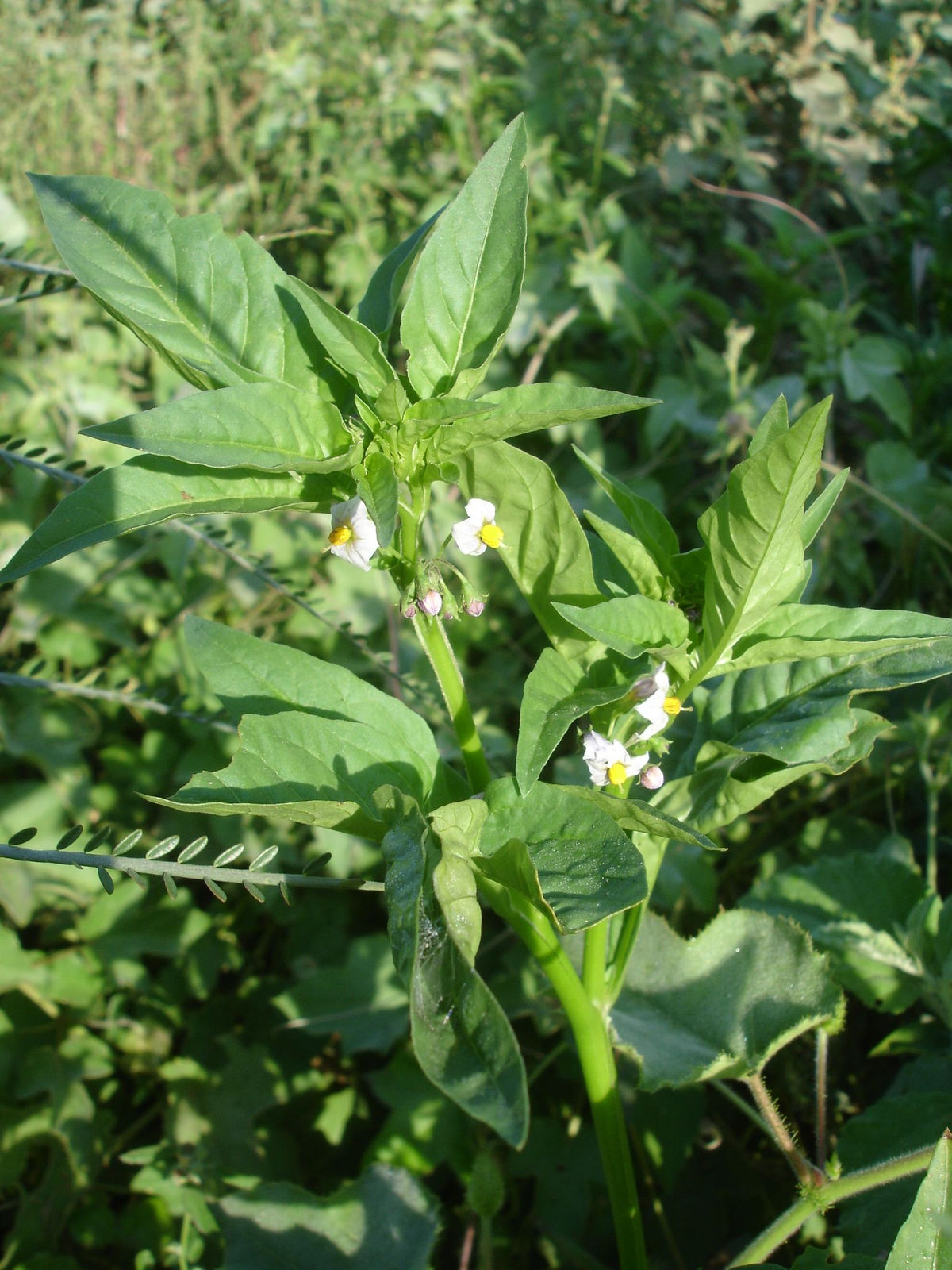
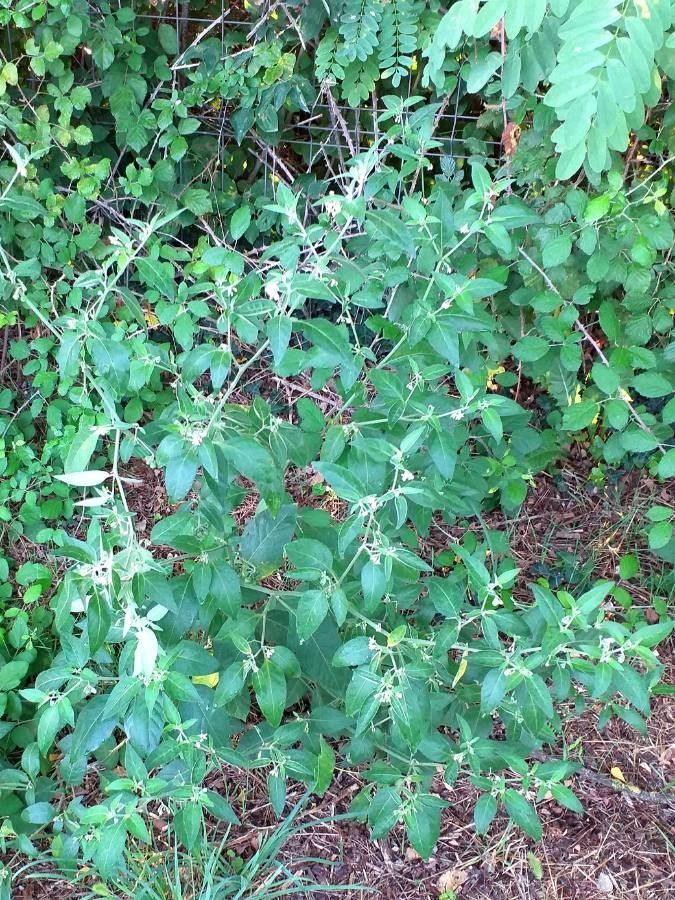
An upright, angular stem, hairless to finely hairy and branched from the base, supports the plant. Typical height ranges from 25 cm to 1.2 m (10 in to 4 ft), with reports up to 1.5 m (5 ft) under favorable conditions. Plants growing in poor soil often remain more compact. 2 4
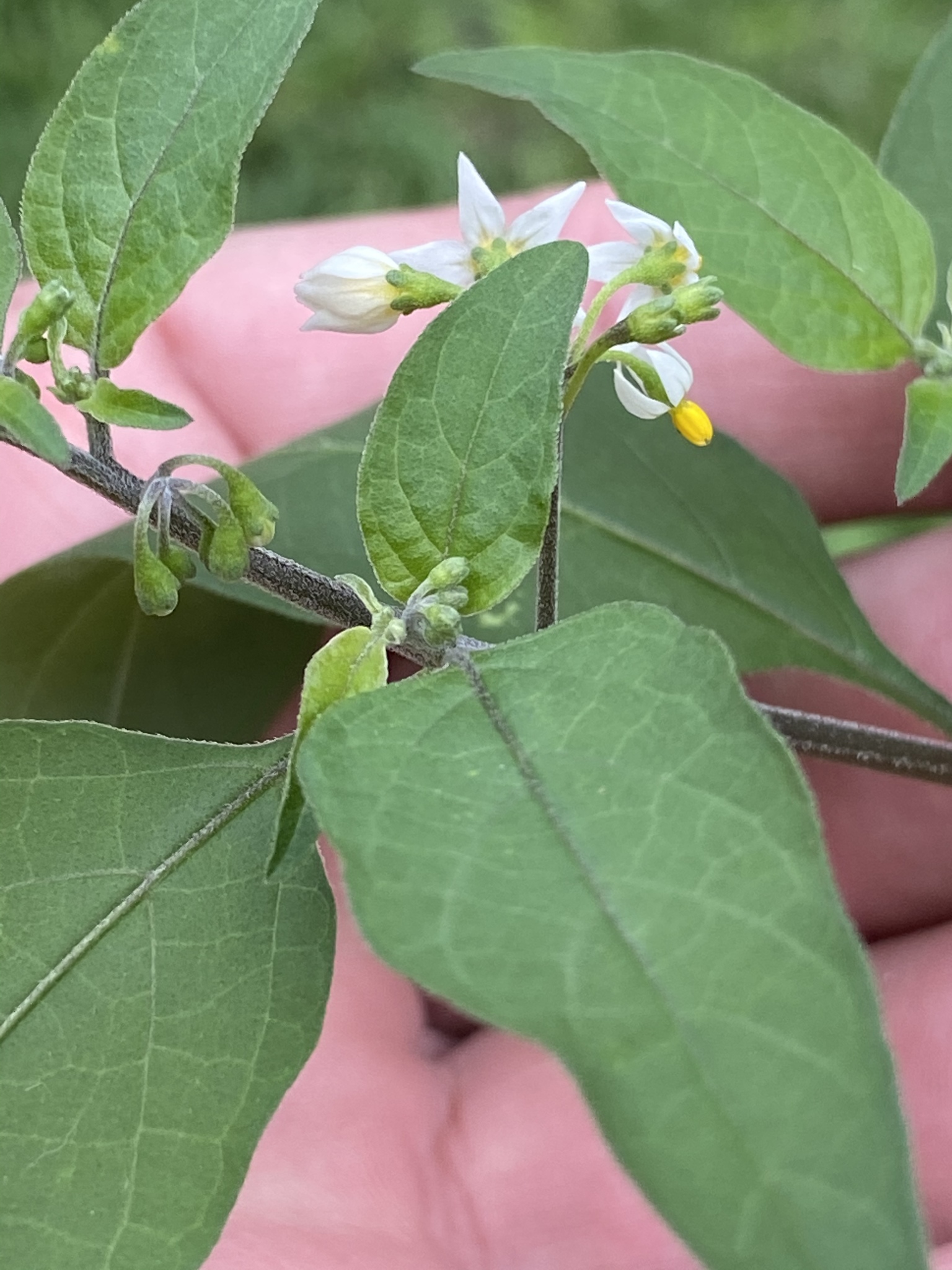
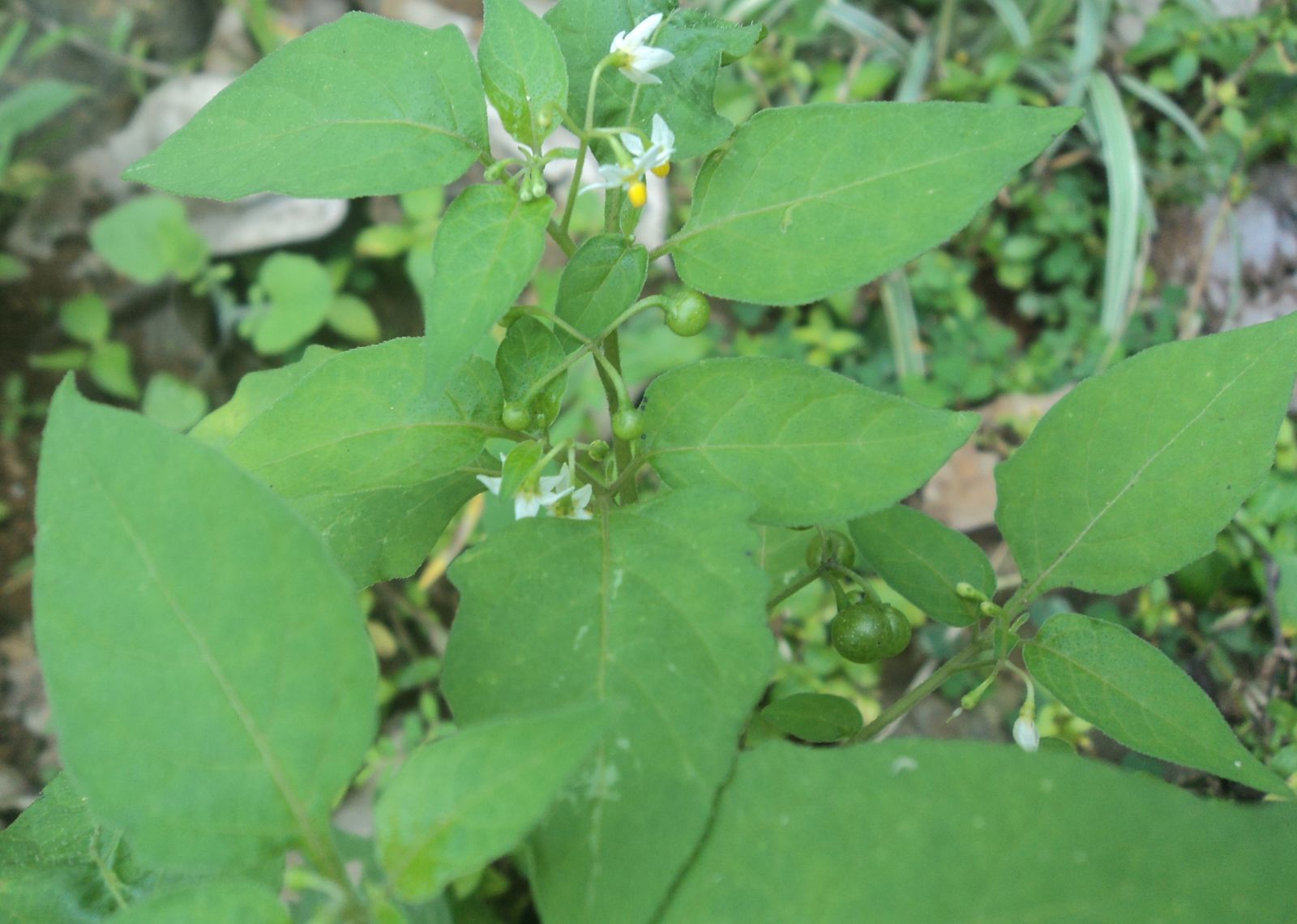
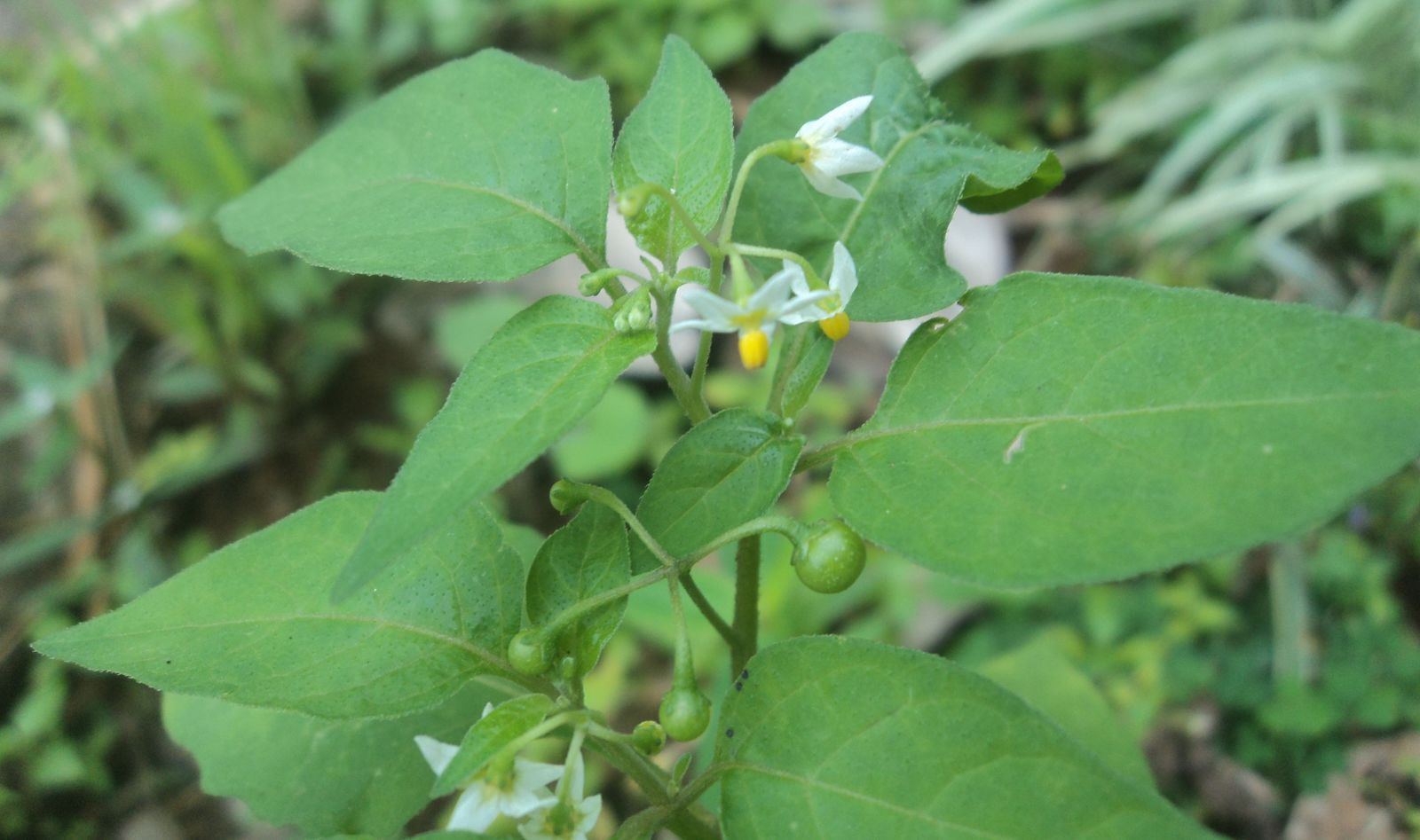
Alternate leaves are oval to lance-shaped, measuring 4–8 cm (1.5–3 in) long and 2–4 cm (0.8–1.5 in) wide. Their edges are wavy or slightly toothed and their undersides finely hairy. White star-shaped flowers have five petals and yellow stamens joined into a cone. They open in small umbels in the leaf axils, during summer and fall in temperate climates. 2
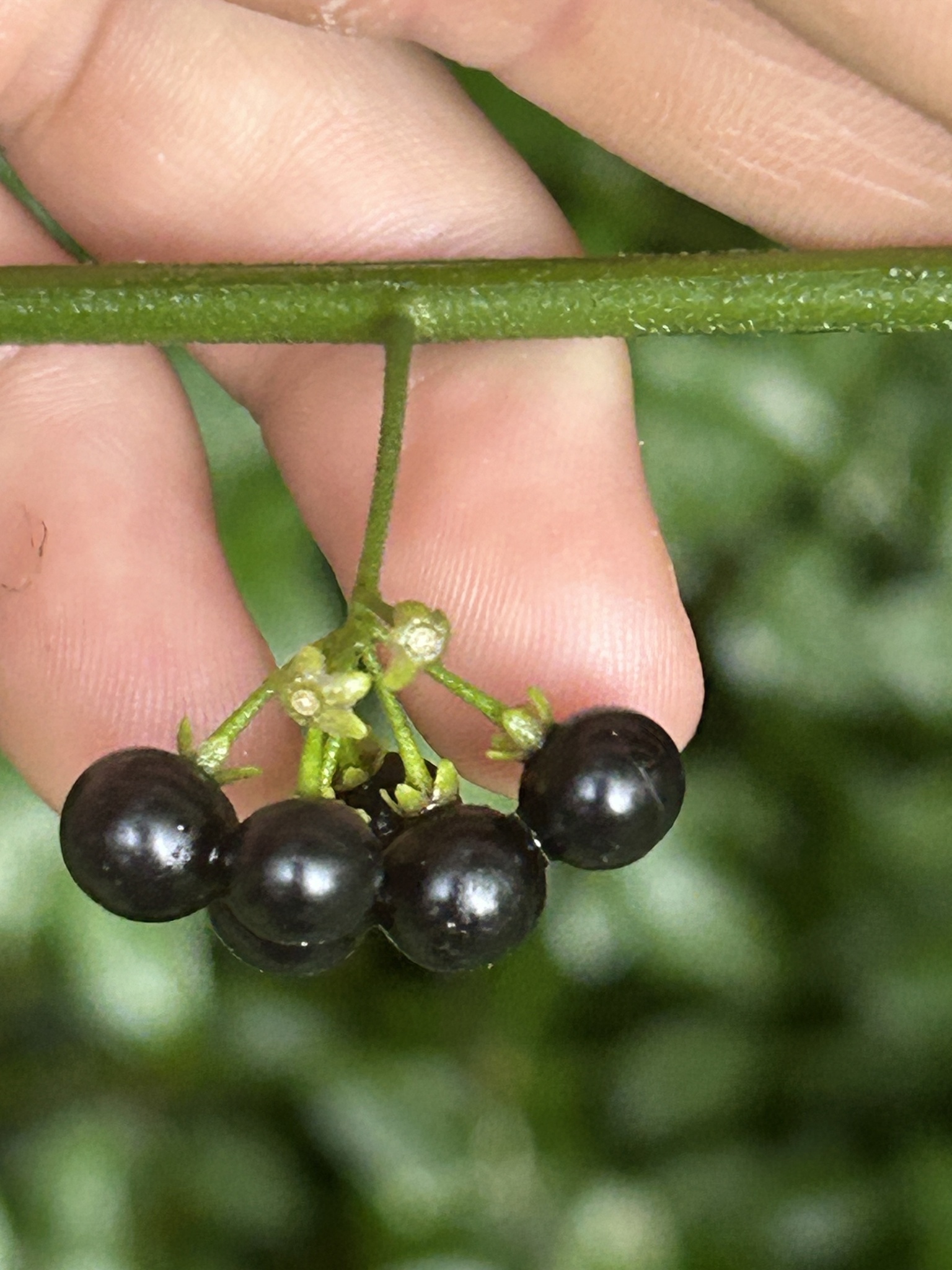
Fruit provides a clearer recognition feature than leaf shape or stem height. Each round berry starts green with white streaks, then becomes glossy black or purple-black at full maturity. Less than 1 cm (0.4 in) across, it contains 50–100 tiny seeds. A green berry is not ripe, even when it has reached a substantial size. 2 4
Useful taxonomy
Membership of the much-discussed Solanum nigrum complex explains many identification difficulties. This group contains morphologically similar species that were long confused in floras and herbarium collections around the world. Several names have been associated as synonyms with the accepted name:
- Solanum nigrum var. americanum (Mill.) O.E.Schulz (synonym)
- Solanum nodiflorum Jacq.
- Solanum ptychanthum Dunal
- Solanum patulum (L.) Roth
- Solanum nigrum var. nodiflorum (Jacq.) A.Gray
The name Solanum ptychanthum was long applied to North American eastern black nightshade, distinguished by details of the fruit and seedlings before being treated as a synonym. Without the complete scientific name, visual separation from Solanum nigrum remains uncertain even for an experienced botanist. 1
Habitat and range
Across the Americas, POWO places the native range from southern Canada to tropical and subtropical regions. Some regional floras extend that range to Melanesia, New Guinea and Australia. Australian authorities instead document the species as introduced in their territory, a point on which sources continue to disagree. 1
Waste ground, fallow land, field and path edges, open woodland and recently disturbed or cultivated soil all provide habitat. Humans and birds that eat the ripe berries have spread the plant widely. It now occurs through most tropical regions and many temperate ones, including mainland France, where the INPN records casual occurrence rather than established populations. 3 6
Life cycle and reproduction
Germination begins a life cycle completed within one growing season: spring to fall in temperate climates and almost continuously in the tropics. Flowering continues for several months. Each pollinated flower produces a berry that takes a few weeks to change from green to glossy black. 2
Reproduction takes place solely by seed. A ripe berry contains 50–100 seeds, dispersed mainly by birds attracted to the black fruit. This prolific seed production, combined with rapid germination on disturbed ground, explains why dense colonies often appear in gardens and freshly cultivated fields. 2
Uses and risks
Several tropical cuisines use the young shoots and leaves as cooked greens, known as brède in the Indian Ocean region and associated with callaloo preparations in the Caribbean. The cooking water concentrates soluble alkaloids and is always discarded. The leaves are reported to supply nearly 6,990 mg of beta-carotene per 100 g. Fruit is eaten only when fully black and ripe, never while green. 3
Other plant parts are toxic, particularly unripe berries and raw foliage, which are rich in steroidal glycoalkaloids including solanine, solamargine and solasonine. According to the Hong Kong Hospital Authority toxic plant database, 20 mg of solanine, equivalent to about 5 g (0.18 oz) of unripe fruit, may already cause poisoning. Symptoms include nausea, vomiting, diarrhea and abdominal pain, sometimes with confusion or loss of coordination. 4
For the closely related Solanum nigrum, often confused with Solanum americanum, the ASPCA documents comparable toxicity to cats, dogs and horses. Ingestion can cause excessive salivation, lethargy and digestive problems. This evidence concerns that related species rather than a separate veterinary assessment of American black nightshade. 5
Varieties, look-alikes and related plants
Horticultural cultivars are not recognized for Solanum americanum. It is a spontaneous wild plant, never selected for ornamental use. 3
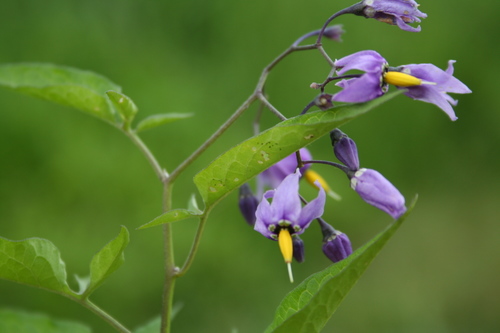
Eurasian black nightshade, Solanum nigrum, is the main look-alike because its fruits and seedlings are almost identical. Another potentially confusing name is Solanum ptychanthum, now treated as a synonym but still used in some North American floras. Geographic distribution combined with examination of the seed is needed to resolve these names and plants, beyond a simple look around the garden. 1
When the exact identity of a wild plant remains uncertain, the same precaution applies wherever it grows: never eat a green berry. Culinary use should be limited to fully black or purple berries from a plant identified with certainty.
Main sources
- Plants of the World Online / Kew, Solanum americanum Mill.
- North Carolina Extension Gardener Plant Toolbox, Solanum americanum
- Plants For A Future, Solanum americanum
- Hospital Authority (Hong Kong) Toxic Plant Database, Solanum americanum
- ASPCA, Black Nightshade (Solanum nigrum) toxicity entry
- INPN / MNHN, Solanum americanum Mill., 1768 - American black nightshade
- Tela Botanica / eFlore bdtfx, Solanum americanum Mill.
- USDA PLANTS Database, Solanum americanum (symbol SOAM)
Frequently asked questions
Is American black nightshade poisonous?
Yes, especially its unripe berries and raw foliage, which contain steroidal glycoalkaloids including solanine. Fully black or purple berries, when cooked or fully ripe, are traditionally eaten in several regions.
Can you eat American black nightshade?
Young leaves are eaten cooked, known as brède in the Indian Ocean region. The cooking water, which concentrates soluble alkaloids, is always discarded. Fruit is eaten only when fully ripe and black.
How do you distinguish American black nightshade from Solanum nigrum?
Distinguishing them in the field is difficult because the leaves and berries are almost identical. The most reliable approach combines geographic range with close examination of the seed, beyond a simple visual inspection.
Where is American black nightshade native?
Plants of the World Online places its native range in the Americas, from southern Canada into tropical and subtropical regions. It is now widespread through the tropics and many temperate regions.
Is American black nightshade invasive?
It is not classified as invasive in France, where the INPN describes its occurrence as casual. Elsewhere, particularly in Australia, local authorities describe it as introduced rather than native.
What does brède morelle mean?
In the Indian Ocean region, brède refers to leafy greens prepared as a cooked vegetable. Brède morelle specifically denotes young shoots of Solanum americanum prepared this way.
How many seeds does one berry contain?
Each ripe berry holds 50–100 seeds, explaining the prolific seed production and ability to quickly recolonize disturbed soil.
Similar plants
If you are unsure about a plant’s toxicity, ask a botanist or veterinarian for advice.