
Carolina horsenettle (Solanum carolinense, )
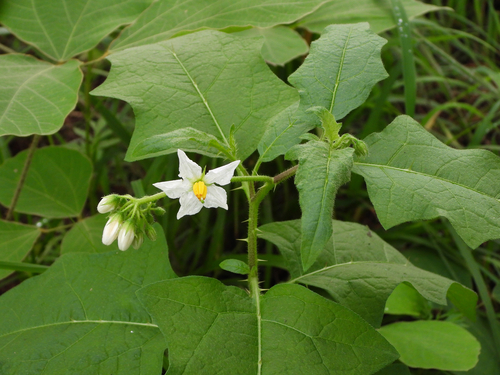
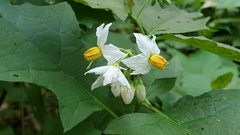
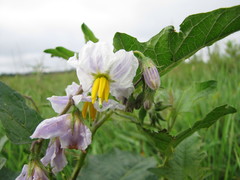
Carolina horsenettle (Solanum carolinense L., 1753) is a perennial in the Solanaceae family, native to the southeastern United States. It is now widely naturalized in temperate North America and invasive in about fifteen European countries, Asia and Australia. Its prickly stems and leaves, star-shaped flowers and toxic, tomato-like berries make it a distinctive weed of crops and pastures.
Read moreCarolina horsenettle, Horsenettle, Bull nettle and Devil’s tomato
Allow a few hours of direct sun per day, preferably morning or evening.
Full sun; tolerates light partial shade



© photo
(c) Chuangzao, some rights reserved (CC BY-NC), uploaded by Chuangzao · cc-by-nc
Craig Martin · cc0
Sara L Giles · cc0
Taken Aug 15, 2018 by Photoflora - Corine OOSTERLEE (©)
Taken Jun 29, 2022 by Nicole Barnett 79 Barnett (cc-by-sa)
Taken May 15, 2021 by Matt Miller (cc-by-sa)
© copyright of the Board of Trustees of the Royal Botanic Gardens, Kew.




Global distribution
Solanum carolinense is native to the southeastern and east-central United States, from New England to Florida, extending to southern Canada, Haiti and northeastern Mexico. Introduced elsewhere, it is established in about fifteen European countries, Asia, southern Africa and Australia, where it is regulated as an invasive weed.
- Native4
- Invasive5
- United States
- Canada (southeast)
- Mexico (northeast)
- Haiti
- Mainland France
- Germany
- Italy
- Japan
- Australia
Hexagons: regions where the plant occurs. Green dots: native range.1
Identity
Carolina horsenettle (Solanum carolinense L., 1753), also called horsenettle, is an herbaceous perennial in the genus Solanum and the Solanaceae family. Plants of the World Online accepts the name published by Linnaeus in Species Plantarum in 1753. 1 8
Its epithet carolinense refers to the Carolinas, the southeastern US region where Linnaeus placed the plant’s range. The name horsenettle links its nettle-like prickles with its frequent occurrence in pastures. Horses nevertheless avoid the foliage because of its unpleasant taste. Other English names include bull nettle and devil’s tomato. 2
Recognition
Upright, angular stems distinguish this weed, which reaches 30 cm–1.2 m (1–4 ft). White to yellowish prickles become woody with age. Plants sometimes spread outward, forming dense colonies rather than isolated individuals. 2 3
Alternate oval to oblong leaves measure 7–15 cm (3–6 in) long, with wavy, irregularly lobed margins. Star-shaped hairs cover the leaves, and prickles line the undersides of the larger veins, separating this species from most other weedy Solanaceae. 2 3
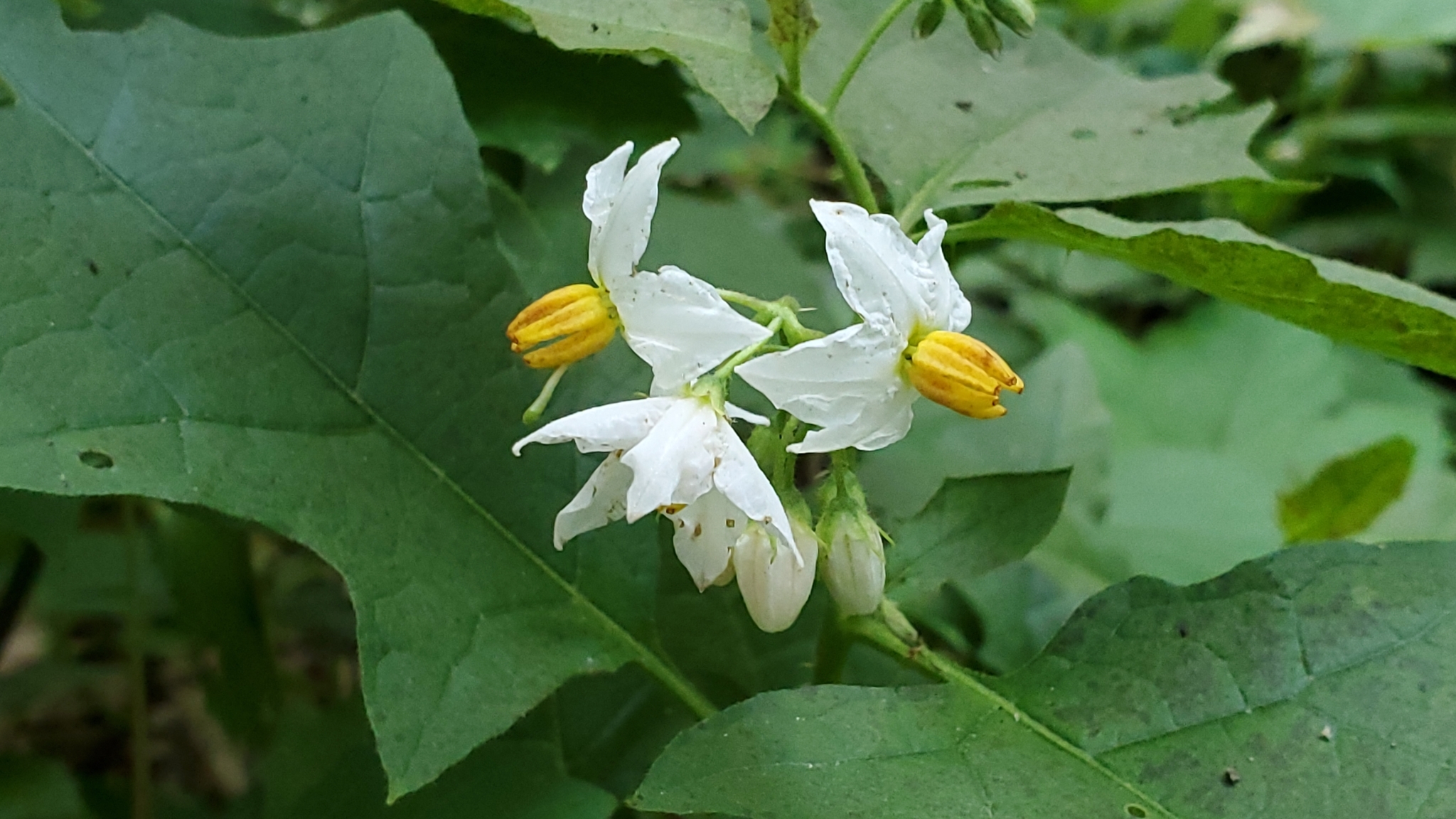
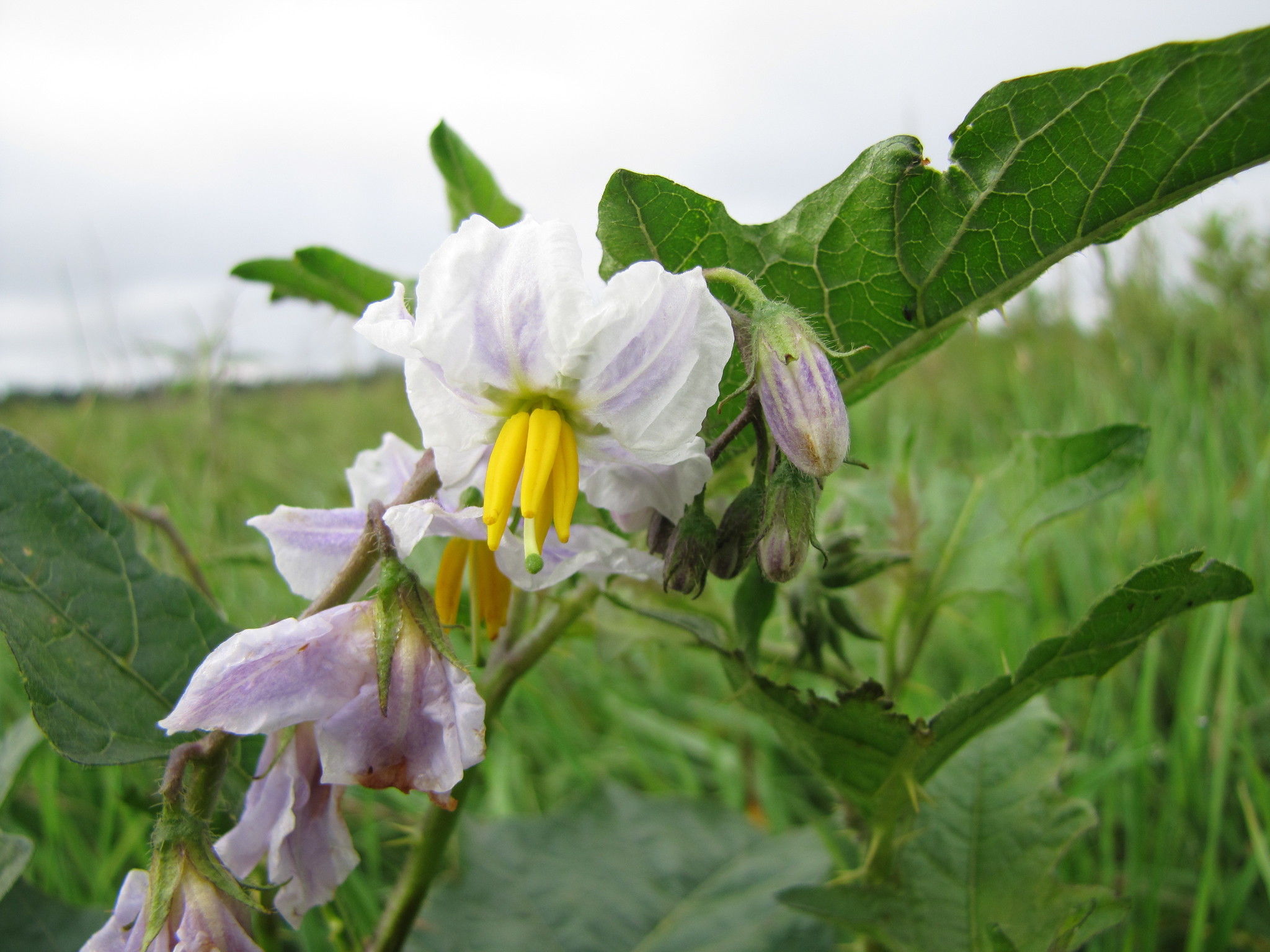
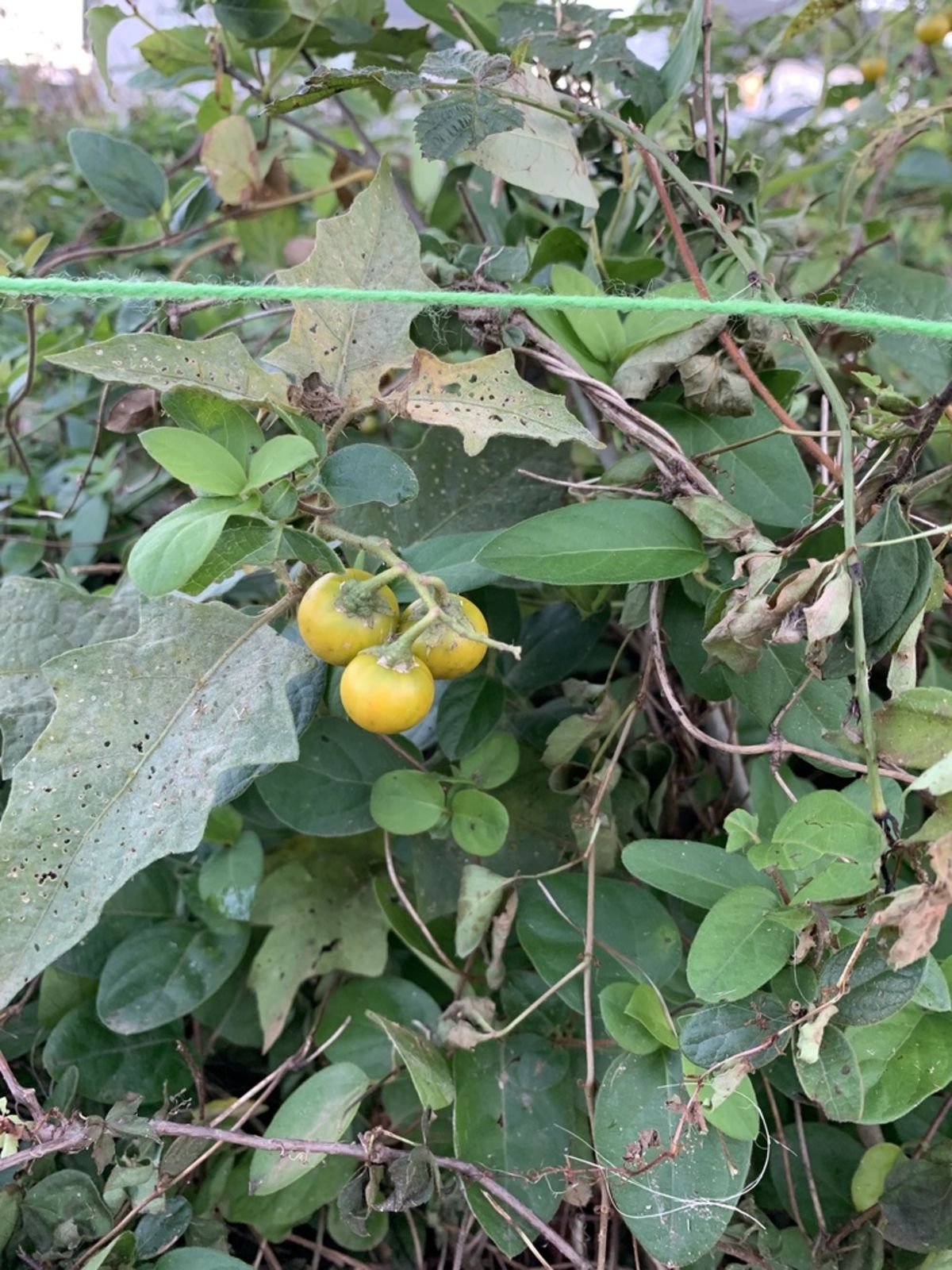
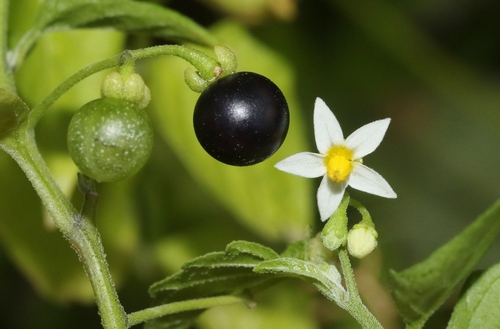
White to pale violet, star-shaped flowers open in small cymes from summer to early fall and measure about 2 cm (0.8 in) across. Five conspicuous yellow stamens are the sole food cue for bumblebees, which buzz-pollinate the flowers without receiving nectar. Round, hairless berries measure 1.5–2.5 cm (0.6–1 in) across. Initially green, they become yellow and wrinkled, resembling tiny tomatoes, and contain about 60 flattened seeds. 2 3
Useful taxonomy
For Carolina horsenettle, Plants of the World Online accepts Solanum carolinense L., published in 1753. Two varieties are currently recognized: Solanum carolinense var. carolinense, the typical form, and Solanum carolinense var. floridanum Chapm., described from Georgia and Florida. 1
Historical heterotypic synonyms subsequently assigned to the species include Solanum floridanum Raf., Solanum godfreyi Shinners, Solanum obliquatum Raf. and Solanum pleei Dunal. The accepted scientific name provides a stable reference, particularly because these names overlap in older regional floras. 1
Within the Solanaceae, Solanum belongs to the subfamily Solanoideae and tribe Solaneae. The genus also includes tomato and eggplant. This relationship helps explain why Carolina horsenettle hosts several pests and diseases shared with nearby vegetable crops. 5
Habitat and range
Across its native range, Solanum carolinense occurs in the southeastern and east-central United States, from New England to Florida, extending to southern Canada, Haiti and northeastern Mexico. It colonizes sandy to loamy soils in full sun, tolerating dry as well as occasionally wet conditions. 2 7
Introduced populations are established in about fifteen countries of the EPPO region, including Germany, Italy, the Netherlands and France. They are generally still limited and occur beside corn, soybean and beet fields or along roads. The European and Mediterranean Plant Protection Organization places the species on its A2 alert list and recommends regulation as a quarantine pest. 5
Beyond Europe, records include temperate Asia, Japan, where it is called warunasubi, Australia and southern Africa, where it is classed as a noxious weed. Within the United States, Alaska, Michigan, Maryland, Iowa and Nevada officially designate it noxious despite its native status elsewhere in the country. 5 4
Life cycle and reproduction
Seeds and a root system combining a deep taproot with creeping rhizomes allow Carolina horsenettle to reproduce. A single root fragment left in the ground can regenerate an entire plant. Poorly managed shallow cultivation may therefore multiply patches instead of eliminating them. 5
Summer to early fall is the flowering season. Green berries then take several weeks to turn yellow and wrinkled. Pheasants, wild turkeys and small mammals eat ripe fruit and carry seeds over long distances, adding to the colony’s continuous spread through its roots. 3
Strong fall frosts kill aboveground foliage, but the taproot and rhizomes survive temperate winters across most of the species’ naturalized range. Colonies consequently resume growth the following spring. 5
Uses and risks
In agriculture, Carolina horsenettle competes with low-growing crops and pasture plants, reduces yields and resists several common herbicides, including glyphosate. Managing it requires combining chemical control with cultivation suited to perennial weeds. 5
Every part contains glycoalkaloids, chiefly solanine and soladulcidine, concentrated particularly in foliage and unripe green fruit. Ingestion causes nausea, excessive salivation and digestive problems; severe cases involve respiratory depression, and deaths have been reported in young children. Livestock are also at risk: an amount equivalent to about 0.1% of body weight is considered toxic. Gloves protect against prickles and reduce skin contact with solanine when pulling plants. 7 6
Roots and berries nevertheless appeared in the US National Formulary from 1916 to 1936 as traditional antispasmodics and diuretics for asthma or epilepsy. Their use has now been completely abandoned because of the plant’s toxicity. 7
Varieties, look-alikes and related plants
Horticulture recognizes no cultivars of Carolina horsenettle. It remains a wild weed that has never been selected for ornament. 2
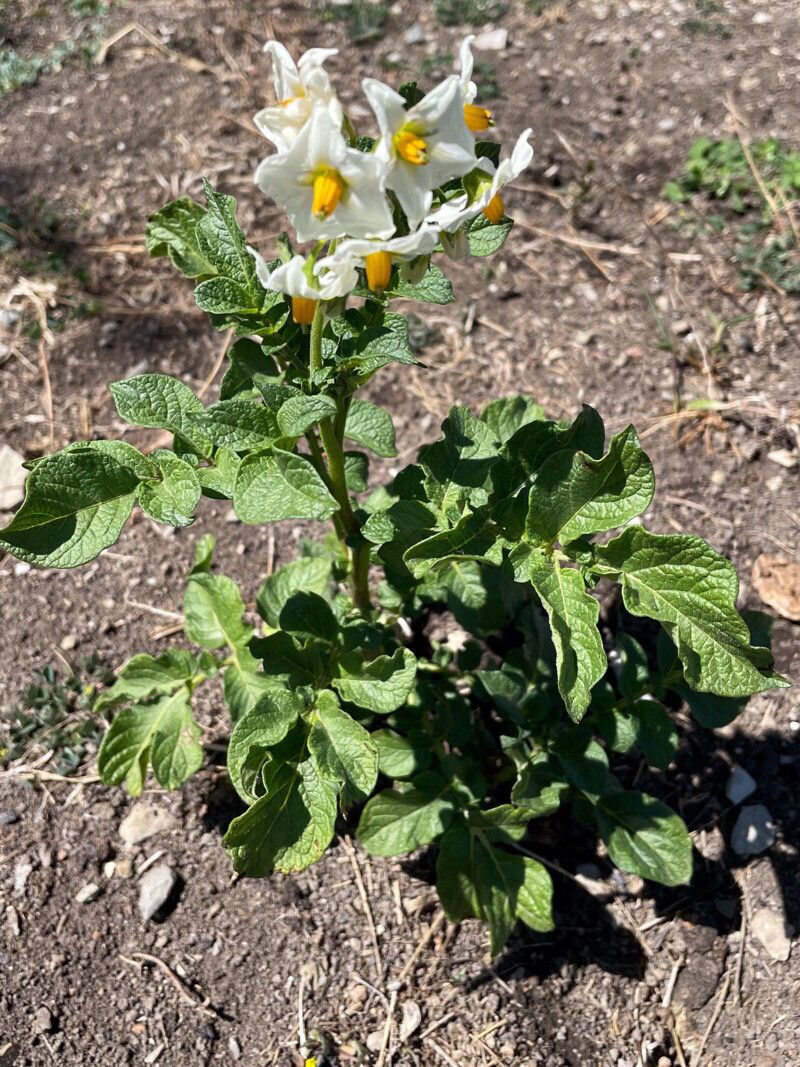
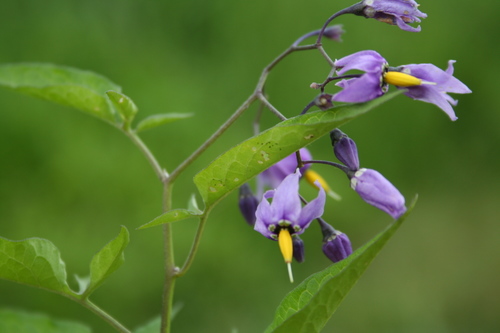
Three other prickly or poisonous nightshades cause most confusion: bittersweet nightshade (Solanum dulcamara), which climbs without prickles and has violet flowers with yellow centers; Solanum rostratum, with much denser prickles and yellow flowers; and Solanum elaeagnifolium, easily recognized by the silvery felt covering its leaves. 5
An upright habit combined with prickles on both stems and major leaf veins identifies Solanum carolinense more reliably than leaf shape alone. A climbing or prickle-free plant points immediately toward another species of the genus.
Main sources
- Plants of the World Online / Kew, Solanum carolinense L.
- North Carolina Extension Gardener Plant Toolbox, Solanum carolinense
- Illinois Wildflowers, Horse Nettle (Solanum carolinense)
- USDA PLANTS Database, Solanum carolinense profile
- EPPO Global Database, Solanum carolinense (SOLCA) datasheet
- Cornell University, Plants Poisonous to Livestock — Solanum spp. (including Horse Nettle), Internet Archive capture 8 January 2026
- Plants For A Future, Solanum carolinense
- INPN / MNHN–OFB, Solanum carolinense L., CD_NOM 124023: original species notice, archived 11 December 2021
Frequently asked questions
Is Solanum carolinense poisonous?
Yes. All parts contain glycoalkaloids such as solanine, with a documented risk of death, especially in children. Green fruit and foliage contain the highest concentrations.
Can you eat ripe Solanum carolinense berries?
No. Unlike other Solanum species such as tomato, no part of this plant is considered edible, even the ripe yellow fruit.
Why is Solanum carolinense so hard to remove?
It regenerates from root fragments left in the soil after pulling or shallow cultivation, and resists several common herbicides, including glyphosate.
Is Solanum carolinense invasive in France?
EPPO places it on its A2 alert list. It is established in still limited populations in about fifteen European countries, including France, usually along crop fields and disturbed areas.
How can you distinguish Solanum carolinense from Solanum dulcamara?
Solanum carolinense grows upright and has many prickles on its stems and leaves. Solanum dulcamara climbs or trails and has no prickles.
Which animals eat Solanum carolinense?
Pheasants, wild turkeys and small mammals eat ripe berries and disperse the seeds, while livestock usually avoid the prickly, toxic foliage.
Has Solanum carolinense been used medicinally?
The roots and berries appeared in the US National Formulary from 1916 to 1936 as traditional antispasmodics and diuretics. This use has been abandoned because of the plant’s toxicity.
Similar plants

If you are unsure about a plant’s toxicity, ask a botanist or veterinarian for advice.