
Giant bird-of-paradise flower (Strelitzia nicolai, )
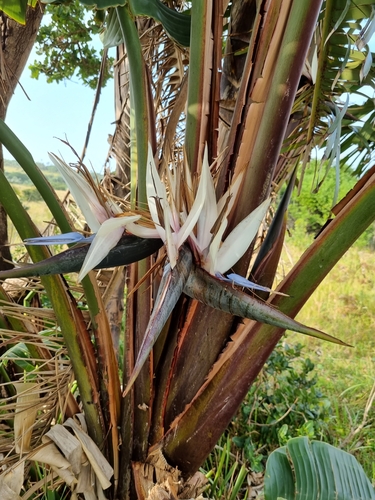
The giant bird-of-paradise flower (Strelitzia nicolai) is a tree-like perennial in the family Strelitziaceae, native to the coast of southern Africa. Its woody stems build a visible trunk topped by a fan of leaves, and its white and blue-black flower is far larger than that of its cousin Strelitzia reginae.
Read moreGiant white bird of paradise, White bird of paradise, Bird-of-paradise tree and Wild banana
Allow a few hours of direct sun per day, preferably morning or evening.
Global distribution
The native range of Strelitzia nicolai runs along the coast of southern Africa, from the Eastern Cape to KwaZulu-Natal, with populations also recorded in Mozambique, Botswana and Zimbabwe. Outside that range the species has naturalized in Mexico (Veracruz) and eastern Australia, and it is widely grown in mild climates or indoors elsewhere.
- Native4
- Introduced2
- South Africa
- Mozambique
- Botswana
- Zimbabwe
- Mexico
- Australia
Hexagons: sourced regions. Green dots: native range. Statuses according to POWO (Kew).
Identity
The giant bird-of-paradise flower (Strelitzia nicolai Regel & Körn., 1858), also known as the bird-of-paradise tree, belongs to the genus Strelitzia in the family Strelitziaceae. Regel and Körnicke described it in 1858. Where Strelitzia reginae tops out at 1–2 m (3–6.5 ft) with no trunk, Strelitzia nicolai builds a woody trunk 6–9 m (20–30 ft) tall, and that is the difference you notice first in the field. 1 2
The bird-of-paradise name comes from the flower. A blue-black bract holds white sepals and a purplish blue "tongue," and the whole shape recalls the crested head of an exotic bird, much as in Strelitzia reginae. The name wild banana describes the fan of leaves instead, often mistaken for a young Musa before the trunk appears. 3 4
Recognition
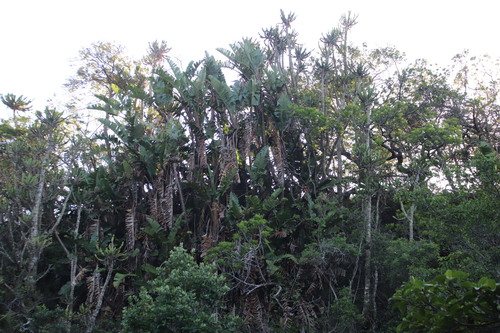
Clumping and tree-like, Strelitzia nicolai raises upright woody stems that form a visible trunk up to 6–9 m (20–30 ft) high, while the whole clump spreads 2–3.5 m (6.5–11.5 ft). Its gray-green leaves, arranged in a fan at the tips of the stems, reach 1.8 m (6 ft) long and shred easily in wind. 4 3
The inflorescence combines a beak-shaped blue-black bract, white sepals and a purplish blue tongue; together they can measure up to 18 cm (7 in) high and 45 cm (18 in) long. Flowers emerge one after another from the same bract and each lasts only a few days, over several weeks of bloom. 4 3
Before its trunk develops, a young plant resembles a banana or a juvenile Strelitzia reginae; only flowering, which takes several years of growth, settles the question with certainty. 3
Useful taxonomy
POWO/WCVP still accepts the name Strelitzia nicolai Regel & Körn. The main synonyms to know are:
- Strelitzia alba subsp. nicolai (Regel & Körn.) Maire & Weiller
- Strelitzia quensonii Lem.
The case of alba subsp. nicolai shows the trap: this demoted rank still turns up in some databases, but it does not replace the accepted name. Nor should the species be confused with Strelitzia alba, a distinct, fully accepted species that shares the loose label of large white-flowered strelitzia. 1 5
Together, Strelitzia nicolai, Strelitzia alba and Strelitzia caudata make up the three large tree-like species of the genus. Because they share the same woody habit, nurseries often mix them up. 4
Habitat and range
In the wild, the species ranges from the Great Fish River area in the Eastern Cape to Richards Bay in KwaZulu-Natal, with populations also recorded in Mozambique, Botswana and Zimbabwe. It grows in evergreen coastal forest and coastal thicket across southern Africa. 6 3
Beyond that range, the plant has naturalized in the Mexican state of Veracruz and in eastern Australia, between northern New South Wales and southern Queensland. It is also grown in Florida, coastal California and around the Mediterranean: once rooted, it copes with poor soil and salty sea air. 4 3
Life cycle and reproduction
Where it is cultivated, bloom begins in spring; in its native southern African range, it runs from June to September. Whether raised from seed or a division, a young plant needs 5–10 years to form a trunk before its first flower. 6 3
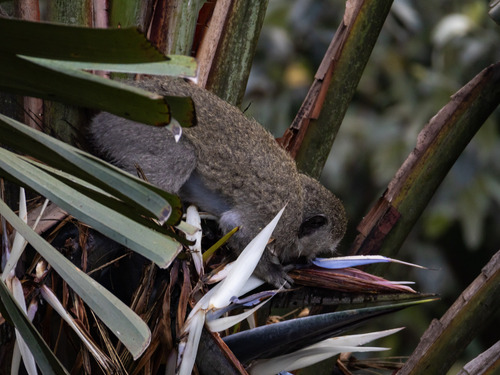
Sunbirds and other nectar-feeding birds pollinate the flower in the wild by perching on the bract. Monkeys also feed on the flowers and seeds, and frogs and ducks shelter in the dense foliage. After pollination, the flower gives way to a brown, three-sided capsule that releases black seeds capped with an orange aril. 3
For gardeners, offshoot division of basal suckers yields a flowering plant sooner than seed, which needs soaking first and several patient years before the first bloom. 4 3
Uses and risks
Ornamental, architectural planting remains the main use: in mild climates, roughly USDA zones 10 and 11, the fan-shaped silhouette anchors a sunny bed, a patio or a poolside. Where winters bring frost, it stays a large specimen for an atrium or a very bright room indoors. Locally, its dried stems are also twisted into rope. 3
Contact with the sap irritates the skin. Eating the fruit, seeds or leaves causes nausea, vomiting and drowsiness in cats, dogs and horses, and may bring abdominal cramps and diarrhea in people. 3
Chemical analysis has confirmed that Strelitzia nicolai is one of the rare plants containing bilirubin, a pigment usually associated with the breakdown of hemoglobin in animals. 7 4
Varieties, look-alikes and related plants
No widely distributed, stable cultivar exists for this species; the differences seen at nurseries mostly concern vigor and how quickly a trunk forms in a given growing climate. 3
Common look-alikes include:
- Strelitzia alba, another large tree-like strelitzia with white flowers, distinct but often sold under the same trade name
- Strelitzia caudata, the third large tree-like species of the genus, with more restricted populations
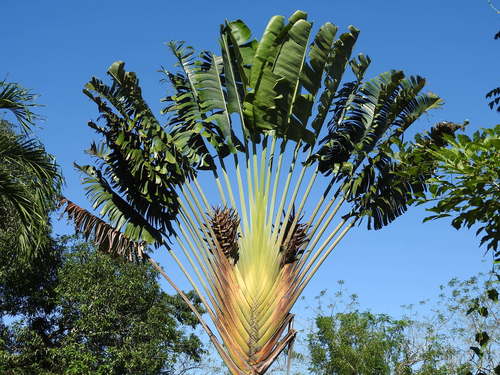
- Ravenala madagascariensis, whose fan of leaves is almost identical, although the two genera belong to separate families
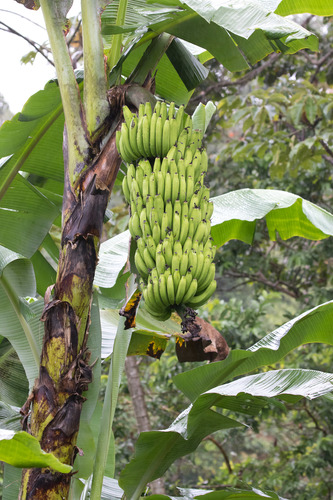
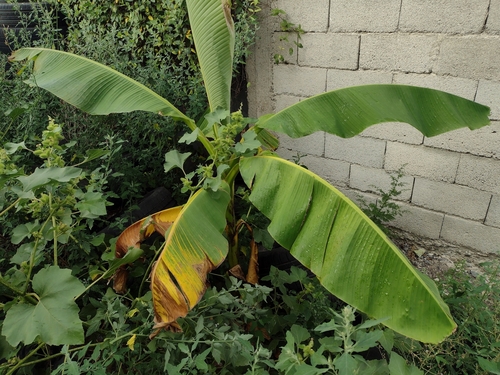
- young bananas of the genus Musa, whose juvenile foliage resembles a Strelitzia nicolai that has not yet formed a trunk
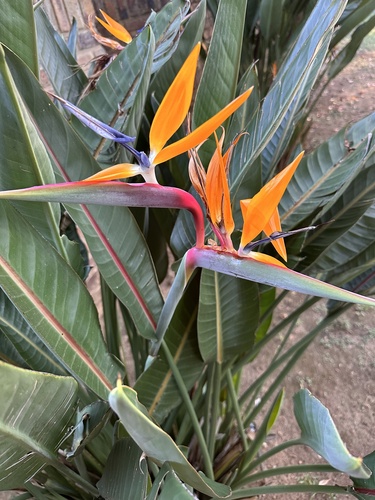
- Strelitzia reginae, much smaller, herbaceous and trunkless, with orange and blue flowers
Without a flower or a well-formed trunk, these plants are hard to tell apart with certainty from foliage alone.
Main sources
- Plants of the World Online / Kew, Strelitzia nicolai Regel & Körn.
- International Plant Names Index, Strelitzia nicolai Regel & Körn.
- GBIF Backbone Taxonomy, Strelitzia nicolai
- NC State Extension Gardener Plant Toolbox, Strelitzia nicolai
- Wikipedia (en), Strelitzia nicolai
- Wikipedia (fr), Strelitzia nicolai
- INPN / MNHN, Strelitzia nicolai, oiseau du paradis blanc
- PubMed / NCBI, bilirubin pigment identified in Strelitzia nicolai (PMID 19206232)
Frequently asked questions
Is Strelitzia nicolai a banana plant?
No. Strelitzia nicolai belongs to the family Strelitziaceae, separate from the banana family (Musaceae), even though its young fan of leaves looks a lot like a juvenile Musa.
What is the difference between Strelitzia nicolai and Strelitzia reginae?
Strelitzia nicolai is a much larger, tree-like plant with a woody trunk and white and blue-black flowers. Strelitzia reginae stays a low, trunkless herbaceous clump with its familiar orange and blue flowers.
Is Strelitzia nicolai toxic to cats and dogs?
Yes, though only mildly. The fruit, seeds and sap can cause nausea, vomiting and drowsiness in cats, dogs and horses, and the sap irritates skin on contact.
Why won't my Strelitzia nicolai flower?
The plant takes several years to build a trunk before it first flowers, and it needs full, direct sun to get there. A plant that is too young, too shaded or recently repotted can hold that stage back for a long time.
How do Strelitzia nicolai, Strelitzia alba and Strelitzia caudata differ?
These are the three large, tree-like species of the genus, and they share a similar woody habit. Nurseries mix them up often; only close botanical examination of the flower separates them with certainty.
Can Strelitzia nicolai survive frost?
It tolerates a light, brief frost down to about -2 °C (28 °F), but harder or longer cold badly damages the foliage and can kill the rootstock.
Does this plant really contain bilirubin?
Yes. Strelitzia nicolai is one of the few plants in which bilirubin, a pigment normally associated with animals, has been confirmed by chemical analysis.
Similar plants
Botanical data compiled from reference sources (RHS, Kew Gardens, POWO). This profile is for guidance only and is not a substitute for advice from a botanist or veterinarian if you have concerns about toxicity.