
Common bird-of-paradise flower (Strelitzia reginae, )
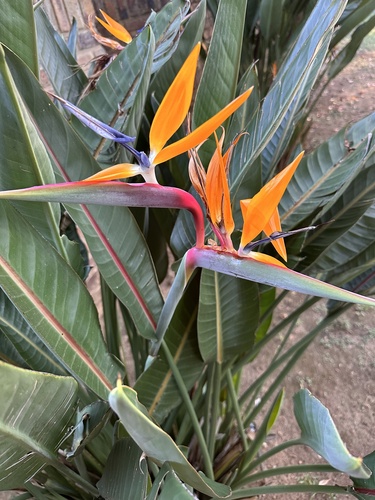
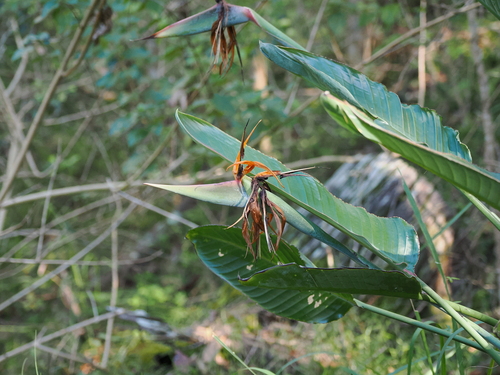
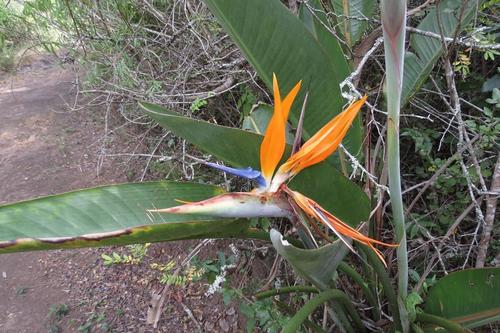
The common bird-of-paradise flower (Strelitzia reginae) is a herbaceous perennial in the family Strelitziaceae, native to southeastern South Africa. Its flower rises from a green, beak-shaped bract and pairs three orange sepals with three violet-blue petals, a silhouette that gave the plant its common name.
Read moreBird of paradise and Crane flower
Allow a few hours of direct sun per day, preferably morning or evening.
Global distribution
The native range of Strelitzia reginae is limited to southeastern South Africa, between the Eastern Cape and KwaZulu-Natal. The species is very widely grown beyond that range as an ornamental and cut flower, especially in Mediterranean and subtropical climates.
- Native1
- South Africa
Hexagons: sourced regions. Green dots: native range. Statuses according to POWO (Kew).
Identity
The common bird-of-paradise flower (Strelitzia reginae Banks, 1788), also known as crane flower, is a herbaceous perennial in the genus Strelitzia, the type genus of the family Strelitziaceae. Sir Joseph Banks described it in 1788 and dedicated it to Queen Charlotte of Mecklenburg-Strelitz, wife of King George III, whose house name the genus still carries. 1 2
Its common name comes straight from the flower. The green, beak-shaped bract holds orange sepals and violet-blue petals arranged like the crested head of an exotic bird about to take off. The names crane flower and bird of paradise draw on the same animal image, which has nothing to do with the plant's botanical classification. 3
Recognition
Long, leathery leaves on stiff stalks fan out from a rhizomatous base and build a dense clump. The gray-green, oval blade measures 25–70 cm (10–28 in) long and 10–30 cm (4–12 in) wide; planted in the ground, the whole clump commonly reaches 1–2 m (3.3–6.5 ft) tall. 4 3
The flower is the real signature of the species. An upright green bract edged in purple, shaped like a beak, encloses several buds that open one after another over several weeks. Each flower pairs three orange sepals with three violet-blue petals, two of which are fused into an arrow-shaped, nectar-bearing structure that releases pollen under the weight of a visitor. 3 2
Across its native range, sunbirds, small nectar-feeding birds, perch on the bract to drink. Their weight springs the mechanism and coats their feet with pollen, which they carry to the next flower. In cooler climates without these pollinators, the plant rarely sets fruit unless pollinated by hand. 3
Useful taxonomy
POWO/WCVP accepts the name Strelitzia reginae Banks. Several historical varieties and forms have been described, most of them now synonyms of the type species:
- Strelitzia reginae var. ovata (W.T.Aiton) Baker
- Strelitzia reginae var. humilis (Link) Baker
- Strelitzia reginae subsp. parvifolia (W.T.Aiton) Maire & Weiller
- Strelitzia angustifolia (W.T.Aiton) Sm.
One case deserves a closer look. The reduced-leaf form with no true blade, long treated as Strelitzia reginae var. juncea, is now recognized by POWO as a separate species, Strelitzia juncea. A plant sold under that name therefore no longer belongs, botanically, to Strelitzia reginae. 1 5
Habitat and range
South Africa holds the entire native range, between the Eastern Cape and KwaZulu-Natal, where the plant grows in coastal thickets, scrubby forest margins and along riverbanks in a subtropical climate. 1 6
Brought to the royal gardens at Kew in the late 18th century, the species later spread to most regions with mild, dry winters, from California and coastal Australia to the Mediterranean basin. It does not tolerate prolonged cold below 10 °C (50 °F). That limit, which matches USDA zones 9 to 11, explains why its worldwide horticultural spread stays concentrated in Mediterranean and subtropical climates, far from its strict native range in South Africa. Where winters are colder, it is grown in a container and brought under cover. 3 2
Life cycle and reproduction
Flowering peaks in winter and early spring on a mature, well-established clump. From seed, a young plant usually takes three to five years to bloom for the first time; without full, direct sun, even a mature clump may never flower, however many years it stays in place. 3 4
After pollination, the flower gives way to a woody brown capsule that releases black seeds topped with a bright orange aril, an effective lure for seed-dispersing birds. 2
In cultivation, dividing mature clumps in spring yields a flowering plant faster than sowing, which calls for several years of patience. Seed remains an option, but the thick, hard seed coats need soaking first; without it, germination stays slow and uneven. 4
Uses and risks
Ornament comes first: a container plant for bright rooms where winters are cold, a bed or low hedge in full sun where they are mild, and a cut flower prized by florists because its stem stays fresh for weeks in water. 2 4 The flower of Strelitzia reginae is also the official flower of the city of Los Angeles, a status that has boosted its popularity in California gardens. 7
The fruit and seeds contain gastrointestinal irritants. The ASPCA lists Strelitzia reginae as toxic to cats, dogs and horses, with symptoms limited to nausea, vomiting and drowsiness. The ASPCA also notes that this toxicity is much milder than that of the genus Caesalpinia, sometimes sold under the same common name, bird of paradise. 8
Airborne allergy is not a concern with the foliage or flower. The plant does not shed wind-borne pollen, which places it among the least allergenic plants on the OPALS scale. The documented risk is therefore digestive, tied to eating the fruit or seeds, and never respiratory. 7
Varieties, look-alikes and related plants
Among selections with golden-yellow rather than orange sepals, Mandela's Gold is the one most often offered by cut-flower specialist nurseries, more so than Kirstenbosch Gold; it needs the same growing conditions as the type species. 4
Common look-alikes include:
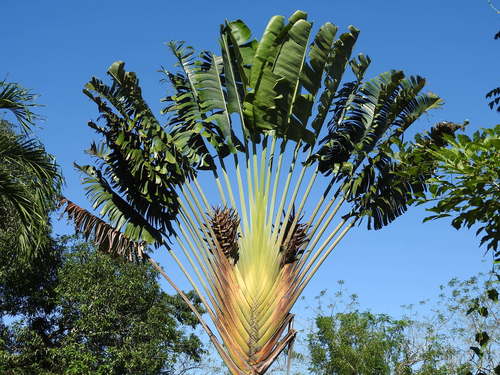
- Strelitzia nicolai, much larger, treelike, with white and blue flowers
- Strelitzia juncea, whose leaves are reduced to bare stalks with no blade
- Caesalpinia gilliesii, an unrelated shrub that shares the name bird of paradise and is considerably more toxic
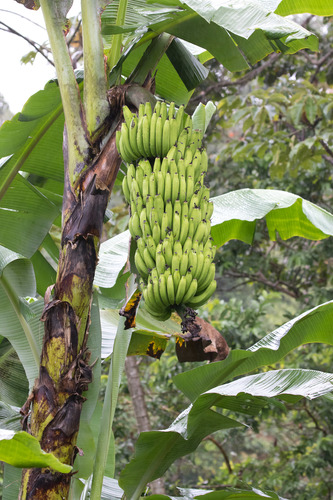
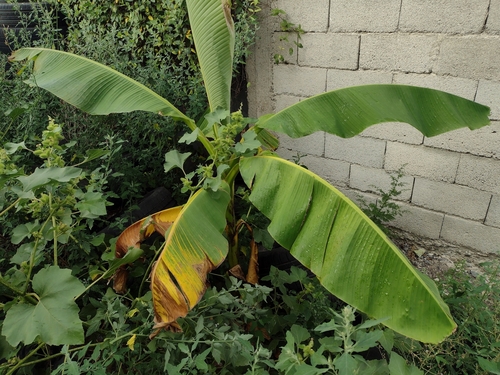
- bananas in the genus Musa, whose juvenile foliage resembles that of a young clump before flowering
Foliage alone is misleading before bloom. The most reliable clue, far more than leaf shape, is the flower, with its beaked bract and orange sepals, which none of these plants reproduces.
Main sources
- Plants of the World Online / Kew, Strelitzia reginae Banks
- Royal Horticultural Society, Strelitzia reginae
- Missouri Botanical Garden Plant Finder, Strelitzia reginae
- NC State Extension Gardener Plant Toolbox, Strelitzia reginae
- ASPCA, Bird of Paradise Flower toxicity entry
- International Plant Names Index, Strelitzia reginae Banks
- GBIF Backbone Taxonomy, Strelitzia reginae
- Wikipedia (en), Strelitzia reginae
Frequently asked questions
Is the bird-of-paradise flower a banana?
No. Strelitzia reginae belongs to the family Strelitziaceae, separate from the banana family (Musaceae), even though young foliage can be confusing. Only the beak-shaped flower settles the question beyond doubt.
Why won't my bird-of-paradise flower bloom?
A seed-grown plant usually takes three to five years to flower for the first time, and it needs full, direct sun. A plant that is too young, too shaded or recently moved into an oversized pot can hold off flowering for a long time.
Is the bird-of-paradise flower toxic to cats and dogs?
Yes, but mildly. The ASPCA lists the fruit and seeds as gastrointestinal irritants for cats, dogs and horses, with symptoms limited to nausea, vomiting and drowsiness.
What is the difference between Strelitzia reginae and Strelitzia nicolai?
Strelitzia nicolai is a much larger shrub or small tree, with white and blue flowers carried on a woody trunk. Strelitzia reginae stays a low herbaceous clump with its signature orange and blue flowers.
How is the bird-of-paradise flower pollinated in the wild?
Sunbirds perch on the beak-shaped bract to drink nectar; their weight opens the floral mechanism and dusts their feet with pollen. In cooler climates, where these birds are absent, hand pollination is often needed to get seed.
Does the name Strelitzia juncea refer to a variety of Strelitzia reginae?
Not anymore. Long treated as a reduced-leaf variety of Strelitzia reginae, this form is now recognized by POWO as a separate species, Strelitzia juncea.
Is the bird-of-paradise flower the same plant as Caesalpinia gilliesii?
No. The two plants share the common name bird of paradise but are not related botanically; Caesalpinia gilliesii is considerably more toxic.
Similar plants
Botanical data compiled from reference sources (RHS, Kew Gardens, POWO). This profile is for guidance only and is not a substitute for advice from a botanist or veterinarian if you have concerns about toxicity.