
Goosefoot-plant (Syngonium podophyllum, )
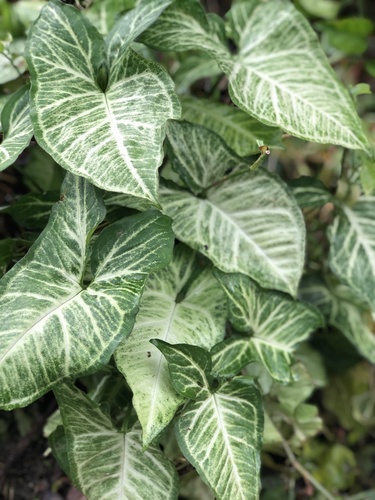
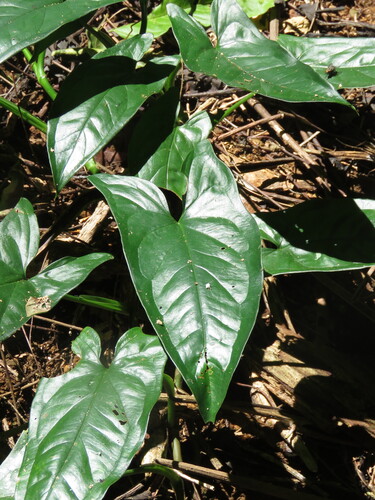
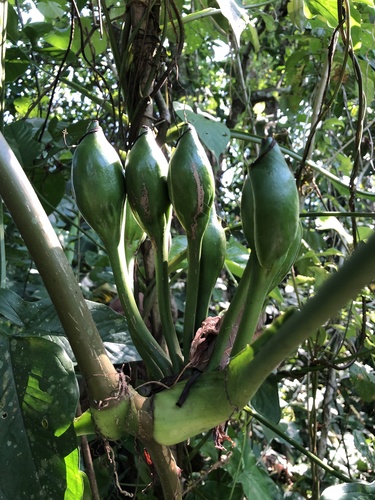
The goosefoot-plant (Syngonium podophyllum) is a hemiepiphytic vine in the arum family, Araceae, native to a broad band of Latin America from Mexico to Bolivia. Young plants carry simple, arrow-shaped leaves; once mature and climbing, they produce compound leaves with several leaflets, quite unlike the potted plant most people know.
Read moreArrowhead vine, Arrowhead plant, Syngonium, Nephthytis and American evergreen
Give plenty of ambient light without direct sun on the leaves.
Global distribution
The native range of Syngonium podophyllum runs from southern Mexico to Bolivia, with populations recorded in Costa Rica, Panama, Colombia, Brazil and Ecuador. Outside that range the species has naturalized widely as a garden escape, to the point of becoming invasive in several tropical and subtropical regions.
- Native7
- Introduced3
- Invasive1
- Mexico
- Guatemala
- Costa Rica
- Panama
- Colombia
- Brazil
- Bolivia
- Hawaii
- Singapore
- South Africa
- United States (Florida)
Hexagons: sourced regions. Green dots: native range. Statuses according to POWO (Kew).
Identity
The goosefoot-plant (Syngonium podophyllum Schott, 1851), often simply called syngonium, is a perennial climber in the genus Syngonium, part of the arum family, Araceae. The epithet podophyllum comes from Greek and means "foot-shaped leaf," a nod to the fan of leaflets on adult foliage. 1 2
Nephthytis, a trade name still common in garden centers, stems from an old horticultural mix-up: the plant was sold for years under a name borrowed from a separate African genus. Arrowhead vine and arrowhead plant describe the juvenile, arrow-shaped leaf, the only form most growers see before the plant starts to climb. 3 4
Recognition
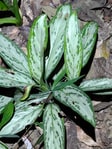
Leaf shape changes sharply with age, a trait botanists call heterophylly. Juvenile leaves are simple and arrow-shaped, dark green above and paler beneath, 8–20 cm (3–8 in) long. Once the plant climbs and matures, they become pedate, split into 5 to 9 leaflets, with a central lobe up to 25 cm (10 in) long. An undivided leaf is therefore no defect; it simply marks the juvenile stage. 4 5
In a pot the plant commonly reaches 1.5–2.5 m (5–8 ft) tall with a spread of 50 cm to 1 m (20 in to 3.3 ft); in the wild, leaning on a trunk, it climbs to 10 m (33 ft). Juvenile leaf stalks can themselves exceed 40 cm (16 in), so a young plant looks bulky next to the modest size of its blades. Thin aerial roots cling to moist trunks, walls and rocks, and the milky sap irritates skin and eyes on contact. 2 6 4
Useful taxonomy
Syngonium holds about thirty South and Central American species, and botanical revisions have folded several names into S. podophyllum as synonyms or varieties:
- Syngonium vellozianum Schott
- Syngonium affine Schott
- Syngonium willdenowii Schott
- Syngonium riedelianum Schott
- Syngonium xanthophilum Schott
- Xanthosoma gracile Miq.
- Pothos auritus Willd.
All seven are synonyms that fell out of use after taxonomic revision, which is why some nurseries still sell the same plant under several different labels. The stable reference remains the name accepted by POWO: Syngonium podophyllum Schott. 1
Habitat and range
Wild populations stretch from southern Mexico to Bolivia, with records from Costa Rica, Panama, Colombia, Brazil and Ecuador. The species lives in the shaded understory of humid tropical forest, from sea level to middle elevations, climbing trunks toward filtered light. 4 7
Beyond that range, Syngonium podophyllum has naturalized widely as an escape from ornamental planting. In Florida, the first wild record dates from 1966 in Brevard County; the Florida Invasive Species Council now lists it as Category I, since it can form a dense ground mat that smothers native vegetation, including some rare ferns. 6 7
Similar invasive populations are reported from Pacific islands, Australia, South Africa and Singapore, nearly always traced to houseplants dumped outdoors rather than to natural spread. 7
Life cycle and reproduction
Blooms seldom appear indoors, yet a mature, climbing plant in a favorable climate flowers normally, mostly in summer. The inflorescence pairs a white spadix about 8 cm (3 in) long with a spathe whose closed, bulbous lower part turns from green to red as the fruit ripens, while the open, short-lived upper part stays cream. Flower buds, green to reddish at first, whiten as they open. 4
The fruit is an ovoid syncarp about 5 cm (2 in) long, holding several ovoid seeds of 8 mm (0.3 in) set in white pulp. In cultivation this stage hardly matters: propagation almost always relies on stem cuttings with a node, rooted in water or moist mix, where roots start within 2 to 3 weeks. Dividing well-grown clumps also works. 4 3
Uses and risks
Grown mainly as an ornamental, it serves as a groundcover or as a climber on moist walls and rocks in frost-free tropical climates, roughly USDA zones 10 to 12; where winters turn cold, it is kept as a potted houseplant, with or without a pole. A support brings the plant closer to its natural climbing habit. Without one, it stays a low clump and keeps its simple juvenile leaves, never forming the divided adult foliage. 2 3
Every part of the plant contains insoluble calcium oxalates in the form of raphides. The ASPCA lists Syngonium podophyllum as toxic to cats, dogs and horses: if eaten, it causes oral irritation, excessive drooling and difficulty swallowing. Contact with the sap can also irritate skin and eyes, so gloves are worth wearing when pruning or repotting. 8 3
Varieties, look-alikes and related plants
Cultivar names on nursery tags mostly describe a variegation or a color. White Butterfly shows a broad silvery central patch; Pink Allusion and Neon Robusta develop pink to orange foliage that fades in low light; Mini Pixie is a dwarf form with short internodes. None of these labels marks a distinct species. 2
Common look-alikes include:
- Philodendron hederaceum, whose heart-shaped young leaves resemble the arrow-shaped juvenile leaves of syngonium
- some Xanthosoma species, which also have arrowhead leaves when young
- Epipremnum aureum, another indoor climber often mistaken for it when no flower or fruit is present
Maturity settles the question at a glance: a simple, arrow-shaped juvenile leaf stays ambiguous among the three genera, but pedate leaflets in 5 to 9 divisions point to Syngonium podophyllum alone.
Main sources
- Plants of the World Online / Kew, Syngonium podophyllum Schott
- Royal Horticultural Society, Syngonium podophyllum details
- Missouri Botanical Garden, Syngonium podophyllum plant finder
- NC State Extension Gardener Plant Toolbox, Syngonium podophyllum
- ASPCA, Arrow-Head Vine toxicity entry
- IUCN Global Invasive Species Database, Syngonium podophyllum
- USDA PLANTS Database, Syngonium podophyllum profile (SYPO)
- University of Florida IFAS Assessment, Syngonium podophyllum
- Monaco Nature Encyclopedia, Syngonium podophyllum
Frequently asked questions
Is the goosefoot-plant a philodendron?
No. Syngonium podophyllum belongs to the Araceae, like Philodendron, but it forms its own genus, Syngonium. The mix-up comes mostly from the similar arrow-shaped young leaves of the two genera.
Why don't my syngonium leaves have any divisions?
Simple, arrow-shaped leaves are normal on a young plant. Separate leaflets appear only at maturity, often once the plant has a pole to climb.
Is syngonium toxic to cats and dogs?
Yes. All parts contain insoluble calcium oxalates, and the ASPCA lists the plant as toxic to cats, dogs and horses, with oral irritation and drooling if eaten.
Why is syngonium invasive in Florida?
Escaped from ornamental cultivation, the species forms a dense ground mat and climbs trees in moist areas. FLEPPC lists it as Category I, and the first wild record dates from 1966 in Brevard County.
How can you tell the variegated cultivars apart?
White Butterfly, Pink Allusion and Albo-Variegatum are horticultural labels tied to a particular variegation, not distinct species. The variegation often fades in low light.
Does syngonium flower indoors?
Flowering is rare in a pot but possible on a mature, climbing plant in a favorable climate. The inflorescence pairs a white spadix about 8 cm (3 in) long with a greenish spathe that turns cream.
Similar plants
Botanical data compiled from reference sources (RHS, Kew Gardens, POWO). This profile is for guidance only and is not a substitute for advice from a botanist or veterinarian if you have concerns about toxicity.