
Blue agave (Agave tequilana, )
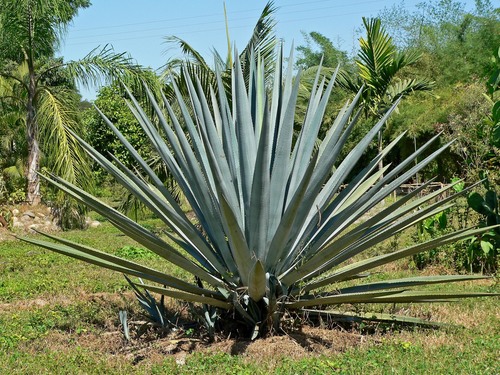


Blue agave (Agave tequilana) is a monocarpic succulent in the Asparagaceae, cultivated extensively in the Mexican state of Jalisco. Its rosette of rigid blue-gray leaves stores inulin in the core, called the piña. Cooking and distillation turn those reserves into the only drink legally permitted to bear the name tequila.
Read moreBlue agave, tequila agave, Weber’s blue agave and Agave azul
Allow a few hours of direct sun per day, preferably morning or evening.
Full sun to light partial shade


© photo
(c) Stan Shebs, some rights reserved (CC BY-SA) · cc-by-sa
Wikimedia Commons · CC BY-SA or Public Domain
© copyright of the Board of Trustees of the Royal Botanic Gardens, Kew.


Global distribution
Agave tequilana is native to western and central Mexico, with its historic and commercial cultivation concentrated in Jalisco. Unlike Agave americana, it has not naturalized widely outside cultivation. Elsewhere it occurs mainly in succulent collections.
Identity
Blue agave (Agave tequilana F.A.C.Weber, 1902), also called tequila agave or blue maguey, is a monocarpic succulent in the genus Agave, family Asparagaceae. Its commercial identity rests on a simple requirement: legal tequila must use Agave tequilana. The epithet tequilana directly reflects its role as the raw material for a drink protected by a Mexican denomination of origin. 1 6
The French physician and botanist Frédéric Albert Constantin Weber described the species in 1902. It remains closely associated with the Mexican state of Jalisco, where intensive cultivation occupies tens of thousands of hectares. 2 5
Recognition
Agave tequilana forms a compact rosette 1.2–1.8 m (4–6 ft) across, with rigid, lance-shaped leaves in the characteristic blue-gray that gives blue agave its common name. Each leaf is 90–120 cm (35–47 in) long and just 8–12 cm (3–5 in) wide. Brown marginal teeth stand 1–2 cm (0.4–0.8 in) apart, and a brown terminal spine measures 1–2 cm (0.4–0.8 in). 7
Rigid blue-gray foliage distinguishes it from its close relative Agave americana, whose leaves are broader, longer and markedly greener. This color contrast often distinguishes them in the field without measuring a leaf. Mature after 5–8 years, the plant can produce a branched, umbel-bearing flower stalk 5–6 m (16–20 ft) tall, approaching 10 m (33 ft) under the most favorable conditions. Flowers are pale green with purple-tipped tepals. 7 4
Useful taxonomy
POWO/WCVP accepts Agave tequilana F.A.C.Weber. It has also been treated as a subspecies of a broader taxon: Agave angustifolia subsp. tequilana (F.A.C.Weber) Valenz.-Zap. & Nabhan. Published in 2004, that homotypic name remains a synonym in the accepted classification, rather than replacing the species name. 1 2
The close relationship between Agave tequilana and Agave angustifolia explains some field confusion. Both have rosettes and overlapping ranges in western Mexico. Compared with A. angustifolia, the blue-gray color and narrower leaves of A. tequilana remain reliable distinctions. 5
Habitat and range
The native range lies in western and central Mexico, with a historic cultivation center in Jalisco, often above 1,500 m (4,920 ft). The plant grows on well-drained, sandy volcanic soils in a semi-arid climate moderated by elevation. 1 7
The tequila denomination of origin, administered by the Tequila Regulatory Council (CRT), governs commercial cultivation beyond Jalisco in designated municipalities of four neighboring states. Outside that production system, the species remains uncommon. Unlike Agave americana, it has not naturalized widely at other latitudes. 6
Life cycle and reproduction
Flowering ends the cycle: the rosette dies after fruiting, as in most monocarpic agaves. Commercial growers almost always prevent flowering. Harvesters, or jimadores, cut out the heart, the piña, before the stalk emerges, generally after 6–12 years depending on cultivation and growing conditions. 7 4
A harvested piña commonly weighs 40–90 kg (88–198 lb) and stores the inulin accumulated during growth. Cooking converts this complex sugar into fermentable sugars. Each plant consequently yields about 5 liters (1.3 US gallons) of alcohol after distillation. 4 7
When flowering occurs, pollination depends mainly on a nectar-feeding long-nosed bat, with insects and hummingbirds also contributing. Commercial propagation is almost entirely clonal, using basal offsets, greatly reducing the genetic diversity of cultivated fields. 4
This clonal uniformity affects crop management. Replanted offsets in different fields often share the genetic makeup of a founding plant established decades earlier. A whole field can then respond almost identically to the same disease or climatic stress, explaining how quickly dieback episodes spread. 4
Uses and risks
Economic production outweighs every other use. Agave tequilana is the only species authorized for tequila under its denomination of origin, a protected designation defended internationally by the CRT since 1994. A drink made from another agave cannot legally carry the name, even if distilled by the same method. 6
Intensive clonal cultivation has a documented drawback. Low genetic diversity favors a disease complex known as TMA, agave sadness and death, involving Fusarium fungi, Erwinia bacteria and the agave weevil. 4
Like most agaves, fresh tequila agave sap and leaves contain irritating calcium oxalates and saponins. Contact causes dermatitis, while eating them raw irritates the mouth and digestive tract. Cooking and fermenting the piña remove this caustic character; the risk described here concerns the raw material rather than the finished product. 3
Varieties, look-alikes and related plants
The commercial name agave azul, or Weber Azul, does not denote a separate registered cultivar. It refers to the wild type grown industrially under the accepted binomial Agave tequilana. A more compact, broader-leaved clone called Chato occurs on some Jalisco farms, although growers and nurseries do not always assign it the same precise varietal status. 7
Frequent lookalikes include Agave angustifolia, within which A. tequilana was long treated as a subspecies, and other blue-leaved agaves grown for mezcal or ornament. Strong blue-gray color and narrow, rigid leaves distinguish it from greener ornamental agaves. A history of cultivation in regular Jalisco fields supports the identification. 5 1
Main sources
- Plants of the World Online / Kew, Agave tequilana F.A.C.Weber
- International Plant Names Index, Agave tequilana F.A.C.Weber
- Plants For A Future, Agave tequilana
- Encyclopaedia Britannica, blue agave
- USDA ARS GRIN Global Taxonomy, Agave tequilana
- Consejo Regulador del Tequila (CRT), Denomination of Origin Tequila
- LLIFLE Encyclopedia of Succulents, Agave tequilana
- GBIF Backbone Taxonomy, Agave tequilana F.A.C.Weber
Frequently asked questions
Is blue agave the only plant used for tequila?
Yes. The tequila denomination of origin, overseen by the Tequila Regulatory Council since 1994, reserves the name for drinks made from Agave tequilana grown in designated areas. Other agaves are used for mezcal, a separate category.
Why is the plant harvested before flowering?
Flowering uses the piña’s accumulated inulin reserves to produce the stalk and flowers. Harvesting beforehand preserves a core rich in fermentable sugars, essential to tequila production.
Is blue agave toxic to cats and dogs?
Like most agaves, its fresh sap and leaves contain irritating calcium oxalates and saponins. Contact causes dermatitis; eating them raw irritates the mouth and digestive tract in animals and humans.
How long does a piña take to reach harvest?
Generally 6–12 years, depending on growing conditions and cultivation. This is much longer than most annual agricultural crops and helps explain the high value of each harvested plant.
How does blue agave differ from American century plant?
Agave tequilana has narrower, more distinctly blue-gray leaves and is cultivated almost exclusively for tequila in Jalisco. The larger, more widely naturalized Agave americana is mainly ornamental.
Can tequila be produced outside Mexico?
No. The denomination of origin restricts production to designated areas, mainly Jalisco and certain municipalities in neighboring states. Legal production under that name is excluded outside this area.
Do names such as Chato denote a different species?
No. Azul and Chato are horticultural or cultivation names related to leaf shape and color, rather than distinct species or botanical varieties of Agave tequilana.
Similar plants

If you are unsure about a plant’s toxicity, ask a botanist or veterinarian for advice.