
Breadfruit (Artocarpus altilis, )
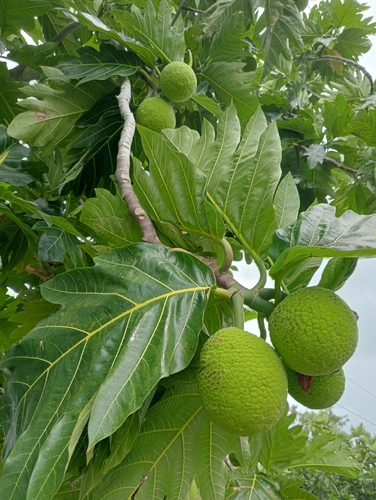

Breadfruit (Artocarpus altilis (Parkinson) Fosberg) is a large tree in the Moraceae originating in New Guinea and the Indo-Malayan archipelago. Austronesian navigators spread it throughout the Pacific before its introduction to the Caribbean in the late 18th century. Its large fruit has a bread-like texture when cooked, serving as a starchy vegetable while green or a sweet fruit when ripe, and feeding communities across many tropical regions.
Read moreBreadfruit
Allow a few hours of direct sun per day, preferably morning or evening.
Full sun for adults; partial shade useful for young plants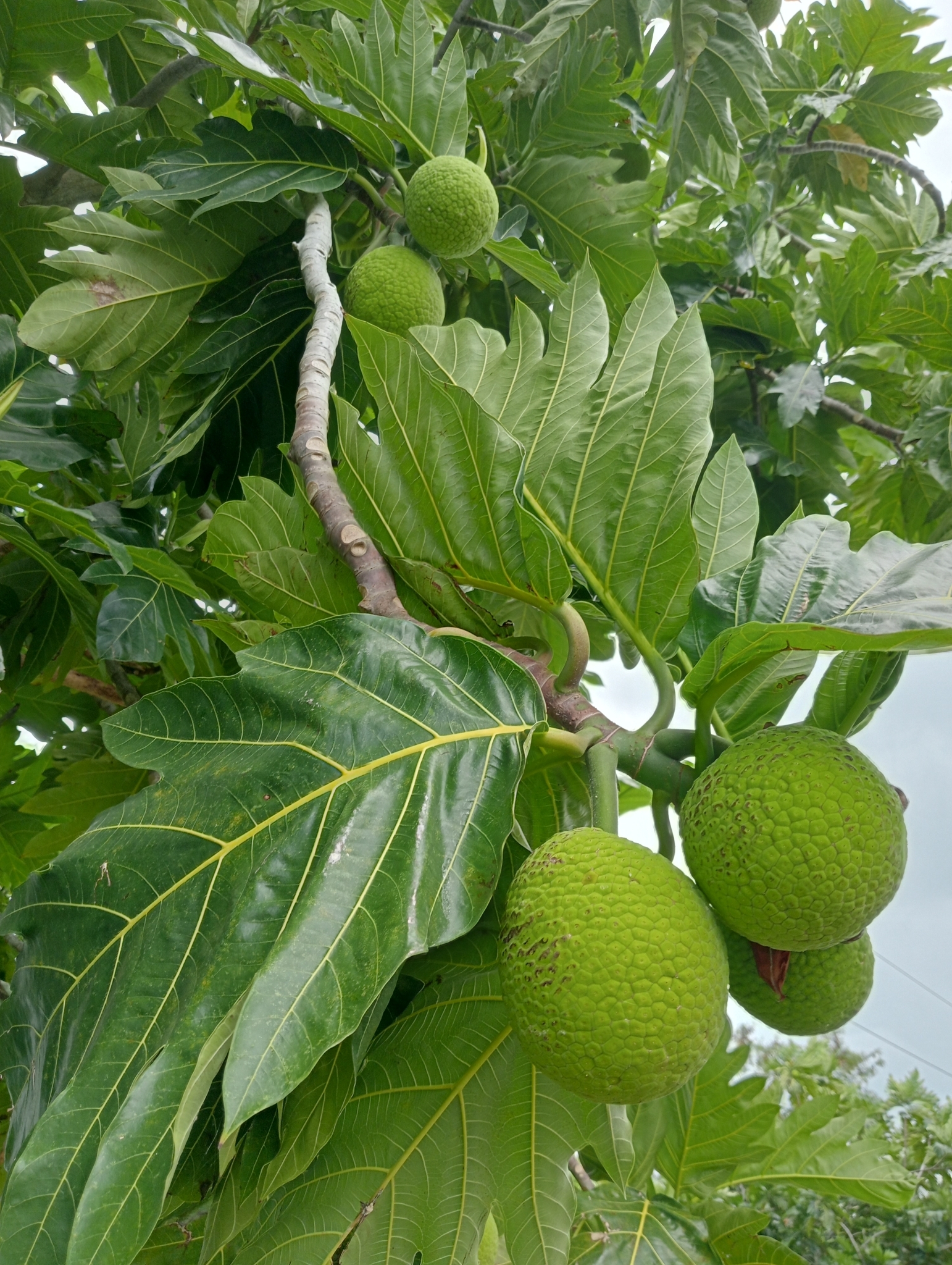


© photo
John Barkla · cc0
Damien Wallace · cc-by
Wikimedia Commons · CC BY-SA or Public Domain
Taken Oct 11, 2012 by John Tasirin (cc-by-sa)
Taken Aug 15, 2014 by Photoflora - Jean-Luc TASSET (©)
Taken Nov 16, 2012 by John Tasirin (cc-by-sa)
Taken Feb 15, 2017 by Photoflora - Benoit BOCK (©)
Taken Oct 19, 2022 by Arvind Kulkarni (cc-by-sa)
© copyright of the Board of Trustees of the Royal Botanic Gardens, Kew.


Global distribution
The native range of Artocarpus altilis extends from New Guinea through the Indo-Malayan archipelago to western Micronesia. Its spread throughout the Pacific accompanied Austronesian migrations long before European contact. Its later introduction to the Caribbean is much better documented.
- Native3
- Introduced6
- New Guinea
- Indonesia
- Philippines
- French Polynesia
- Hawaii
- Jamaica
- Saint Lucia
- Trinidad and Tobago
- West Africa
Hexagons: regions where the plant occurs. Green dots: native range.1
Identity
Breadfruit (Artocarpus altilis (Parkinson) Fosberg, 1941) belongs to the Moraceae, in the same genus as jackfruit (Artocarpus heterophyllus). Its name combines the Greek artos, bread, and karpos, fruit, referring to the texture of the cooked fruit rather than its outward appearance. 1 4
The naturalist Sydney Parkinson described the species in 1773 as Sitodium altile, from a specimen collected during James Cook’s first Pacific voyage. Francis Raymond Fosberg transferred it to Artocarpus in 1941, accounting for the two authors in its currently accepted scientific name. 5 4
Recognition
Artocarpus altilis is evergreen or partly deciduous depending on climate, reaching 25–30 m (82–98 ft) in natural conditions. The sometimes buttressed trunk can exceed 1 m (3.3 ft) in diameter in the wild. Cultivated trees rarely exceed 15 m (49 ft), barely half the maximum height recorded in forest. 6 7
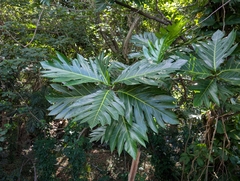
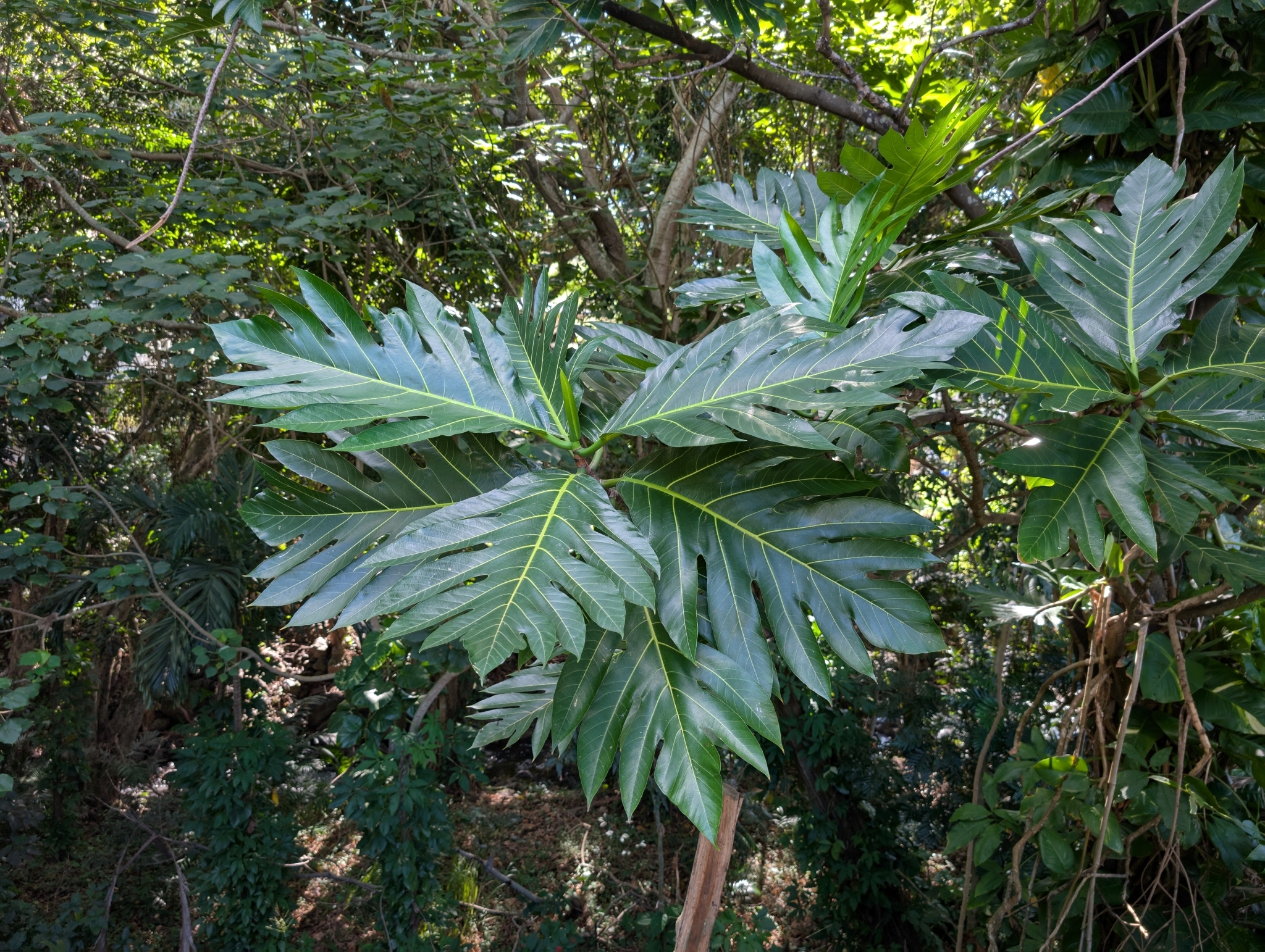
The alternate, leathery, glossy leaves commonly measure 40–90 cm (16–35 in) long and 20–50 cm (8–20 in) wide. Entire at the base, they are deeply divided farther up into 5–11 pointed lobes. Prominent yellow veins on the upper surface contrast with a duller, slightly hairy underside. 2
Male and female flowers grow on the same tree. The male inflorescence is a hanging cylindrical spike 12–30 cm (4.7–11.8 in) long; the much shorter, egg-shaped female head measures about 6 cm (2.4 in). All parts, including young shoots and fruit stalks, exude milky, gummy latex when injured. 2
Taxonomy
Names used in cultivation overlap with botanical synonyms. Important historical names include:
- Sitodium altile Parkinson (basionym)
- Artocarpus incisus (Thunb.) L.f.
- Artocarpus communis J.R.Forst. & G.Forst.
- Artocarpus incisus var. seminifer (Stokes) Duss
Artocarpus communis names the same species as the accepted name Artocarpus altilis, including on nursery labels. A more consequential confusion is with Artocarpus camansi, a close but distinct species that consistently produces many seeds, unlike the nearly seedless fruit of cultivars now distributed through the Pacific. 1 4
Habitat and distribution
The native range extends from New Guinea through the Indo-Malayan archipelago to western Micronesia. Breadfruit grows in lowland wet forest, along watercourses and at freshwater swamp margins, below 650 m (2,130 ft), reaching 1,550 m (5,090 ft) in cultivation. 3 2
Its spread throughout the Pacific accompanied Austronesian migrations, long before European contact. Early European navigators observed it in the Marquesas in 1595, then in Tahiti in 1606. 2
Compared with centuries of oral transmission across the Pacific, its introduction to the Caribbean is particularly well documented in surviving expedition logs. Captain William Bligh’s first expedition began in 1787 and loaded more than 1,000 plants aboard HMS Bounty; all were lost during the mutiny. His second expedition eventually delivered more than 2,100 plants to Jamaica in 1793. 2
Life cycle and propagation
In favorable conditions, trees begin producing 3–6 years after planting and remain productive for decades. Annual yields range from 50 to 200 fruits, depending on cultivar and climate. Harvests concentrate in summer and fall in some growing regions, with timing varying geographically. 6 2
Commercial propagation favors root cuttings: a piece 2.5–6 cm (1–2.4 in) in diameter, with its latex coagulated using potassium permanganate before planting, roots in 2–5 months. Natural suckers and air layering are also used. Seed propagation is limited to seeded varieties, whose seed quickly loses viability. 2 3
Many Pacific cultivars, now predominant in cultivation, are seedless. Their fruit has a central core, sometimes bearing aborted seeds, and they are propagated through suckers or cuttings rather than seed. 2
Uses and risks
The fruit is eaten cooked at every stage. Boiled, roasted or baked while green, it supplies a starch similar to potato; when ripe, the sweet flesh is made into desserts or jam. Seeds of seeded varieties are eaten boiled or roasted. 3 2
Although not toxic, raw fruit of most varieties has a purgative effect. Some cultivars need boiling twice to neutralize this effect. The milky latex present throughout the tree irritates skin on direct contact and has traditionally been used to caulk Pacific canoes. 2
The pale, lightweight, termite-resistant wood is used for structural timber and canoes across the Pacific. The palatable leaves feed livestock, but young trees must be protected from horses, which readily gnaw their bark. 2
Cultivars and similar plants
Several hundred named cultivars occur in the Pacific. Seedless Ma'afala, originating in Samoa and Tonga, now dominates Pacific and Caribbean planting programs ahead of Buco Ni Viti, an oblong-fruited Fijian cultivar, and the Tahitian White group. The latter two are sought more for texture than for their wide distribution. 2
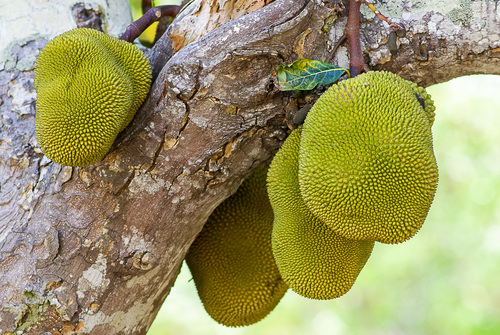
The commonest lookalikes are Artocarpus camansi, with softly spiny fruit consistently containing many seeds, and jackfruit, Artocarpus heterophyllus, with much heavier, more strongly scented fruit. Less divided foliage and the almost consistent absence of seeds in Pacific breadfruit cultivars are the most useful field distinctions. 4 5
Main sources
- Plants of the World Online / Kew, Artocarpus altilis (Parkinson) Fosberg
- Purdue University NewCrop (Morton, Fruits of Warm Climates), Breadfruit
- Plants For A Future, Artocarpus altilis
- Integrated Taxonomic Information System (ITIS), Artocarpus altilis
- USDA NPGS GRIN Global Taxonomy, Artocarpus altilis
- Useful Tropical Plants Database, Artocarpus altilis
- Monaco Nature Encyclopedia, Artocarpus altilis
Frequently asked questions
Is breadfruit a fruit or a vegetable?
Botanically, it is a fruit. In cooking, it serves chiefly as a starchy vegetable when harvested green and as a sweet fruit when fully ripe.
Is breadfruit toxic to cats and dogs?
The cooked fruit is not toxic to domestic animals or humans. The milky latex present throughout the tree irritates skin on direct contact. This answer concerns the cooked fruit.
Why do some breadfruit trees have no seeds?
Most cultivars distributed in the Pacific and Caribbean, such as Ma'afala, were selected for seedless fruit. Their fruit has a central core, sometimes bearing aborted seeds, and they can only be propagated through cuttings or suckers.
How do breadfruit and jackfruit differ?
Artocarpus altilis and jackfruit, Artocarpus heterophyllus, belong to the same genus but are distinct species. Jackfruit has much heavier, more strongly scented fruit, often borne directly on the trunk.
Where does the name breadfruit come from?
Early European navigators compared the texture of moderately ripe fruit, once cooked, with fresh bread, giving rise to the English name.
Can breadfruit grow in metropolitan France?
Only in a heated greenhouse or protected botanical collection. It does not tolerate temperatures below 5 °C (41 °F), excluding outdoor ground cultivation beyond tropical and subtropical conditions.
What happened to Captain Bligh’s breadfruit plants?
His first expedition aboard HMS Bounty in 1787 was lost in the mutiny. His second attempt eventually delivered more than 2,100 plants to Jamaica in 1793, underpinning much subsequent Caribbean cultivation.
Similar plants
If you are unsure about a plant’s toxicity, ask a botanist or veterinarian for advice.