
Chinese trumpet vine (Campsis grandiflora, )


Chinese trumpet vine (Campsis grandiflora (Thunb.) K.Schum., 1894) is a deciduous woody climber in the Bignoniaceae family, native to eastern China and Japan. Less vigorous than its North American relative Campsis radicans, it climbs by twining stems with few aerial roots and carries large orange to red trumpet flowers in terminal panicles in summer.
Read moreChinese trumpet vine and Chinese trumpet creeper
Allow a few hours of direct sun per day, preferably morning or evening.
Full sun; tolerates light partial shade


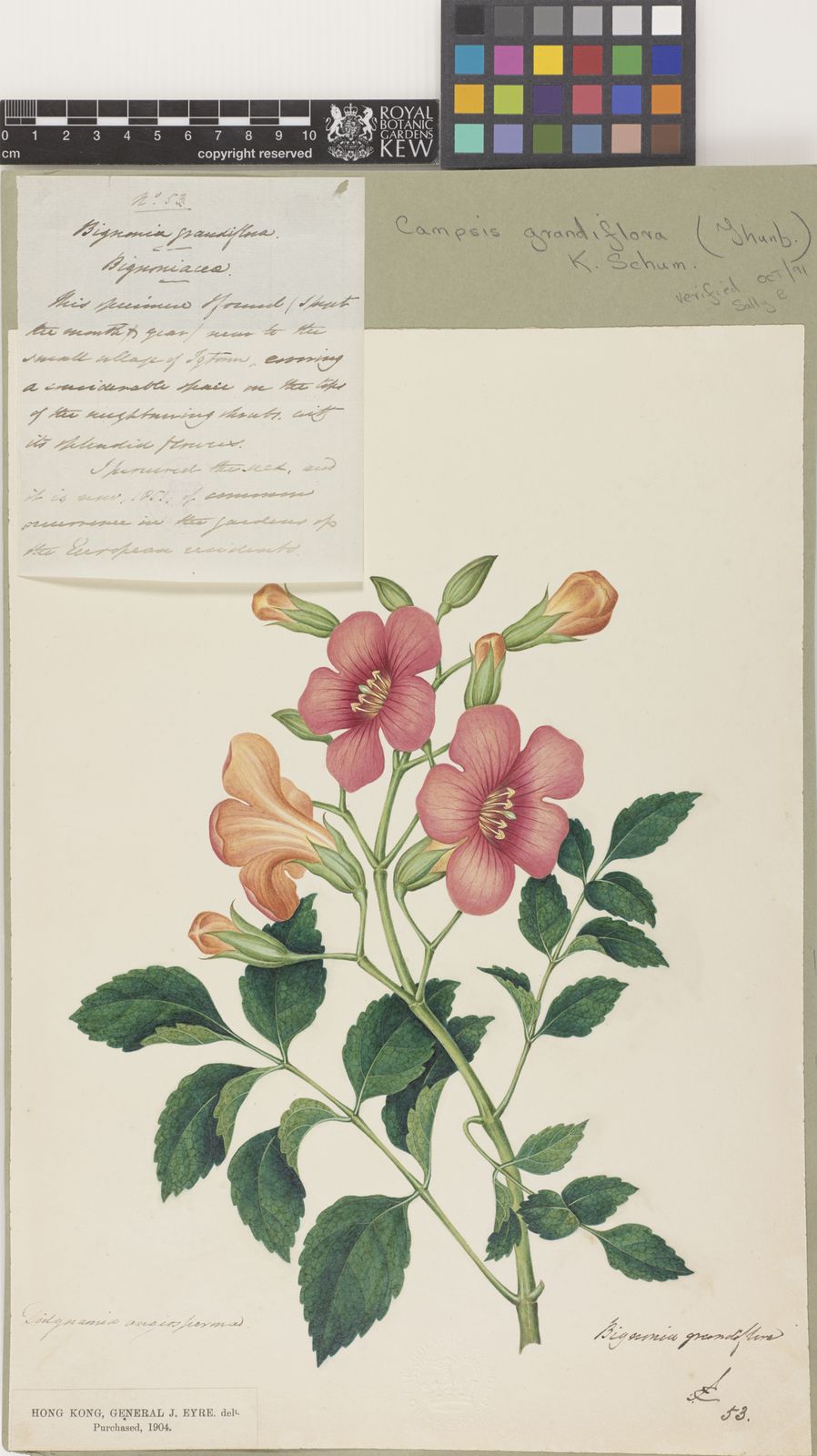
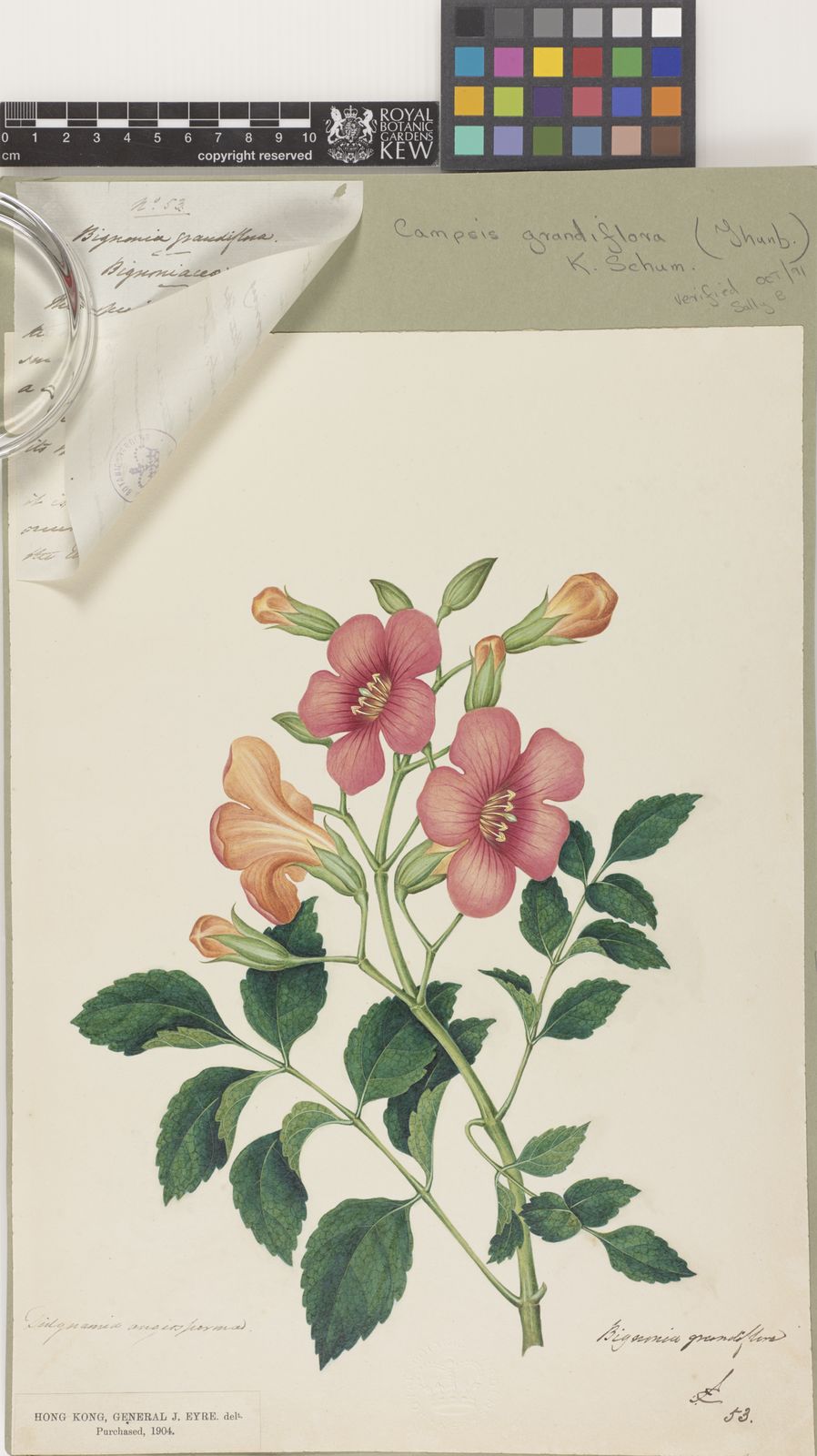
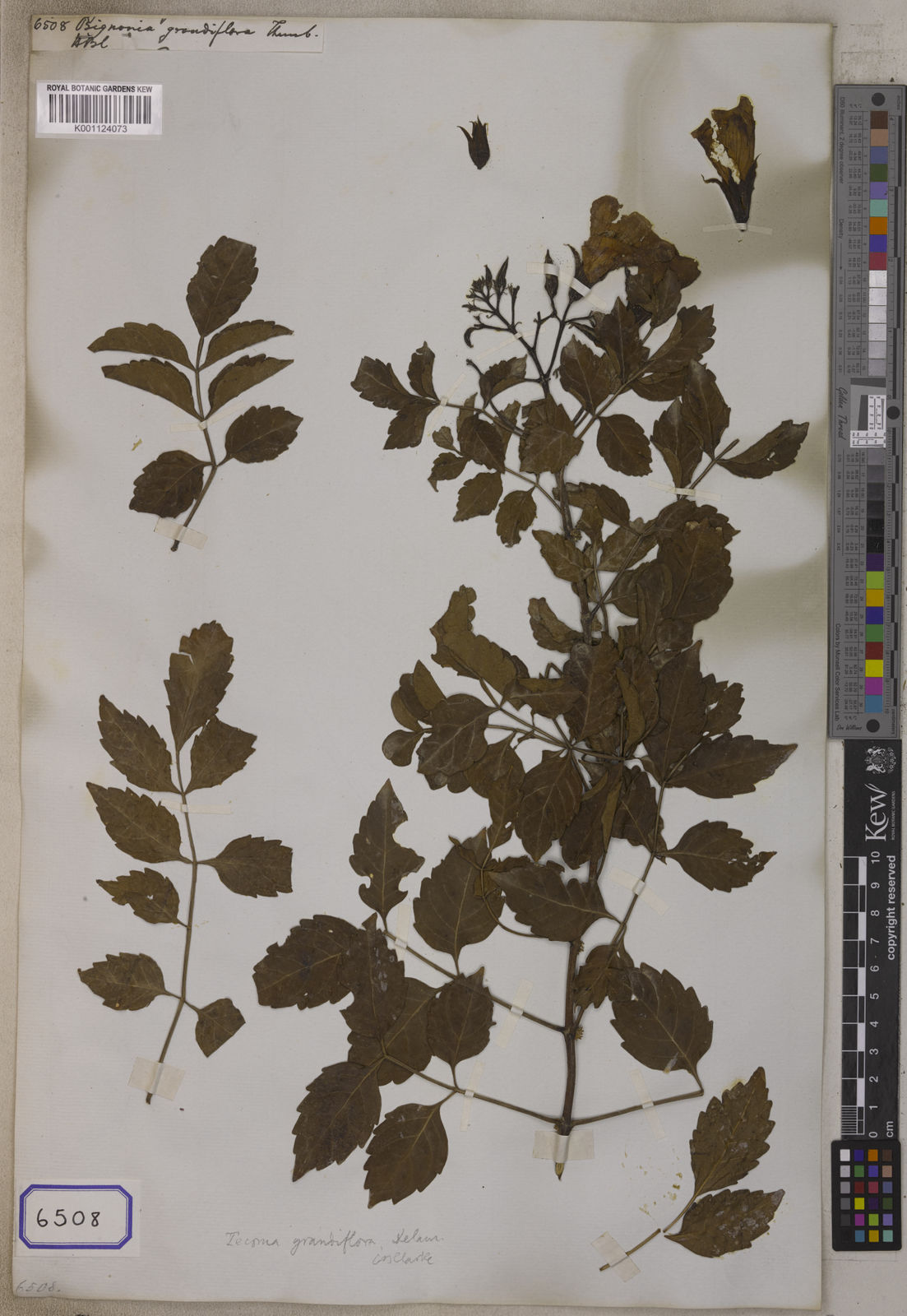
© photo
Wikimedia Commons · CC BY-SA or Public Domain
Wikipedia · CC BY-SA
Taken Jul 16, 2020 by Dieter Wagner (cc-by-sa)
Taken Jul 20, 2020 by Dieter Wagner (cc-by-sa)
Taken Oct 7, 2022 by Jim Knopf (cc-by-sa)
Taken Aug 1, 2017 by Dieter Wagner (cc-by-sa)
© copyright of the Board of Trustees of the Royal Botanic Gardens, Kew.


Global distribution
According to POWO/WCVP, Campsis grandiflora is native to eastern China and Japan. Long cultivated in Japan, Korea and Taiwan, it reached Europe around 1800 as an ornamental climber and was later introduced to North America. In metropolitan France it remains a collector or garden vine, with no invasive status documented by INPN.
- Native2
- Introduced1
- China
- Japan
- United States
Hexagons: regions where the plant occurs. Green dots: native range.1
Identité
Chinese trumpet vine (Campsis grandiflora (Thunb.) K.Schum., 1894), also called Chinese trumpet creeper, is a deciduous woody climber in the genus Campsis and family Bignoniaceae. Its generic name comes from the Greek kampsis, meaning a bend, in reference to the curved stamens inside the flowers. 1
Thunberg first described this species in 1784 as Bignonia grandiflora. Karl Schumann transferred it to Campsis in 1894, producing its current name. Native to eastern China and Japan, Chinese trumpet vine has been cultivated there as an ornamental for several centuries. 1 4
Recognition
Twining stems provide the main means of climbing, with relatively few aerial roots to anchor the vine. Without regular tying, it can pull away from a support. This limited self-attachment distinguishes it from its North American relative Campsis radicans, which climbs much more readily by aerial roots. 4 2
Planted in the ground against a sheltered wall, the vine can reach 8–12 m (26–39 ft) high with a spread of 2–4 m (7–13 ft). Opposite, pinnately compound leaves carry 7–9 leaflets. Each leaflet is oval, long-pointed, coarsely toothed and hairless on both surfaces. 2 5
Orange to red flowers open into broad trumpets 5–8 cm (2–3 in) across. Groups of 6–12 flowers form drooping terminal panicles from late summer into fall in the temperate Northern Hemisphere. A deeply lobed calyx and open corolla throat separate them from the narrower flowers and less divided calyx of Campsis radicans. 5 3
Useful taxonomy
POWO/WCVP accepts Campsis grandiflora (Thunb.) K.Schum. as the botanical name. Its long synonymy reflects successive placements in Bignonia, Tecoma and Campsis. The names below record those changes rather than representing separate garden species.
- Bignonia grandiflora Thunb., the 1784 basionym
- Tecoma grandiflora (Thunb.) Loisel.
- Campsis chinensis (Lam.) Voss
- Tecoma thunbergii Van Houtte
- Campsis grandiflora f. thunbergii (Van Houtte) Rehder
The historic cultivar 'Thunbergii' was introduced by naturalist Philipp Franz von Siebold in 1856. Its name echoes the last synonym listed above. A shorter corolla tube and reflexed lobes help distinguish this orange-flowered selection from the usual species form. 1 5
Habitat and range
Eastern China and Japan form the native range recognized by POWO/WCVP. Chinese trumpet vine grows along woodland edges and on sunny slopes there. It was introduced to Europe around 1800 as an ornamental climber, extending its garden history far beyond its original range. 1 5
Cultivation now extends to Taiwan, South Korea, North America and France. In France the plant remains a collector or ornamental vine, with no invasive status documented by INPN. That French assessment describes one territory and should not be treated as a regulatory statement for every garden location. 7 4
For garden growing, ordinary well-drained soil that is reasonably fertile and a sunny position sheltered from wind suit this vine. These conditions correspond to USDA zones 6–9 in the cited horticultural references. Exposure and drainage still matter within a given hardiness zone. 4 3
Life cycle and reproduction
Flowers develop on the current season’s shoots, with June–September given for the temperate Northern Hemisphere growing season. Late-winter pruning therefore does not remove the coming season’s flowering wood. The large orange trumpets attract hummingbirds in North America and numerous pollinators in Europe. 3 4
Pollinated flowers develop into elongated capsules that release winged seeds when ripe. Garden propagation mainly uses semi-ripe cuttings, the most reliable method, followed by layering low stems and seed in cool climates. Seed-grown plants take longer to reach their flowering stage. 2 3
Fertile ground can encourage shoots from the roots. This suckering tendency is less pronounced than in Campsis radicans, but checking annually for unwanted shoots helps contain Chinese trumpet vine in a restricted bed. Less aggressive growth still calls for space and occasional control. 4
Uses and risks
Pergolas, trellises and south-facing walls in the Northern Hemisphere are common ornamental settings. Chinese trumpet vine suits Asian-style gardens and pollinator planting alike. Its broad summer flowers provide the main display, while a solid support accommodates the woody framework of a mature climber. 4
Dried flowers have a place in traditional Chinese herbal preparations for menstrual disorders and some rheumatic pains. This is a documented traditional use rather than a validated medical indication. It should be understood as part of the plant’s cultural history, without implying a proven treatment. 6
Consulted horticultural sources document no systemic toxicity and mention no ingestion hazard to people or domestic animals. Sap may nevertheless irritate sensitive skin during pruning. Wearing gloves is a practical response to that contact risk, while the absence of published horse data leaves its specific status uncertain. 4 2
Varieties, look-alikes and related plants
Two widely grown cultivars are 'Thunbergii', with orange flowers and a short corolla, and 'Morning Calm', selected in the United States for peach flowers, a yellow throat and a more compact habit. Their names distinguish cultivated selections rather than changing the identity of the species. 5
The hybrid Campsis x tagliabuana 'Madame Galen' comes from Campsis grandiflora crossed with Campsis radicans. It combines the vigor of the American parent with the broad corolla of the Asian parent. Despite that mixed parentage, it is often sold incorrectly under Campsis grandiflora alone. 5
Confusion with Campsis radicans is especially common. That species produces many more aerial roots, narrower flowers and a less deeply lobed calyx. It also spreads more strongly in rich soil. Comparing these features together is more reliable than identifying a vine from orange flower color alone. 5 4
Main sources
- Plants of the World Online / Kew, Campsis grandiflora (Thunb.) K.Schum.
- Royal Horticultural Society, Campsis grandiflora - cultivation and care
- Missouri Botanical Garden Plant Finder, Campsis grandiflora
- NC State Extension Plant Toolbox, Campsis grandiflora
- Trees and Shrubs Online, Campsis grandiflora
- Plants For A Future, Campsis grandiflora
- INPN / MNHN, Campsis grandiflora (Thunb.) K.Schum., 1894
Frequently asked questions
Is Chinese trumpet vine invasive in France?
INPN documents no invasive status for it in metropolitan France. It can still produce root suckers in rich soil, so check for unwanted shoots each year.
How does it differ from Campsis radicans?
Chinese trumpet vine has far fewer aerial roots, broader flowers with a deeply lobed calyx and mainly twining stems. It is less spreading than its North American relative.
Is Chinese trumpet vine toxic to cats and dogs?
Reference horticultural sources document no known systemic toxicity from ingestion. Sap can irritate sensitive skin, so wear gloves when pruning.
How do I propagate Chinese trumpet vine?
Semi-ripe cuttings in late summer are the most reliable method, followed by layering low stems. Seed also works but takes longer to produce a flowering plant.
Why is my vine not flowering?
Insufficient direct sun and pruning at the wrong time are the most common causes. Flowers form on the current season’s growth, so late-winter pruning does not prevent them.
What is Madame Galen?
Madame Galen is not a cultivar of Campsis grandiflora but the hybrid Campsis x tagliabuana, produced by crossing it with Campsis radicans. It is sometimes mislabeled as C. grandiflora alone.
Similar plants
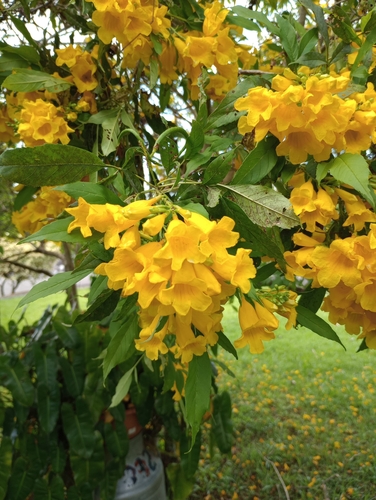

If you are unsure about a plant’s toxicity, ask a botanist or veterinarian for advice.