
Chinese hawthorn (Crataegus pinnatifida, )


Chinese hawthorn (Crataegus pinnatifida Bunge, 1835) is a deciduous shrub or small tree in Rosaceae, native to northern and eastern China, Korea and the Russian Far East. It has deeply divided leaves and few thorns, sometimes none. Its red fruit, shanzha, is eaten fresh, dried or candied and has a long history in traditional Chinese medicine.
Read moreChinese hawthorn, Chinese haw, Chinese hawberry, Mountain hawthorn and Shanzha


© photo
Wikimedia Commons · CC BY-SA or Public Domain
Wikipedia · CC BY-SA
© copyright of the Board of Trustees of the Royal Botanic Gardens, Kew.


Global distribution
Crataegus pinnatifida is native from northern and eastern China, including Hebei, Heilongjiang, Henan, Shandong and neighboring provinces, to Korea and the Russian Far East. It is widely grown in orchards for shanzha in its native range. Elsewhere it is chiefly a collector’s ornamental tree, with no documented invasive naturalization.
- Native3
- Introduced1
- China
- Korea
- Russia (Far East)
- North America
Hexagons: regions where the plant occurs. Green dots: native range.1
Identity
Chinese hawthorn (Crataegus pinnatifida Bunge, 1835) is a shrub or small tree in Rosaceae. Alexander von Bunge described it in 1835; POWO retains this as the accepted name. The epithet pinnatifida combines Latin pinna, feather or wing, with -fida, split, referring to the deeply divided leaves. 1 6
In China, Shanzha (山楂) names both the tree and its red fruit. English names also include Chinese haw, Chinese hawberry and Mountain hawthorn. Sold fresh, dried or candied, the fruit is used in both street confectionery and traditional Chinese medicine. 6
Recognition
Unlike most hawthorns, Crataegus pinnatifida has only a few short thorns, sometimes none, providing an initial field character. The tree reaches 4–7 m (13–23 ft) in height with a comparable spread. Its bark is gray, and young shoots bear reddish-purple buds. 4 6
Leaves measure 5–10 cm (2–4 in) and are deeply lobed, almost pinnate, with 3–5 pairs of divisions often reaching halfway into the blade. This division alone does not rule out other hawthorns with lobed leaves. Foliage turns red in autumn. 6 4
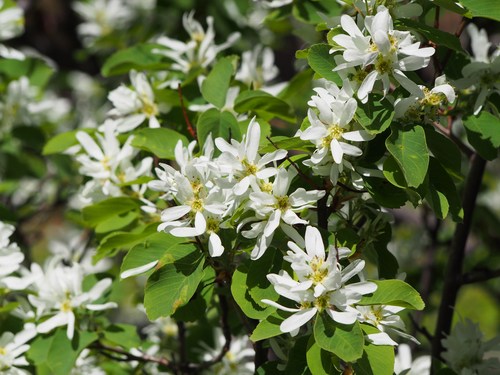
Small white flowers, about 1.5 cm (0.6 in) across, open in spring, around May in the northern native range. They form corymbs 4–6 cm (1.6–2.4 in) across, initially with little scent and later a more pleasant fragrance. The fruit is a dark red, nearly spherical to pear-shaped pome 1–2.5 cm (0.4–1 in) across. It ripens from late summer into autumn, corresponding to late August–October in its native northern range. 4 3
Useful taxonomy
POWO recognizes two accepted varieties of Crataegus pinnatifida: the typical variety pinnatifida and pubescens Nakai, described from Korea for its hairier shoots and leaves. Many other names published during revisions of the genus are now treated as synonyms, including Crataegus pinnatifida var. major N.E.Br., Crataegus pinnatifida f. psilosa C.K.Schneid. and Crataegus pinnatifida var. korolkowii (Regel ex C.K.Schneid.) Y.Yabe. 1
A recurring source of confusion is the unrelated homonymous epithet in Crataegus monogyna var. pinnatifida (Hartm.) Hartm.. This is a variety of European one-seeded hawthorn, not the Asian species described by Bunge. The complete binomial, Crataegus pinnatifida Bunge, is therefore the stable reference. 1
Habitat and range
The native range of Crataegus pinnatifida includes northern and eastern China, including Hebei, Heilongjiang, Henan, Shandong and neighboring provinces, the whole of Korea and the Russian Far East. It grows on hills and low mountains, sunny slopes, in open woodland, at woodland edges and in grassland, as well as on sandy banks and stony slopes up to 2,000 m (6,560 ft) in elevation. 6 3
The IUCN assesses the species as Least Concern (LC), with no identified conservation threat. Outside its original range, Chinese hawthorn is chiefly grown in collections or as an ornamental, notably in Europe and North America, with no documented invasive naturalization to date. Within its native range, it is also extensively grown in orchards, particularly in Shandong and Hebei, provinces known for shanzha production for confectionery and traditional medicine. 8 4
Life cycle and reproduction
Hermaphroditic, insect-pollinated flowers open in spring, around May in the native northern range, shortly after the leaves unfold. Fruits develop throughout summer and ripen from late summer into autumn, corresponding to late August–October there, roughly four to five months after flowering. 4 3
Seed requires warm followed by cold stratification, and germination can take more than 18 months, the main constraint on seed propagation. Seed-raised trees generally bear after 5–8 years, whereas grafting onto a Crataegus rootstock can bring the first crop forward to the third year. 3 4
Uses and risks
Fruit dominates the traditional uses of this hawthorn, well ahead of bark or leaves. In northern China, sugar-coated shanzha threaded onto skewers makes tanghulu, a popular winter street sweet. Cooked into a sweet paste and dried in sheets, it becomes shanzhagao. Juice, syrups and alcoholic drinks provide further uses. 6
Shanzha appears in Li Shizhen's Bencao Gangmu (1593) for digestive and circulatory uses in traditional Chinese medicine. Modern research identifies flavonoids and triterpenoids in the fruit, including hyperin and ursolic acid, associated with cholesterol reduction and a vasodilatory effect in animals. 9 6
The ASPCA classifies the genus Crataegus as non-toxic to dogs, cats and horses. The seeds, however, contain cyanogenic compounds, a feature shared by pome-bearing Rosaceae. They are routinely removed during fruit preparation and should not be consumed in quantity. 5 2
Varieties, look-alikes and related plants
The cultivar 'Big Golden Star', derived from variety major, bears larger fruits than the typical form and has few or no thorns. It is the form most often offered by European nurseries, both as a fruit tree and as an ornamental. 2
The most frequent look-alikes are:
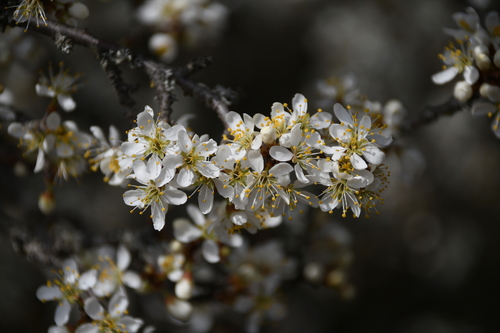
- Crataegus monogyna, also with deeply lobed leaves, but a fruit containing one stone;
- Crataegus laevigata, shallowly lobed, with fruits containing two or three stones;
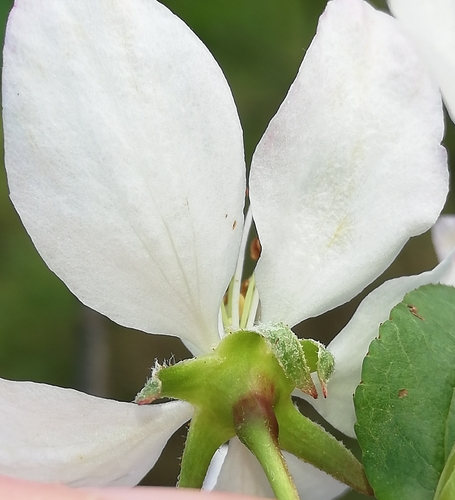
- some wild apples (Malus spp.), whose similar fruits accompany entire, unlobed leaves.
Leaf division and the number of seeds per fruit remain the most reliable field characters for distinguishing these species. 6
Main sources
- Plants of the World Online / Kew, Crataegus pinnatifida Bunge
- Royal Horticultural Society, Crataegus pinnatifida var. major 'Big Golden Star'
- Plants For A Future, Crataegus pinnatifida database entry
- NC State Extension, Crataegus pinnatifida - Chinese Hawthorn
- ASPCA, Hawthorn toxicity entry (Crataegus)
- Wikipédia (FR), Crataegus pinnatifida
- Wikipedia (EN), Crataegus pinnatifida
- IUCN Red List, Crataegus pinnatifida assessment
- Li et al., 2023, Crataegus pinnatifida ethnopharmacological overview, Journal of Ethnopharmacology
Frequently asked questions
Is Chinese hawthorn toxic to dogs or cats?
No. The ASPCA classifies Crataegus, the genus containing Chinese hawthorn, as non-toxic to dogs, cats and horses. Only the fruit seeds, rich in cyanogenic compounds as in many pome-bearing Rosaceae, should be removed before consumption.
Can Crataegus pinnatifida fruit be eaten?
Yes. The fruit, called shanzha, is eaten raw, cooked, dried or made into sweets. The seeds are not eaten and are removed during preparation.
Why does Chinese hawthorn have so few thorns?
Unlike most Crataegus, Crataegus pinnatifida bears only a few short thorns, sometimes none. This makes harvesting easier and provides a readily visible species character.
How does Chinese hawthorn differ from one-seeded hawthorn?
Both species have deeply lobed leaves. Crataegus pinnatifida has several seeds per fruit, whereas Crataegus monogyna has one.
How long has shanzha been used in Chinese medicine?
Li Shizhen’s Bencao Gangmu, published in 1593, already describes its uses for digestive disorders and food stagnation. Modern studies chiefly explore effects on cholesterol and blood pressure.
Does Chinese hawthorn grow in France?
It is not native there, but some European nurseries grow it as an ornamental or fruit tree, notably the cultivar Big Golden Star.
How long does Chinese hawthorn take to bear fruit?
A seed-raised tree generally takes 5–8 years to bear, whereas a grafted tree can produce from its third year.
Similar plants

If you are unsure about a plant’s toxicity, ask a botanist or veterinarian for advice.