
Fire stick (Euphorbia tirucalli, )
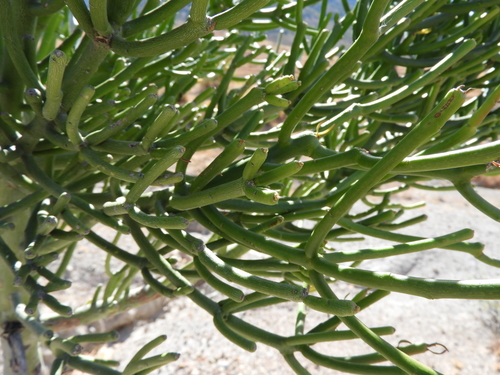
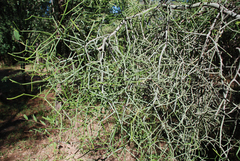

Fire stick (Euphorbia tirucalli L., 1753) is a succulent shrub in the Euphorbiaceae family, native to eastern and southern Africa. Almost leafless, it photosynthesizes through slender cylindrical stems resembling pencils. Its milky latex is highly irritating to skin and eyes, making this popular ornamental a plant that requires careful handling.
Read moreFire stick, Pencil tree, Pencil cactus and Petroleum plant


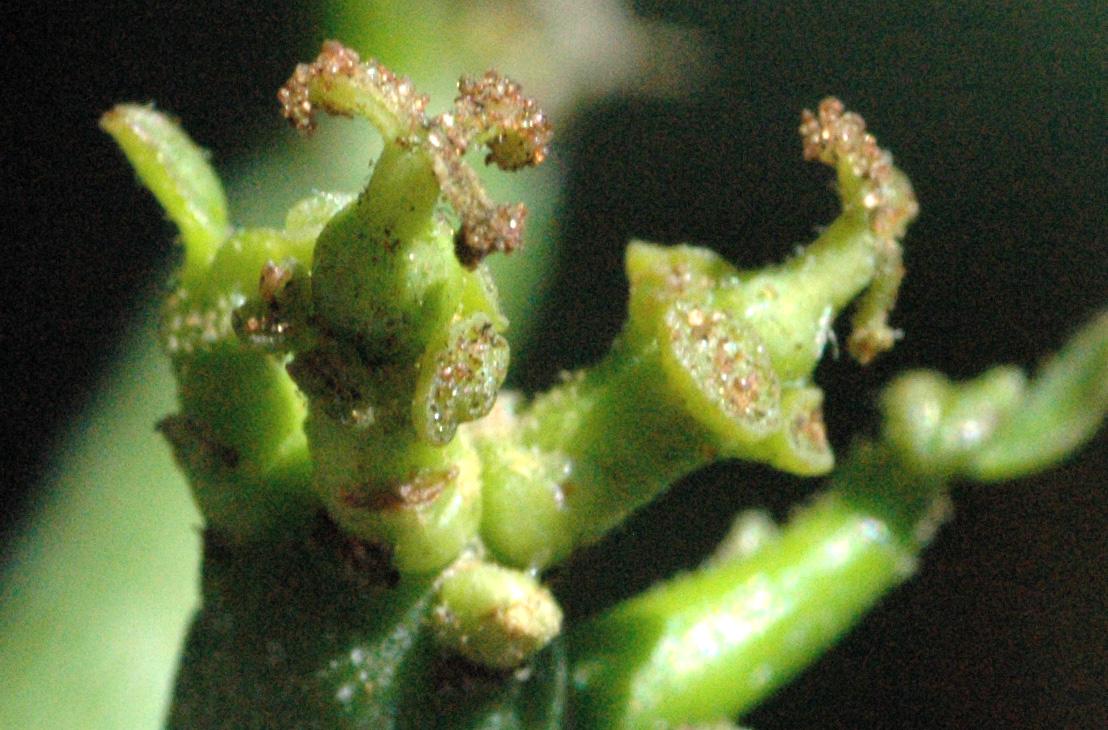
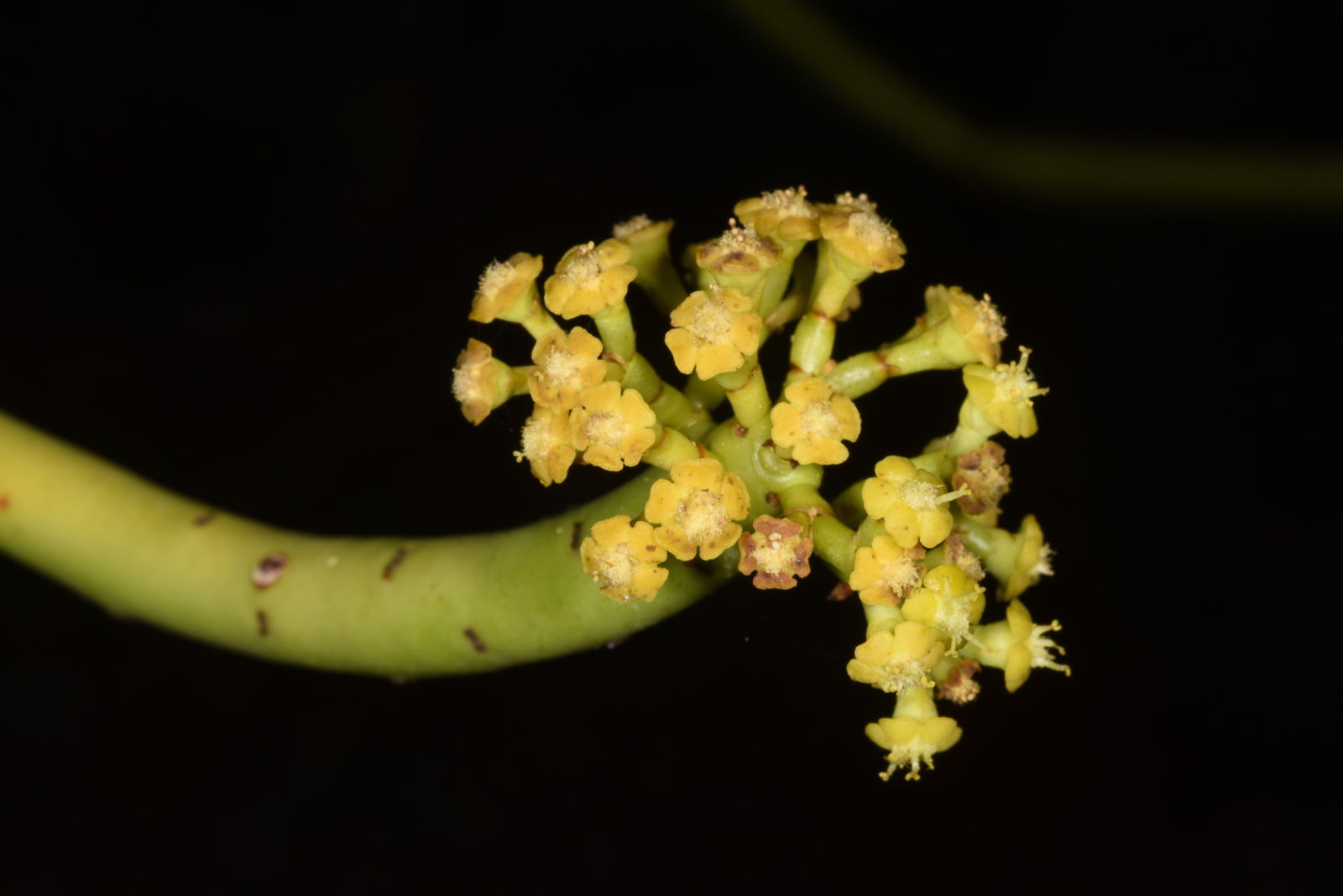

© photo
Leticia Jiménez Hernández · CC BY-NC
Andrew Hankey · cc-by-sa
Alan Manson · cc-by
Taken Jan 16, 2001 by Tela Botanica − Liliane Roubaudi (cc-by-sa)
Taken Jan 8, 2022 by Lesja Murga (cc-by-sa)
Taken May 7, 2014 by Tela Botanica − Céline PIRAT (cc-by-sa)
Taken Oct 18, 2020 by malcolm stander (cc-by-sa)
© copyright of the Board of Trustees of the Royal Botanic Gardens, Kew.




Global distribution
Euphorbia tirucalli is native to eastern and southern Africa and Madagascar, growing on clay or rocky soils. Widely naturalized in the tropics, it has been used for living fences. On some islands, including Cuba and Hawaii, it is now considered invasive.
- Native5
- Introduced2
- Invasive2
- Kenya
- Tanzania
- Mozambique
- South Africa
- Madagascar
- India
- Brazil
- Cuba
- Hawaii
Hexagons: regions where the plant occurs. Green dots: native range.1
Identity
Fire stick (Euphorbia tirucalli L., 1753), also called pencil tree or pencil cactus, belongs to the genus Euphorbia in the Euphorbiaceae family. Linnaeus established the name in 1753, and Plants of the World Online retains it as the accepted combination. 1
In metropolitan France and the French Caribbean, where its Creole name is kréyon, the French name bois de lait refers to white, milky latex released by the slightest stem injury. 2
The species also acquired the French name euphorbe antivénérienne from a traditional medicinal use now discouraged. The plant remains toxic, and preparations made from it are no safe remedy. 5
Recognition
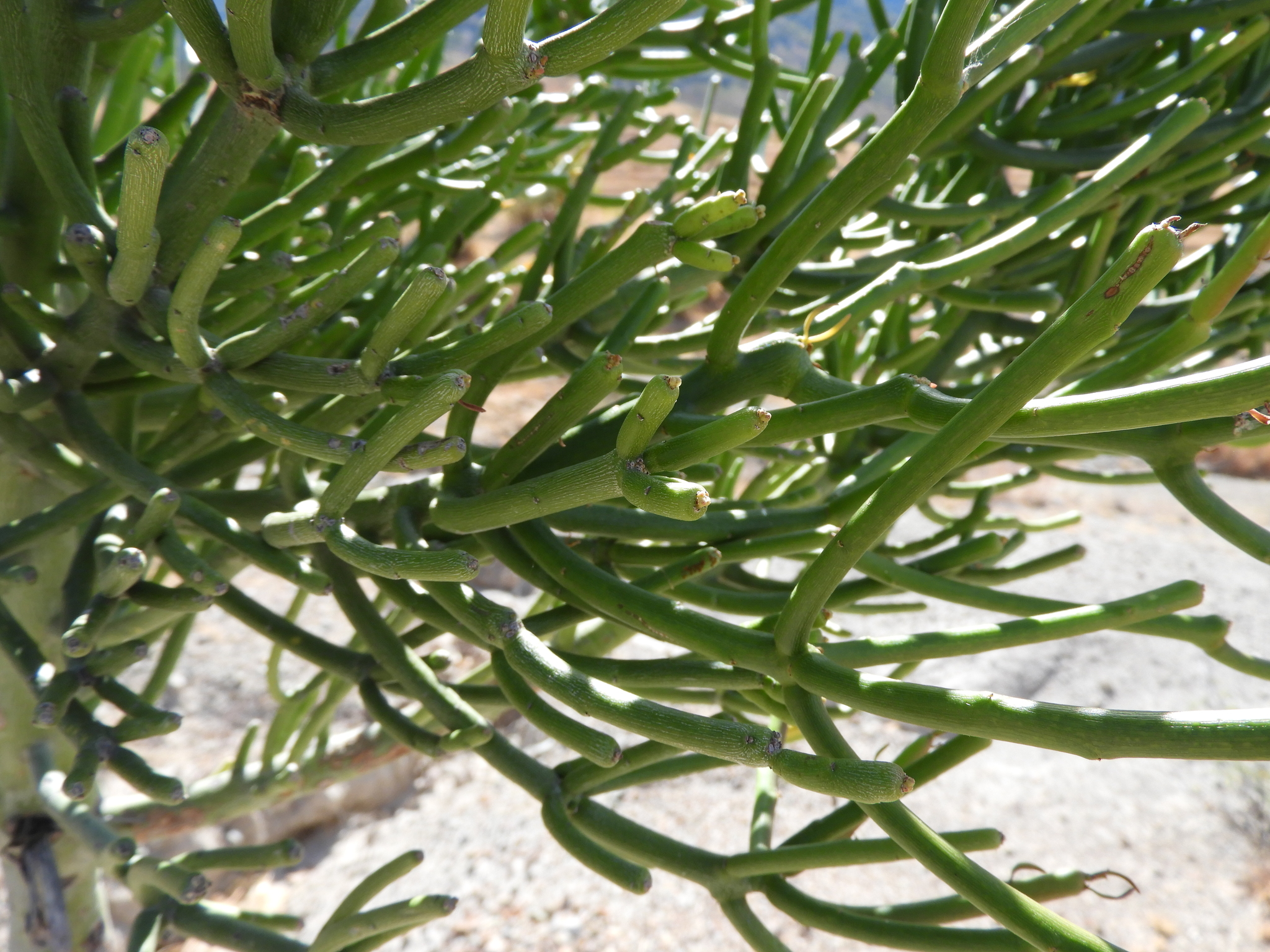
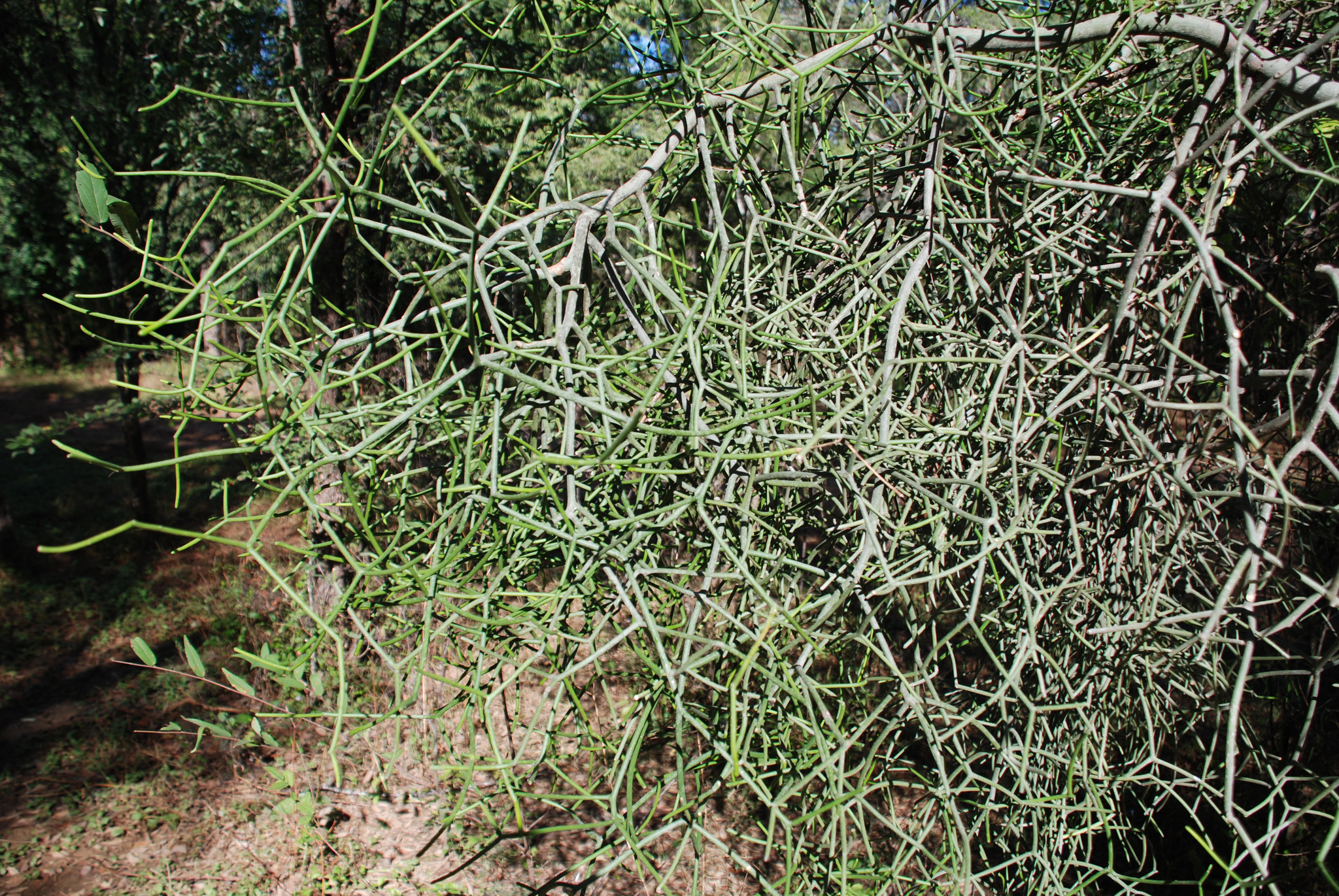
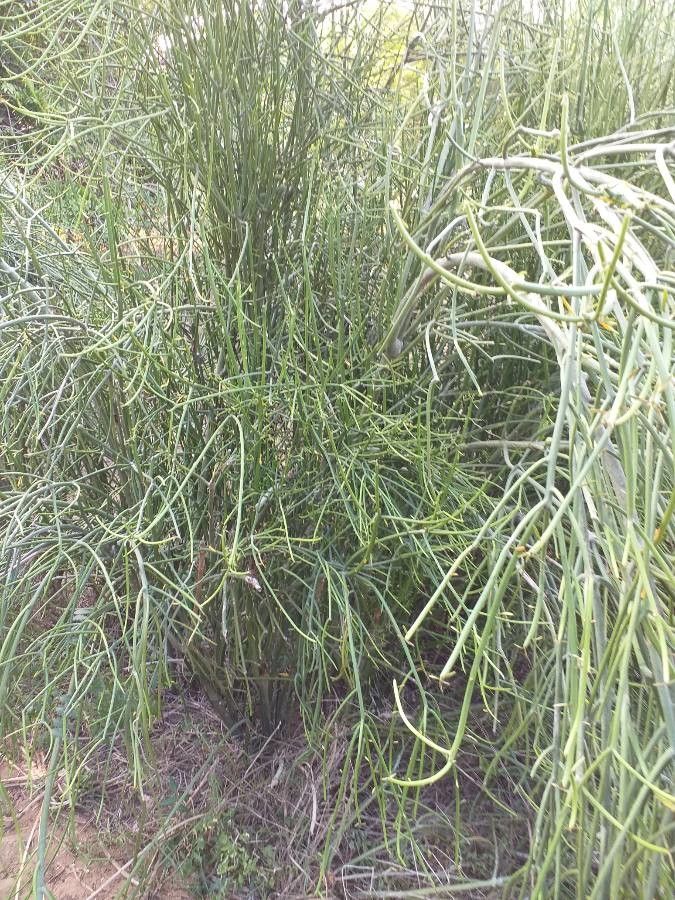
Despite its cactus-like appearance, Euphorbia tirucalli is a bushy shrub or small tree. Light green cylindrical stems, about pencil thickness, form dense coral-like clusters rather than the spiny ribs of a cactus. 3 4
Tiny leaves, 1–2.5 cm (0.4–1 in) long, appear only on young shoots and soon fall. The green stems themselves perform most photosynthesis throughout the year. Almost complete leaflessness is normal for this species, rather than a symptom of disease. 4
In a container it rarely exceeds 1–2 m (3–6.5 ft), but in its native range it can become a bushy tree 9 m (30 ft) tall and 2–3 m (6.5–10 ft) across. 3
The flowers are tiny yellow cyathia clustered at branch tips in spring and summer. They are easily overlooked beside the much more conspicuous stems. 3
Useful taxonomy
The accepted name Euphorbia tirucalli brings together five taxonomic synonyms that help identify old sales labels and botanical literature:
- Euphorbia rhipsaloides Welw. ex N.E.Br.
- Euphorbia laro Drake
- Euphorbia viminalis Mill.
- Arthrothamnus tirucalli (L.) Klotzsch & Garcke
- Tirucalia tirucalli (L.) P.V.Heath
The accepted name is the reliable identifier. Several synonyms have appeared on different commercial labels across regions and periods, without referring to a different species. 1
Habitat and range
The native range lies in eastern and southern Africa, on clay or rocky ground in dry thickets and wooded savannas up to 2,000 m (6,560 ft). Madagascar is also recognized among its territories of origin. 1 5
The plant has naturalized widely in the tropics, including India, Southeast Asia and South America. It was long planted as an impenetrable living fence, its irritating latex helping contain livestock. 5 3
On tropical islands including Cuba and Hawaii, introduced plants have escaped from gardens and become invasive, quickly colonizing open ground. In metropolitan France, pencil tree remains a collection or container plant brought under cover for winter. 5
A useful hedge in its native range can become an unwanted colonizer elsewhere. This contrast explains the species' differing status between countries: the latex-bearing plant used to enclose livestock in Kenya can overrun tropical island waste ground in Cuba or Hawaii. 5
Life cycle and reproduction
Below 15 °C (59 °F), growth slows markedly and nearly stops through a cool winter. It resumes in spring as temperatures and light increase. 4
In cultivation, stem cuttings are almost always used. Cut a section and leave the wound exposed to air to dry and callus for at least 24 hours, stopping latex flow, before inserting it into a barely moist, free-draining substrate. 5
Seed propagation also works but is uncommon in home cultivation. It takes months to produce a usable young plant, whereas a cutting roots in 3–6 weeks. 5
Uses and risks
Eye exposure to latex is the principal hazard. A splash can cause severe burns and temporary blindness lasting several days. Gloves and eye protection are essential when pruning or taking cuttings. 5 4
ASPCA lists the species as toxic to dogs, cats and horses, with mouth and stomach irritation after stem chewing. Oral effects are considered more moderate than the eye hazard. 6
In East African regions where Burkitt lymphoma is endemic, the latex activates the Epstein–Barr virus lytic cycle and weakens virus-specific immunity. This mechanism makes Euphorbia tirucalli an investigated environmental cofactor, rather than a direct cause of the disease. 7
The same latex, rich in triterpene hydrocarbons, prompted biofuel research in the 1970s. Chemist Melvin Calvin called it a petroleum plant. More recent agronomic trials confirm usable hydrocarbon yields on land unsuitable for other crops. 8
Varieties and related plants
'Rosea', sold as Sticks on Fire or Firesticks, is much easier to find in garden centers than other cultivars. Its stems turn yellow, orange and then red in response to cold, full sun or moderate water stress. 3
A crested form with stems fused into a rippled fan circulates among succulent collectors as 'Cristata'. It arises from a horticultural mutation, rather than a recognized botanical variety. 5
Without leaves or spines, pencil tree is sometimes confused with a columnar cactus or other African succulent spurges such as Euphorbia trigona. That species has angular, three- or four-sided stems rather than the round stems of pencil tree. 4
Thornless, rounded stems reaching 9 m (30 ft) in warm open ground and leaves absent for most of the year together identify pencil tree in the field, even without visible flowers or latex.
Main sources
- Plants of the World Online / Kew, Euphorbia tirucalli L.
- INPN / MNHN, Euphorbia tirucalli — milk bush
- Missouri Botanical Garden, Plant Finder, Euphorbia tirucalli
- NC State Extension, Euphorbia tirucalli (Pencil Tree)
- Plants For A Future, Euphorbia tirucalli
- ASPCA, Pencil Cactus toxicity entry
- British Journal of Cancer / Nature, EBV lytic cycle activation by Euphorbia tirucalli latex
- PLOS ONE, Comprehensive characterization of Euphorbia tirucalli as a biofuel source
Frequently asked questions
Is pencil tree a cactus?
No. Despite its thornless succulent stems, it belongs to Euphorbiaceae, not Cactaceae. Its outline and lack of persistent leaves explain the confusion, but do not determine its classification.
Why does pencil tree have so few leaves?
The cylindrical green stems carry out most photosynthesis. Tiny leaves appear only on young growth and soon fall; their absence is not a sign of disease.
Is pencil tree latex dangerous?
Yes, especially to the eyes, where it can cause severe burns and temporary blindness. ASPCA also lists it as toxic to dogs, cats and horses if the stems are chewed.
How can I propagate pencil tree?
Use stem cuttings. Cut a section, let the wound dry for at least 24 hours to stop latex flow, then insert it in a barely moist, free-draining substrate.
Why do the stems of 'Rosea' turn red?
Cold, full sun and slight water stress intensify this cultivar's color. It is sold as Sticks on Fire or Firesticks. In shade with ample water, it becomes greener or yellower.
What minimum temperature can pencil tree tolerate?
Stems begin to suffer below 5 °C (41 °F) and may blacken irreversibly in frost. It suits USDA zones 10–12, with no real tolerance of prolonged cold.
Where does pencil tree come from?
Its native range covers eastern and southern Africa and Madagascar. It has since naturalized widely in the tropics, becoming locally invasive, notably in Cuba and Hawaii.
Similar plants
If you are unsure about a plant’s toxicity, ask a botanist or veterinarian for advice.