
Perfoliate honeysuckle (Lonicera caprifolium, )
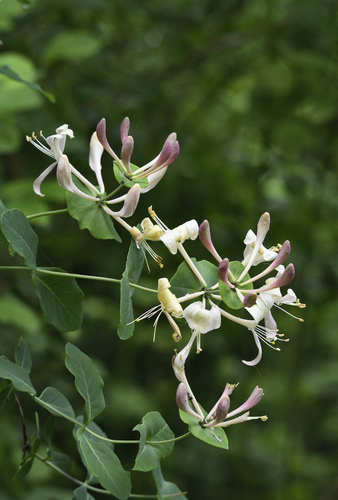

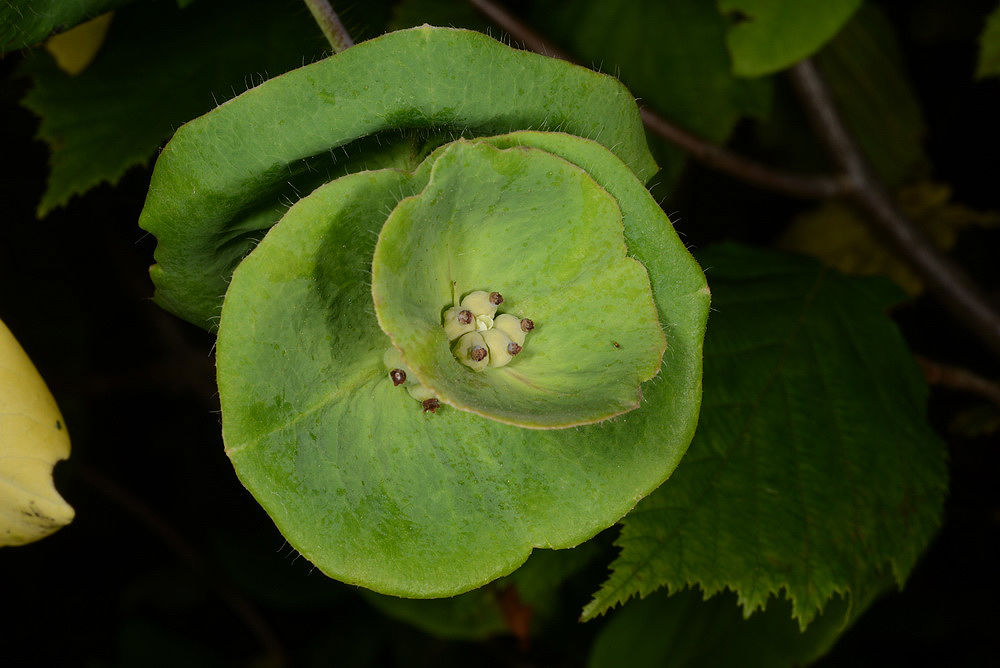
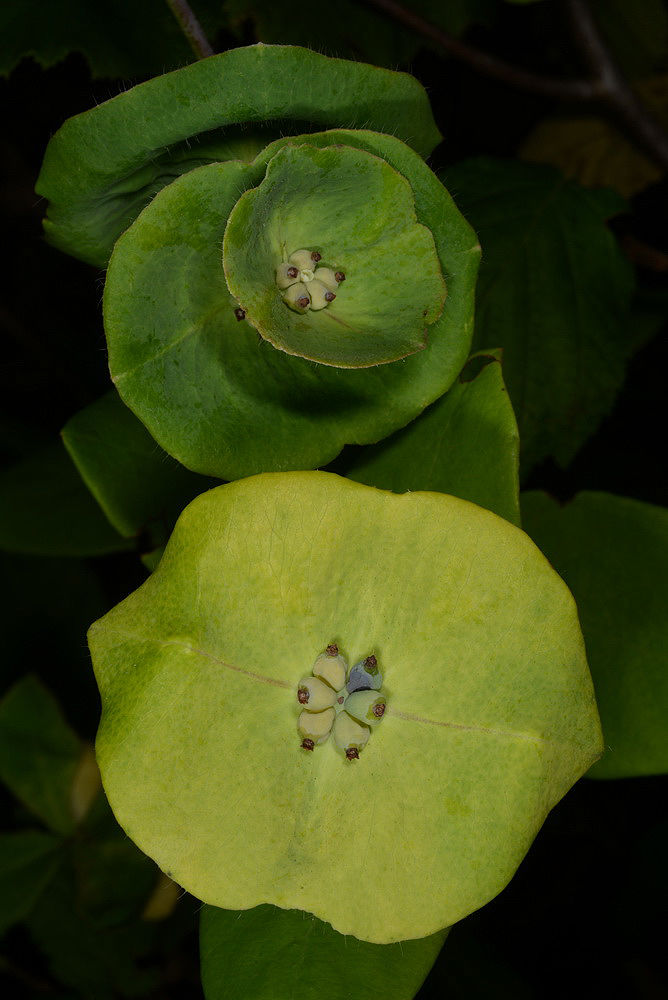
Perfoliate honeysuckle (Lonicera caprifolium L.) is a deciduous twining vine in the Caprifoliaceae family, native from central and southern Europe to the Caucasus. Its most distinctive feature is the fusion of its upper leaves into a continuous disk around the stem, beneath whorls of intensely fragrant cream flowers.
Read morePerfoliate honeysuckle, Italian honeysuckle and Italian woodbine


© photo
(c) samre, some rights reserved (CC BY-NC), uploaded by samre · cc-by-nc
Wikimedia Commons · CC BY-SA or Public Domain
Wikipedia · CC BY-SA
Taken Apr 5, 2013 by Tela Botanica − Alexis Joly (cc-by-sa)
Taken Mar 16, 2013 by Tela Botanica − Alexis Joly (cc-by-sa)
Taken Aug 1, 2020 by Rico Mende (cc-by-sa)
Taken Nov 11, 2022 by Blue Tilia (cc-by-sa)
© copyright of the Board of Trustees of the Royal Botanic Gardens, Kew.




Global distribution
Lonicera caprifolium is native from Italy and southeastern Europe through the northern Balkans and Asia Minor to the Caucasus and northern Iran. It has naturalized in southwestern Europe, escapes from gardens in southeastern England, and has become established in northeastern North America.
- Native5
- Introduced2
- Italy
- Greece
- Turkey
- Georgia (Caucasus)
- Northern Iran
- United Kingdom
- Northeastern United States
Hexagons: regions where the plant occurs. Green dots: native range.1
Identity
Perfoliate honeysuckle (Lonicera caprifolium L., 1753), also called Italian woodbine, is a vine in the Caprifoliaceae family. Carl Linnaeus described it in Species Plantarum. POWO accepts the species under this name and gives its native range as extending from Italy and southeastern Europe to the Caucasus. 1 2
The epithet caprifolium literally means goat leaf. It points to a readily visible feature: the upper leaves fuse into a continuous disk around the stem rather than remaining separate. Perfoliate honeysuckle describes the same arrangement. Italian woodbine instead recalls the area associated with its original description, Italy and southeastern Europe. 5 6
Recognition
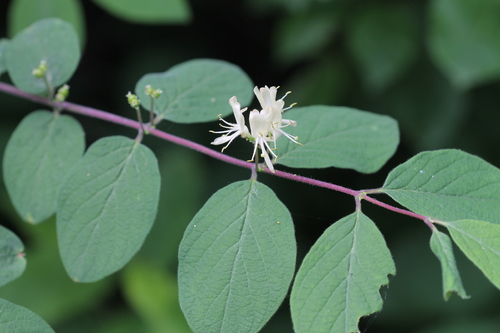
A deciduous twining vine, Lonicera caprifolium climbs without holdfasts or aerial roots: its stems wind directly around a support. The stems remain smooth. Its oval to obovate leaves are glaucous, or blue-green, on the underside, a useful feature to inspect when comparing it with other climbing honeysuckles. 5 3
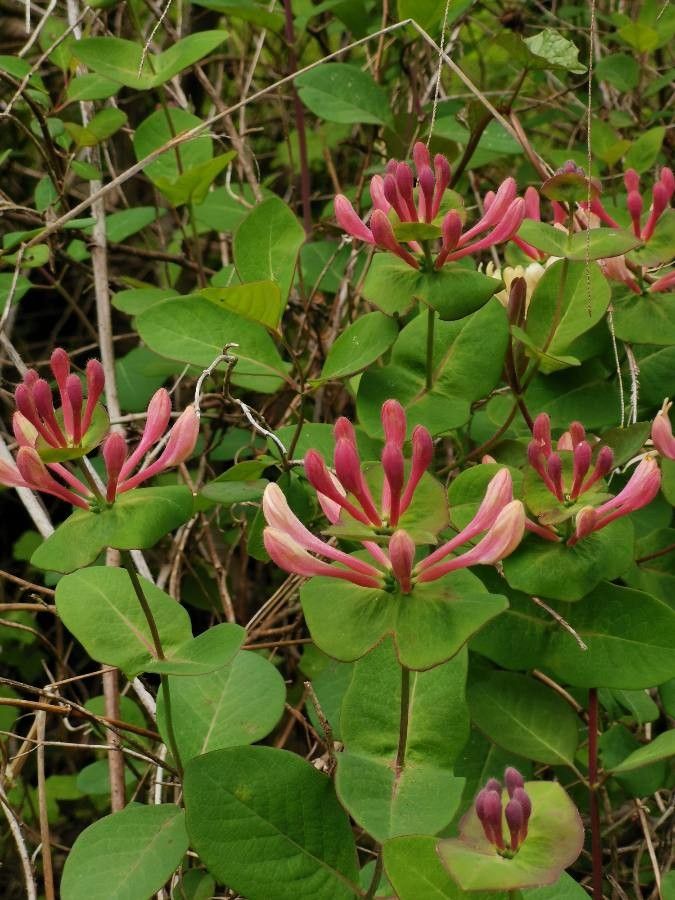
Flower color varies between cultivars, from cream-white to yellow tinged with pink. The fused upper leaves provide a steadier identification feature. One to three pairs form a continuous disk around the stem, directly beneath the whorls of flowers. That leaf structure remains visible even when the plant is not in flower. 5
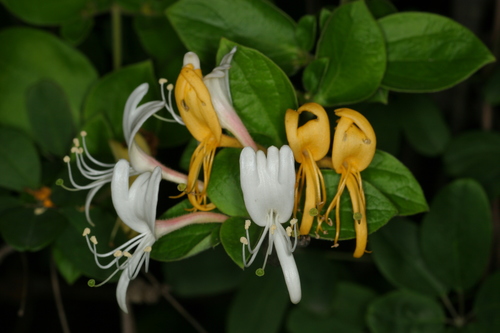
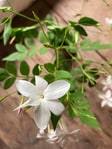
Tubular, two-lipped flowers measure 3.5–5 cm (1.4–2 in) and open cream, often with pink or yellow tints depending on the cultivar. Their powerful nighttime fragrance attracts hawk moths, whose long proboscises reach nectar deep in the flower tube, beyond the reach of most daytime insects. In favorable conditions, the vine climbs 4–8 m (13–26 ft) and covers a support in three to five years; soil and exposure strongly influence that pace. 3 4
Useful taxonomy
Honeysuckles in the genus Lonicera have two very different habits: compact hedge shrubs and twining vines that climb several meters (many feet). Their garden requirements differ accordingly. Lonicera caprifolium belongs to the climbing group, alongside Lonicera japonica and Lonicera periclymenum. A vine that may reach 4–8 m (13–26 ft) needs a stronger support than a shrub planted in a border. The World Checklist of Vascular Plants treats several historical varieties and forms under the accepted species, including Lonicera caprifolium var. major Carrière and Lonicera caprifolium f. pauciflora (Carrière) Rehder.
The scientific name Lonicera caprifolium L. is the reliable reference behind labels such as “Early White” and “Yellow Italian.” Those names refer to horticultural selections, not distinct species. They do not change the plant's taxonomic identity or its underlying cultivation needs, even though their flower color and flowering times differ. 1 2
Habitat and distribution
Hedgerows, scrub, and woodland margins are the natural habitats of this honeysuckle, from Italy and the northern Balkans through Asia Minor to the Caucasus and northern Iran. Established plants tolerate temperatures down to about -20 °C (-4 °F). Its USDA hardiness range is 5–9; local exposure and growing conditions still matter for an outdoor planting. 1 3
Beyond its native range, Lonicera caprifolium has naturalized in southwestern Europe and regularly escapes from gardens in southeastern England. There it grows in hedgerows and woodland edges, looking almost native. It has also become established in northeastern North America. These records concern particular regions and should not be generalized to every English-speaking country. 5 6
In France it remains primarily a garden plant, with no recognized invasive status. INPN and Tela Botanica record its presence, with introduced status varying by region. This French assessment describes its regional status; it does not establish the rules or ecological status that apply wherever a reader gardens. 6
Life cycle and flowering
Early forms such as 'Early White' begin flowering in May in the documented Northern Hemisphere setting, with bloom continuing into August depending on climate and cultivar. Elsewhere, follow the corresponding local late-spring and summer season. Flowers open in tight whorls directly above the fused leaf disk, concentrating their fragrance at the same point on the stem. Outdoors, abundant flowering develops after two to three years, once the vine is well secured to its support. 5 4
After nighttime pollination, berries change from green to orange, then red. They remain tightly clustered at the center of the leaf disk. Heavy fruiting depends on a summer warm enough to bring in hawk moth pollinators; a cool summer markedly reduces the number of berries. The fruit display therefore varies with growing conditions rather than following a fixed annual pattern. 5
Garden propagation chiefly uses semi-ripe cuttings in the local summer or layering stems where they touch the soil. Both methods are faster and more reliable than sowing seed. Seeds need cold stratification before they germinate, adding a substantial wait before a young vine is ready to use in the garden. 4
Uses and risks
Pergolas, old walls, trellises, and informal hedges suit this ornamental climber, which quickly covers a support in a favorable temperate climate. The leaf disk beneath the flowers adds to its appeal near a patio, where the evening scent is particularly noticeable. A suitable support lets the twining stems follow their natural climbing habit. 3
The sources describe risk differently. The RHS says that the fruit is ornamental and should not be eaten, for people and pets alike; it also recommends gloves and protective equipment when handling the plant. PFAF lists no known hazards for this species and records the fruit eaten in small quantities, adding that it is probably cooked first. Cooking is therefore a suggestion in that account, not an established safety measure. Caution remains appropriate around children and domestic animals. 3 4
Fresh leaves and flowers were also used in infusions for coughs or as poultices. These uses are now chiefly of historical interest, rather than recommendations for self-treatment. A record of traditional medicinal use should be understood within that historical setting, alongside the differing assessments of the plant's safety. 4
Varieties, look-alikes, and related plants
Two historical cultivars are prominent in ornamental cultivation. Early White opens highly fragrant white flowers from May in the documented Northern Hemisphere setting; Yellow Italian blooms later, with yellowish flowers flushed red. The name Pauciflora occurs both in botanical synonymy and in horticultural trade, for plants with less conspicuous flowering. Local seasons and cultivar differences affect flowering dates. 5
Common sources of confusion include:
- Lonicera periclymenum, European woodbine, whose stalkless leaves never fuse together;
- Lonicera etrusca, whose upper leaves are fused but densely hairy and glandular, unlike the hairless, glaucous foliage of L. caprifolium;
- Lonicera japonica, a semi-evergreen vine with flowers that change from white to yellow, without a fused leaf disk.
The fused leaf disk is more reliable than flower color or flowering date, both of which overlap between related species. None of those three plants reproduces the disk in precisely the same form. Once that feature is understood, it reduces confusion; in the case of Lonicera etrusca, the hairiness and glands are part of the comparison.
Main sources
- Plants of the World Online / Kew, Lonicera caprifolium L.
- International Plant Names Index, Lonicera caprifolium
- Royal Horticultural Society, Lonicera caprifolium
- Plants For A Future, Lonicera caprifolium
- Trees and Shrubs Online (Bean), Lonicera caprifolium
- Tela Botanica / INPN (BDTFX), Lonicera caprifolium
- USDA GRIN Global, taxonomy detail for Lonicera caprifolium
- Wikidata, Lonicera caprifolium
Frequently asked questions
Is Italian honeysuckle invasive in France?
The species is not classified as invasive in France, where it remains mainly a garden plant. Its status differs in southeastern England, where it escapes from gardens, and in northeastern North America, where it has naturalized. These regional observations do not establish its status elsewhere.
Why do the upper leaves appear fused around the stem?
In Lonicera caprifolium, one to three upper pairs of leaves really do fuse into a continuous disk around the stem. This disk supports the flower whorls and explains both the epithet caprifolium and the English name perfoliate honeysuckle.
Are Lonicera caprifolium berries poisonous?
The RHS says not to eat the ornamental fruit, for people and pets alike. PFAF lists no known hazards for this particular species and records small quantities eaten, with prior cooking described only as probable. That account does not establish that cooking makes the berries safe. Caution remains appropriate around children and animals.
How does it differ from Lonicera periclymenum?
Lonicera periclymenum, European woodbine, has stalkless leaves that never fuse together. Lonicera caprifolium is distinguished by a continuous leaf disk around the stem, visible on flowering shoots.
What does caprifolium mean?
The Latin word caprifolium literally means goat leaf. It refers to the upper leaves fused into a disk, a distinctive feature that Linnaeus retained as the species epithet in 1753.
How can I propagate Lonicera caprifolium in the garden?
Semi-ripe cuttings in the local summer and layering stems where they touch the soil establish most quickly. Seed propagation is also possible, but seeds need cold stratification before germinating, which considerably extends the wait for a usable young vine.
Similar plants
If you are unsure about a plant’s toxicity, ask a botanist or veterinarian for advice.