
Allspice (Pimenta dioica, )
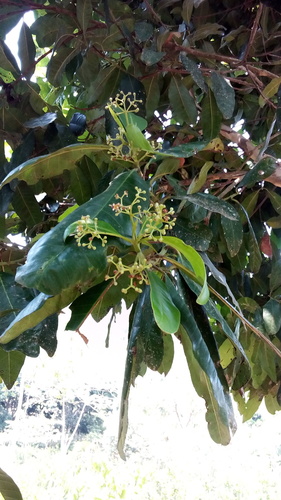


Allspice (Pimenta dioica) is a tree in the Myrtaceae family native to the Greater Antilles and Central America. Its dried green berries provide a single spice whose aroma recalls pepper, cloves, cinnamon and nutmeg.
Read moreAllspice, Jamaica pepper, Myrtle pepper, Pimento and Newspice
Allow a few hours of direct sun per day, preferably morning or evening.
Full sun; tolerates light partial shade


© photo
(c) Pedro, some rights reserved (CC BY-NC), uploaded by Pedro · cc-by-nc
Wikimedia Commons · CC BY-SA or Public Domain
© copyright of the Board of Trustees of the Royal Botanic Gardens, Kew.


Global distribution
Pimenta dioica is native to the Greater Antilles, especially Jamaica, southern Mexico and Central America. Widely cultivated for spice production, it has also naturalized beyond its native range and become locally invasive on several Pacific islands.
- Native4
- Invasive3
- Jamaica
- Mexico
- Guatemala
- Cuba
- Hawaii
- Tonga
- Fiji
Hexagons: regions where the plant occurs. Green dots: native range.1
Identity
Allspice (Pimenta dioica (L.) Merr., 1947), also known as Jamaica pepper, is a tree in the Myrtaceae family native to the Greater Antilles and Central America. 1 3 Its current botanical name reflects a later recombination. Carl Linnaeus first described the species as Myrtus dioica in 1759; Elmer Drew Merrill transferred it to Pimenta in 1947. 1
British merchants coined the English name allspice in the early 17th century after finding the aromas of pepper, cloves, cinnamon and nutmeg in a single dried fruit. The name expresses the idea of one spice recalling several others. 4 The French name quatre-épices follows the same aromatic logic, while piment de la Jamaïque recalls the historically dominant producing country. 7
Recognition
A mature allspice tree grows upright with a narrow, columnar outline, reaching 10–18 m (33–59 ft) in its native range but only 2–4 m (6.5–13 ft) in a large container in temperate climates. 2 6 On older trunks, the pale gray-brown bark flakes away in thin plates, helping distinguish it from other Myrtaceae with similar foliage. 2
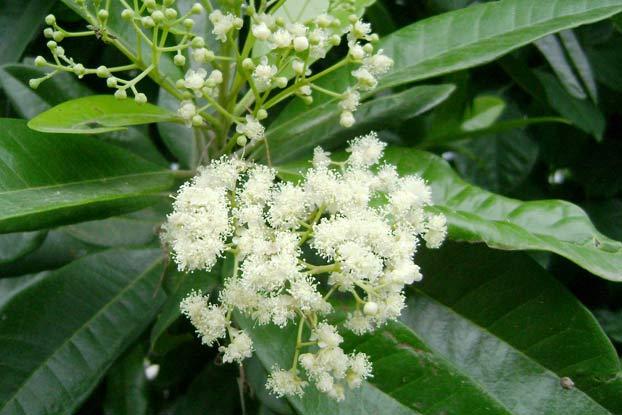
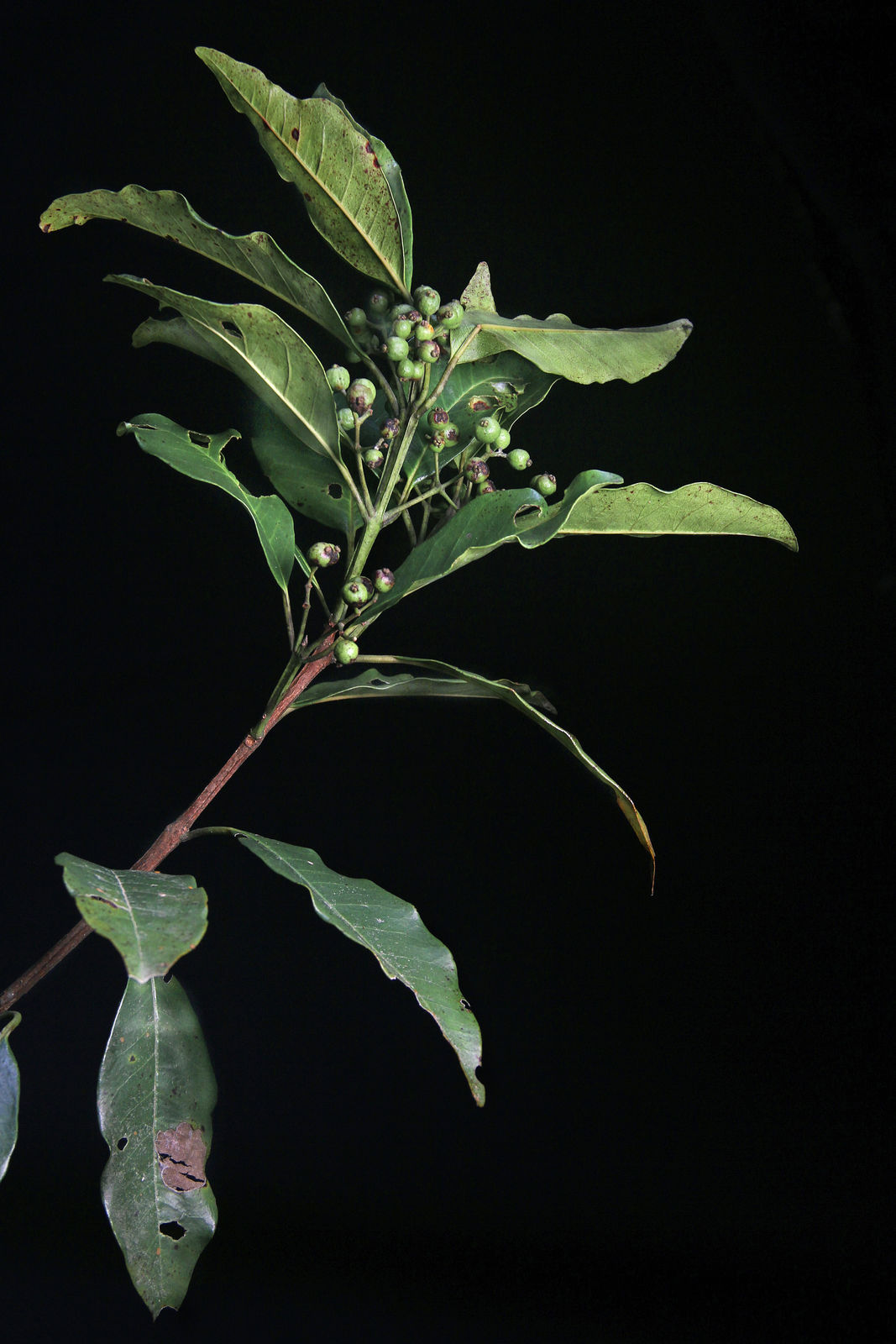
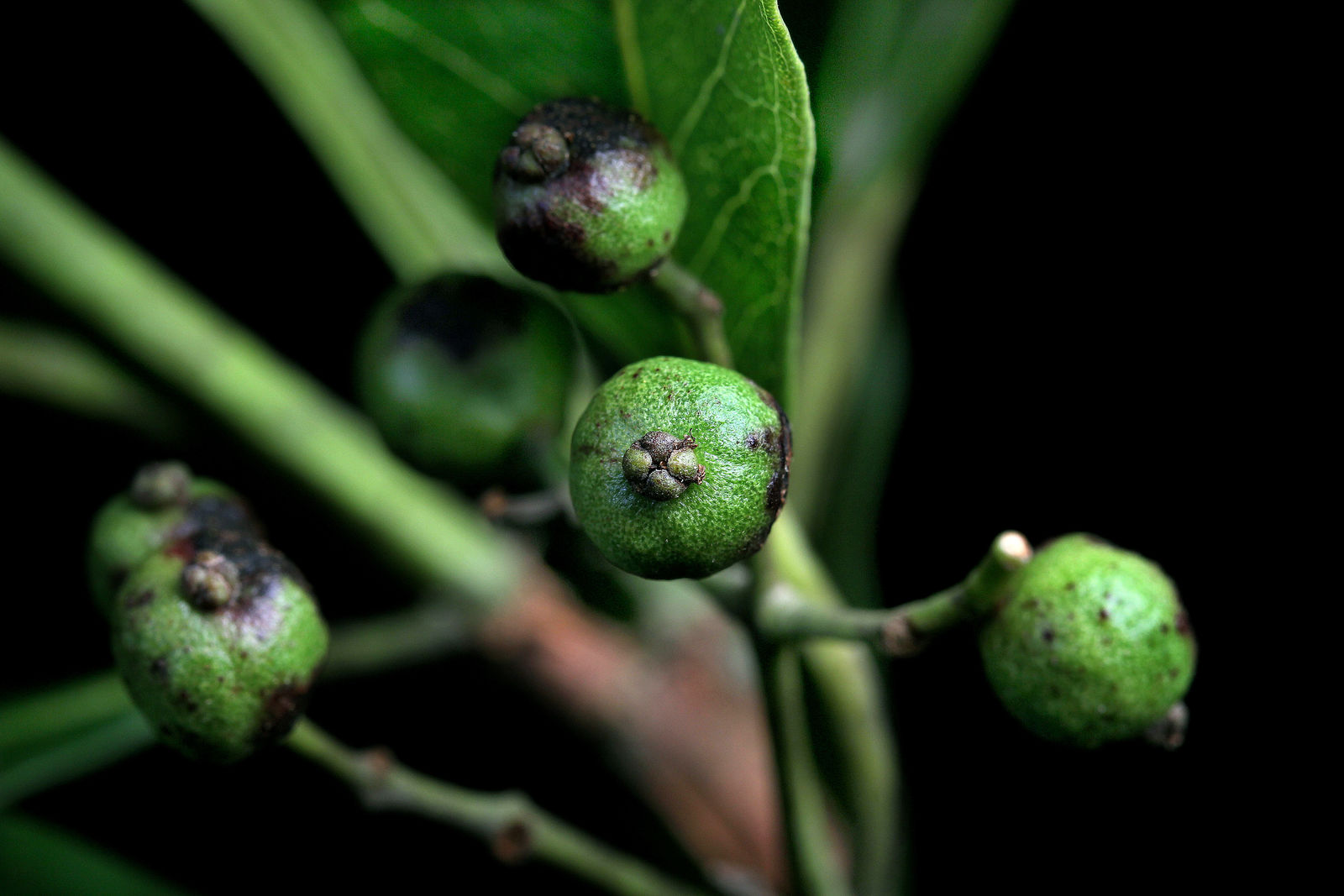
Opposite, leathery and glossy leaves measure 7–15 cm (3–6 in) long. When crushed, they release a distinct clove scent because the leaf tissue contains a high concentration of eugenol. 4 Small, creamy-white flowers cluster in cymes in the upper leaf axils, mainly in summer. 2 The round berry measures 10–15 mm (0.4–0.6 in) and turns from green to reddish brown at full maturity. Harvested green and sun-dried, it becomes the familiar commercial spice; berries left to ripen red on the tree lose most of their aromatic value. 7 2
Useful taxonomy
Several botanical names preceded the adoption of Pimenta dioica. The synonyms most often encountered in older literature and catalogs include:
- Myrtus dioica L., the basionym published in 1759
- Myrtus pimenta L., an older synonym
- Pimenta officinalis Lindl., an older synonym
- Eugenia pimenta (L.) DC., an older combination
- Caryophyllus pimenta (L.) Mill., an older combination
For consistent identification, use the accepted name Pimenta dioica, in the genus Pimenta, which was long confused with the neighboring genus Myrtus. 1 A Mexican form formerly distinguished as Pimenta dioica var. tabasco is now included in the species synonymy, without separate botanical status. 1
Habitat and range
Greater Antillean lowland forests, particularly in Jamaica, form part of the native range, which also includes southern Mexico and Central America. Allspice grows in humid tropical forest on well-drained limestone soils. 1 2 Jamaica has historically been the leading producer. Passage through fruit-eating birds' digestive systems favors seed germination, a mechanism that long limited propagation by competing producers outside the island before techniques were mastered elsewhere. 4
Introductions for spice production have also led to naturalization outside the native range. In Hawaii and other Pacific islands, including Tonga and Fiji, allspice colonizes secondary forest. Birds swallow ripe berries and spread the seeds; dense carpets of seedlings develop beneath fruiting trees. 5 A regional risk assessment identifies the species as capable of causing significant ecological or economic harm in the Pacific. 5 In metropolitan France and French tropical territories such as Réunion, it remains a cultivated collection or conservatory plant, with no naturalization documented to date. 7
Life cycle and reproduction
Separate plants bear male and female allspice flowers: the species is dioecious, so an isolated tree cannot fruit regardless of its care. 7 Summer flowering is followed by green berries that enlarge gradually and are picked before fully ripening. At the green stage, their volatile oil content, including eugenol, is most favorable for drying. 4
Traditional sun-drying takes several days and produces the brown, wrinkled berries sold as spice, resembling large peppercorns. 4 Cultivation relies mainly on seed, which gives vigorous young plants despite slow germination, or air layering, which faithfully reproduces a tree already known to be female and productive. 6
Uses and risks
Dried berries are the main culinary product, used whole or ground in marinades, cured meats, sauces and baked goods. Fresh or dried leaves serve much like bay leaves in Creole cooking. 7 6 Essential oil extracted from leaves and fruit also enters perfumes and traditional Caribbean rubbing preparations such as bay rum. 7
Ordinary culinary use of allspice berries or leaves has no listed toxicity for humans, cats or dogs. 1 The status in horses remains uncertain because specific published data are lacking. Outside measured culinary use, concentrated eugenol essential oil requires the usual precautions for pure essential oils: never apply or ingest it undiluted.
Varieties, look-alikes and related plants
Stable, commercially available ornamental cultivars have not developed in Pimenta dioica as they have in many widely grown houseplants. The notable historical distinction, Pimenta dioica var. tabasco, described a Mexican form now absorbed into the species synonymy, without horticultural selection status. 1
Other aromatic Myrtaceae can cause confusion:
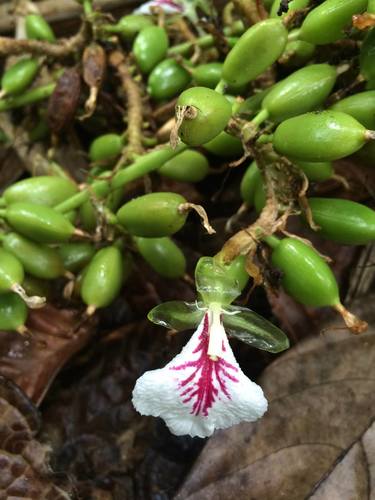
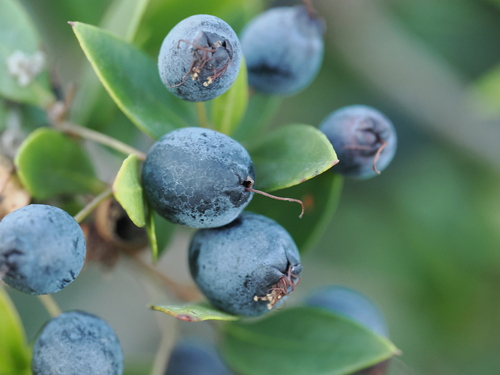
- Myrtus communis, common myrtle, also has fragrant leaves, but they are much smaller;
- Pimenta racemosa, West Indian bay, yields a similar essential oil but is a distinct species;
- Syzygium aromaticum, the clove tree, produces dried flower buds whose scent resembles allspice, without sharing its taxonomic identity.
A clove scent from crushed leaves is therefore insufficient for identification. Flowers on separate male and female trees and round berries that change from green to reddish brown remain the most reliable field characters. 2
Main sources
- Plants of the World Online / Kew, Pimenta dioica (L.) Merr.
- Missouri Botanical Garden Plant Finder, Pimenta dioica
- INPN MNHN, Pimenta dioica (L.) Merr., 1947
- Encyclopaedia Britannica, Allspice
- IUCN Global Invasive Species Database, Pimenta dioica
- Gerbeaud, Allspice (Pimenta dioica)
- French Wikipedia, Allspice
- Florida Plant Atlas (Univ. South Florida), Allspice
Frequently asked questions
Is allspice a chili pepper?
No. Pimenta dioica belongs to the Myrtaceae family, rather than Capsicum, the genus of chili and sweet peppers. Its pepper-related names refer to the resemblance of the dried berries to peppercorns, rather than a botanical relationship.
Why is it called allspice?
The single dried fruit of Pimenta dioica combines aromas recalling pepper, cloves, cinnamon and nutmeg. Allspice describes this complex aroma; it is not a mixture of several spices.
Is allspice toxic to cats and dogs?
No toxicity is listed for ordinary culinary use of the berries or leaves in humans, cats or dogs. Its status in horses remains uncertain because specific published data are lacking.
Why does my allspice tree never fruit?
Pimenta dioica is dioecious, with male and female flowers on separate plants. An isolated tree never fruits; a male and a female plant must grow close to each other.
Can allspice grow outdoors in a temperate climate?
Temperate winters are too cold for this tropical tree, which is sensitive to cold below 10 °C (50 °F). Grow it in a large container outdoors in summer, then move it into a conservatory or heated greenhouse in fall.
Is allspice invasive?
Not within its native range. However, it has naturalized aggressively on several Pacific islands, including Hawaii, where birds disperse its seeds and it colonizes secondary forests.
Similar plants
If you are unsure about a plant’s toxicity, ask a botanist or veterinarian for advice.