
Zebra plant (Tradescantia zebrina, )
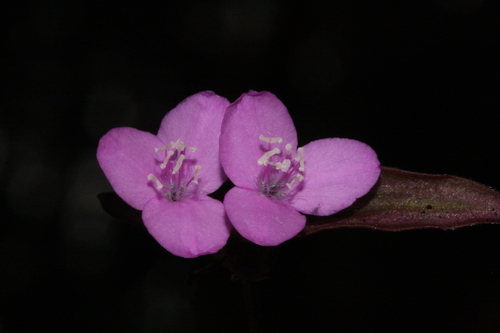
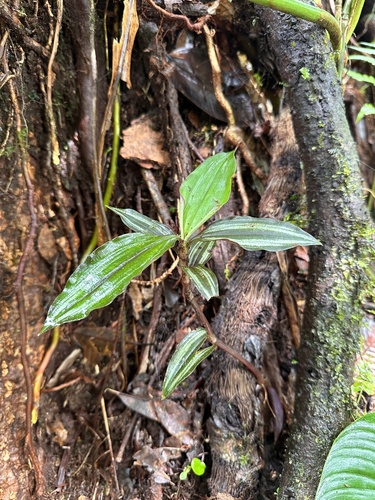
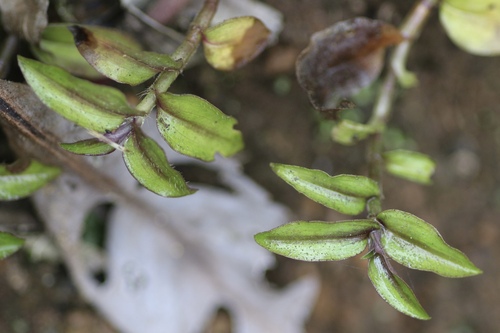
The zebra plant (Tradescantia zebrina), also sold as silver inch plant, is a trailing herbaceous perennial in the spiderwort family, Commelinaceae, native to Mexico and Central America. Its creeping stems carry leaves striped silver and green above and purple beneath; indoors it is grown mostly in hanging baskets for its cascading habit.
Read moreSilver inch plant, Inch plant and Wandering dude
Global distribution
The native range of Tradescantia zebrina runs from southern Mexico through Central America to Colombia. Widely cultivated, the species has naturalized and become locally invasive in several tropical and subtropical regions; those areas of introduction should be kept apart from the native range.
- Native4
- Introduced1
- Invasive2
- Mexico
- Guatemala
- Honduras
- Colombia
- United States (Florida)
- Eastern Australia
- South Africa
Hexagons: sourced regions. Green dots: native range. Statuses according to POWO (Kew).
Identity
The zebra plant (Tradescantia zebrina Bosse, 1849), also called silver inch plant, is a trailing herbaceous perennial in the genus Tradescantia, part of the spiderwort family, Commelinaceae. Several easygoing Tradescantia share the same popular names, while the epithet zebrina points to the silver and green bands that stripe the upper leaf surface. 1 2
Most growers know it as a vigorous houseplant, sold as zebra plant, silver inch plant or simply inch plant. Fleshy stems and foliage that is purple underneath make it an instantly recognizable trailer, valued for its fast growth and forgiving nature. 3 4
Recognition
Look first at the stems: creeping or trailing, fleshy, and quick to root wherever a node touches moist soil. The leaves are oval and pointed, 3–8 cm (1.2–3 in) long, green with two silver bands on top and a strong purple underside. 4 5
One detail helps a great deal with identification. At each node, the leaf base forms a sheath that wraps around the stem, a hallmark of the Commelinaceae. Nodes are evenly spaced, about 2–3 cm (roughly 1 in) apart, which gave rise to the name inch plant. A broken stem oozes a clear, slightly sticky sap. 2 3
The flowers are small and short-lived, with three pink to mauve petals, clustered between two bracts at the stem tips. Grown indoors, the plant stays low at 15–30 cm (6–12 in) tall, but its trailing stems can hang more than 60 cm (24 in) from a hanging basket. 4 6
Useful taxonomy
Bosse described the species as Tradescantia zebrina in 1849. For a long time it sat in a separate genus, Zebrina, now folded into Tradescantia, and several older names still turn up and are worth knowing:
- Zebrina pendula Schnizl.
- Cyanotis zebrina (Bosse) Nees
- Commelina zebrina (Bosse) André
- Tradescantia zebrina var. zebrina
- Tradescantia zebrina var. flocculosa (G.Brückn.) D.R.Hunt
The stable reference remains the accepted scientific name, Tradescantia zebrina, since labels such as Purpusii or Quadricolor refer to horticultural selections, not distinct species or botanical varieties. The synonym Zebrina pendula is still common in older horticultural literature. 1 2
Habitat and range
In the wild, Tradescantia zebrina belongs to the warm, humid regions of southern Mexico and Central America, reaching as far as Colombia. It grows in open woodland understory, on shaded banks, rocks and roadsides, where its creeping stems knit into a dense ground cover. 1 4
Very fast growth and the ability to root from the smallest stem fragment make it an easy species to naturalize outside its home range. In several tropical and subtropical regions, including eastern Australia and South Africa, it has become locally invasive, smothering low-growing plants in damp understory. 5 2
Those areas of introduction should be kept apart from the native American range. Where winters bring frost, the plant is limited to indoor growing or a sheltered spot outdoors, and it poses little risk of naturalizing there. 3 4
Life cycle and reproduction
Like many Commelinaceae, the species bears small, short-lived flowers with three petals, often opening in the morning and withering the same day. Flowering is modest and not the reason anyone grows it; indoors it is irregular at best. 4 6
Its real strength is vegetative reproduction. A broken stem lying on moist ground puts out roots at its nodes and becomes a new plant. That strategy accounts for both its vigor in a pot and how widely it has spread from grower to grower. 5 3
In cultivation, propagation therefore relies mainly on stem cuttings with a node or on division of a dense clump. A cutting taken just below a node and set in water or moist potting mix, somewhere warm with bright indirect light, forms its first roots within one to three weeks. Division simply means splitting a full root ball into several rooted pieces, each of which carries on growing right away. 3 4
Uses and risks
Today Tradescantia zebrina is grown almost entirely as an ornamental: a trailing plant for indoor hanging baskets or, in mild climates, a ground cover and filler for window boxes and containers. The same vigor that makes it easy to grow also drives its invasive behavior in some tropical regions. 2 5
The sap is a mild irritant. On contact it can cause redness and itching on sensitive skin, a dermatitis described in animals as well as people; swallowed, it may bring on mild digestive upset. The ASPCA lists Tradescantia as able to cause dermatitis in cats and dogs, so it makes sense to keep the plant out of reach of pets and young children, and to wear gloves when trimming it. 7 6
Varieties, look-alikes and related plants
Named forms in the trade are not separate species. Purpusii is an almost entirely purple form with little silver variegation; Quadricolor combines green, silver, pink and purple; Burgundy and Silver Plus are horticultural labels built around color. Before buying, check the stems, the firmness of the foliage and whether the bases have gone bare. 3
Common look-alikes include:
- Tradescantia fluminensis, small-leaf spiderwort, with plain green leaves and no silver bands
- Tradescantia pallida, purple heart, upright and purple throughout
- Tradescantia spathacea, which forms a compact rosette with purple undersides
The two silver bands on a green ground, the strongly purple underside and the leaf sheath at each node remain the most reliable ways to confirm that a plant sold as a zebra plant really is Tradescantia zebrina. 4 1
Main sources
- Plants of the World Online / Kew, Tradescantia zebrina Bosse
- Royal Horticultural Society, Tradescantia zebrina, silver inch plant
- Missouri Botanical Garden, Tradescantia zebrina
- Encyclopaedia Britannica, Zebrina pendula (Tradescantia zebrina)
- Plants For A Future, Tradescantia zebrina
- NC State Extension, Tradescantia zebrina
- ASPCA, Wandering Jew (Tradescantia) toxicity entry
Frequently asked questions
Is the zebra plant toxic?
Its sap is a mild irritant to sensitive skin and can cause redness or itching on contact. The ASPCA lists Tradescantia as able to cause dermatitis in cats and dogs, so keep the plant out of reach of pets and young children.
Why is my zebra plant going bare at the base?
Stems lose their lower leaves with age or when light runs short. Pinching the tips regularly thickens the clump, and potting up a young cutting gives you a compact plant again.
Why are the colors on my Tradescantia zebrina fading?
The silver bands and purple undersides fade in shade. Bright indirect light with a little gentle sun brings back the contrast; harsh midday sun, on the other hand, dulls the foliage.
How do you propagate a zebra plant?
Take a stem with at least one node and set it in water or moist potting mix. Roots appear within one to three weeks. That ease of propagation explains why the plant is passed around so widely among growers.
Which plants are mistaken for Tradescantia zebrina?
The usual mix-ups involve small-leaf spiderwort (Tradescantia fluminensis) and purple heart (Tradescantia pallida). Silver bands on a green ground and a purple underside remain good markers.
Is the zebra plant invasive?
Where winters bring frost, it stays a houseplant. In several tropical and subtropical regions, though, its fast growth and stem fragments that root readily make it a locally invasive species.
How much light does Tradescantia zebrina need?
Bright indirect light gives the best foliage, and a little gentle morning sun deepens the colors. In shade the plant gets leggy and loses its silver bands.
Similar plants

Botanical data compiled from reference sources (RHS, Kew Gardens, POWO). This profile is for guidance only and is not a substitute for advice from a botanist or veterinarian if you have concerns about toxicity.