
Baby rubber plant (Peperomia obtusifolia, )
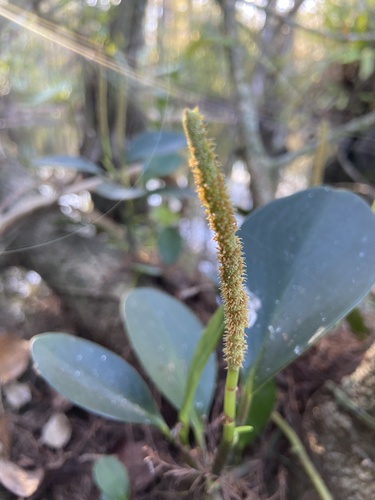
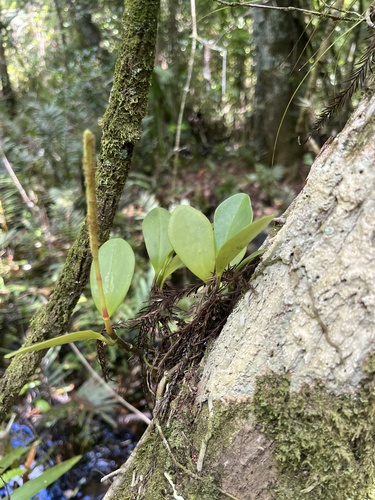
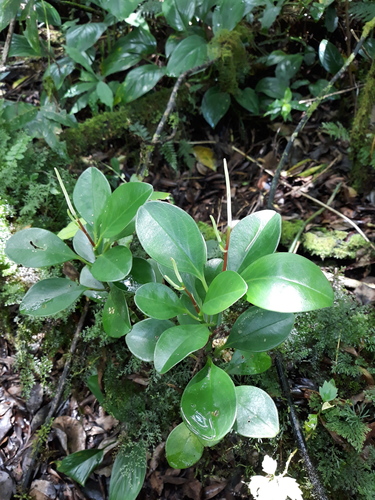
The baby rubber plant (Peperomia obtusifolia) is a semi-succulent herbaceous perennial in the pepper family, Piperaceae, native to tropical America. Compact and bushy, it carries thick, rounded, glossy leaves and remains one of the easiest houseplants to grow, non-toxic to cats and dogs.
Read moreAmerican rubber plant, Pepper face and Blunt-leaved peperomia
Global distribution
The native range of Peperomia obtusifolia runs from southern Mexico through Central America and the Caribbean to northern South America, and is sometimes reported as far as Florida. Widely grown as a houseplant, it has spread far beyond that range; those regions of introduction should be kept apart from its American native range.
- Native7
- Introduced1
- Mexico
- Guatemala
- Costa Rica
- Panama
- Colombia
- Venezuela
- Cuba
- United States (Florida)
Hexagons: sourced regions. Green dots: native range. Statuses according to POWO (Kew).
Identity
The baby rubber plant (Peperomia obtusifolia (L.) A.Dietr.) is a semi-succulent herbaceous perennial in the genus Peperomia, part of the pepper family, Piperaceae. Its epithet obtusifolia means "blunt-leaved" and describes the rounded tip of the leaf blade. 1 2
Most growers know it as a small tabletop or desk houseplant, sold as baby rubber plant, American rubber plant or pepper face. Its thick, smooth and very glossy leaves have earned it a reputation as an easy plant, reinforced by the Award of Garden Merit it received from the Royal Horticultural Society. 3 4
Recognition
Foliage is the first giveaway: fleshy, semi-succulent leaves, oval to elliptic, with a rounded, almost blunt tip, 5–15 cm (2–6 in) long and a shiny deep green. The veins barely show on the upper surface, which makes the blade look even smoother. 4 5
The stems are thick and water-filled too, often flushed reddish, and form a dense, compact clump. The plant stays low, rarely more than 30 cm (12 in) tall in a pot, with a similar spread. That bushy habit sets it apart from upright houseplants such as ficus. 5 3
Flowering takes the typical Piperaceae form: slender, upright, greenish white spikes up to about 12 cm (5 in) long. These catkin-like inflorescences are inconspicuous and hardly ornamental, but they confirm the plant's place in the pepper family. 4 2
Useful taxonomy
Albert Dietrich published the name Peperomia obtusifolia (L.) A.Dietr. in 1831, based on a Linnaean basionym. The genus Peperomia is huge, and several old or horticultural names are still in circulation; the main synonyms and historical names worth knowing are:
- Peperomia obtusifolia var. obtusifolia
- Peperomia obtusifolia Miq. nom. illeg.
- Peperomia obtusifolia var. clusiifolia (Jacq.) C.DC.
- Peperomia obtusifolia var. cuneata (Miq.) Griseb.
- Peperomia obtusifolia f. pusilla Miq.
The stable reference is the accepted scientific name, Peperomia obtusifolia, because cultivar names such as Variegata or Greengold refer to horticultural selections, not to distinct species or botanical varieties. 1 6
Habitat and range
Tropical America is home to Peperomia obtusifolia, from southern Mexico through Central America and the Caribbean to northern South America. There it grows in humid, shaded understory, from the lowlands to middle elevations, on cool soils rich in organic matter. 1 4
Like many peperomias, it often lives as a semi-epiphyte, settling at the base of trunks, on rotting stumps or in humus-filled crevices without parasitizing its host. That habit explains its modest root system and its liking for light, free-draining mixes. 5 7
As a popular houseplant, the species has traveled far beyond its range; it is reported in Florida, at the northern edge of its natural distribution. Those areas of introduction or cultivation should be kept apart from its American native range. 2 1
Life cycle and reproduction
Established plants send up one or more greenish white spikes above the foliage. These dense inflorescences, characteristic of the Piperaceae, carry tiny petal-less flowers; they appear mostly in spring and summer and go largely unnoticed indoors. 4 2
Propagation is one of the species' great strengths in cultivation, because it is remarkably easy. A stem cut just below a node roots readily in water or moist mix. The plant also accepts leaf cuttings: a healthy leaf kept with its stalk and set on a light mix can produce a new plant. 5 3
Either way, warmth and bright indirect light help the first roots form within three to six weeks. Because the root system stays small, young plants can then grow for a long time in modest pots, as long as the mix never becomes waterlogged. 7 4
Uses and risks
Its use is essentially ornamental: a small indoor foliage plant or, in tropical climates, a groundcover for shaded understory. Fleshy leaves, a compact habit and tolerance of moderate light make it a common choice for offices and apartments. 3 4
On the safety side, it has a rare advantage: the ASPCA lists the baby rubber plant as non-toxic to cats and dogs. No particular symptoms are expected after contact or ingestion, which makes it one of the safest plants for a household with pets or young children. That is still no reason to let a pet make a habit of chewing the leaves. 8 5
Varieties, look-alikes and related plants
Variegated forms are not separate species. Variegata and Albomarginata have leaves edged in cream or white; Greengold and Golden Gate carry golden yellow variegation that brightens in good light. Before buying, check the cultivar name, how firm the stems are and that the base shows no blackening. 3
Common look-alikes include:
- Peperomia clusiifolia, with larger leaves often edged in red
- Peperomia caperata, with puckered, deeply veined leaves of a very different look
- Peperomia argyreia, the watermelon peperomia, with silver-striped leaves
A rounded leaf tip, thick fleshy leaves and reddish stems remain the most reliable clues that a plant sold as a peperomia really is Peperomia obtusifolia. 4 1
Main sources
- Plants of the World Online / Kew, Peperomia obtusifolia (L.) A.Dietr.
- Royal Horticultural Society, Peperomia obtusifolia
- Missouri Botanical Garden, Peperomia obtusifolia
- North Carolina State Extension, Peperomia obtusifolia
- Plants For A Future, Peperomia obtusifolia
- Encyclopaedia Britannica, Peperomia
- ASPCA, Baby rubber plant (Peperomia obtusifolia) non-toxic entry
- International Plant Names Index, Peperomia obtusifolia (L.) A.Dietr.
Frequently asked questions
Is Peperomia obtusifolia toxic to cats and dogs?
No. The ASPCA lists the baby rubber plant as non-toxic to cats and dogs. It is one of the safest houseplants to keep in a home with pets.
Why are my Peperomia obtusifolia leaves going soft?
Soft or drooping leaves almost always point to overwatering. Let the potting mix dry out, check that the pot drains, and water less often to prevent rot.
Is Peperomia obtusifolia a succulent?
It is semi-succulent. Its thick leaves and stems store water, but it remains a plant of the humid forest floor that dislikes harsh sun, unlike true full-sun succulents.
How do you propagate Peperomia obtusifolia?
Propagation is very simple. Take a stem with a node, or a leaf with its stalk, and set it in water or moist mix. Roots appear in three to six weeks in warm conditions.
How much light does Peperomia obtusifolia need?
Bright but indirect light gives the densest foliage. It tolerates partial shade at the cost of looser growth, and direct sun bleaches its fleshy leaves.
How big does Peperomia obtusifolia get?
In a pot it forms a compact clump 15 to 30 cm (6 to 12 in) tall, rarely more. It is a small plant, well suited to a table, a shelf or a desk.
Which plants are mistaken for Peperomia obtusifolia?
Mix-ups mostly involve Peperomia clusiifolia and other fleshy-leaved peperomias. The rounded leaf tip and reddish stems remain good clues.
Similar plants

Botanical data compiled from reference sources (RHS, Kew Gardens, POWO). This profile is for guidance only and is not a substitute for advice from a botanist or veterinarian if you have concerns about toxicity.