
Fosteriana tulips (Tulipa fosteriana, )
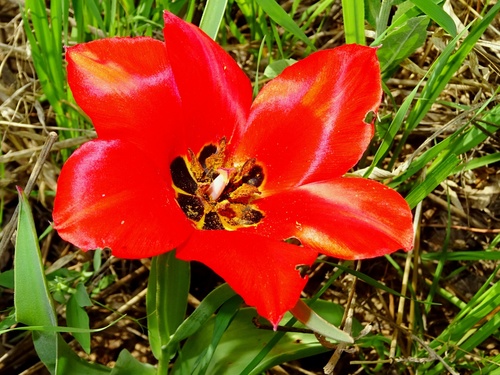


Fosteriana tulips (Tulipa fosteriana W.Irving) are robust tulips in the Liliaceae family. The botanical species is native to Central Asia, from the Pamir Mountains to Afghanistan according to POWO. In gardens, the associated Fosteriana or Emperor tulips are known for large early flowers and bulbs that persist better than many border tulips.
Read moreFosteriana tulips, Foster's tulip and Emperor tulip
Allow a few hours of direct sun per day, preferably morning or evening.


© photo
(c) Nasser Halaweh, some rights reserved (CC BY), uploaded by Nasser Halaweh · cc-by
Wikimedia Commons · CC BY-SA or Public Domain
© copyright of the Board of Trustees of the Royal Botanic Gardens, Kew.


Global distribution
POWO records a Central Asian native range, from the Pamir Mountains to Afghanistan, and describes the species as a bulbous geophyte of the temperate biome. In metropolitan France, it is treated as a cultivated plant that may persist in gardens, rather than as invasive.
- Native5
- Central Asia
- Pamir Mountains
- Afghanistan
- Tajikistan
- Uzbekistan
Hexagons: regions where the plant occurs. Green dots: native range.1
Identity
Fosteriana tulips (Tulipa fosteriana W.Irving, 1906) take their botanical reference from a true species, rather than merely a catalog name. POWO accepts the species, published in 1906 in The Gardeners' Chronicle, and records a Central Asian native range from the Pamir Mountains to Afghanistan. 1
GBIF records the same scientific name, species rank, Liliaceae family and publication date of 1906. Tulipa fosteriana is therefore a stable botanical name, while cultivars sold under the Fosteriana label still require a more precise identification. 2 1
The common name Foster's tulip reflects the epithet fosteriana. In horticulture, related forms are often sold as Fosteriana tulips or Emperor tulip selections. The RHS distinguishes the species Tulipa fosteriana from the Fosteriana Group, whose cultivars resemble it in their broad leaves and large spring flowers. 3
Keeping those categories distinct avoids treating every Emperor cultivar as a wild plant or reducing the botanical species to an unnamed red garden tulip. The binomial establishes the species identity; group and cultivar names describe the horticultural selection more precisely.
Recognition
A tunicated bulb produces broad, lance-shaped leaves in spring, green to blue-green in color. Several Fosteriana cultivars have purple or bronze leaf markings. The RHS describes the species as a bulbous perennial with broadly lance-shaped leaves and bowl-shaped, lightly scented crimson-red flowers with a darker basal mark. 3
For garden planning, the RHS places mature height in the 0.1–0.5 m (4–20 in) range and gives about 45 cm (18 in) for T. fosteriana. Large flowers in the group can reach roughly 12 cm (5 in) across, giving a stronger visual effect than many small species tulips. 3
Although the typical species is red, the horticultural group covers a wider palette. The RHS describes white, yellow and red shades for the group; cultivar profiles such as 'Sweetheart' and 'Juan' illustrate yellow, white, orange and red flowers, as well as bronze-marked foliage. 3 3
Reliable identification in a garden needs more than color. An early large red bowl may suggest the species, while a white flower such as 'Purissima', yellow-and-white 'Sweetheart' or orange-red 'Juan' points toward the Fosteriana Group and a particular cultivar. 3
Taxonomy and names
Both POWO and GBIF accept Tulipa fosteriana W.Irving, placing it in Tulipa, Liliaceae and Liliales. GBIF also lists synonyms such as Tulipa affinis Botschantz. and Tulipa victoris Vved., which help interpret old catalogs and botanical lists. 1 2
Tulip classification has a difficult history. Christenhusz and colleagues' study of Tulipa covers cultural history, molecular analyses and an infrageneric revision. For T. fosteriana, the practical point is to distinguish a species, a horticultural group and a cultivar name. 8
Group number (13) is the RHS designation for Fosteriana. These tulips often have purple-marked leaves and springtime bowl-shaped flowers in white, yellow or red, with a contrasting color at the tepal bases. 3
Names such as Red Emperor, White Emperor, Purissima, Sweetheart and Juan belong to horticultural naming. They help identify the desired garden display, but do not replace the botanical name Tulipa fosteriana or the need to read the complete label.
Origin and habitat
From Central Asia around the Pamir Mountains to Afghanistan lies the native range given by POWO. The same source describes Tulipa fosteriana as a bulbous geophyte of the temperate biome. Its visible cycle fits that description: a brief spring season above ground followed by a long underground rest. 1
Pacific Bulb Society describes a robust Central Asian tulip growing in deep, humus-rich pockets between rocks at about 1,700 m (5,600 ft) elevation. That habitat helps explain the value of well-drained but fertile soil: roots need air, moisture during growth and mineral reserves. 6
In metropolitan France, T. fosteriana is treated here as a cultivated garden plant. The sources used do not establish invasiveness in France. Bulbs may persist, divide and return for years in suitable soil, but garden persistence alone does not amount to invasive status or establish a status for other countries. 3 1
Garden naturalizing is therefore conditional on the site: full sun, good drainage, foliage retained until it yellows and summers without waterlogging. Fosteriana tulips often persist better than border tulips grown as annual displays, but remain sensitive to heavy, wet soil. 3 4
Life cycle, flowering and naturalizing
Dry dormant bulbs are planted in fall. The RHS's September-to-November advice applies to Northern Hemisphere conditions; use the corresponding local fall season elsewhere. Plant two to three times the bulb's height deep, with RHS profiles for several Fosteriana tulips also giving 10–15 cm (4–6 in). 4 3
Aboveground growth occupies only a short period. Leaves emerge in late winter or early spring, flowering follows in early to mid-spring and the foliage then yellows. This is a normal part of the bulb's reserve cycle, rather than automatic evidence of failure. Cutting leaves too soon greatly reduces the chance of another good flowering. 4
Compared with many border tulips, specialist tulips close to wild species are more likely to naturalize and multiply in gardens, according to the RHS. Its T. fosteriana profile also notes that species tulips may remain in place for several years without annual lifting when conditions suit them. 4 3
Relatively dry summers favor successful dormancy. The RHS notes that lifting, drying and storing tulip bulbs during summer can improve repeat flowering by imitating the hot, dry summers of their natural habitat. For Foster's tulip, this approach fits its rocky mountain setting. 4 6
Growing in gardens and pots
Successful planting starts with full sun, fertile well-drained soil and protection from strong winds and excessive winter wet. The RHS gives these conditions for Tulipa fosteriana and adds that species tulips can stay in the ground for several years. 3
Chalky, loamy, sandy or even clay soil can work if drainage is effective. Heavy ground that stays saturated in winter is the real problem. In containers, choose a deep pot with drainage holes and peat-free potting mix combined with grit, then water without waterlogging it. 4 3
During active growth, border tulips often need no extra water if rain keeps the soil moist. The RHS advises watering borders after more than two or three dry weeks, aiming for moisture without saturation. Pots require closer checks because their mix can swing quickly between dry and soaked. 4
Feed bulbs intended to remain in place while they are growing. The RHS recommends a high-potassium liquid fertilizer from early spring, March in its UK calendar, to support the following year's flowers, stopping when the leaves yellow. Bulbs used only for a seasonal display do not need the same continuing care. 4
Removing spent flowers and fallen petals limits seed production and damp places where disease can develop. Leave green leaves intact so they can replenish bulb reserves. Separate offsets in summer, when the plant is dormant. 3 4
Diseases, pests and common failures
Tulip fire, caused by Botrytis tulipae, is a key disease to recognize. The RHS describes distorted, twisted, browned leaves, sometimes with gray fungal growth, together with spots on flowers. Wet springs and crowded planting favor the disease. 5
The main preventive measures are nonchemical: inspect bulbs before planting, discard bulbs with rot or black sclerotia, remove infected plants promptly, space bulbs adequately and avoid replanting tulips on a contaminated site for several years. 5
For T. fosteriana, the RHS also lists slugs, aphids, stem and bulb nematodes, bulb-eating squirrels, tulip fire and rot in poorly drained soil. These risks make bulb quality and drainage more useful priorities than elaborate care routines. 3
A missing plant in the following year does not always mean disease. Common causes include a weakened bulb, foliage removed too early, an overly wet summer, too little sun or bulbs eaten by animals. Fosteriana tulips may be more forgiving than some border tulips, but cannot compensate for saturated soil.
Toxicity and precautions
Tulips are not food plants. The RHS warns that every part can cause digestive upset if eaten, and bulb handling can cause allergic skin reactions in some people. 4 3
For animal exposure, the ASPCA lists Tulipa spp. as toxic to dogs, cats and horses, with tulipalin A and B as the toxic principles and the greatest concentration in the bulb. Reported signs include vomiting, depression, diarrhea and excessive salivation. 9
An ASPCApro veterinary article on spring bulbs adds that Tulipa contains irritant or allergenic compounds, including tulipalin A and B and tuliposide A, concentrated in the bulb. It associates tulips with contact dermatitis, vomiting and diarrhea. 10
Wear gloves when handling many bulbs, store bulbs beyond the reach of dogs, cats, horses and children, and call a veterinarian after animal ingestion. A cut flower contains lower concentrations than a bulb, but that does not make it edible.
Cultivars and look-alikes
The Fosteriana Group links a botanical species with garden selections. The RHS describes the typical species as crimson red, while cultivars range through white, yellow, orange, red, pink and purple. Large cup-shaped flowers, early bloom and broad leaves remain the most useful shared features. 3
Creamy-white Purissima, also sold as White Emperor, is a familiar example. Sweetheart has yellow-and-white flowers; Juan combines orange-red flowers with a yellow base and bronze-marked leaves. These names denote cultivars rather than species. 3
Chicago Botanic Garden describes 'Flaming Emperor' as a very early Fosteriana tulip with pink-flamed white flowers, a relatively short habit and broad foliage. It also emphasizes full sun, well-drained soil and protection from animals that dig up or eat bulbs. 7
Other species tulips are the main look-alikes: Tulipa kaufmanniana is shorter and often called a water lily tulip; Tulipa greigii frequently has strongly marked leaves; Tulipa sylvestris is yellow and more suited to naturalizing in grassy settings; and Tulipa gesneriana covers large garden tulips of complex parentage. 4 8
Read a bulb label in full: species, group, cultivar, bulb size and flowering period all help define the purchase. “Fosteriana” alone indicates a horticultural group; “Tulipa fosteriana 'Juan'” or “Tulipa 'Purissima' (13)” gives a much more precise identity.
Main sources
- Plants of the World Online / Kew, Tulipa fosteriana W.Irving
- GBIF Backbone Taxonomy, Tulipa fosteriana W.Irving
- Royal Horticultural Society, Tulipa fosteriana Fosteriana tulip
- Royal Horticultural Society, How to grow tulips
- Royal Horticultural Society, Tulip fire
- Pacific Bulb Society, Tulipa species two
- Chicago Botanic Garden, Tulipa fosteriana Flaming Emperor
- Christenhusz et al. 2013, Tiptoe through the tulips
- ASPCA, Tulip toxicity entry
- ASPCApro / Veterinary Medicine, Spring-blooming bulbs
Frequently asked questions
Is Tulipa fosteriana a species or a garden group?
Both levels exist. POWO accepts Tulipa fosteriana W.Irving as a species; the RHS also uses Fosteriana Group for cultivars that resemble it or descend from it.
What is the natural color of Tulipa fosteriana?
The RHS describes the typical species with crimson-red flowers and a darker basal mark. Fosteriana cultivars can be white, yellow, orange, pink or purple.
Why are they called Emperor tulips?
Emperor is a commercial name applied to several Fosteriana cultivars, such as Purissima or Red Emperor. It does not replace the scientific name or the cultivar name.
Do Fosteriana tulips return every year?
They can persist for several years in full sun, well-drained soil and fairly dry summer dormancy. Waterlogged soil greatly reduces that persistence.
When should I plant the bulbs?
Plant dormant bulbs in fall, pointed end up, about 10–15 cm (4–6 in) deep or two to three times their height. Bulbs should be firm and free of mold.
Is Tulipa fosteriana toxic to animals?
Yes. The ASPCA lists Tulipa spp. as toxic to cats, dogs and horses, with toxins most concentrated in the bulb.
How should I deal with tulip fire?
Remove affected plants, discard suspect bulbs, avoid crowded planting and keep tulips off a contaminated site for several years.
Similar plants





If you are unsure about a plant’s toxicity, ask a botanist or veterinarian for advice.