
Care guide
Peace lily care
Spathiphyllum wallisii
Keep your peace lily between 12 and 24 °C in bright, indirect light. Water when the top few centimetres of potting mix have dried, then let the pot drain. If the leaves droop, check the root ball before adding water. For new white spathes, look first at light and the maturity of the clump.
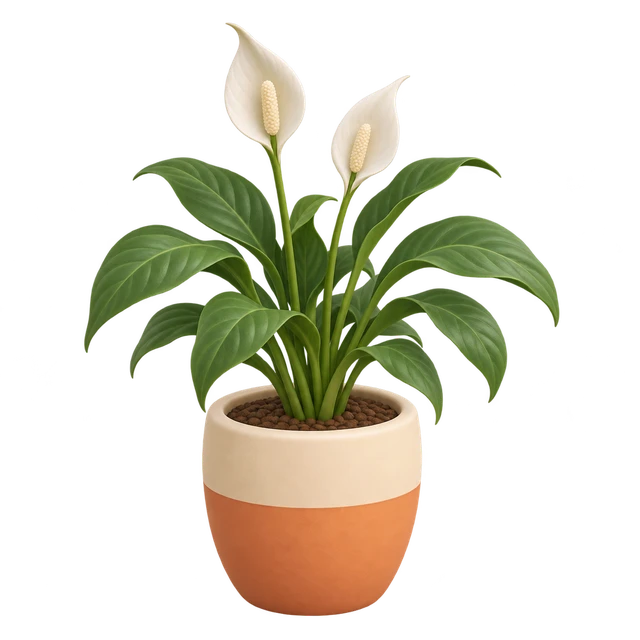
When should you water a peace lily?
Water when the top few centimetres of potting mix have dried, then let the pot drain. A peace lily (Spathiphyllum wallisii) likes a moist root ball, with air around its roots. From April to October, check for this drying before each watering; in winter, water less often as growth slows.1
17 cL every 11 days
When the top few centimetres have dried; water less often in winter.
Lift the pot and feel the potting mix. A light pot and a dry surface suggest thirst. A heavy pot that is still damp needs more time: in persistently saturated soil, roots can rot and the leaves can droop despite the available water.2 Read the position of the leaves alongside the condition of the root ball.
A truly thirsty plant may perk up within a few hours of a thorough watering. Tips or edges damaged during that dry spell may stay brown. Repeated wilting also leaves its mark on the foliage: water once the surface has dried, before the whole clump collapses.3
How should you water it?
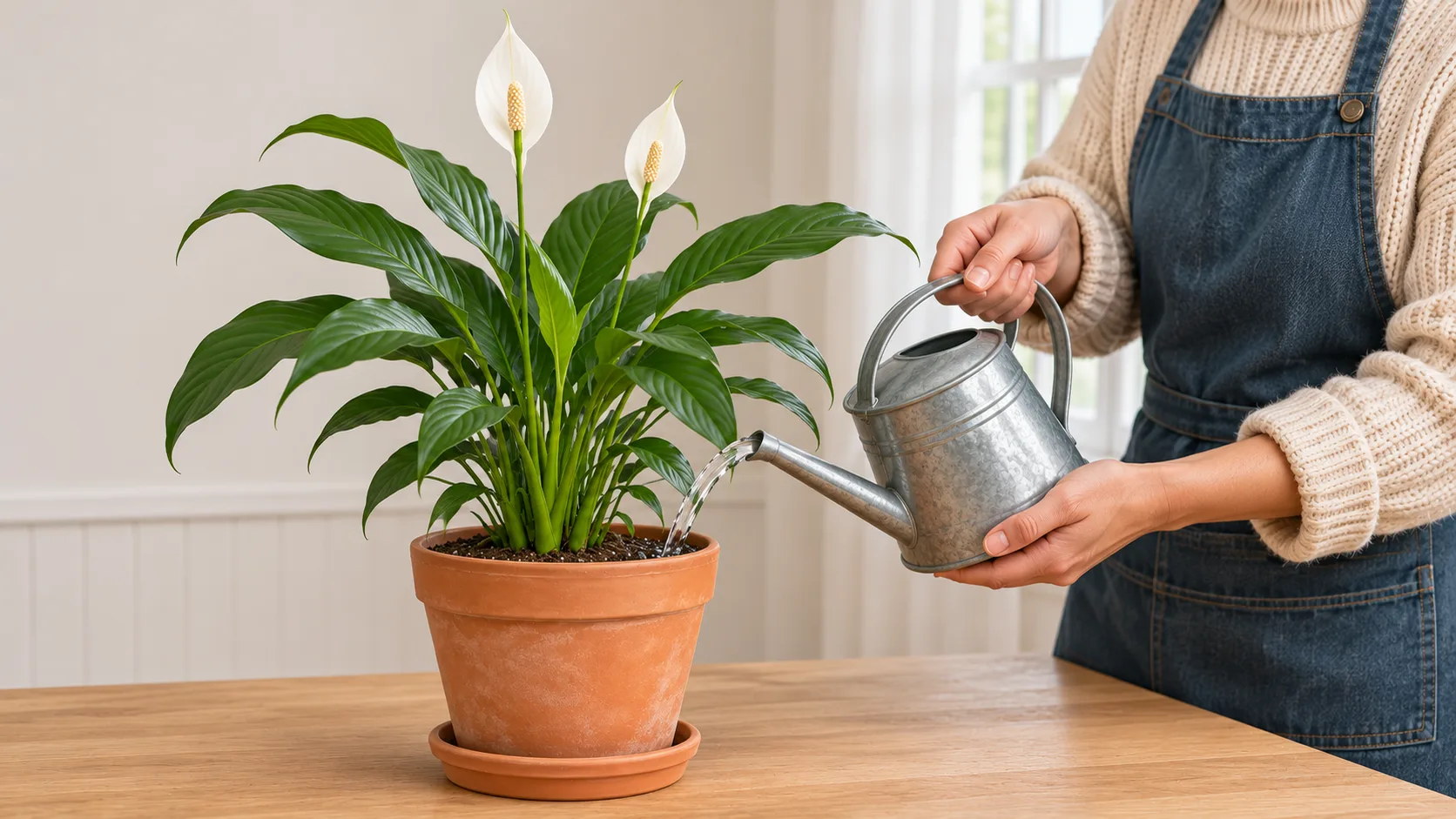
Take the nursery pot out of its outer pot and water evenly over the potting mix. Let the excess drain away, then empty the outer pot before putting the plant back. The root ball stays moist while the bottom of the pot remains clear of standing water.4
Use rainwater or filtered water where possible: fluoride in some tap water can damage the leaves.1 Brown tips can also result from fertiliser salts, sun or dry air; compare these causes before changing your whole routine.5 A neighbouring pothos has its own watering needs: check each root ball separately.
Where should you put a peace lily?
Place it near a window in bright, indirect light, protected from summer sun. A sheer curtain can filter the rays reaching the leaves. In deep shade, the plant survives but grows very slowly and rarely flowers.1
Look at the light on the leaves: a balcony above the window or a neighbouring building reduces it. If the exposed side turns pale or scorches, filter the sun. Paling caused by excess light can resemble a nutrient deficiency; extra fertiliser would then make matters worse.3
Give the pot a quarter turn at each watering to keep growth even.1 A peace lily spreads out from its base; a large climbing plant such as a monstera needs a different arrangement around the window.
How can you keep the leaves healthy?
Keep the foliage away from radiators and cold draughts. A bathroom with a window can suit this plant, which appreciates moderate humidity.2
Inspect the leaf undersides and stalks: mealybugs often shelter there.5
When and how should you repot a peace lily?
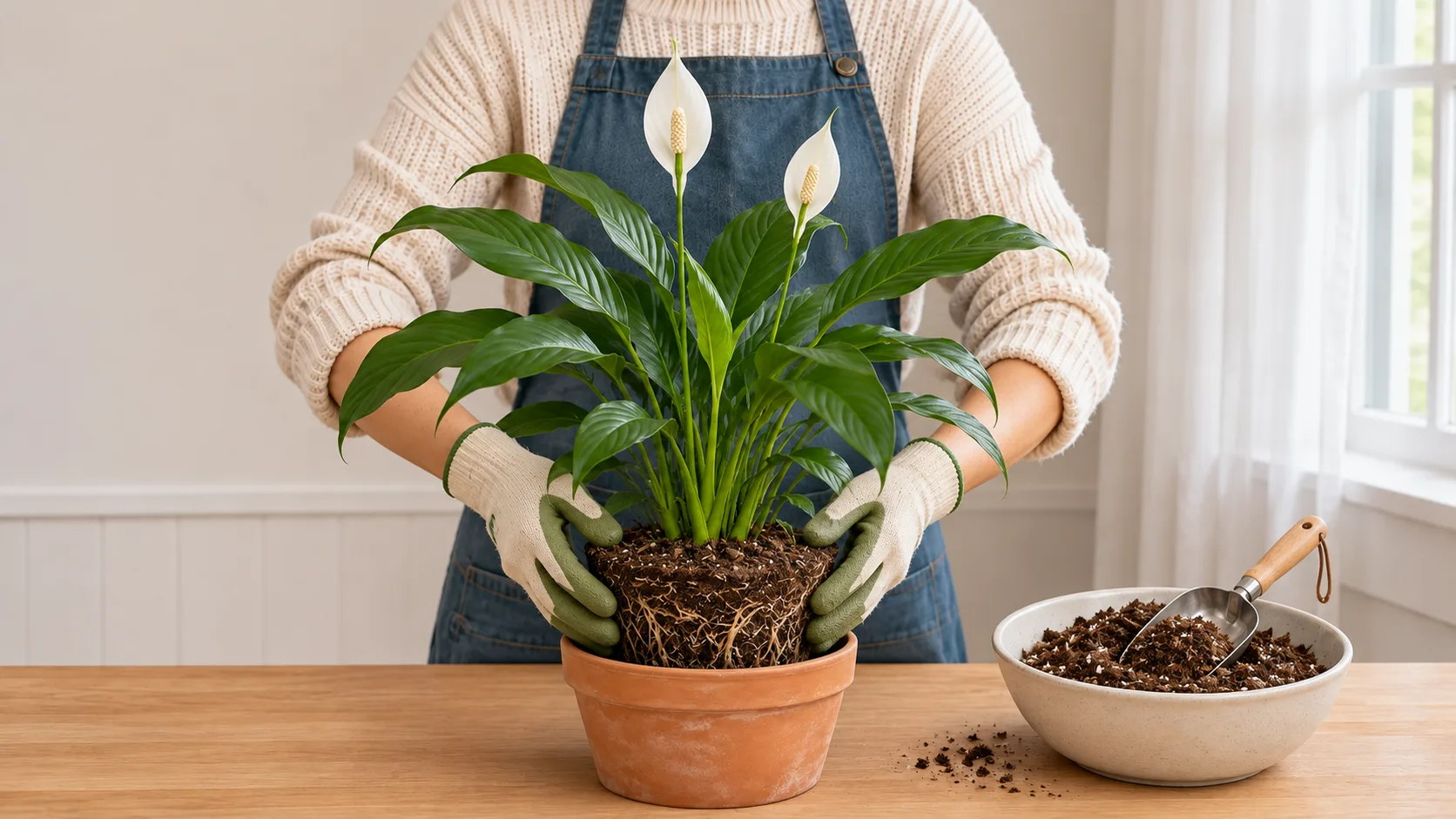
Repot in spring when roots have densely filled the pot, using a container only slightly larger. After purchase, a plant can often stay in its original pot for at least 1 to 2 years. Gently slide out the root ball to check the roots before deciding.1
- When to repot
- When roots fill the potSource: Royal Horticultural Society — Spathiphyllum wallisii
- The new pot
- 2,5 to 5 cm widerDiameter and depth <25 cm; increase ≤1/3Source: Royal Horticultural Society
A tightly packed root ball, or potting mix that dries very quickly after watering, indicates a lack of space.1 If repotting is needed, February or March offers a late-winter window; adjust this to the return of growth in your home.5
For an existing pot less than 25 cm (about 9.8 in) in diameter and depth, choose one 2.5 to 5 cm (about 1 to 2 in) wider and deeper, increasing its size by no more than one-third: this is the general guideline for repotting container plants.6 A peace lily also needs just a small increase in volume: a large container around a small root ball stays wet for too long.1
Mix 3 parts peat-free potting mix with 1 part perlite, or 75% and 25%.1 Perlite helps keep the mix open. Choose a pot with drainage holes, position the root ball and fill around it. Water until it runs out through the holes, then let the pot drain.6
What fertiliser does a peace lily need?
Apply a balanced liquid fertiliser once a month during active growth, at one-quarter of the recommended strength. Monthly feeding suits Spathiphyllum wallisii; dilution limits root and leaf-tip burn.75 Feed during the brighter months, from April to October.1
- Fertilizer
- BalancedLiquidSource: Royal Horticultural Society — Spathiphyllum wallisii
- Feeding
- April to OctoberSource: Royal Horticultural Society — How to grow peace lilies
- Frequency
- One feed per monthindoorsSource: Royal Horticultural Society — Spathiphyllum wallisii
- Avoid
- Exceeding the dose on the labelSource: NC State Extension Gardener Plant Toolbox — Spathiphyllum
A balanced fertiliser supplies the main nutrients without heavily favouring any one of them. Measure the fertiliser with its measuring cap or scoop, then reduce the amount to one-quarter. Products vary in concentration, so calculate the dilution from the instructions on that particular label.5
Between feeds, let water pass through the potting mix and drain freely. Leaching limits salt build-up. Burnt tips and roots after repeated feeding suggest fertiliser burn.5 Stop feeding and check the drainage.
Should you cut off leaves and flowers?
Cut faded leaves and spent flower stalks at the base, wearing gloves. Removing faded growth is enough to tidy the clump. The sap can irritate skin; keep the cut material away from children and animals.1
Follow the leaf stalk, which joins the leaf to the base, or the flower stalk down to where it starts. Move the faded part clear before cutting to protect the healthy green leaves beside it. A spathe that turns green can still look attractive; wait until it fades before removing the stalk.12
What temperatures can a peace lily tolerate?
Keep it between 12 and 24 °C indoors, away from cold draughts. The range suits peace lilies grown as houseplants. In mainland France, a peace lily spends winter indoors, in a bright room with moderate temperatures.1
Temperatures for peace lily
In °C, thresholds given by the sources.
- Some cultivars may suffer damage7,2 °C
- Ideal: 12 to 24 °C
- Moderate room temperature: 12 to 24 °C
If you put it outdoors in shade for summer, watch night temperatures: the species' H1b rating means summer outdoor cultivation with minimum temperatures of 10 to 15 °C.7 Bring it inside before autumn temperatures fall, and protect it during winter transport too.1
Cold can cause black patches and root damage; some cultivars show damage at around 7.2 °C.3 Leaves resting against cold glass deserve as much attention as the room thermometer. Move the pot away from a window opened for ventilation.
How big does a peace lily grow?
Indoor peace lilies range from small clumps to large plants around 90 cm (about 35.4 in) tall and wide, depending on the variety. Larger forms are common in indoor cultivation.5 The botanical species Spathiphyllum wallisii stays smaller: 10 to 50 cm (about 3.9 to 19.7 in) in height and spread.7
- Mature height
- 10 to 50 cm
- Spread
- 10 to 50 cm
- Growth
- Slow to moderate indoors
Check the cultivar name before buying. ‘Gemini’ and ‘Variegata’ reach around 30 cm (about 11.8 in); ‘Mauna Loa’ approaches 90 cm (about 35.4 in).1 ‘Sensation’ forms a large clump around 1 m (about 3.3 ft) tall and can exceed 1.5 m (about 4.9 ft), depending on conditions and the plant's development.85
The peace lily botanical profile distinguishes the species from these cultivated selections. For a large plant, allow room for the leaves to spread freely, rather than a windowsill intended for a small pot.
Why isn't your peace lily flowering?
First move the plant closer to indirect light, then allow a young clump to mature. Deep shade greatly reduces flowering; age and variety also affect flower production.19
- What triggers flowering
- Plant maturitySource: UF/IFAS ENH1047 — Spathiphyllum Flowering: Keys to the Future
- Flowering
- In springDepending on maturity and cultivarSource: UF/IFAS ENH1047 — Spathiphyllum Flowering: Keys to the Future
Spathes appear mainly in spring and summer.1 Some cultivars flower in several flushes; in ‘Petite’, flowering depends on both maturity and season.9 A young division needs to rebuild a vigorous clump before it can perform like a mature flowering plant.
The white part is a spathe. The true flowers are grouped on the spadix.10 An old spathe turning green is part of its ageing; it is a different issue from a lack of new flower stalks.2
Flowering plants sold throughout the year may have been induced to flower during commercial production. At home, focus on light and healthy roots, and keep feeding moderate during growth.95
A month-by-month care calendar
Repot and divide as spring growth resumes, then support growth from April to October. Lower light in winter means watering less often and stopping fertiliser.1
| Task | January | February | March | April | May | June | July | August | September | October | November | December |
|---|---|---|---|---|---|---|---|---|---|---|---|---|
| Watering | reduced | reduced | moderate | moderate | high | high | high | high | high | moderate | reduced | reduced |
| Growth | resting | resting | active | active | active | strong | strong | strong | active | active | resting | resting |
| Feeding | no | no | no | yes | yes | yes | yes | yes | yes | yes | no | no |
| Repotting | no | favorable window | favorable window | favorable window | no | no | no | no | no | no | no | no |
In February–March, inspect a root ball that dries too quickly; repot if roots fill the entire container.51 In spring, a large clump can be divided. From April to October, check the surface before watering and watch new leaves to judge whether care needs adjusting.1
In summer, filter direct rays and keep an eye on pots that dry quickly. In autumn and winter, maintain good light and check that the outer pot is empty after watering.14 A ZZ plant or snake plant in the same room needs separate checks: compare their needs before watering all the pots together.
How do you propagate a peace lily?
Divide a large clump in spring, keeping roots and several vigorous stems on each section. Division is a straightforward way to obtain new plants with roots already in place.1
- Division
- In springSource: Royal Horticultural Society — How to grow peace lilies
Wear gloves, prepare the pots, then remove the root ball. Find groups of leaves connected to their roots. Separate them by hand, or cut through the root mass if it is too dense. Pot up each division in a container suited to its roots, using an airy mix. The repotting guide explains container preparation and drainage.1
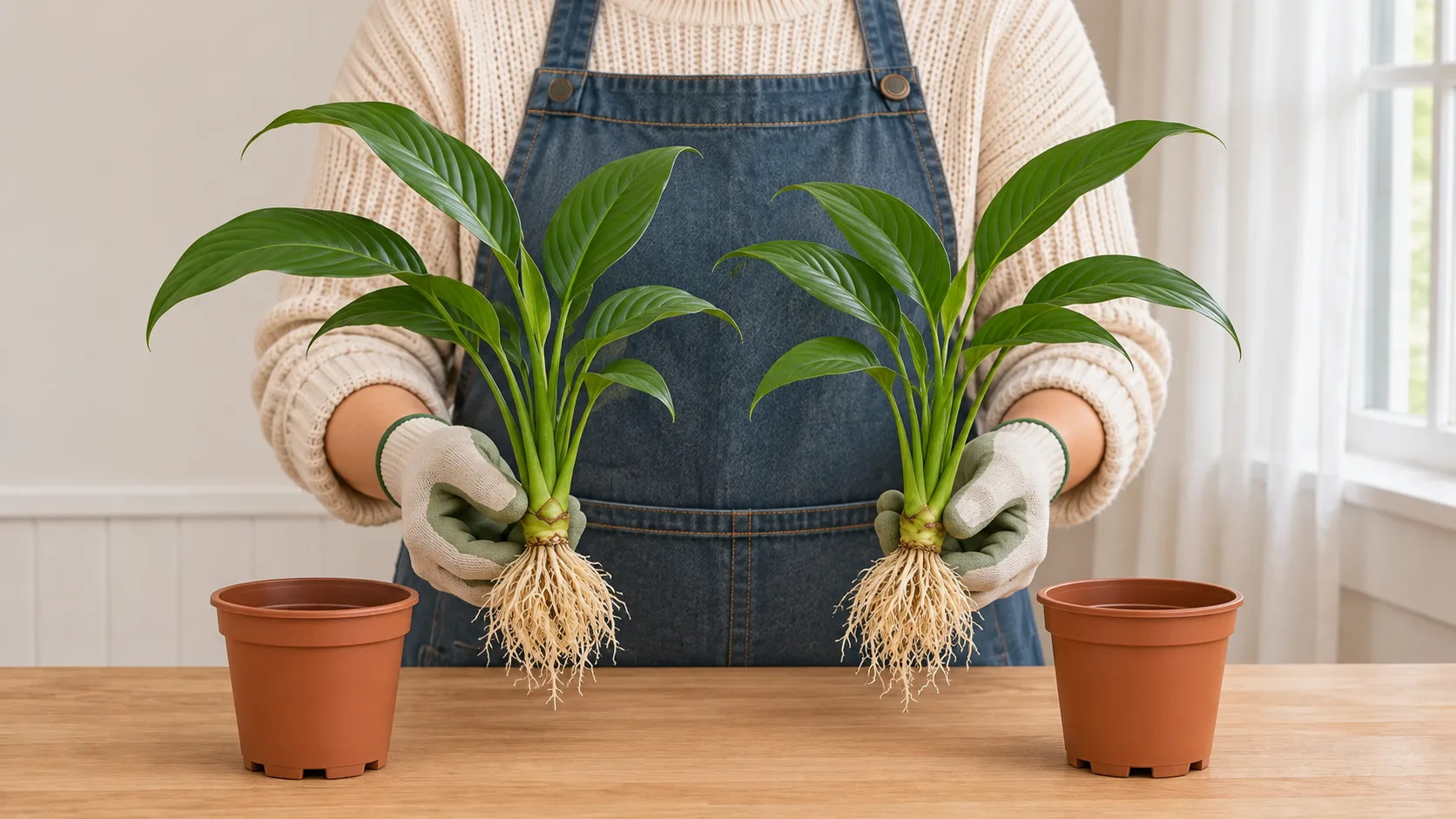
A division already has roots: watch for new shoots to assess recovery, while providing indirect light and a moist root ball.1 Keep each rooted section together as you work, so you do not end up with a leaf detached from the base.
Yellow leaves, brown tips or drooping: what should you check?
Feel the potting mix, lift the pot and inspect leaf undersides before treating anything. A drooping clump in a dry pot needs the opposite response to a limp clump in saturated soil.2
Peace lily symptoms: likely causes and first steps.
| Observed sign | What to check | First step |
|---|---|---|
| Drooping leaves, dry potting mix | Light pot, dry root ball | Water thoroughly and let it drain.2 |
| Limp clump, waterlogged potting mix | Drainage and root rot | Empty the outer pot and let excess moisture drain; inspect the roots.2 |
| Burnt tips after feeding | Salt build-up | Stop feeding and flush the mix if it drains freely.5 |
| Pale leaves on the window side | Excessive direct sun | Filter the rays.3 |
| White cottony clusters | Mealybugs on leaf undersides and stalks | Isolate the pot and identify the insect.5 |
| Small shields attached to foliage | Scale insects | Inspect neighbouring plants too.4 |
| Black areas after cold transport | Draughts or chilling | Move indoors to moderate temperatures, away from cold air.3 |
| Dry tips near a radiator | Dry air, but also watering and feeding | Move away from the heat and check the root ball.25 |
Scale insects and mealybugs can be found on the plant; fertiliser burn needs to be checked against the feeding history. For a clump yellowing in damp soil, investigate overwatering first. Judge the effect of a change by the new leaves; tissue that has already dried out remains damaged.3
A spotted or yellowing leaf? Take a photo: Floralens identifies the problem and what to do next.
| What you see | Likely cause | What to do |
|---|---|---|
| Soil stays soggy, suffocating roots and causing rot. | OverwateringExternal Factors | Treating Waterlogged Soil |
| Brown leaf tips and a white crust on the soil. | Salt BuildupExternal Factors | Flushing Soil Salts |
Are peace lilies toxic to cats and children?
Keep the plant away from children and animals: its calcium oxalates irritate the mouth. After ingestion, call a poison centre for a person or a vet for an animal.1112 In France, the national ORFILA number is 01 45 42 59 59.13
Identification, symptoms and first steps: peace lily toxicity in children and animals.
Which peace lily should you choose?
Choose the mature size first, then green or variegated foliage. A compact cultivar needs a different space from a large selection. The cream or white streaks on variegated forms are part of their normal appearance.5

Sensation
Horticultural name
A large cultivated selection with broad, ribbed, dark green leaves.
Chopin
Stable cultivar
A cultivar with narrow white spathes held up to 50 cm (about 20 in) high.
Domino
Variegated
A variegated selection of Spathiphyllum wallisii with pale green to cream streaks.
Gemini
Variegated
A compact form with pale streaks, similar to Variegata.
Variegata
Variegated
A horticultural label for white or cream variegation.
Mauna Loa
Horticultural name
A horticultural name often associated with peace lilies; check which species is being sold.
Varieties documented in the botanical profile.
Peace lily varieties: size and features to help you choose.
| Name | Size or feature | What does it suit? |
|---|---|---|
| ‘Chopin’ | Narrow white spathes held up to 50 cm (about 19.7 in) high1 | Slender white inflorescences |
| ‘Gemini’ and ‘Variegata’ | Around 30 cm (about 11.8 in); white markings, stronger in ‘Variegata’15 | A small variegated clump |
| ‘Domino’ | Around 30 to 90 cm (about 11.8 to 35.4 in), pale green to cream streaks5 | Variegated foliage that may need more space |
| ‘Petite’ | Compact, stocky habit3 | A small houseplant |
| ‘Power Petite’ | Dense growth, selected for small containers3 | A small container |
| ‘Mauna Loa’ | Around 90 cm (about 35.4 in), white spathes up to 10 cm (about 3.9 in)1 | A larger potted plant |
| ‘Sensation’ | Large clump with broad, ribbed, dark green leaves8 | Generous foliage for an open space |
Check the full name on the label: ‘Sensation-Mini’ is a distinct selection developed for smaller containers.3
Frequently asked questions
How long does a peace lily spathe stay attractive?
A peace lily spathe can remain attractive for more than a month after turning green. The white spathe becomes pale green after about ten days, then retains its decorative value for at least a month. The timings refer to the spathe, the large structure surrounding the small flowers.5