
Care guide
Bigleaf hydrangea care
Hydrangea macrophylla
Give bigleaf hydrangeas sheltered partial shade and moist soil, checking pots daily in summer. In France, plant between October and April when the ground is frost-free. In spring, cut dry flowerheads back to healthy buds and remove just a few old stems: flowering depends on the wood you keep.
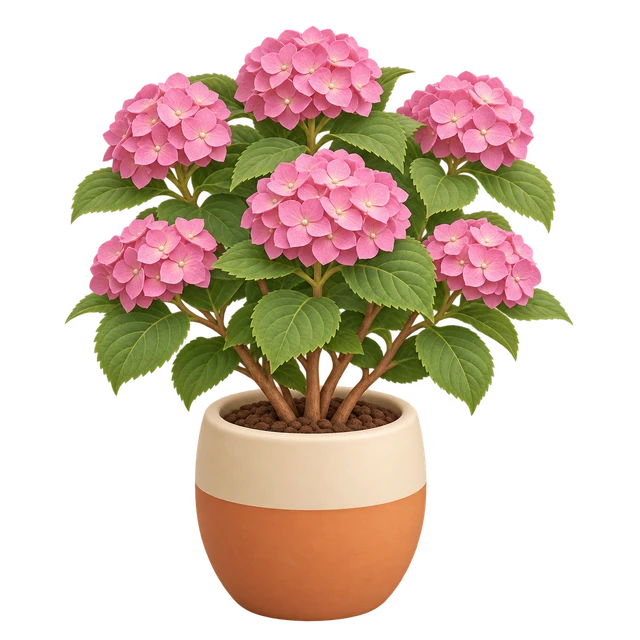
Bigleaf hydrangea (Hydrangea macrophylla) forms its main flowers on the previous year’s stems. Hard pruning or a late frost can therefore leave a healthy green shrub without flowers. The botanical profile of bigleaf hydrangea helps you recognise its large mopheads and lacecaps before choosing its care. 1
How often should you water a hydrangea?
Water deeply during dry spells, then check the soil before watering again. In a dry summer, one watering a week is a starting point for a plant in the ground; heat, sandy soil and recent planting can increase its needs. Rainfall and the actual moisture inside the rootball determine when to water. 2
10 L every 30 days
Water according to rootball moisture; prevent it drying out
Every 7 days
During the first growing season, pay particular attention to spring and summer plantings after 7 to 10 days without significant rain. A light shower can leave the centre of the rootball dry. Water slowly to reach both the rootball and the surrounding soil. 3
During a heatwave with soil dry at depth, water needs can be much higher: 10 L/m² per day was the evapotranspiration forecast for Angers, France, in July 2022. This figure concerns a border in those extreme conditions; adjust watering to rainfall and soil moisture, and do not apply this rate to a pot's volume. 4
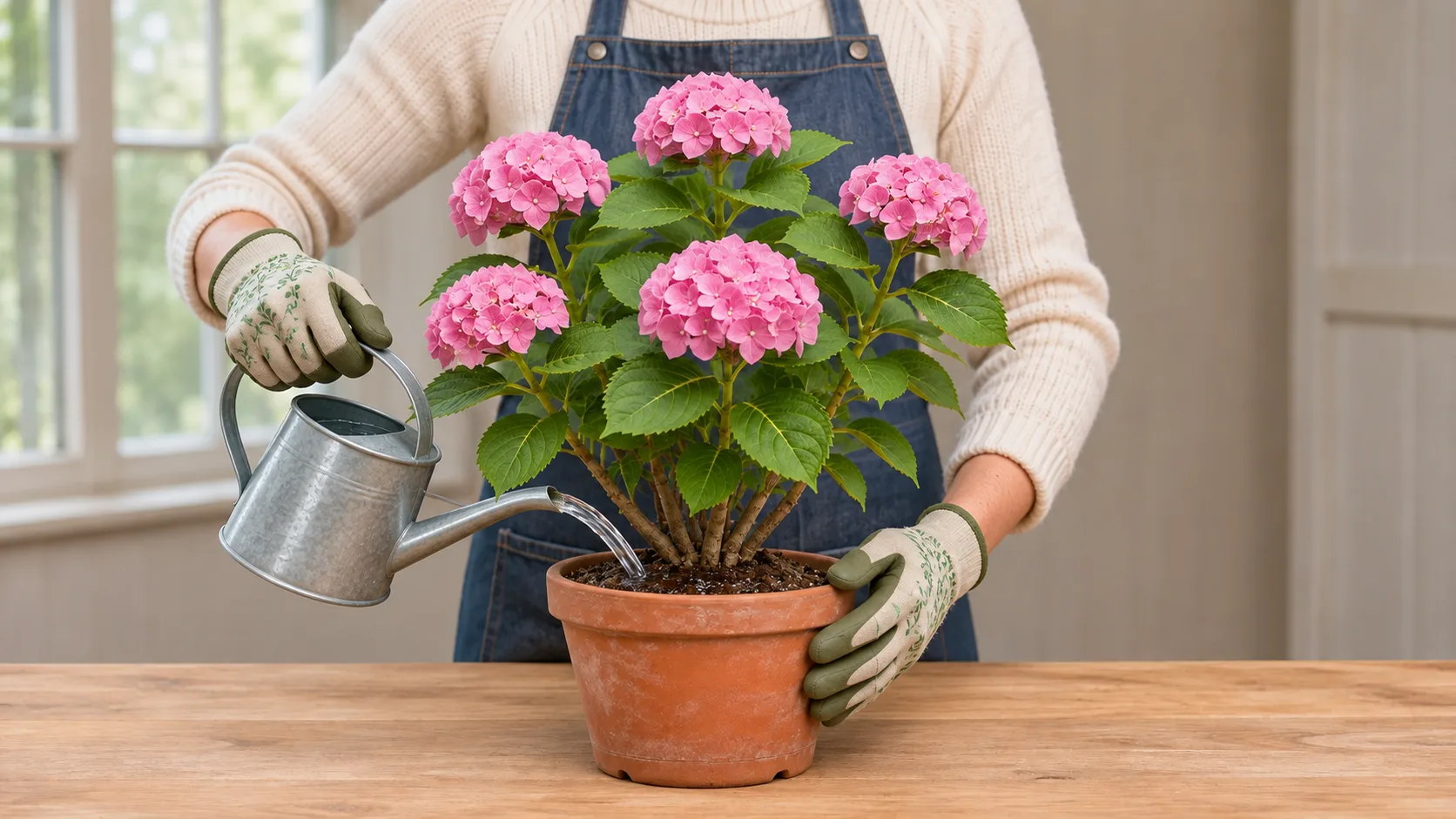
In pots, check daily in hot or windy weather, or twice a day in extreme heat. These are checks: add water when the compost needs it. If leaves droop above an already sodden rootball, clear the drainage first. 5
How do you water without damaging the flowers?
Pour water at the base, onto the compost, keeping the flowerheads dry. If a newly planted rootball absorbs water poorly, split the watering into two rounds half an hour apart: this lets the rootball absorb more than a quick flow running past the roots. 64
Prefer rainwater for blue-flowered varieties. When rainwater runs out, tap water helps prevent drought. Organic mulch and a shadier position for the container also slow drying. 3
What light does a hydrangea need?
Choose partial shade, with morning or late-day sun and shelter from scorching afternoon sun. Light shade suits the plant; consistently moist soil allows it to tolerate more sun. On a south-facing balcony, macrophylla hydrangeas become harder to keep hydrated. 17
Garden exposure
Choose the side of the house where bigleaf hydrangea will grow.
Watch the heat from the wall, the wind and how quickly the pot dries. A sheltered position avoids both drying winds and frost pockets that expose young shoots in spring. Allow enough room for the shrub’s mature size, so it can grow without being cut back every year. 83
When and how should you plant a hydrangea in the garden?
In France, plant from October to April, during dormancy and outside freezing weather. Autumn or spring offers a convenient window if the soil is workable. Avoid waterlogged ground and dry spells, which make establishment harder. 63
- Moisten the rootball before removing the pot. 6
- Dig a hole as deep as the rootball and about three times as wide. 3
- Set the top of the rootball level with the soil, backfill and water. 3
- Mulch, leaving 10 to 15 cm (about 4–6 in) clear around the base. Spacing ranges from 90 cm to 2.4 m (about 3–8 ft) depending on vigour: check the cultivar before planting a close hedge. 3
The soil should be rich, moist and well drained: surplus water flows away instead of collecting around the roots. If the ground stays saturated after rain, choose another position or a suitable container. 68
Which pot and compost should you choose?
Choose a compact cultivar and a pot with drainage holes. For the first move into a larger pot, allow at least 10 litres (about 2.6 US gal) after a 2-litre (about 0.5 US gal) pot, or 15 litres (about 4 US gal) after a 3-litre (about 0.8 US gal) pot. For long-term growing, plan for a container at least 40 cm (about 16 in) across and deep, sized to the mature rootball. 79
Use a planting compost for shrubs that holds moisture. Avoid pure heath soil: it is too poor in nutrients and drains too freely, leaving a potted hydrangea short of water and nutrients. The nursery Boos Hortensia also advises against ericaceous potting compost for this use. 710
Raise the container on pot feet and keep its drainage holes clear. Remove the saucer during winter rain; in summer, move a pot that dries too quickly into more shade. 113
For container sizing and refreshing the compost, growing hydrangeas in pots explains the steps and checks.
What fertiliser does a hydrangea need?
An established garden hydrangea rarely needs regular fertiliser. Excess nitrogen encourages soft leafy growth, reduces bud formation and increases frost sensitivity. Start by maintaining soil moisture with well-rotted compost and mulch. 36
- Feeding
- In springonly if the plant is struggling, particularly in sandy soil · in the groundSource: How to grow shrubby hydrangeas / RHS Growing Guide
- Feeding
- In springAccording to the compost and chosen product · in a potSource: DCM France
- Avoid
- Excess nitrogenSource: How to grow shrubby hydrangeas / RHS Growing Guide
A struggling plant in poor or sandy soil may benefit from spring feeding. The DCM hydrangea fertiliser sold in France and cited here contains alum to encourage blue flowers: avoid this formulation if you want to keep pink flowers. Its fertiliser rates are 150 g/m² in spring in the ground and 3 to 5 g per litre of compost in pots; these are not rates for a separate application of alum. For another fertiliser, follow its packaging and account for fertiliser already mixed into the compost. 3125
When should you prune a hydrangea to preserve its flowers?
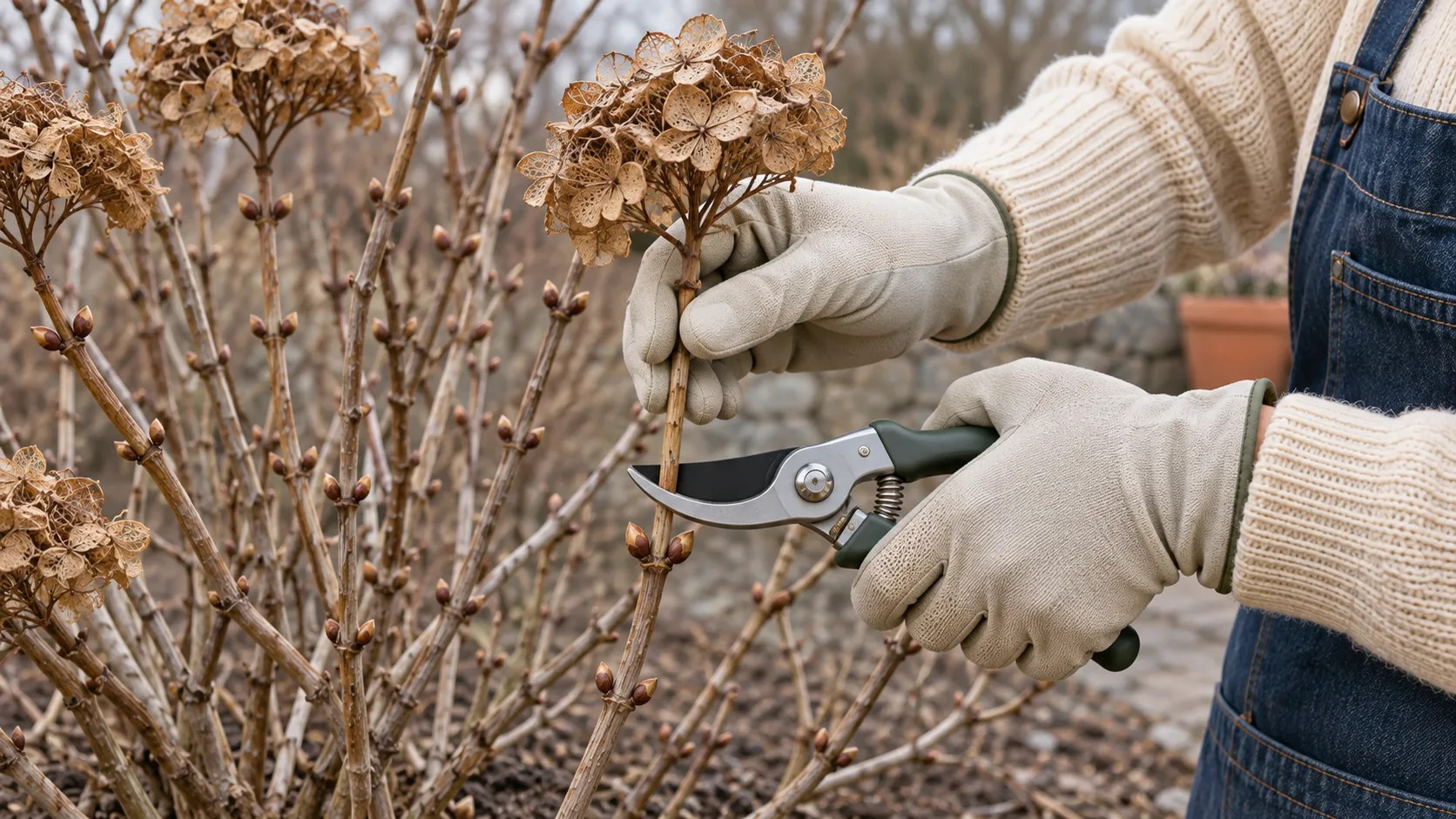
Tidy in late winter or spring, outside freezing weather, keeping healthy buds. In France, March is a common guide; in cold gardens, leave dry flowerheads longer, until spring is well established. They protect the buds beneath them. 693
| Task | January | February | March | April | May | June | July | August | September | October | November | December |
|---|---|---|---|---|---|---|---|---|---|---|---|---|
| Watering | reduced | reduced | reduced | moderate | moderate | high | high | high | moderate | reduced | reduced | reduced |
| Growth | resting | resting | active | active | strong | strong | strong | strong | active | resting | resting | resting |
| Feeding | no | no | no | no | no | no | no | no | no | no | no | no |
| Repotting | no | no | favorable window | favorable window | favorable window | no | no | no | favorable window | favorable window | no | no |
- Softwood cutting
- In summerfrom late spring to midsummerSource: How to grow shrubby hydrangeas / RHS Growing Guide
- Semi-ripe cutting
- In summerin midsummerSource: How to grow shrubby hydrangeas / RHS Growing Guide
- Hardwood cutting
- In winterSource: How to grow shrubby hydrangeas / RHS Growing Guide
Cut each faded head back to the first or second pair of strong buds. Remove one or two of the oldest stems at the base, keeping young, healthy shoots. Cutting the whole shrub low and level removes the previous year’s wood, which carries the flowers on traditional forms. 313
Lacecap hydrangeas can be deadheaded after flowering, cutting back to the second pair of leaves below the head. Panicle and smooth hydrangeas flower on new shoots: identify the species before choosing a harder prune. 132
To distinguish the species and find the cutting point, pruning a hydrangea shows which branches to keep and which to renew.
The plant-by-plant pruning guides give the pruning season for each garden shrub.
How well does a hydrangea tolerate frost?
The base can survive even when stems and buds are damaged. The H5 rating corresponds to a reference range of −15 to −10 °C under British growing conditions. It describes the shrub’s hardiness, with differences according to exposure and cultivar. 8
- Winter conditions
- Outdoors, protectedSource: How to grow shrubby hydrangeas / RHS Growing Guide
- Protect
- Before the first frostsshelter the container and protect young buds · in a potSource: How to grow shrubby hydrangeas / RHS Growing Guide
In Japan, hydrangeas can tolerate −10 to −20 °C, with old stems freezing and regrowth from the base. This regrowth can produce a leafy plant without the flowers expected on old wood. 6
In winter, temperatures below about −12 °C can kill bigleaf hydrangea flower buds. This is no guarantee that the flower buds will survive above that temperature: temperature changes and late frosts can also compromise flowering. In spring, shelter buds and young shoots whenever frost is forecast. 143
For pots, choose a sheltered wall or cold greenhouse. Wrapping the container alone gives too little insulation to prevent the rootball freezing. After damage, wait until you can identify living wood; a seemingly dead plant may need watching until midsummer before you give up on it. 315
How large does a mature hydrangea grow?
Allow room for the mature cultivar. The species commonly reaches 1.5 to 2.5 m (about 5–8 ft) tall and wide, maturing in 5 to 10 years. Compact selections suit small terraces better: ‘Tovelit’ stays between 0.5 and 1 m (about 20 in to 3 ft 3 in) in both dimensions. 816
- Mature height
- 0,9 to 2,5 m
- Spread
- 0,9 to 2,5 m
- Growth
- Fast according to NC State
A large hydrangea kept in a narrow passage needs regular removal of flowering wood. Choosing the right variety avoids repeated pruning and lets the shrub retain its rounded shape. 13
How do you get flowers every year?
Keep flowering wood, protect buds and avoid excess fertiliser. In France, flowering runs from July to the first frosts, depending on the variety and conditions. After hard pruning, traditional hydrangeas spend a season rebuilding their branches. 6133
For repeat flowering on new shoots, choose a named cultivar with that trait. ‘Bailmer’, Endless Summer The Original, flowers on old wood and then on new wood. Keeping healthy stems also preserves its first flush. 17
What care does a hydrangea need through the seasons?
- From October to April in France, outside freezing weather: plant, then monitor establishment and drainage. 6
- In late winter or spring: remove dry heads above healthy buds, renew a few old stems and mulch. 63
- From late spring to midsummer: take softwood cuttings from a non-flowering shoot. In summer, concentrate on watering pots and new plantings. 318
- Before cold weather: shelter pots, clear drainage and leave dry mophead flowerheads in place. 313
How do you propagate a hydrangea?
Take a soft, non-flowering shoot, from late spring to midsummer. Prepare a section 5 to 10 cm (about 2–4 in) long, cut below a node, then remove the lower leaves. Insert it into peat-free cuttings compost, in diffuse light and a humid atmosphere. 318
Under cover, softwood cuttings often root in 2 to 4 weeks with bottom heat of 18 to 24 °C. Open the bag at least twice a week for 10 minutes, then increase ventilation gradually after rooting. Temperature and the stage of shoot growth affect establishment. 18
A cutting-grown plant may take 2 to 3 years to produce its first flowers. Keep it growing with careful watering and protection suited to its small container. 3
To prepare the shoot and care for the first roots, taking hydrangea cuttings explains the method under cover.
Why are the leaves turning yellow or developing spots?
Examine young leaves, leaf undersides and rootball moisture. The table helps you choose a check before acting; several causes can affect a weakened plant at the same time. 198
Quick diagnosis of hydrangea leaf and root problems
| Visible sign | Possible cause to check | First action |
|---|---|---|
| Yellow young leaves with green veins | Unavailable iron, particularly in chalky soil | Check pH and soil condition before adding iron 19 |
| White powder on leaves | Powdery mildew | Improve airflow through the branches and monitor its spread 1 |
| Spots with tan centres and purple edges | Possible Cercospora leaf spot | Collect fallen leaves and water at the base 2 |
| Grey-brown fluff on soft tissues | Grey mould | Remove affected parts and reduce damp, enclosed conditions 20 |
| Drooping leaves, dry soil | Lack of water | Rehydrate the rootball and protect from scorching sun 5 |
| Wilting in a sodden pot | Waterlogging or damaged roots | Clear the container’s holes and inspect the roots 11 |
| Cottony masses attached to stems or leaves | Hydrangea scale | Examine leaf undersides and remove accessible infestations 21 |
For more detail, see the iron deficiency and powdery mildew diagnoses.
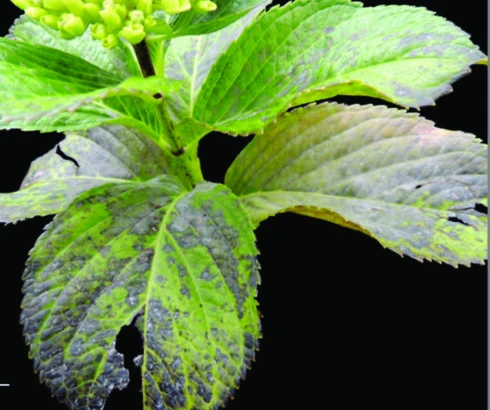
To recognise vine weevils, capsid bugs and root problems too, hydrangea diseases connects each sign with the appropriate action.
Is hydrangea poisonous to pets and children?
Keep hydrangeas out of reach of children and animals. They contain cyanogenic glycosides and are toxic to cats, dogs and horses. 123 In people, ingestion can cause vomiting or diarrhoea. 24 Call a vet for an animal; for a person in France, call a poison centre on 01 45 42 59 59, without inducing vomiting or giving drinks. Keep a photo. 2526
Which hydrangea variety should you choose?
Compare mature size with the space available, then flower shape. The dimensions describe the cultivars; watering, soil and pruning influence their growth. 8

Ayesha
Stable cultivar
Mophead with spoon-shaped florets, pink or blue depending on soil conditions.
Nikko Blue
Stable cultivar
A traditional cultivar with rounded mophead flowerheads.
Endless Summer The Original
Stable cultivar
A repeat-flowering selection associated with the name 'Bailmer', illustrating flowering on old and new wood.
Mariesii Perfecta
Stable cultivar
A lacecap name listed as Blue Wave; colour still depends on the cultivar and soil.
Lanarth White
Stable cultivar
White lacecap listed in horticultural selections; white forms do not always follow the pink/blue response to pH.
Nigra
Stable cultivar
A cultivar known for its dark young stems, distinct from any separate wild taxon.
2 more varieties documented in the botanical profile.
Six cultivars: space required and implications for care
| Cultivar | Features and dimensions | When to choose it |
|---|---|---|
| ‘Tovelit’ | 0.5 to 1 m (about 20 in to 3 ft 3 in) tall and wide; pink, purple or blue heads | A small container or border where its natural size limits pruning 16 |
| ‘Lanarth White’ | About 1.2 m (about 4 ft); white lacecap with small lilac or blue central flowers | A coastal or exposed garden: it tolerates these sites and poor soil better 27 |
| ‘Madame Émile Mouillère’ | About 1.8 m (about 6 ft); large white heads up to 20 cm (about 8 in) across | A position protected from direct sun; allow for heads drooping under the weight of rain 27 |
| ‘Bailmer’ | Endless Summer The Original; flowers on old then new wood | Repeat flowering after the first flush; keep healthy old wood to enjoy both waves 17 |
| ‘Ayesha’ | 1 to 1.5 m (about 3 ft 3 in to 5 ft) tall and wide; flowers with small cup-shaped sepals | Distinctive flowers in a medium-sized space, larger than for ‘Tovelit’ 28 |
| ‘Tricolor’ | 1.5 to 2.5 m (about 5–8 ft) tall and wide; vigorous growth and green, grey and pale yellow variegated leaves | A border with room for its spread, chosen for its foliage too 29 |
Frequently asked questions
Measure the pH before trying to change flower colour. Cultivars respond differently to soil acidity. 3
What pH keeps hydrangea flowers blue?
For a cultivar capable of turning blue, aim for acidic soil, around pH 4.5 to 5, with available aluminium. In chalky ground, grow it in a container to make the mix’s pH easier to control, and prefer rainwater. White varieties keep their colour despite the compost’s acidity. 3