
Care guide
ZZ plant care
Zamioculcas zamiifolia
Water your ZZ plant after the potting mix has dried completely: roughly twice a month in summer and once in winter, adjusted to the root ball. Keep it in indirect light and a room above 15 °C. Its rhizomes store water; a full saucer puts them at risk of rot.
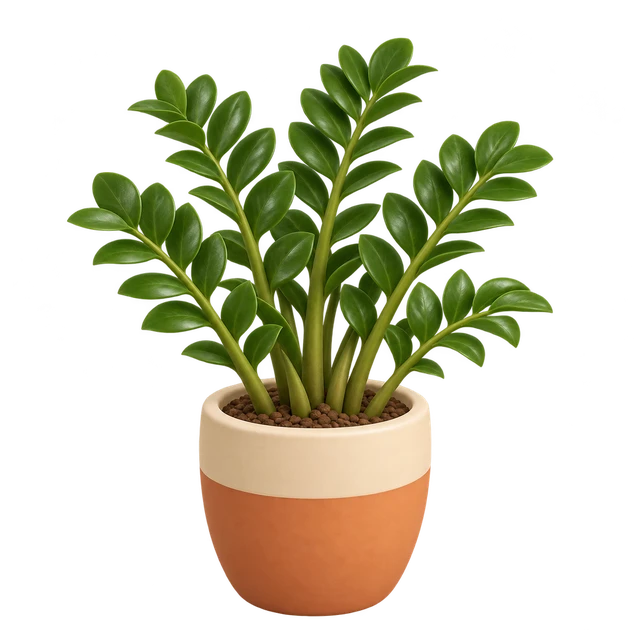
How often should you water a ZZ plant?
Let the entire root ball dry out: allow roughly two waterings a month in summer and one in winter, only when the potting mix is dry. The ZZ plant (Zamioculcas zamiifolia) stores water in its fleshy rhizomes and thick leaves. These reserves let it wait between waterings. 1
17 cL every 16 days
After the potting mix has dried completely
About twice a month, after complete drying
About once a month, if the potting mix is dry
The monthly guideline reflects slower winter growth. Near a bright window, a small root ball may dry faster than a large pot at the back of a room. Complete drying takes priority over the date: if in doubt, wait longer. 2
Check before pouring
Feel the potting mix and lift the pot to compare its weight with how heavy it was after watering. A dry surface can hide moisture below: check deep into the root ball before deciding. This check puts the rule of letting the potting mix dry completely into practice. 1
Leave the watering can aside while the soil is damp. Yellow leaves in a heavy pot, especially with a soft base, call for checks for overwatering and root rot. 3
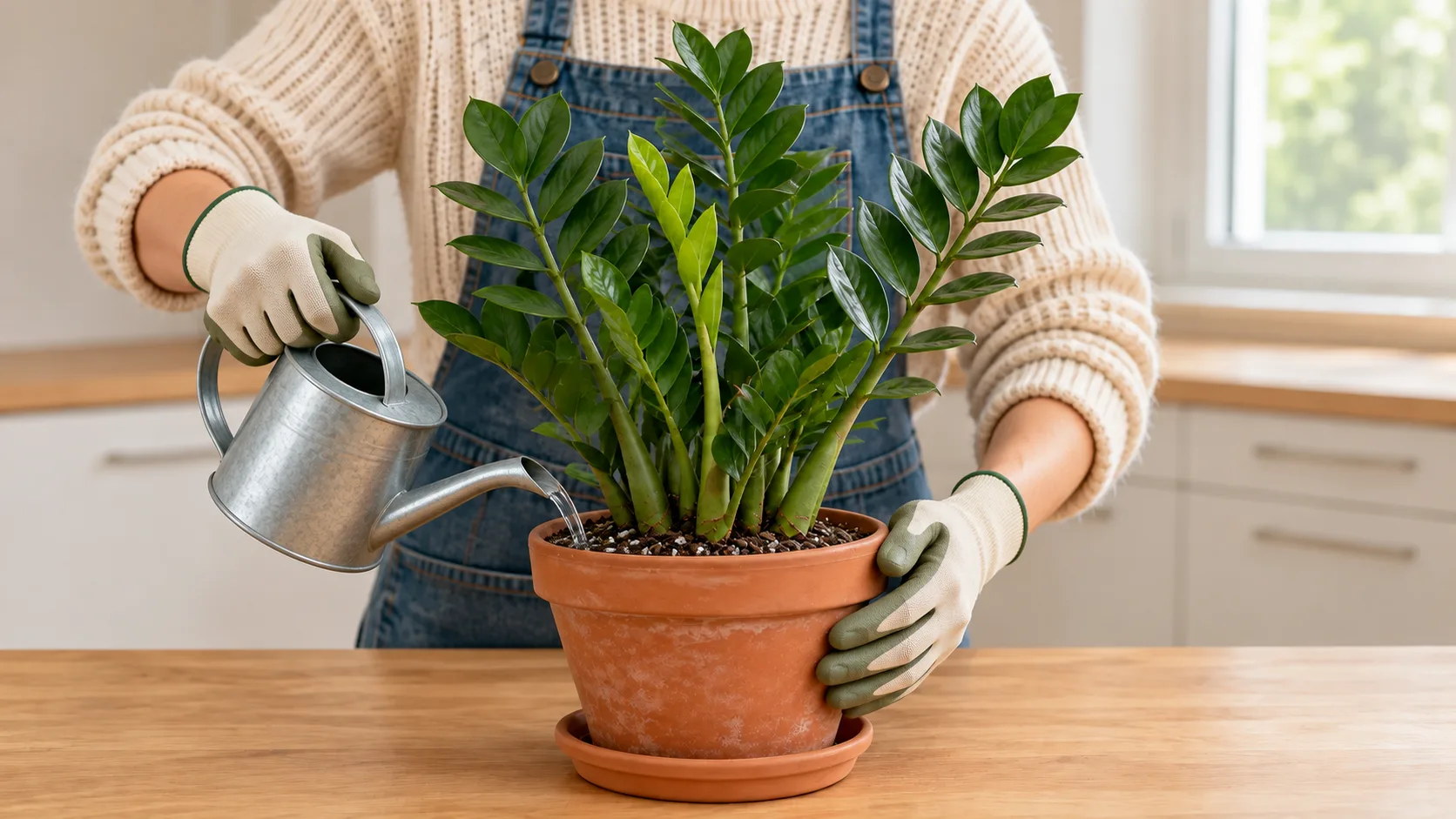
How do you water a ZZ plant without waterlogging the pot?
Moisten the mix, let it drain and empty the saucer after 15 minutes. Use lukewarm water, poured onto the potting mix in the morning. Checking after 15 minutes prevents the plant from sitting in its drainage water. 2
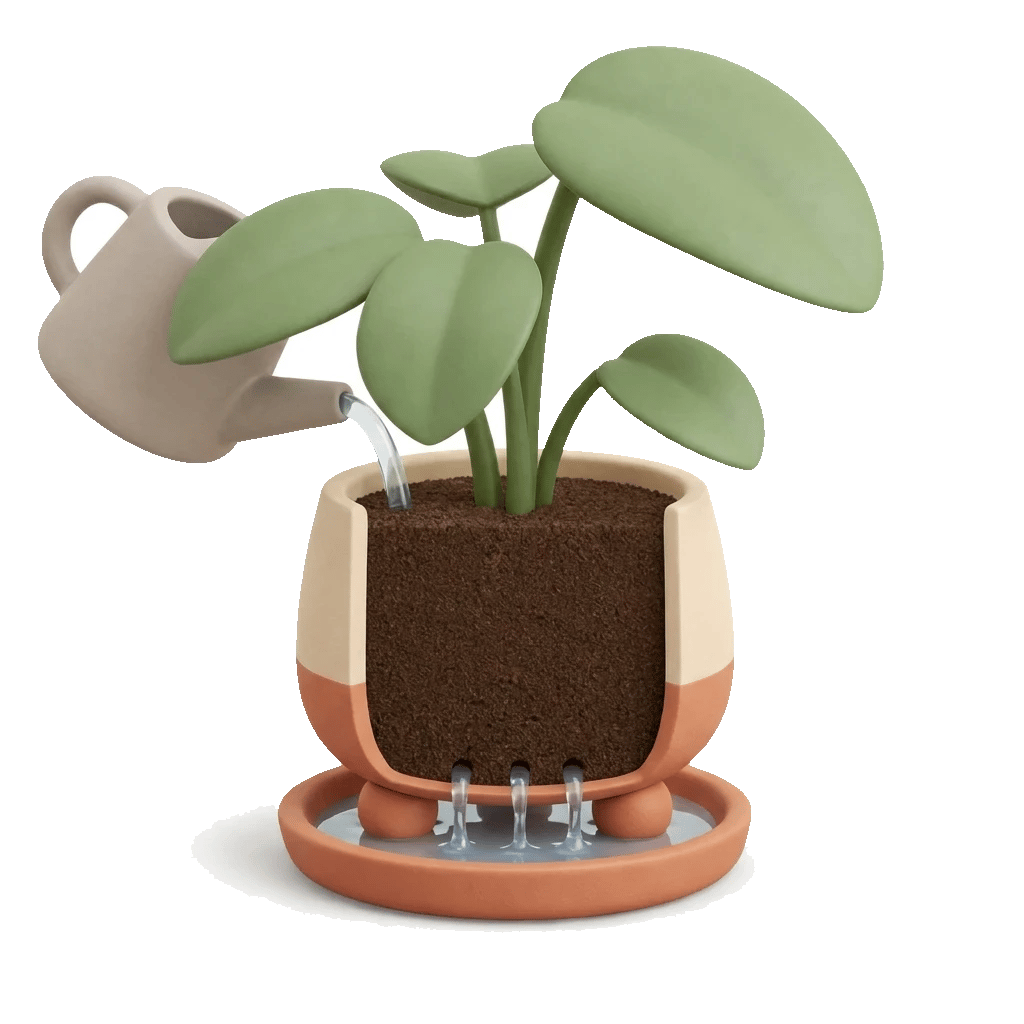
- pour slowly
- water drains out
Water until it drains
Water the potting mix and empty the saucer after 15 minutes Pour until water runs out through the drainage holes: the root ball is wet all the way through.
Take the nursery pot with drainage holes out of its decorative outer pot to water it. Let the excess drain away before putting it back. An outer pot full of water defeats the purpose of drainage holes: the base stays submerged and the rhizomes can rot. 2
Wet the mix at this watering, then wait until it has dried completely before watering again. Repeated small top-ups keep the pot damp, whereas this plant's reserves allow it to cope with dry intervals. 1
Where should you put a ZZ plant?
Choose bright indirect light, away from direct rays that scorch the leaflets. Shade is tolerated, with slower growth. A spot lit by a window encourages new leaves; prolonged survival in a dark corner can precede decline. 12
Indoors, look for filtered light; outdoors in summer, place the pot in shade. 4
Bleached, curled leaflets or brown patches after direct sun are reasons to move the pot. 2 Leaf stalks bending away from the light can also indicate excessive exposure. 3 See the brown leaf spots.
Should you mist a ZZ plant?
Keep normal room humidity: misting is unnecessary. ZZ plants adapt to varying air humidity. 25 Ordinary household humidity is enough for Raven too. 6 Pay closer attention to moisture in the potting mix, since too much damages the rhizomes. 2
Which pot and potting mix should you use for repotting?
Choose a pot with drainage holes, only slightly larger. For a container under 25 cm (about 10 in) wide and deep, add 2.5 to 5 cm (about 1–2 in) to these dimensions, without increasing them by more than one third of the current pot. Keep the container close to the volume of the roots to avoid a large reservoir of damp potting mix. 76
Repot when the roots are crowded, emerge through drainage holes or distort the container. Raven typically needs this every two to three years, only when necessary. 67 Developing new leaf shoots can press against the sides and eventually split a pot if the plant stays in it too long. 3
Removing and settling the root ball
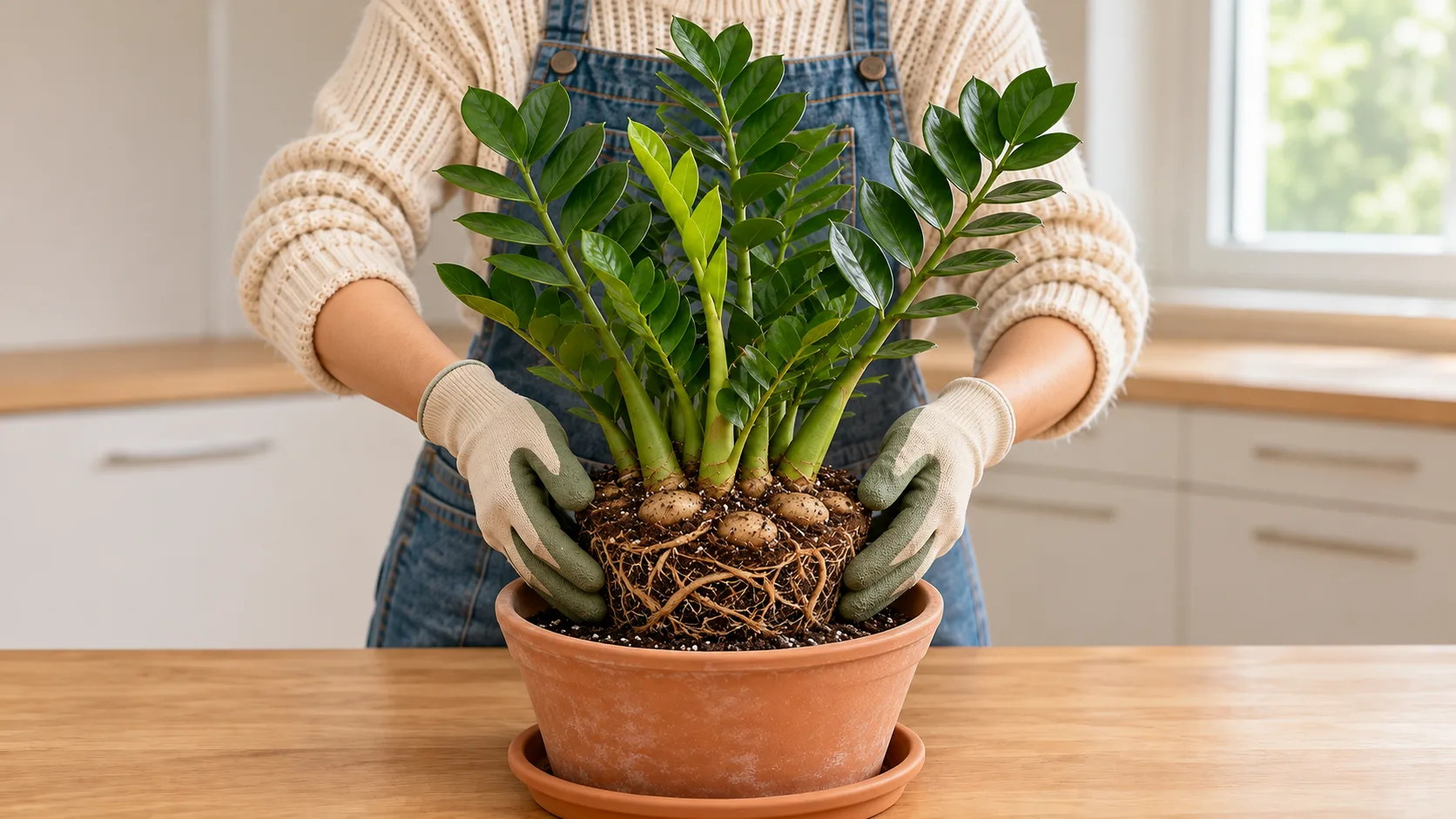
Repot in spring, as growth begins, wearing gloves. This timing helps the plant settle into its new container; gloves protect against contact with irritating sap. 78
- Gently remove the root ball and remove loose potting mix from around the roots.
- Inspect the base; remove soft or rotten roots with a clean tool. 7
- Set the root ball in a free-draining houseplant potting mix, in a pot with drainage holes. The mix must let excess water escape freely. 19
- Let the pot drain after watering and empty the outer pot. 2
A large volume of fresh mix around a small root ball stays damp for longer. Increase the pot size modestly rather than allowing room for several years of growth. 76 An oversized clump can also be divided while it is out of its pot. 5
Which fertilizer does a ZZ plant need?
Apply a balanced houseplant fertilizer once or twice a year, during growth. This light feeding suits a plant that grows slowly in a home. 1 Space the feeds from spring to fall, when new leaves are developing. 2
- Fertilizer
- BalancedSource: NC State Extension
- Feeding
- During active growthDuring growth from spring to fallSource: New York Botanical Garden
- Frequency
- Once or twice a yearindoorsSource: NC State Extension
- Frequency
- Once or twice during growth, at half strengthindoorsSource: University of Connecticut
- Avoid
- Exceeding the dose on the labelSource: Royal Horticultural Society
With a liquid fertilizer, give one or two half-strength feeds during growth: halve the amount of product stated on the label for the same volume of water. 3 Do not combine feeding regimens; too much fertilizer harms ZZ plants. 6
For a healthy plant growing slowly, check the light first. Growth is much slower under household lighting than in a bright greenhouse. 3 Yellowing in a damp root ball, however, calls for a check of watering and roots. 2
How do you maintain and prune the leaves?
Cut faded leaves at soil level and leave healthy leaves whole. This is all the pruning a ZZ plant needs; its shape comes from the leaves emerging from the rhizome. 8
Each tall upright axis is a compound leaf, with a petiole continuing into an axis that carries the leaflets. Cutting off its tip shortens a leaf rather than encouraging a branch to divide. 8 Remove damaged parts with clean tools, wearing gloves. 68
The leaflets are naturally glossy: leaf shine products are unnecessary. 10 Keep healthy leaves rather than trying to change their appearance.
The plant pruning section explains techniques for species that need formative pruning.
What temperatures can a ZZ plant tolerate?
Keep ZZ plants between 18 and 26 °C, with a minimum growing temperature of 15 °C. These temperatures suit a plant grown in warmth. 11 Keep the pot away from heating and air-conditioning vents, which expose the foliage to air currents. 2
Temperatures for ZZ plant
In °C, thresholds given by the sources.
- Slower growth, possible damage10 °C
- Recommended minimum growing temperature15 °C
- Ideal: 18 to 26 °C
- Winter conditions
- Indoors all yearSource: Royal Horticultural Society
- Winter watering
- About once a month, depending on dryingSource: New York Botanical Garden
Below 10 °C, growth slows and cold damage can occur; ZZ plants are frost tender. 12 Protect the plant before it reaches this threshold by keeping it in a heated room.
On a terrace in summer, choose shade and bring the pot indoors when nights fall below about 16 °C. 1 A heated conservatory is suitable; a cold one exposes this tropical plant to excessively low temperatures. 811
The rhizome stores water for dry periods. This reserve suits the alternating rains and droughts of its East African habitat; it does not protect the plant from frost. 58 Find other plants that need shelter in the overwintering section.
How big does a ZZ plant grow?
Allow roughly 50 cm to 1 m (about 20 in to 3 ft 3 in) in height and width; large specimens can reach 1.20 m (about 4 ft). The final size depends on conditions and cultivar. 81
- Mature height
- 0,6 to 1,2 m
- Spread
- 0,6 to 1,2 m
- Growth
- Slow
Plants reach mature size in two to five years, with leaves 40 to 60 cm (about 16–24 in) long bearing six to eight pairs of leaflets. 8 The clump slowly widens as new leaf shoots emerge: leave room around the pot as well as above it. 3
Raven reaches up to 1 m (about 3 ft 3 in) in height and width. Its black foliage therefore comes with the proportions of a floor plant. 13
Unobtrusive flowers
Let flowers develop if they appear; remove them at the base once faded. 8 The small flower structures emerge close to the soil, mainly on older plants. 2 A spadix is accompanied by a spathe. 1 The foliage remains the main ornamental feature.
The month-by-month care calendar
In spring, check whether the roots have room; during growth, feed sparingly; in winter, water less often. Spring is a good time to repot. 7 Feeding follows growth from spring to fall, with two feeds during this period. 2
| Task | January | February | March | April | May | June | July | August | September | October | November | December |
|---|---|---|---|---|---|---|---|---|---|---|---|---|
| Watering | high | high | high | high | high | high | high | high | high | high | high | high |
| Growth | resting | resting | resting | resting | resting | resting | resting | resting | resting | resting | resting | resting |
| Feeding | no | no | no | yes | no | no | no | no | yes | no | no | no |
| Repotting | no | no | favorable window | favorable window | favorable window | no | no | no | no | no | no | no |
In a northern-hemisphere home, April and September can serve as reminders for these two feeds, provided the plant is growing. The root ball and the appearance of new leaves determine the care needed. 2 In winter, start from the guideline of one watering a month, after checking that the mix has dried. 1
How do you propagate a ZZ plant?
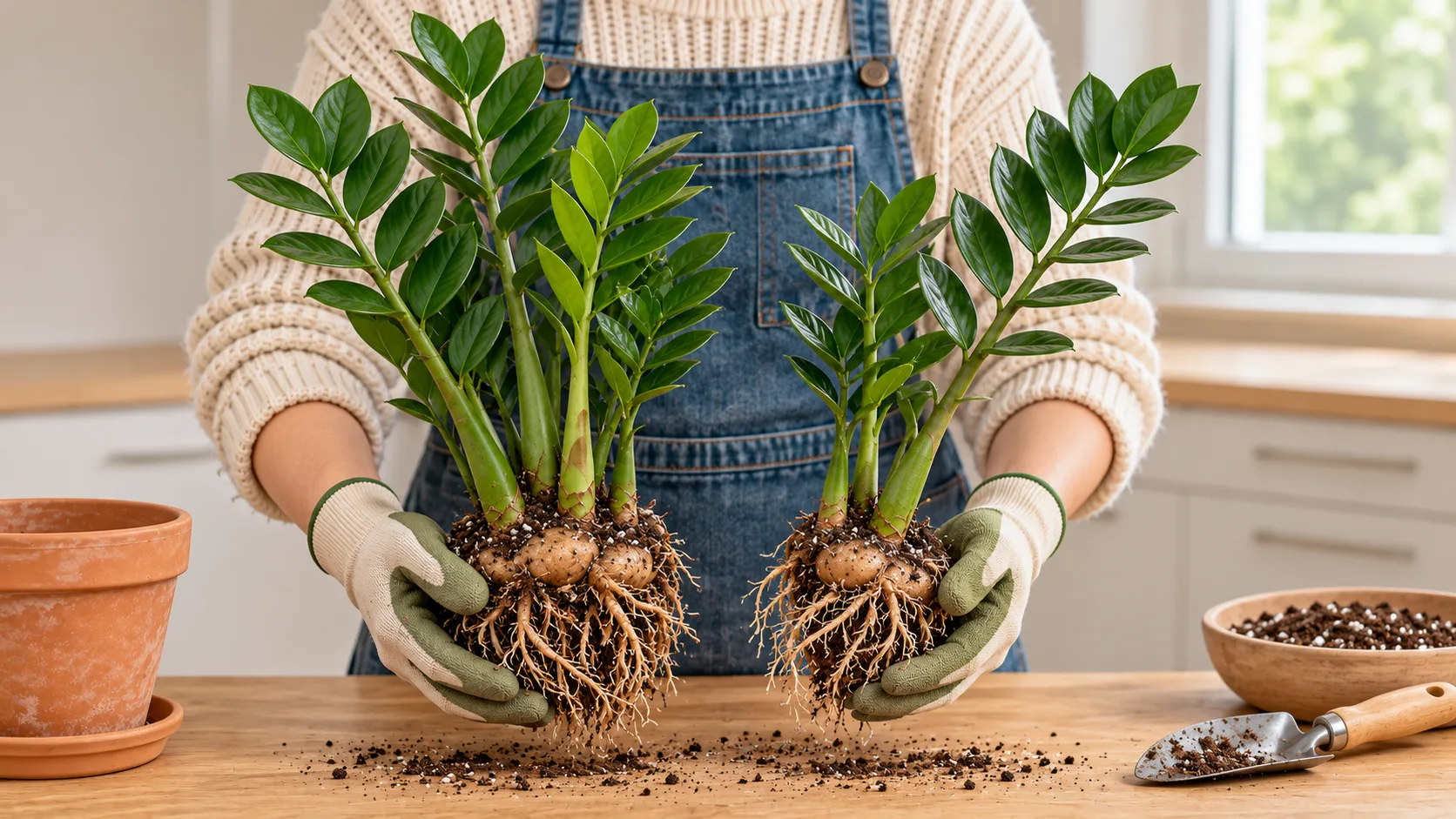
Divide a clump for a self-supporting plant sooner; a leaflet cutting can take nine months to form a rhizome at home. Division retains roots and reserves from the start. 53
Dividing a clump
Choose a healthy portion that retains roots and at least one leafy axis. Gently loosen the root ball to find groups of rhizomes. Separate the roots by hand, or use a clean, sharp tool if necessary. 5
Pot each division in a free-draining mix, water lightly and keep it in bright indirect light while it establishes. Leave enough roots on each portion for it to take up water and nutrients. 5
Taking a leaflet cutting
Take a healthy leaflet with its small stalk and let the cut dry for a few hours. A leaflet can form new storage organs at its base. 38
- Insert the stalk about 1.3 cm (about ½ in) into clean, moist growing medium. 5
- Provide bright indirect light, warmth around 27 °C, and high air humidity. 5
- Keep the medium moist during rooting: this cutting starts without an adult plant's reserves. 5
- Wait for roots and then a rhizome to form. The rhizome may start forming at around one month in a greenhouse, but take up to nine months in a home. 3
Propagation in shallow water is also possible; move the cutting into potting mix once roots and a rhizome have developed. 5 Compare other methods in the plant propagation section.
Yellow leaves and other problems: what should you check?
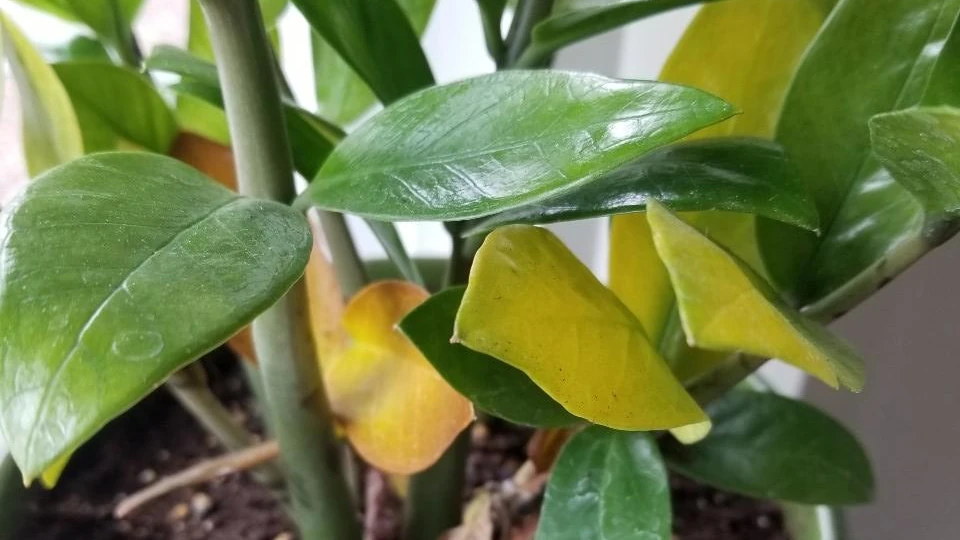
Check the potting mix first: yellow leaves with damp soil suggest excess water; pale, scorched leaves after sun exposure call for a new position. These clues guide your checks before adding any water or fertilizer. 32
ZZ plant symptoms, possible causes and first steps
| What you see | Cause to check | First step |
|---|---|---|
| Yellow leaves, damp mix, soft base | Excess water, possible rot 3 | Empty trapped water; unpot to inspect the roots if the base softens |
| Bleached, curled or brown-marked leaflets after exposure | Excessive direct sun 2 | Move the pot out of direct rays |
| Healthy foliage, very few new leaves | Low light, slower growth 3 | Move closer to bright indirect light |
| Small shells attached to leaves | Scale insects 14 | Inspect the undersides and leaf attachments; identify the insects before treatment |
Telling yellowing apart from a cultivar's natural color
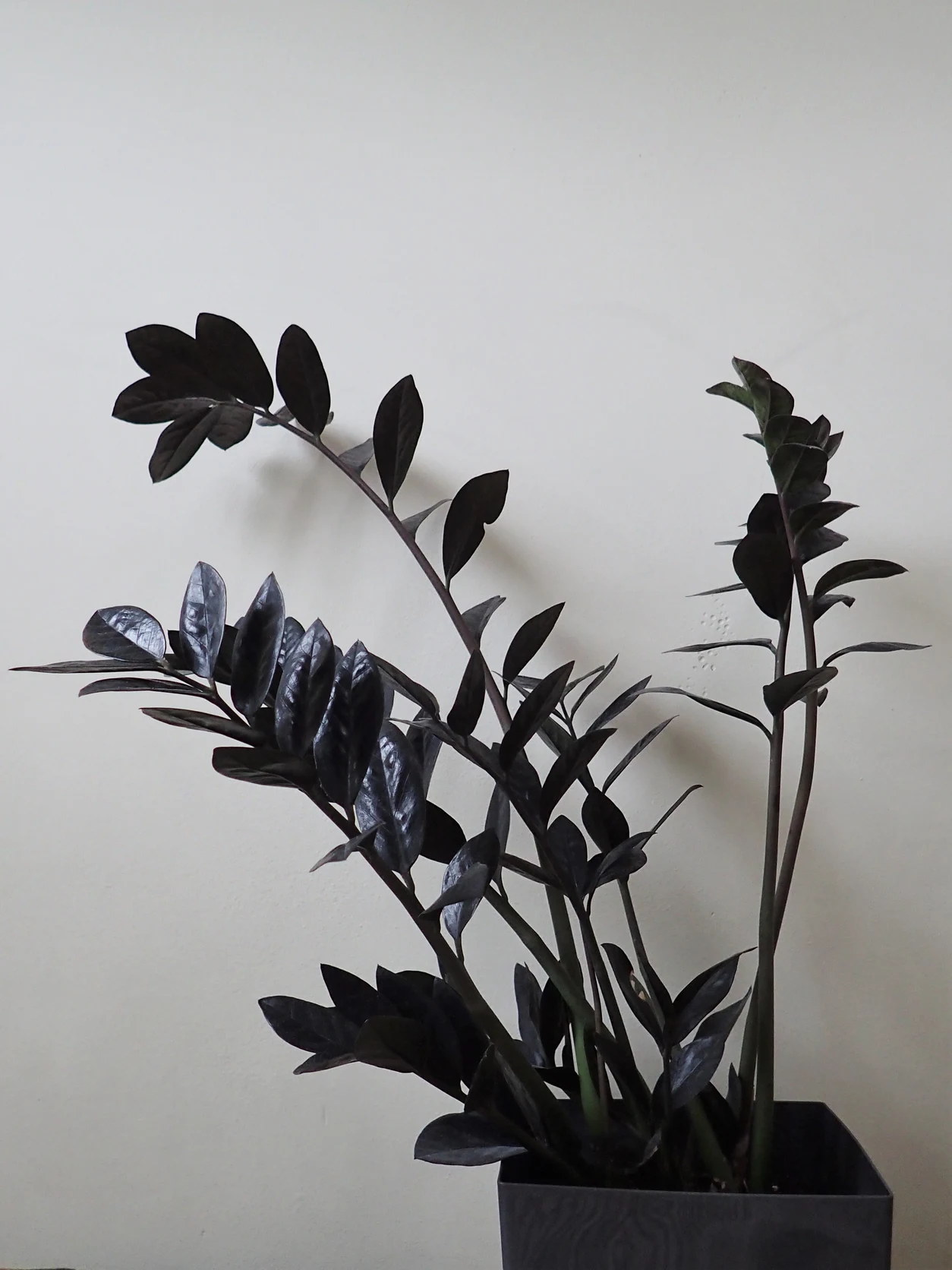
Look at the leaf's age and the firmness of its base. On Chameleon, young foliage emerges golden yellow, then turns green. On Raven, it emerges light green, then darkens. 1 A leaf turning yellow in a damp root ball, with softened rhizomes, calls instead for a check of watering. 3
Looking for pests
Inspect the undersides of the leaflets and their attachments. Brown shells suggest scale insects, while cottony clusters suggest mealybugs. Aphids, thrips and whiteflies are also insects to watch for. 15
Unsure about a damaged leaf? Photograph it: Floralens helps identify the problem before you change its care.
| What you see | Likely cause | What to do |
|---|---|---|
| Soil stays soggy, suffocating roots and causing rot. | OverwateringExternal Factors | Treating Waterlogged Soil |
| The plant wilts and yellows while the soil stays wet. | Root RotDiseases | Treating Waterlogged Soil |
| White cottony clumps in leaf axils and on stems. | MealybugsPests | Eliminate Armored Scale Insects |
| Small, immobile waxy shells (1–3 mm) on stems and leaves. | Armored ScalePests | Eliminate Armored Scale Insects |
Is a ZZ plant toxic?
Keep ZZ plants away from children, cats and dogs; wear gloves when handling them. Their calcium oxalates irritate tissues. 318 In France, after ingestion, call 01 45 42 59 59 for a person, or a veterinarian for an animal. 15 See the risks associated with ZZ plants.
Which ZZ plant variety should you choose?
Choose Raven for dark foliage, Chameleon for golden young leaves or Lucky for rounded leaflets. These selections mainly change the outline or color of the foliage. 1
Stable cultivar
New leaves emerge light green and age to purple-black; a horticultural cultivar, not a species.
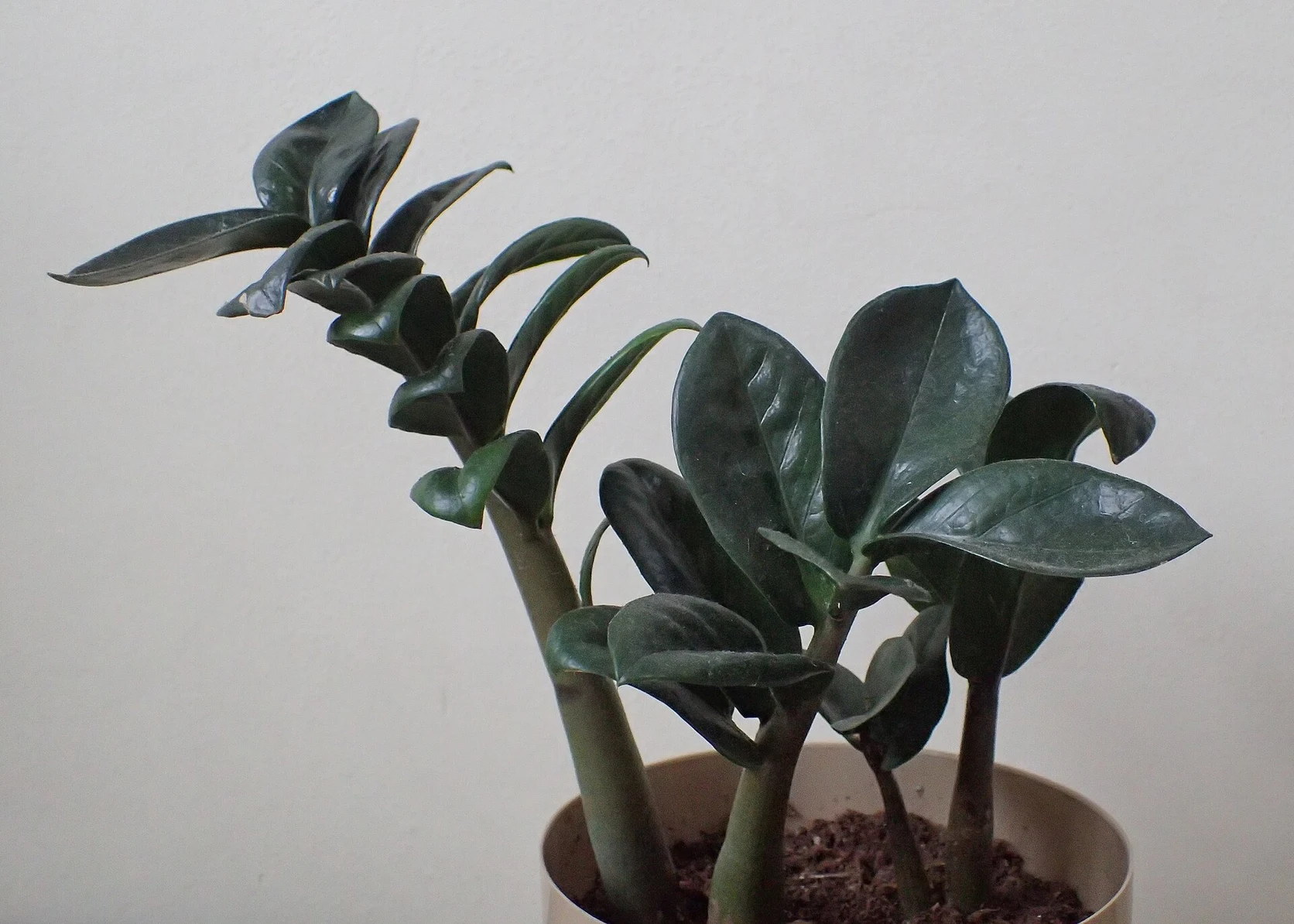
Zenzi
Stable cultivar
Trade name for Hansoti 13; stiff, upright leaves, closely spaced leaflets and a naturally compact habit.
Chameleon
Stable cultivar
Young golden-yellow leaves turn green as they mature.
Lucky
Stable cultivar
Cultivar with wider leaflets and rounded tips.
Variegata
Variegated
Variegation is rare in commerce; check its stability on each individual plant.
Varieties documented in the botanical profile.
Choosing a ZZ plant variety by foliage and space needed
| Variety | What changes | What to allow for |
|---|---|---|
| Raven, 'Dowon' | Young leaves green, mature leaves purple-black 14 | Up to 1 m (about 3 ft 3 in) in height and width 13 |
| Zenzi, 'Hansoti 13' | Closely spaced leaflets, compact upright habit 1617 | Can reach 50 cm (about 20 in) or more 16 |
| Chameleon | Young leaves golden yellow, then dark green 1 | Recognize the normal color of new growth |
| Lucky | Broad leaflets with rounded tips 1 | Choose for the shape of the foliage |
To follow the change from green to black and allow room for the clump, see Raven ZZ plant care. Scientific names and confusion with palms are explained in the ZZ plant botanical profile.
Frequently asked questions
Can you keep a ZZ plant in a windowless office?
Can a ZZ plant regrow after losing its leaves during a drought?
Can a bare ZZ leaf stalk with no leaflets make a cutting?
Choose a healthy leaflet with its stalk instead. A cut axis without an attached leaflet can fail to form callus and roots. A leaflet cutting can form roots and then a small rhizome. 5