
Care guide
Pothos care
Epipremnum aureum
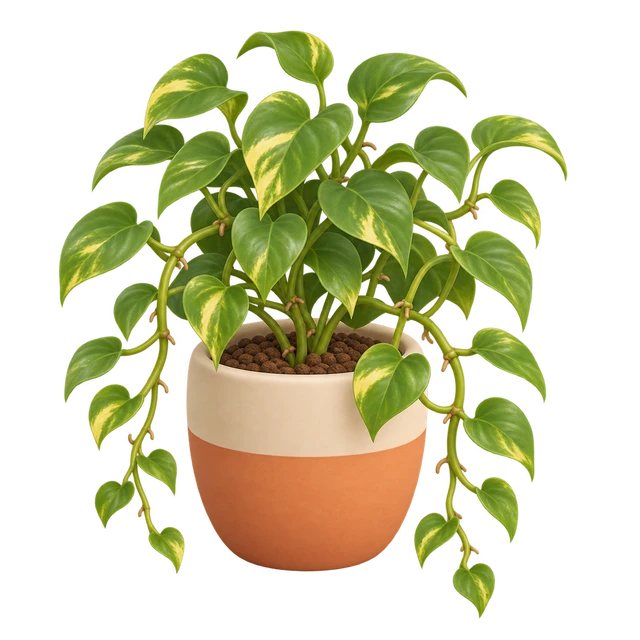
Pothos grows well when the top two centimetres (about ¾ in) of compost dry between waterings, near a window without scorching sun. Prune its long stems or train them onto a damp support. Keep them away from children and animals: the plant contains irritating crystals.
How often should you water pothos?
Water when the top two centimetres (about ¾ in) of compost are dry. Pothos (Epipremnum aureum) copes better with slight drying between waterings than a constantly wet root ball. In winter, excess water particularly encourages root rot1. Push a finger into the compost beneath the foliage: if the surface still feels moist, wait.
17 cL every 11 days
After the top two centimetres (about ¾ in) of compost have dried
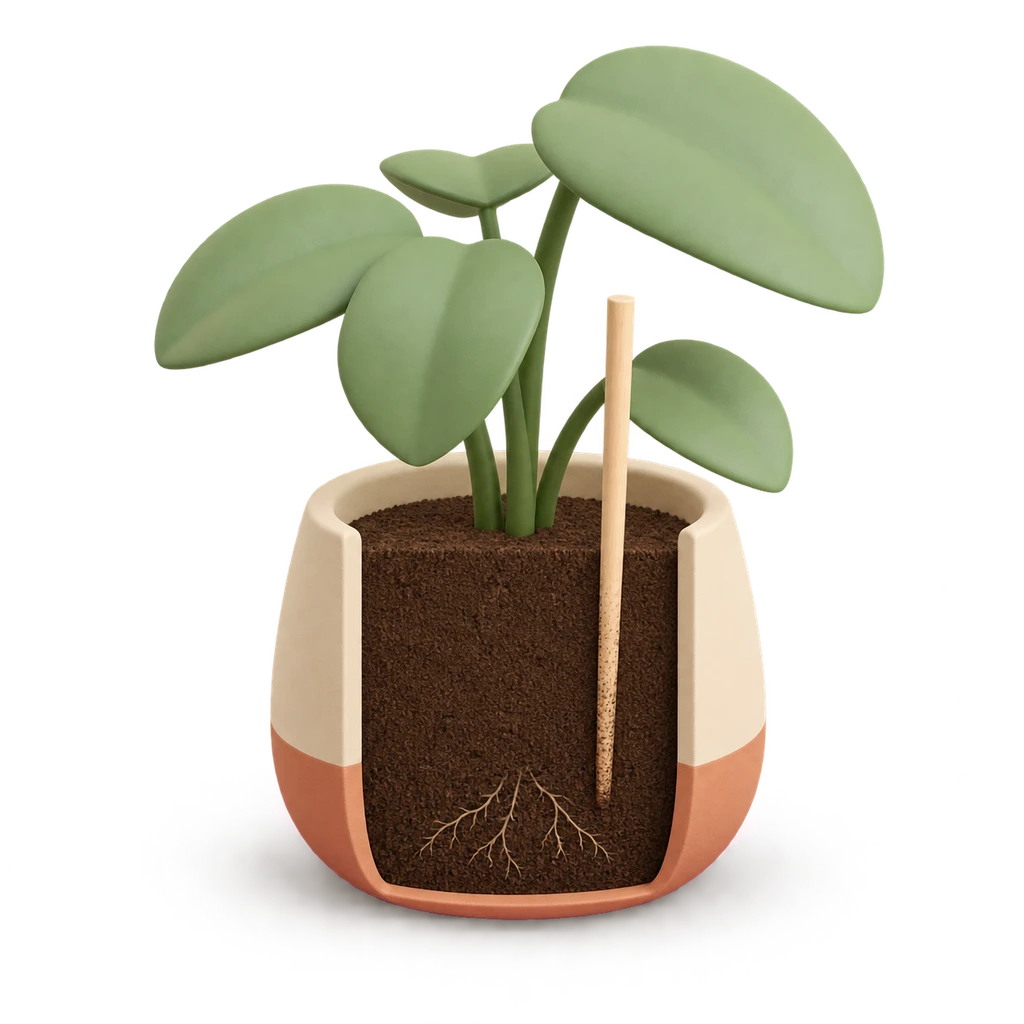
Potting mix dry to 1 cm: still moist
The finger test
Push a finger or wooden skewer 2 cm into the potting mix: if it is dry, water; if it is still moist, wait. The condition of the mix decides, not the calendar.
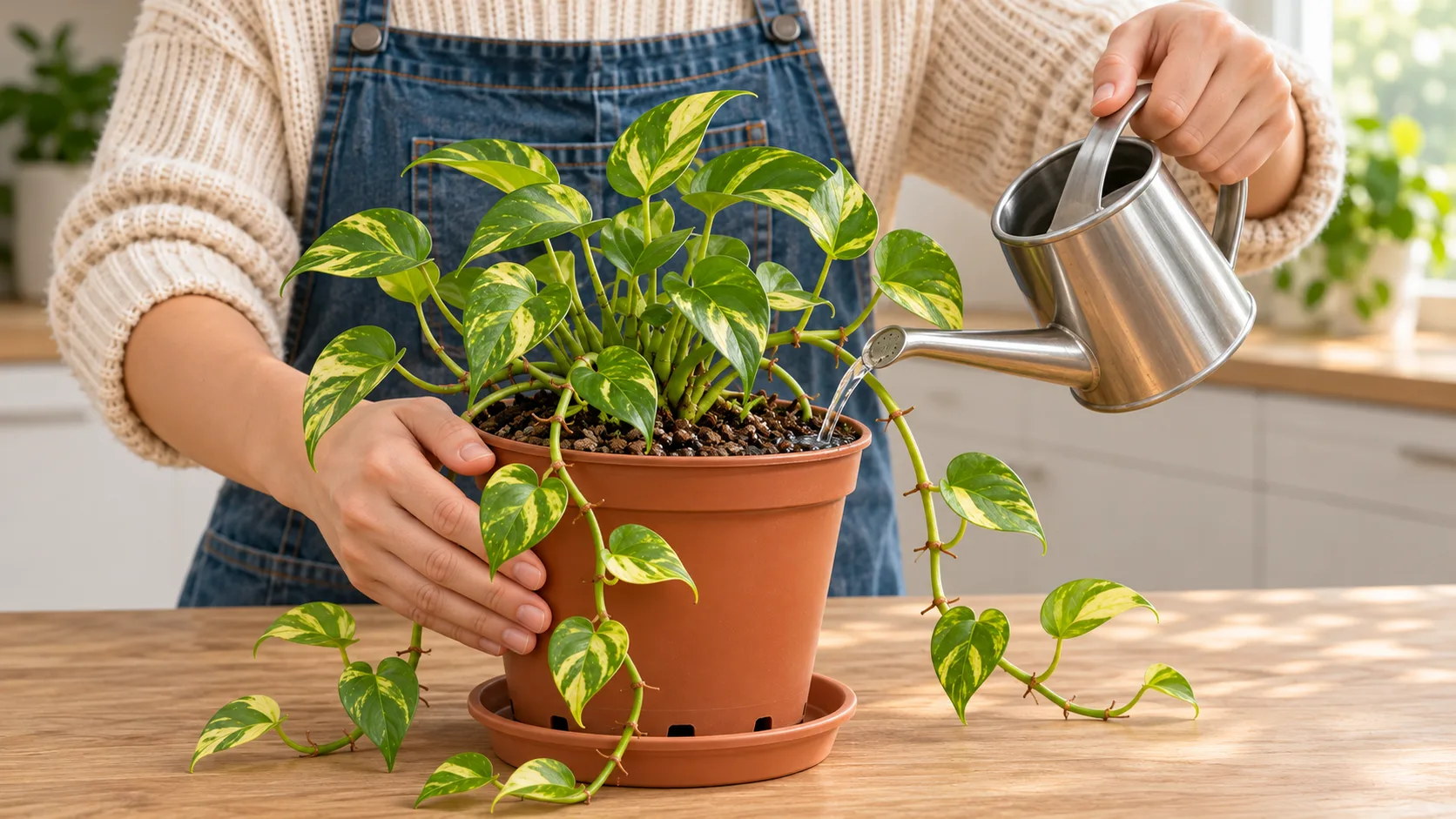
Water needs to reach all the roots2. Pour slowly onto the compost until water emerges through the drainage holes, allow it to drain, then empty the saucer or outer pot3. Wet the whole root ball, then let the surface dry before watering again. Repeated small sips and water left beneath the pot make this harder to manage.
Adjust your checks to the room. Porous terracotta dries faster than a non-porous container3. In winter, keep using the finger test and leave longer between waterings as drying slows1. An old yellow leaf can occur with compost that is too dry or too wet4: feel the soil before adding water. The guides to overwatering and underwatering help distinguish these conditions.
Where should you place pothos to keep its variegation?
Choose an east- or west-facing window; at a south-facing window in the northern hemisphere, filter the sun through a sheer curtain. Pothos likes bright, indirect light, away from direct summer sun and deep shade5. In a dark corner, it may survive for a long time while growing poorly6.
Variegation helps you judge the position. Smaller, less colourful new leaves are a reason to reassess the light; dry brown patches in the pale areas may instead result from excessive light or heat4. Examine recent growth: tissue that has already scorched remains damaged after you move the plant4.
Wipe off dust with a damp cloth so light can reach the foliage1. The heart-leaf philodendron looks similar on a plant shop shelf. A groove along the leaf stalk helps identify pothos; a philodendron's leaf stalk is smooth2.
Should you mist pothos?
Move the pot away from the radiator first: pothos tolerates normal household humidity. This tropical climber has no essential need for high humidity5. It prefers humidity of 50 to 70%, but also tolerates the 30 to 60% common in homes2.
A humidifier can help in a dry room2. Before installing one, check other causes of dry tips too: intense sun, unsuitable watering or fertiliser build-up27. A waterlogged root ball needs better drainage even when the air is dry. Inspect leaf undersides and their attachments while cleaning: cottony clusters there may indicate mealybugs7.
Which compost should you use, and when should you repot pothos?
Repot in spring, usually every two to three years, when roots fill the pot. Roots packed tightly in the root ball or visible at the drainage holes are the signal5. Gently slide the plant out to inspect its roots before choosing the new container.
- Repot
- Every 2 to 3 yearsindoorsSource: Royal Horticultural Society
- When to repot
- In springSource: Royal Horticultural Society
- The new pot
- 2,5 to 5 cm widerDiameter and depth <25 cm; increase ≤1/3Source: Royal Horticultural Society
For a pot under 25 cm (about 9.8 in) in both diameter and depth, choose one 2.5 to 5 cm (about 1 to 2 in) wider and deeper, without exceeding one third more than the current pot8. A container that is only slightly larger is enough; a large volume of unoccupied compost holds moisture around pothos roots for too long5. Keep drainage holes clear and use a saucer that is easy to empty3.
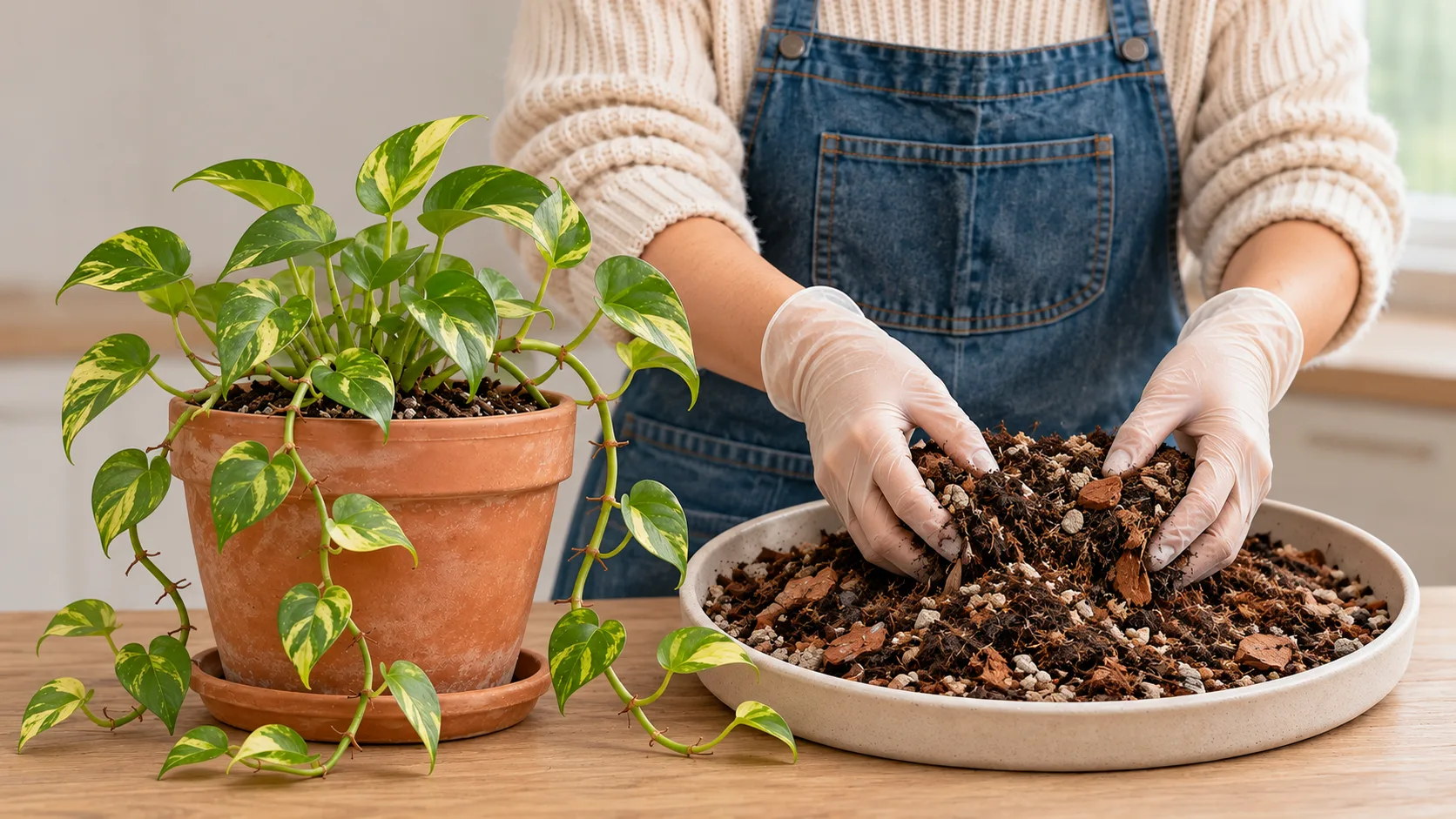
The growing medium should be airy, slightly acidic and well drained. Peat-free houseplant compost is suitable. To make a mix, use three parts peat-free ericaceous compost, one part horticultural grit and one part medium-grade orchid bark5. Drainage allows moisture to remain without keeping the root ball saturated. Prepare a climbing support too if you want to train the stems upwards5.
Which fertiliser should you give pothos?
Apply a liquid houseplant fertiliser once a month from April to October if these are your growing months. This schedule supports pothos growth in northern temperate conditions5. Follow the dose on the label: concentrations vary between products910. In winter, stop feeding when the plant is resting7.
- Feeding
- April to OctoberindoorsSource: Royal Horticultural Society
- No fertilizer
- In winterSource: University of Wisconsin-Madison Extension
- Frequency
- Once a monthindoorsSource: Royal Horticultural Society
- Avoid
- Exceeding the dose on the label, feeding during dormancySource: University of Wisconsin-Madison Extension
Choose a complete fertiliser containing nitrogen, phosphorus and potassium, suitable for foliage plants910. A plant slowed by low light needs a better position first. Its nutrient needs decrease as light levels fall11. Adding more doses increases the risk of salt build-up in the compost.
Black tips or edges, sometimes with yellowing, can result from excess fertiliser. Too much or too little water causes similar signs7. Check the root ball and recent feeding before fertilising a yellow plant. See fertiliser burn.
After buying, wait about four weeks before feeding or repotting a healthy plant, to let it adjust to your home4. A rotting root ball, however, needs an immediate root inspection.
How do you prune a pothos with bare stems?
Cut a stem just above a leaf to encourage side shoots. The bud in the leaf axil can grow and fill out the plant5. Spring is suitable for pinching out shoot tips12. Start with long vines that have become sparsely leafed.
Older leaves naturally yellow and fall, leaving most of the remaining foliage at the ends of the stems7. Pruning helps restore a bushy shape, while enough light supports new shoots6. Keep healthy tips for propagation.
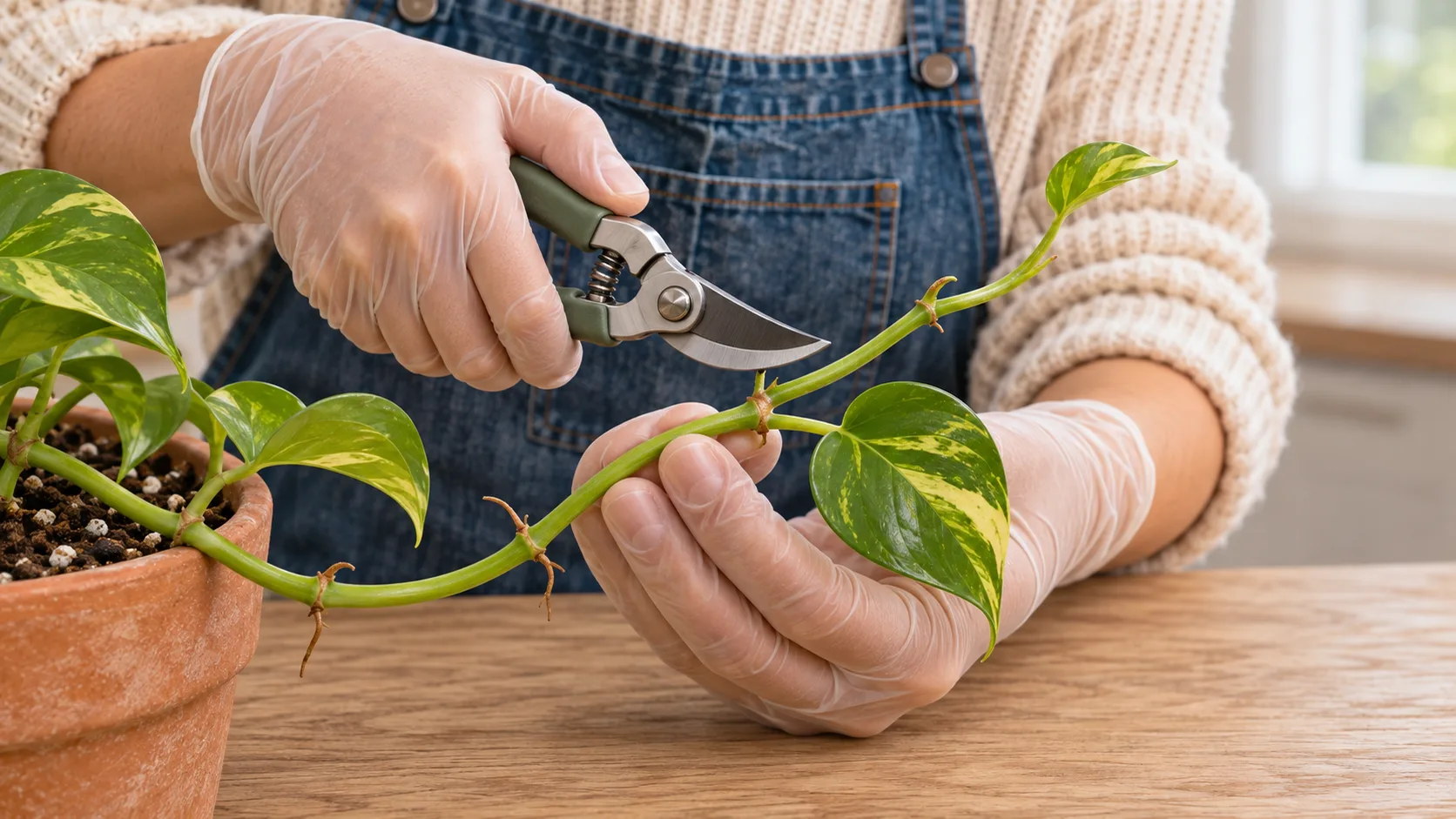
Find the node, where a leaf and its bud join the stem. On the parent plant, cut above the leaf; on the cutting, trim just below a node before placing it in water5. The pruning cut and the cut used to prepare a cutting fall on opposite sides of the node.
Wear gloves to avoid contact with irritating sap5. Pruning plants depends on their growth habit; for a nearby monstera, consult its guide before choosing stems to cut.
What temperature suits pothos?
Keep pothos between 18 and 30 °C, away from cold draughts and direct heat. This range supports indoor growing5. Keep foliage away from heating vents, air conditioning and cold windowsills2.
Temperatures for pothos
In °C, thresholds given by the sources.
- Exposure lasting several hours0,6 °C
- Ideal: 18 to 30 °C
The H1b hardiness rating describes a plant that can go outdoors in summer when minimum temperatures remain within 10 to 15 °C; it is a guide to seasonal outdoor growing under British conditions12. Pothos hardiness means bringing it indoors before cold nights in climates with cool winters, while keeping it somewhere bright.
Several hours at around 1 to 4 °C, or a sudden temperature change, can cause scattered brown spots in the centres of leaves4. Return the plant to steady warmth. For a summer stay on a balcony, choose sheltered, bright shade, away from scorching sun5.
How large can pothos grow, and does it need a support?
Allow for stems two metres (about 6.6 ft) long or more, and use a damp support to encourage large leaves. This length is common in indoor epipremnums1. The species profile gives a mature height of 4 to 8 m (about 13.1 to 26.2 ft) and a spread of 1 to 1.5 m (about 3.3 to 4.9 ft) in favourable conditions12. Pruning keeps the vine within the space available.
| Support | Recommendation | Why |
|---|---|---|
| Moss pole | Ideal | Keep the support damp so roots can grip it Source: Royal Horticultural Society |
| Coir pole | Suitable | Keep the coir damp and guide the stems Source: Royal Horticultural Society |
| Trellis | Suitable | Tie in stems that do not grip the support Source: Royal Horticultural Society |
The foliage changes with age. Juvenile leaves reach 10 cm (about 3.9 in), while lobed adult leaves can reach 70 cm (about 27.6 in)13. Young plants have undivided leaves; perforations appear in mature foliage14. A hanging pot generally retains juvenile foliage6.
Aerial roots anchor into a pole covered with moss or coir kept damp. Guide and tie in stems that stray away from it5. Support together with enough light encourages large leaves6. A hanging basket displays trailing vines; a pole shows off the climbing habit.
The month-by-month care calendar
In spring, check the roots; from April to October, if that is your growing season, support growth with monthly feeding. Repotting and pinching out take place in spring512. Use this return to growth to choose between a shorter hanging plant and a vine trained onto a support.
| Task | January | February | March | April | May | June | July | August | September | October | November | December |
|---|---|---|---|---|---|---|---|---|---|---|---|---|
| Watering | reduced | reduced | moderate | moderate | high | high | high | high | high | moderate | reduced | reduced |
| Growth | resting | resting | active | active | strong | strong | strong | strong | active | active | resting | resting |
| Feeding | no | no | no | yes | yes | yes | yes | yes | yes | yes | no | no |
| Repotting | no | no | favorable window | favorable window | favorable window | no | no | no | no | no | no | no |
In summer, watch how the compost dries and protect leaves from scorching rays5. As autumn returns, keep the plant warm. In winter, the finger test still determines whether water is needed; stop feeding while growth has slowed17.
Throughout the year, inspect leaf axils, leaf undersides and stems while cleaning. Mealybugs form white clusters; scale insects look like brown bumps. Their honeydew can leave foliage sticky7. Early detection helps you separate the pot from other plants before taking cuttings.
How do you propagate pothos?
Keep at least one node and one leaf on each cutting; roots usually take three to four weeks to appear. Pothos roots in water or vermiculite in warm conditions7. Spring and summer are suitable for stem cuttings and layering12.
- Stem cutting with a node
- In springroots in 3 to 4 weeks · roots well in waterSource: Floralens guide
- Stem cutting with a node
- In summerSource: Royal Horticultural Society
- Layering
- In springSource: Royal Horticultural Society
Take a healthy stem, cut just below a leaf attachment, then place its base in a glass of water in a bright position5. Keep the node in the water and the foliage above it. Once roots appear, transfer it to compost; several cuttings together make a fuller pot57.
Layering suits a vine flexible enough to reach a neighbouring pot. Pin a node against well-drained compost and let roots form before separating the young plant5. Other species can be propagated this way too: see plants to propagate.
For preparing the stem section, choosing water or compost and potting it up: propagate pothos step by step.
Common problems: diagnosis
Feel the compost, check the roots and turn leaves over before changing the care. Watering, fertiliser salts and sap-feeding insects can cause similar symptoms7. Read a leaf's colour alongside the condition of the pot.
| What you see | Cause to check | First action |
|---|---|---|
| Older yellow leaves, very dry or wet compost | Unsuitable watering4 | Feel the root ball and check the outer pot |
| Brown or almost absent roots | Rot, often linked to overwatering7 | Unpot to examine the roots |
| Black tips and edges | Unsuitable watering or fertiliser salts7 | Check drying and recent feeding |
| White cottony clusters in leaf axils | Mealybugs7 | Isolate the pot and inspect leaf undersides |
| Brown bumps on stems and leaves | Scale insects7 | Examine the insect before treating |
| Small new leaves with less variegation | Insufficient light, among other causes4 | Reassess the position |
| Brown spots in the centres of leaves | Cold or a sudden temperature change4 | Restore steady warmth |
| Scorched, dry pale areas | Excessive light or heat4 | Filter the sun and move away from heat |
Mealybugs can also hide on the roots. Their honeydew feeds sooty mould7. Compare them with scale insects before choosing a treatment.
Brown-black leaves with veins still pale sometimes accompany rot caused by Phytophthora nicotianae. Wilting with black veins and stems may suggest Ralstonia solanacearum. Irregular dark spots, with leaves sticking together, can accompany Rhizoctonia solani15. These diseases described in commercial growing need a confirmed diagnosis to identify the organism.
Discard diseased material and start again with healthy cuttings in clean compost15. For a collapsed plant in wet soil, consult root rot before adding more water.
A spotted leaf or a cluster beneath it? Photograph the affected part and the whole plant: Floralens helps identify the problem and what to do.
| What you see | Likely cause | What to do |
|---|---|---|
| Soil stays soggy, suffocating roots and causing rot. | OverwateringExternal Factors | Treating Waterlogged Soil |
| The plant wilts and yellows while the soil stays wet. | Root RotDiseases | Treating Waterlogged Soil |
| The soil is dry and leaves are soft and drooping. | UnderwateringExternal Factors | Rescue by Soaking |
| White cottony clumps in leaf axils and on stems. | MealybugsPests | Eliminate Armored Scale Insects |
| Small, immobile waxy shells (1–3 mm) on stems and leaves. | Armored ScalePests | Eliminate Armored Scale Insects |
| Brown leaf tips and a white crust on the soil. | Salt BuildupExternal Factors | Flushing Soil Salts |
Is pothos toxic?
Keep the whole plant out of reach: its calcium oxalate crystals are irritating16. See pothos risks.
Which pothos variety should you choose?
Choose for the light available: Jade tolerates a dimmer position, while Marble Queen and Snow Queen need more indirect light. Colour, leaf size and vigour then help you choose the look of the pot72.
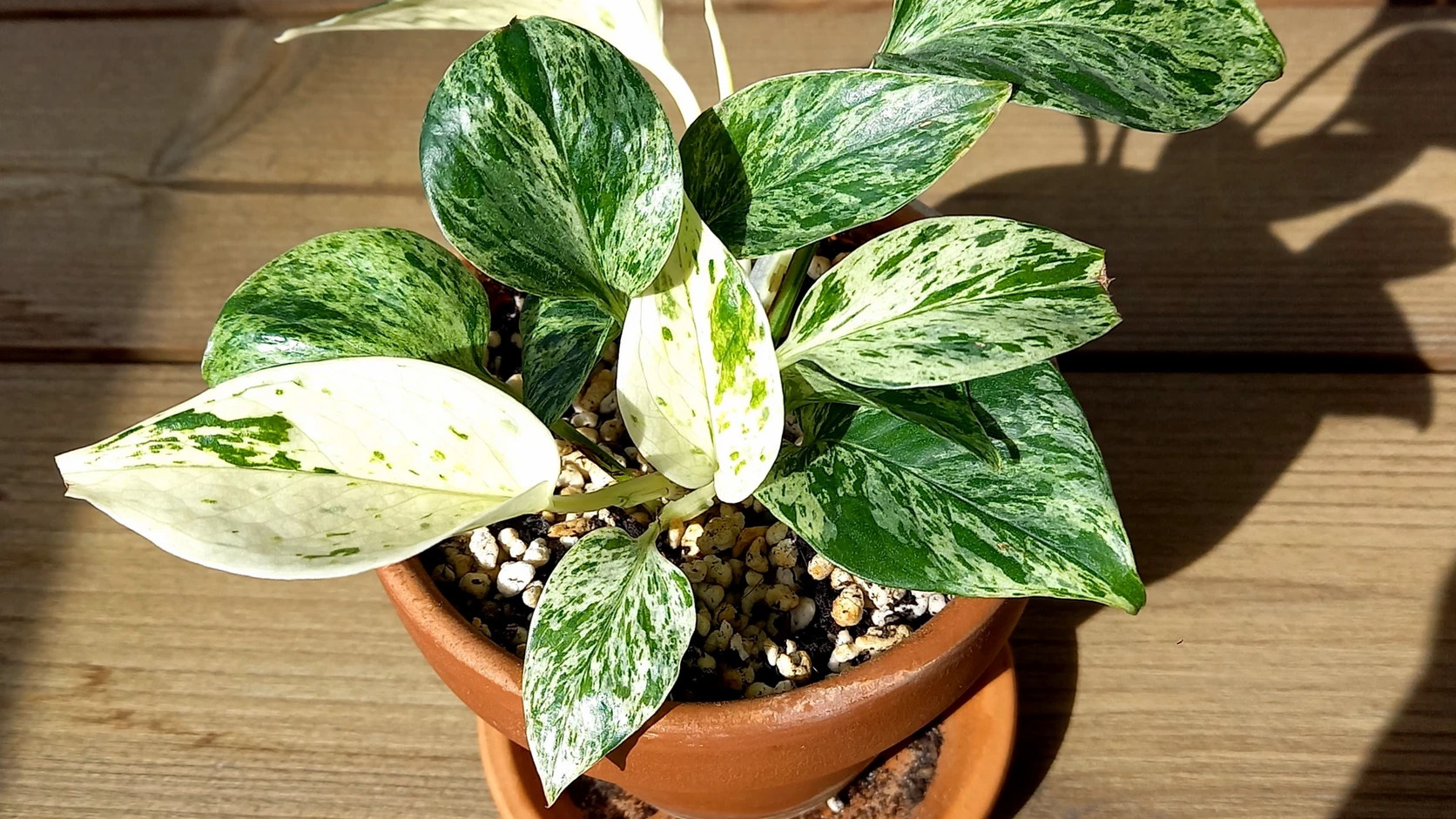
Variegated
Green foliage marbled with white or cream.
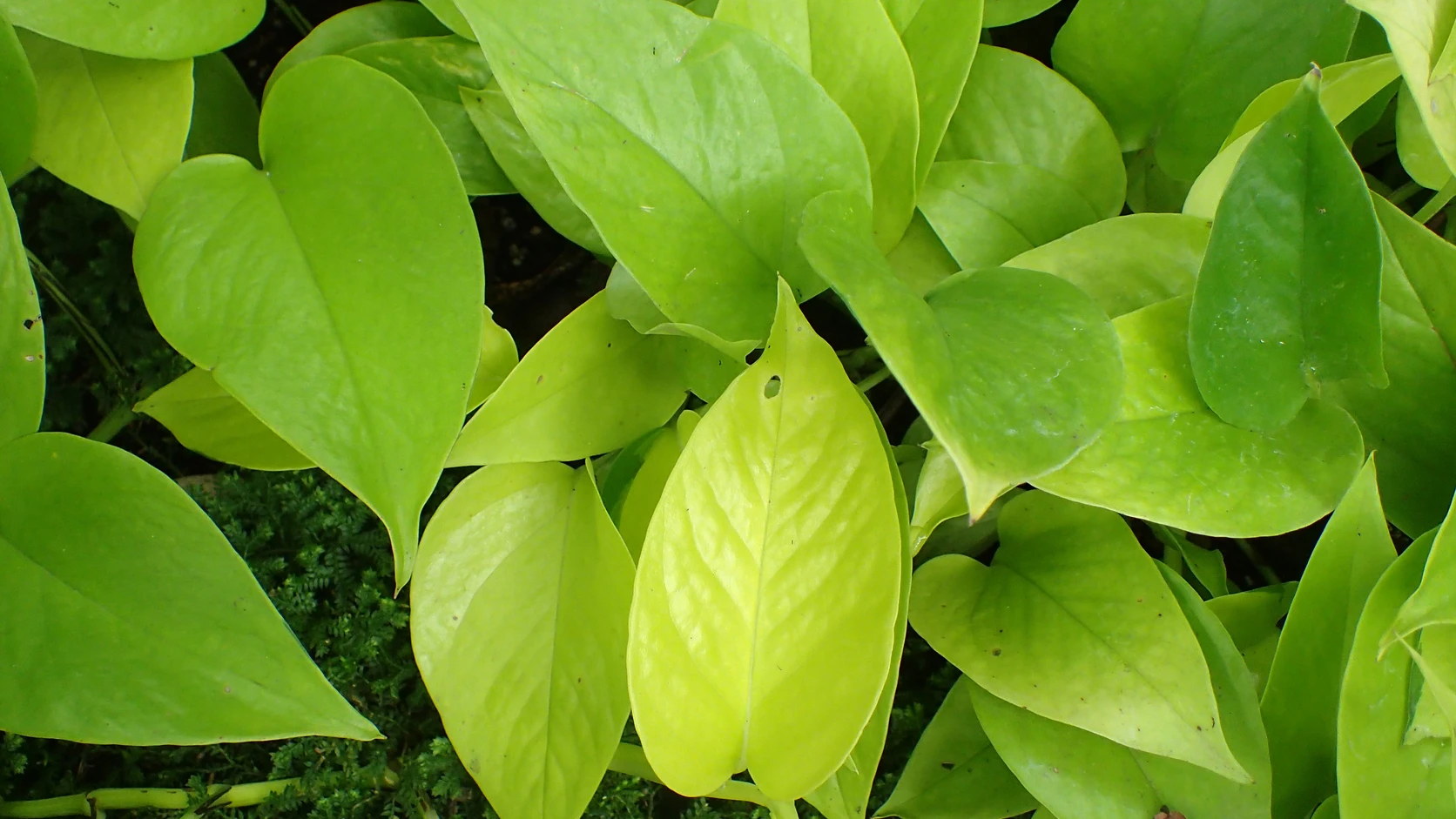
Horticultural name
Uniform yellow to chartreuse-green foliage.
Golden Pothos
Horticultural name
Green leaves marked with yellow and cream. The standard form of the species.
N'Joy
Variegated
A selection variegated with cream and grey-green, also sold as N’Joy.
Global Green
Variegated
Green-on-green variegation, usually with a dark edge and paler centre.
Jade
Horticultural name
Solid dark-green leaves; good tolerance of lower light.
2 more varieties documented in the botanical profile.
| Variety | Foliage | What guides the choice |
|---|---|---|
| Golden Pothos | Green splashed with yellow and cream | The standard golden-leaved form4 |
| Jade | Solid dark green | Good tolerance of low light7 |
| Neon | Uniform chartreuse yellow-green | Fast growth, thinner and narrower leaves, tolerance of lower light2 |
| Marble Queen | Green marbled with white or cream | More light; greener and faster than Snow Queen2 |
| Snow Queen | Mostly white, flecked with green | Very bright, indirect light to support growth2 |
| Global Green | Dark green edges, paler centre | Green-on-green variegation, sometimes with cream patches7 |
| Pearls and Jade | Green, white and silvery grey | Small leaves and slower growth than most varieties7 |
| Hawaiian | Stronger yellow, larger leaves | Larger foliage than the usual form415 |
For white and cream marbling, see Marble Queen pothos care; for lime foliage and fast growth, see Neon pothos care2.
N'Joy also has elongated leaves variegated with cream and grey-green15. Compare several leaves when choosing and check the botanical name: Cebu Blue belongs to Epipremnum pinnatum, while “satin pothos” is generally Scindapsus pictus2.
The origin and botany of pothos explain these labels. Kew recognises Epipremnum aureum as a distinct species, native to Moorea in the Society Islands19.
Frequently asked questions
For a limp leaf or droplets at its tip, examine the compost before adding water. The same plant can show a watering problem or simply release liquid through its leaves720.
Why is my pothos dripping water?
Beads of liquid may be guttation. When evaporation slows, often at night in very moist compost, glands at the leaf edges release liquid. Look at where it appears: drops at the tips differ from a sticky deposit associated with insects20.