
Hydrangea pruning: keep the right buds
Pruning hydrangeas: keep the right buds
On a bigleaf hydrangea, keep dry flowerheads over winter, then cut above healthy buds in spring. Thin old stems at the base: cutting the whole clump back removes the next flowers. Panicle and smooth hydrangeas need different pruning.
When should you prune a hydrangea?
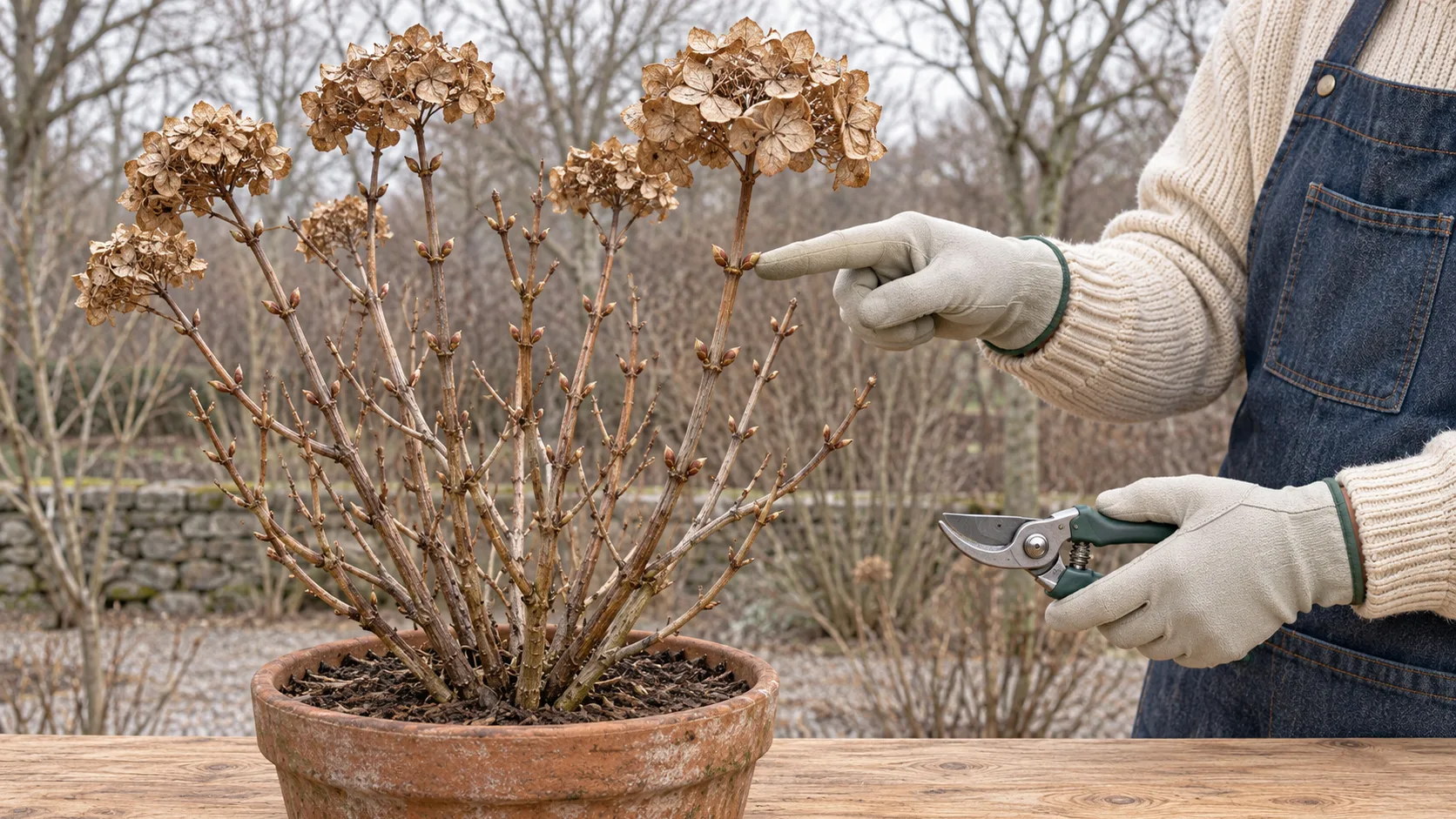
Tidy bigleaf hydrangeas in late winter or spring, outside freezing weather. In France, March is a common guide; in cold gardens, wait until living buds are clearly visible and hard frosts have passed. Dry mophead flowerheads protect the buds beneath them through winter. 123
- Main pruning
- MarchOutside freezing weather; delay in cold gardensSource: A. Bihaki
- Light pruning
- After floweringLacecap hydrangeasSource: Hydrangea Pruning | RHS Advice
- Flowers form on
- Last year's woodSource: Hydrangea Pruning | RHS Advice
| Conditions | January | February | March | April | May | June | July | August | September | October | November | December |
|---|---|---|---|---|---|---|---|---|---|---|---|---|
| Main pruning | no pruning | no pruning | Main pruning | no pruning | no pruning | no pruning | no pruning | no pruning | no pruning | no pruning | no pruning | no pruning |
This page covers bigleaf hydrangea (Hydrangea macrophylla), with mophead or lacecap flowers. Traditional forms flower mainly on the previous year’s wood. Pruning keeps healthy shoots, removes old flowers and renews a few ageing stems at the base. 45
To reduce a branch that has become awkward, act just after flowering, before future buds form. Keep this occasional reduction separate from spring removal of dry flowerheads. The plant-by-plant pruning guides give the season for other garden shrubs. 6
Which type of hydrangea do you have?
Identify the species before choosing a cutting height. Old wood here includes last year’s healthy shoots. On traditional macrophylla hydrangeas, keeping these shoots preserves their flowers. 4
| Species | Wood carrying flowers | Season | Action |
|---|---|---|---|
| H. macrophylla, traditional forms | Previous year’s shoots | Late winter or spring, outside freezing weather | Cut below dry heads, above healthy buds; remove a few ageing stems at the base 415 |
| H. serrata | Wood retained from the previous season | Spring | Light tidying as for lacecap macrophylla hydrangeas 5 |
| H. paniculata | Current year’s shoots | Early spring | Shorten last year’s stems to a pair of healthy buds 65 |
| H. arborescens, including ‘Annabelle’ | Current year’s shoots | Early spring | Set the height of the framework to suit the growth required 657 |
Climbing hydrangea, Hydrangea anomala subsp. petiolaris, needs another approach: shorten overlong shoots just after summer flowering, preserving the upper part where many flowers grow. 5
Check the species and cultivar name on the label. The botanical profile of bigleaf hydrangea helps you recognise macrophylla forms. Some repeat-flowering cultivars bloom again on new shoots; their precise names let you establish whether they have that ability. 4
Where should you cut below a faded flower?
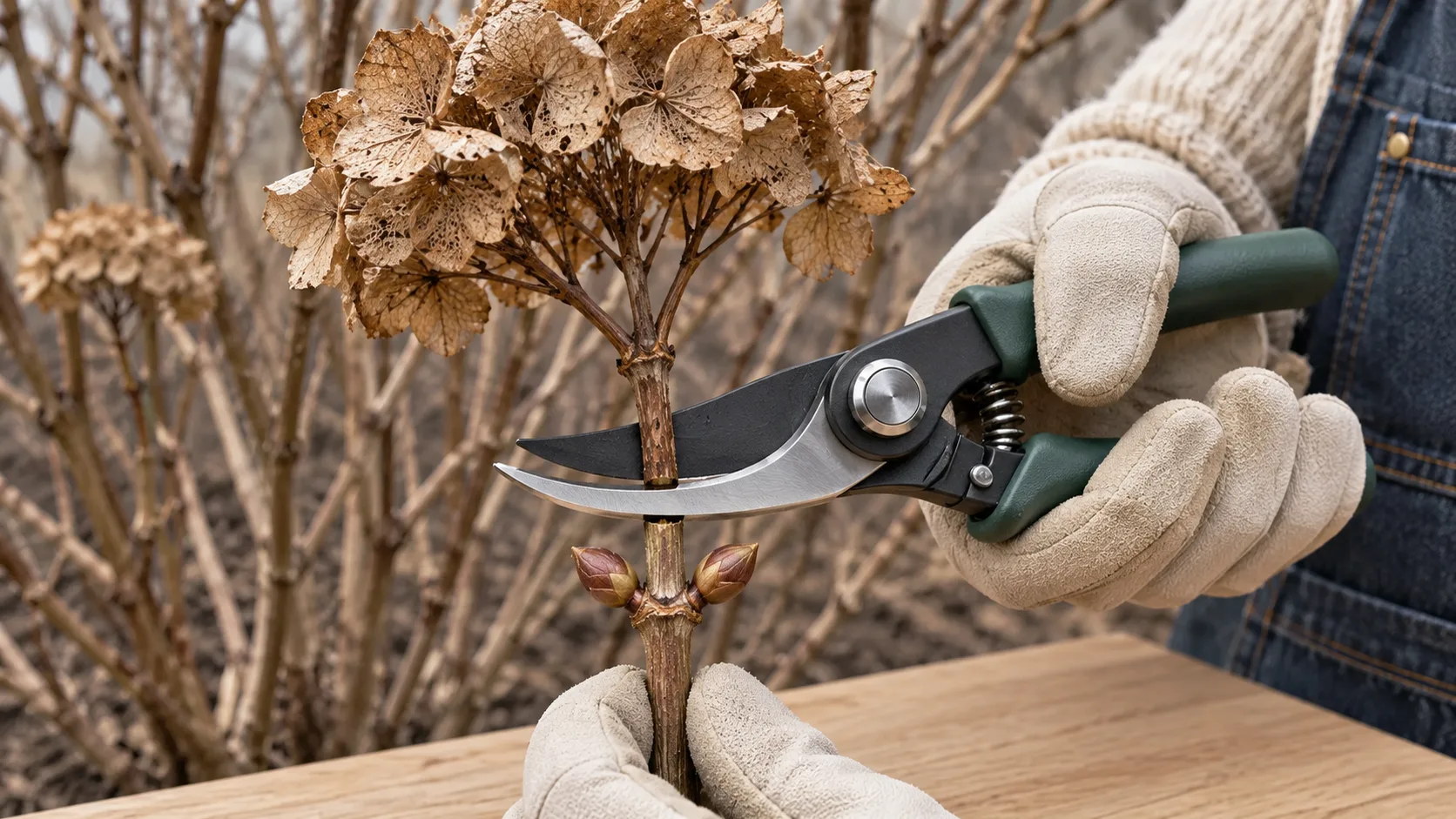
Cut below the dry head, just above the first or second pair of strong buds. Follow each shoot down from the flowerhead to find living buds. Keep them on the branch, even if that leaves the shrub with uneven heights. 53
If the top of the shoot has frozen, go down to the first intact bud pair on healthy wood. Adjust the cut for each stem: an intact shoot and a frost-damaged one may need different final heights. 5
How do you prune while keeping the young stems?
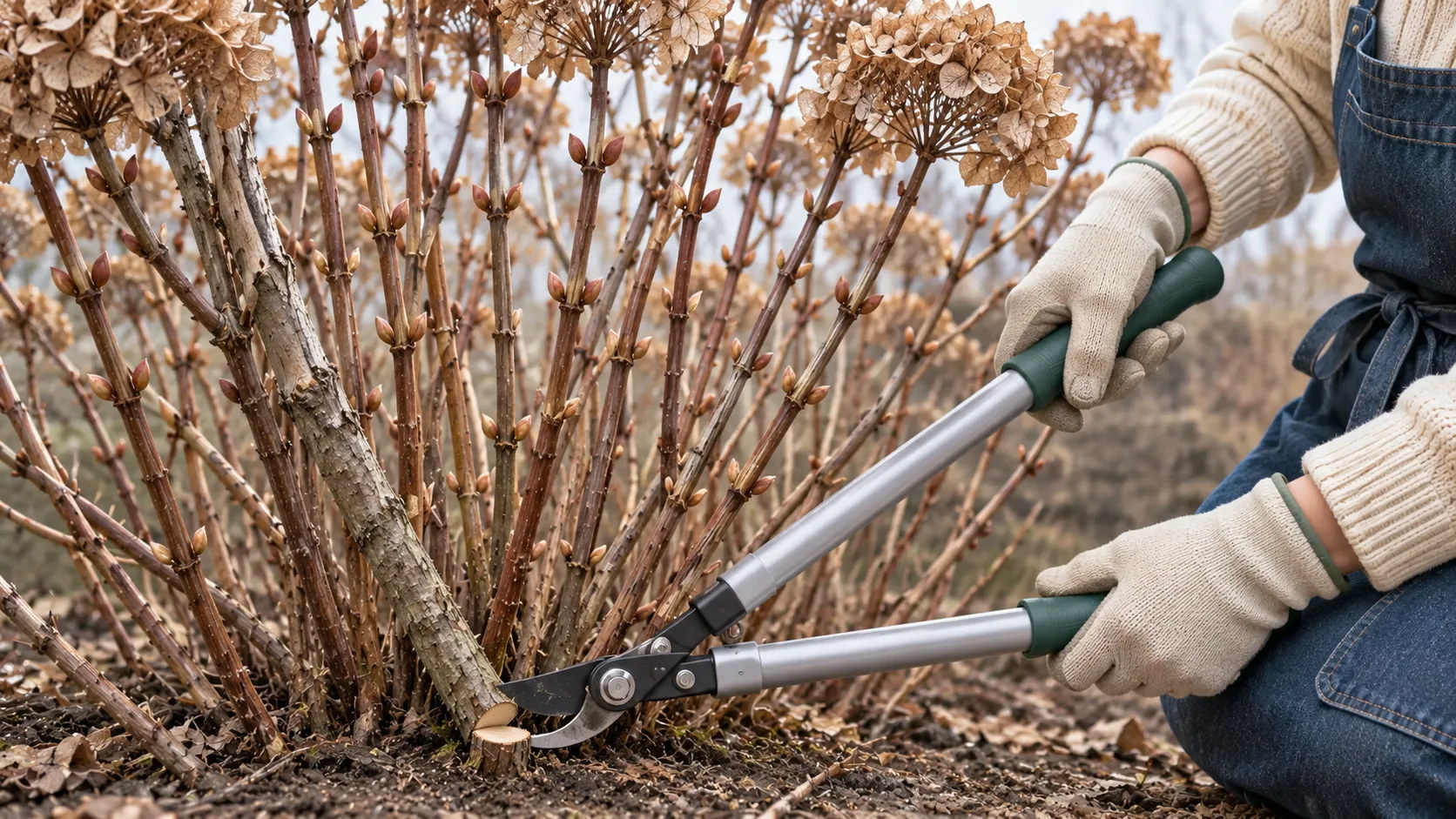
Remove dry flowers and damaged wood, then just 1 or 2 of the oldest stems at the base. This limited renewal encourages new shoots that will carry more flowers. Vigorous young stems are the replacements to keep, rather than branches to shorten as a matter of routine. 53
- Identify the species and living shoots before cutting. On a traditional macrophylla, preserve the previous year’s flowering wood. 4
- Cut off dry flowerheads above a pair of healthy buds; adjust the cut if frost has damaged the tip. 5
- Remove dead or weak wood, particularly spindly stems trailing on the ground. 5
- Remove 1 or 2 old stems at the base, making room for renewal. Keep vigorous young branches to replace them. 3
- Retain the other healthy branches, rather than cutting them all back. Traditional forms depend on this retained wood for flowering. 54
Light renovation maintains the clump without cutting everything down. Mopheads and lacecaps can also flower with little intervention when their size suits the space and the branches remain healthy. 5
Should you remove faded flowers in autumn?
On mophead hydrangeas, keep dry flowerheads until spring. They protect the tender buds below. Removal after flowering remains possible in very mild gardens; frost-prone positions benefit from keeping the heads over winter. 5
Lacecap hydrangeas tolerate deadheading after flowering. Cut back to the second pair of leaves beneath the head to limit seed formation, while preserving the rest of the healthy branch. 5
Preserve healthy branches while clearing old flowers. Cutting below each head removes the flower remains; cutting everything halfway down can remove shoots carrying buds. Keep the wood formed in the previous season. 54
Can you prune ‘Annabelle’ like a mophead hydrangea?
Prune ‘Annabelle’ in spring as a smooth hydrangea. It belongs to Hydrangea arborescens; like panicle hydrangeas, it flowers on new shoots. Pruning sets the framework from which new shoots will grow. 756
For panicle and smooth hydrangeas, shorten last year’s stems to a pair of healthy buds. Pruning to the lowest pair leaves a framework generally below 25 cm (about 10 in); retaining about 60 cm (about 24 in) produces a taller plant. Traditional macrophylla hydrangeas instead need their previous year’s shoots preserved. 5
For panicle and smooth hydrangeas, removing dead wood in spring is the essential task. Annual pruning can improve flowering; adjust its intensity to the height you want. 5
How do you renovate an old hydrangea that has grown too tall?
Prefer removing old stems at the base if you want to retain some flowering wood. Remove only 1 or 2 old stems during routine care. An overgrown hydrangea need not be cut entirely to the ground: start by identifying healthy wood, dead wood and branches you can keep. 5
Complete coppicing is still possible for a plant that has become too large or badly shaped. Cutting every stem to the base has a cost: no flowers that summer, with new stems flowering the following year. Complete renovation rebuilds the branches rather than immediately increasing flowers. 5
Repeat-flowering cultivars can produce a second flush on new shoots. ‘Bailmer’, Endless Summer The Original, flowers first on old wood, then on new wood. Keep its healthy stems to enjoy the first flush. 8
To avoid repeated renovation, choose a cultivar suited to the space available when planting. The species reaches a mature height of 1.5 to 2.5 m (about 5–8 ft); that range explains why a large plant eventually obstructs a narrow passage. 9
Container dimensions and constraints are explained in the hydrangea in pots guide .
What should you cut after a late frost?
Cut back only the damaged part, to a healthy bud pair on living wood. Young shoots and buds are particularly exposed to spring frost. A surviving shrub can therefore lose some flowers while its base remains alive. 53
Wait for growth to restart before judging uncertain stems. Dormant buds may grow after frost; for a plant that appears completely damaged, keep observing until midsummer before lifting it. 10
Blackened leaves, weakened stems or wilting first call for a diagnosis. The weather damage diagnosis explains checks after frost; the root rot diagnosis helps distinguish a sodden rootball from a plant affected by cold alone. 103
For symptoms affecting the shrub, see the hydrangea disease guide .
Which tools and precautions do you need?
Wear gloves and disinfect tools after cutting diseased parts. Contact with this hydrangea can cause skin reactions. On a plant with grey mould or leaf spots, remove diseased tissues and correct standing water problems. 91
Large heads weighed down by rain can bend under their own weight. On ‘Générale Vicomtesse de Vibraye’, hard pruning produces particularly large flowerheads: prefer light pruning to limit drooping. 7
What should you do with cut branches?
Choose a shoot at the right stage for the season when taking cuttings. Young soft shoots can be taken from late spring to midsummer; semi-ripe shoots in midsummer. Keep healthy stems needed for flowering during spring tidying. 3
To choose and prepare a non-flowering shoot, see the hydrangea cuttings guide .
For now, keep the healthy young stems that renew the shrub, and later collect an appropriate shoot instead of emptying the clump during maintenance. 35
Which pruning mistakes remove the flowers?
Shortening all the healthy wood on a traditional macrophylla removes the shoots that would have flowered. That approach is unsuitable for a plant whose main flowering develops on the previous year’s wood. Reserve complete renovation for cases where rebuilding the branches justifies a season without flowers. 54
Copying ‘Annabelle’ pruning on a bigleaf hydrangea applies another species’ method. Framework heights of 25 or 60 cm (about 10 or 24 in) concern panicle and smooth hydrangeas. 5
Removing dry heads in autumn in an exposed garden loses the protection they give the underlying buds. Keep dry mophead flowerheads over winter. 5
Forcing growth with fertiliser after hard pruning cannot recreate removed buds. Excess feeding favours soft leafy growth, with fewer buds and greater cold sensitivity. The hydrangea care guide puts pruning alongside watering, light and soil care. 3
Frequently asked questions
Can you tidy a hydrangea in March?
Should you cut more if the hydrangea was left unpruned last year?
Macrophylla hydrangeas can flower with little pruning. Start with dead wood and dry flowers, then remove only one or two old stems at the base. After a year without pruning, keep the healthy shoots that carry future buds. 5
Can you shorten a branch after flowering?
For an awkward branch, shortening just after flowering gives the plant more time to prepare future buds. Cut only the protruding growth; late, general pruning of old wood can remove the next flowers. 6